
How to Manufacture Custom Backpacks: Brief to Container
Factory guide to custom backpack manufacturing: tech pack, materials, sampling, cutting, branding, sewing, load tests, QC, packing, MOQ, cost and lead time.
A backpack looks straightforward on a design board: a front panel, a back panel, two shoulder straps, a zipper and a logo. On a sewing line it is one of the most component-heavy soft goods a factory makes. A mid-range laptop backpack we produce has 47 cut pieces, 11 different materials, 6 hardware items, 2 kinds of foam and roughly 180 metres of thread, and every one of those parts has to arrive at the right station, in the right colour, in the right order, 10,000 times without variation. The moment an order moves from a sample to a container, the question stops being "can you make this bag?" and becomes "can you make this bag identically for three weeks?"
Custom backpacks are manufactured in a fixed sequence: a specification (tech pack) is turned into a costed bill of materials; a pattern is drafted and a sample sewn and approved; materials are bought, inspected and cut in bulk; branding is applied to flat panels; components are pre-assembled and then joined on a balanced sewing line; the finished bag is load-tested and inspected; and the order is packed, labelled and loaded. The approved sample, the signed-off fabric swatches and the artwork are the only production standard - everything that follows is measured against them.
This guide walks through each stage the way it actually happens on our floor in Baigou, with the decisions a buyer has to make at each step, the numbers we work to, and the places where orders most often go wrong. It is written for brand owners, importers and school-programme buyers who want to understand what they are paying for - and how to write a brief that gets the bag they imagined, not the bag the factory found easiest to make.
What Should You Prepare Before a Backpack Goes into Production?
A backpack project should start with a written brief that a factory can quote from, sample from and later inspect against. It does not have to be a professional tech pack, but it has to turn design intent into measurable statements. "A rugged 30 L hiking pack" cannot be quoted; "30 L, 52 x 32 x 20 cm, 600D PU polyester body, 1680D base, #8 coil zippers, EVA back panel, 38 mm webbing, 100 pcs first order, screen-printed logo" can.
What Does the Factory Actually Need to Quote?
The factory needs to know what the bag has to do, not just what it looks like. Two backpacks with the same silhouette and the same 600D shell can be built to completely different standards depending on whether they are a promotional giveaway or a two-year-warranty retail product. The following list is what our sales engineers ask for before they open a costing sheet:
- Finished dimensions (height, width, depth) and target volume in litres
- Intended user and use: school child, commuter with a 15.6" laptop, hiker with 12 kg of gear
- Main fabric, base fabric and lining, or a reference bag we can match
- Number of compartments and pockets, and what each must hold
- Zipper size and type on each opening (coil, Vislon, metal; #5, #8, #10)
- Shoulder-strap construction: foam thickness, mesh, width, sternum strap yes/no
- Back panel: flat, padded, air-channel, frame sheet
- Branding: method, artwork file, size and placement of every logo
- Labels and hang tags; care/compliance labels for the destination market
- Colourways and expected quantity per colour
- Individual and carton packing requirements
- Target FOB or landed price, if there is one
- Delivery date and destination port
Quantity per colour matters more than total quantity. An order of 1,000 pieces in one colour cuts and sews as one run; 1,000 pieces across five colours is five fabric lots, five sets of cut bundles and five chances for a shade mismatch. We price and schedule it as five small orders sharing tooling.
Is a Full Tech Pack Required?
No, but the closer a brief is to one, the fewer sampling rounds it takes. A professional tech pack contains a spec sheet with a dimension drawing, a bill of materials (BOM) listing every fabric, trim and hardware item with supplier references, a construction page showing seam types and stitch density, artwork files with Pantone references, and a packing specification. Most first-time buyers arrive with a sketch, a reference photo and a competitor bag; we build the tech pack for them during sampling and it becomes the contract document for bulk. What we cannot do is guess at a load rating or a compliance requirement - those have to come from the buyer.
What Must Be Locked Before Quotation?
| Decision | Why it has to be fixed first | Typical cost swing if changed later |
|---|---|---|
| Main fabric denier and coating | Drives 35-45% of material cost; decides cutting method | 8-20% of unit price |
| Zipper brand and size | YKK/SBS vs. generic doubles or halves zipper cost; size changes pattern | 3-6% |
| Shoulder strap padding | Foam density and thickness change sewing time and bulk | 2-4% |
| Laptop sleeve / frame sheet | Adds 4-6 cut pieces and two operations | 4-7% |
| Branding method | Screen print is set up per colour; embroidery is priced per stitch count | 1-8% |
| Colour count | Each colour is a separate fabric lot and cutting run | MOQ per colour |
| Packing | Polybag vs. printed box changes carton cube and freight | 2-10% landed |
Anything outside this table - pocket shape, pull tab style, lining print, label position - can be adjusted during sampling at little cost. Anything inside it should be decided before a quotation is accepted, because every one of them cascades into the pattern.
Which Materials Go into a Custom Backpack?
A backpack is not one fabric. Even a simple school bag uses a shell, a base, a lining, mesh, foam, webbing, binding, thread and a zipper tape, and each has its own specification, supplier and lead time. Buyers who specify only the shell fabric leave 60% of the bill of materials to factory default - and factory default is chosen for cost.
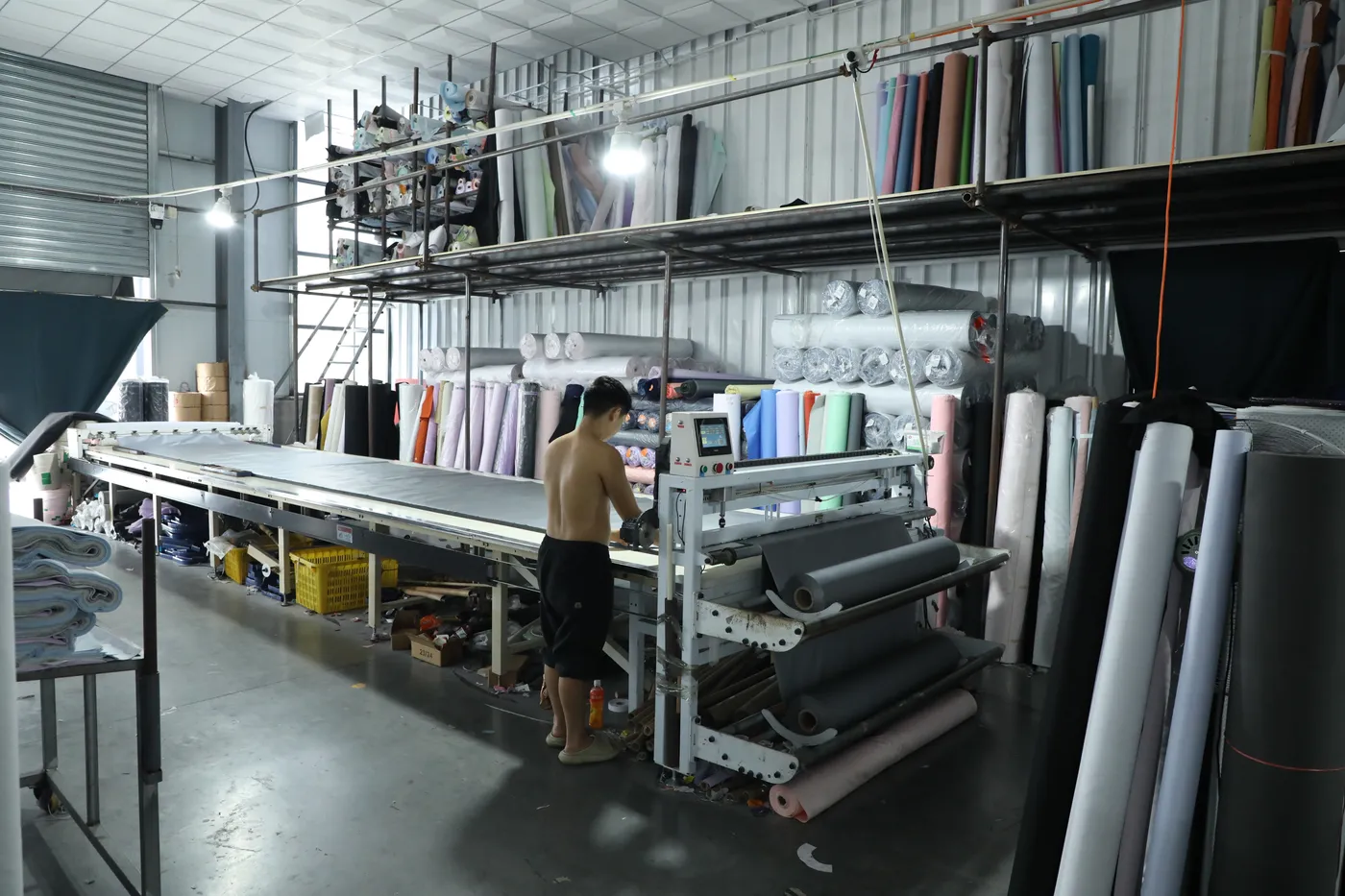 Incoming shell and lining rolls staged in the cutting room. Each roll is checked for shade, width and weight before it is released to the spreader.
Shell and Base Fabrics
The shell is the visible body. The base is the bottom panel and lower corners, which take most abrasion. Specifying a heavier base than shell is the single cheapest durability upgrade on any backpack.
| Fabric | Typical use | Finished weight | Relative cost | Notes |
|---|---|---|---|---|
| 600D polyester, PU | School, promotional, entry daypack shell | 280-320 gsm | 1.0x | Widest colour stock; prints well |
| 900D polyester, PU | Business, travel, premium school | 360-400 gsm | 1.25-1.3x | Denser hand; better abrasion |
| 1680D ballistic polyester | Base panels, laptop bags, tactical | 520-580 gsm | 1.6-1.8x | Basket weave; near-double abrasion life |
| 420D / 500D nylon | Lightweight hiking, cycling | 180-260 gsm | 1.4-1.9x | Higher tear strength per gram; dye-lot variation |
| 1000D Cordura-type nylon | Tactical, military, work packs | 400-450 gsm | 2.2-2.8x | Best abrasion; stiff; limited colours |
| RPET 600D | Sustainability-led retail lines | 290-330 gsm | 1.15-1.3x | GRS certificate available per lot |
| TPU-laminated / tarpaulin | Roll-top, dry-bag style | 450-650 gsm | 1.8-2.5x | Welded or bound seams; no needle holes |
| Cotton canvas 12-16 oz | Heritage / lifestyle | 400-540 gsm | 1.2-1.6x | Shrinks; needs wash-test before cutting |
We hold 16 shell fabrics and 60+ colours in 600D as stock, which is why a 100-piece first order in a standard colour can start cutting within days. Custom colours and custom-woven articles are dyed to order at the mill with a 300-500 m minimum per colour - for 600D at roughly 1.1 m per school backpack, that is 270-450 bags before the fabric is used up.
Lining, Mesh and Foam
| Component | Standard spec | Upgrade | What it changes |
|---|---|---|---|
| Lining | 210D polyester, PU | 210D printed lining, 300D, RPET | Interior look; tear resistance of pockets |
| Air mesh (straps, back) | 3 mm sandwich mesh | 5-8 mm 3D spacer mesh | Breathability; strap thickness |
| Strap foam | 8 mm EVA, 25 kg/m3 | 10-12 mm EVA 35 kg/m3, PE + EVA laminate | Comfort under load; resistance to flattening |
| Back panel foam | 5 mm PE | 8 mm EVA with channels; 1.5 mm HDPE frame sheet | Load transfer; stiffness for laptop protection |
| Laptop sleeve | 5 mm foam + 210D | 8 mm foam + brushed tricot | Drop protection |
| Interfacing / stiffener | None | Non-woven 80 gsm or PE board in front panel | Holds shape when empty |
Foam density is the specification buyers most often leave blank and factories most often cut. A 25 kg/m3 EVA strap flattens visibly after a school year; 35 kg/m3 does not. The difference is about 0.15 USD per bag.
Webbing, Binding and Thread
Shoulder straps carry webbing that anchors them to the body and to the adjuster. We use 38 mm polypropylene webbing (1,000 N break) on school bags and 38 mm nylon webbing (1,800-2,200 N) on laptop and hiking packs. Binding tape covering internal seams is 20-25 mm polyester, 2.5 mm thick; thinner tape saves a few cents and frays at the zipper ends within months. Thread is bonded polyester or nylon, tex 70 (size 69) for body seams and tex 90-135 for bartacks and webbing attachment. All of this belongs on the BOM; none of it is visible on a swatch card.
Zippers and Hardware
Zippers are the component customers touch most and the failure customers forgive least. The decision has three parts: chain type, size and brand.
| Zipper spec | Where it goes | Cycle rating | Relative cost |
|---|---|---|---|
| #5 nylon coil | Small pockets, lining | 5,000+ | 1.0x |
| #8 nylon coil | Main compartments on school / daypacks | 10,000+ | 1.6x |
| #10 nylon coil | Main compartments on travel / hiking | 15,000+ | 2.1x |
| #8 Vislon (moulded plastic) | Tactical, outdoor, cold climates | 10,000+ | 2.4x |
| #5 reverse coil, water-resistant | Laptop sleeves, tech pockets | 8,000+ | 3.0x |
| #10 metal (brass / aluminium) | Heritage, fashion | 8,000+ | 3.5-5x |
Brand is a separate decision. YKK and SBS zippers cost 40-100% more than generic Chinese chain and are what most European and North American retailers specify. For GCC school programmes we default to SBS #8 coil: it survives sand and 45 °C car interiors better than generic chain, at a cost about half of YKK. Sliders, pulls, buckles, ladder locks and D-rings are chosen alongside - our hardware guide covers the 31 items we stock and when to use each.
Does Heavier Fabric Mean a Better Backpack?
Not by itself. The fabric is rarely the first thing to fail on a backpack; the seam at the top of the shoulder strap is. A 1680D shell sewn with a single row of tex 70 thread and no bartack will lose a strap before a 600D shell with a reinforced box-X and a tex 135 bartack shows wear. Fabric weight buys abrasion life and a premium hand. Construction buys load life. A good specification spends on both in proportion to how the bag will be used - and for a school bag carried by a 10-year-old, construction is where the money should go.
How Is a Custom Backpack Sample Developed?
Sampling turns the brief into a physical object that both sides agree is the standard. At Senszx the first sample takes 3-5 working days from confirmed materials; complex packs with frame sheets, welded seams or custom hardware take 7-10. Every stage of it happens in our pattern room.
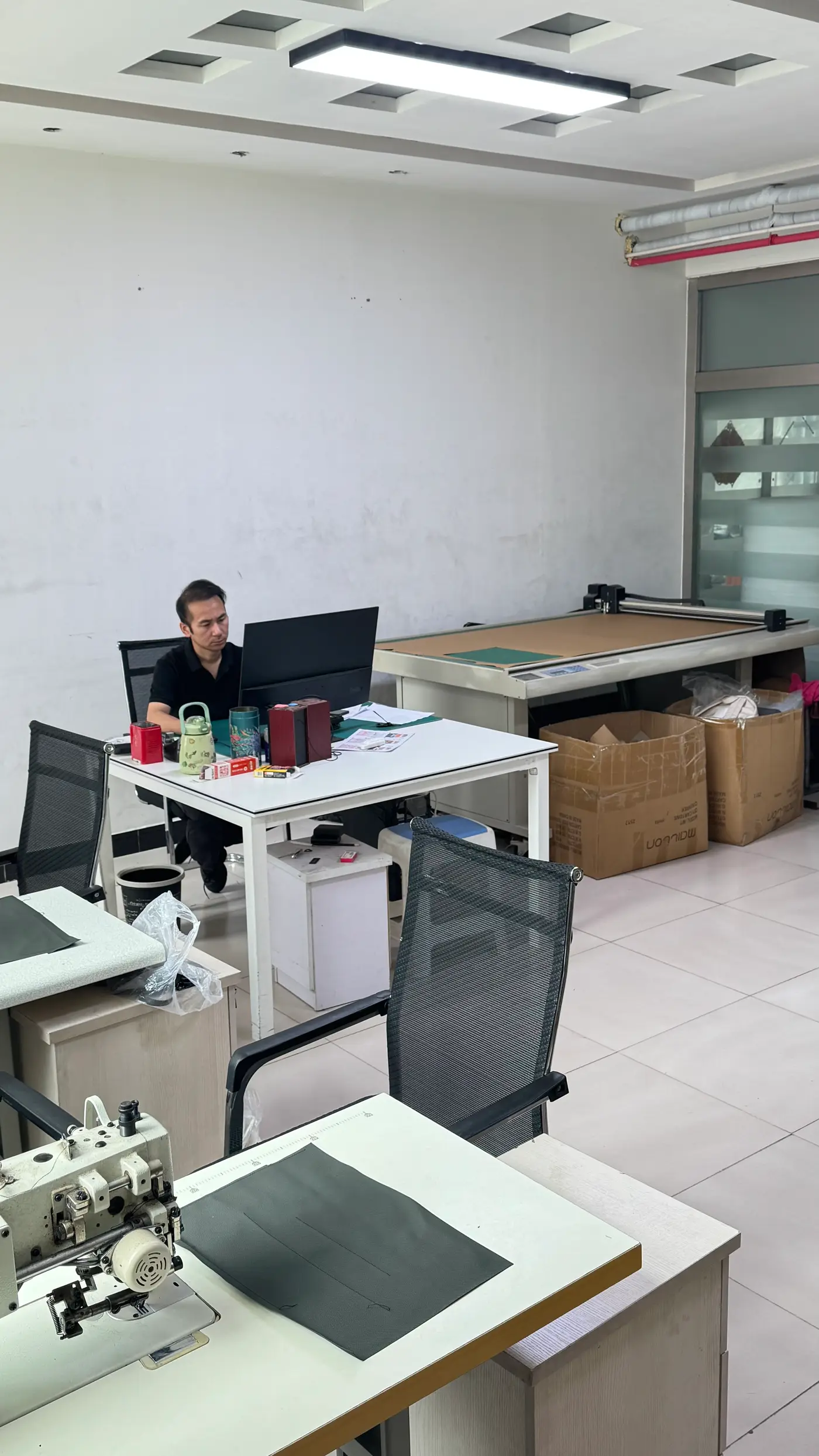 The pattern is drafted in CAD, then plotted full-size. The same digital pattern later drives the CNC cutter for bulk, so a sample-to-bulk dimension drift of more than 3 mm is unusual.
How Does Pattern Making Work?
A pattern maker converts the finished dimensions into a set of flat pieces with seam allowances, notches and grain lines. A 30 L daypack has 35-50 pieces; a laptop backpack with organiser panel and side pockets can exceed 60. Each piece is labelled with the material it is cut from, so the lining pieces, foam pieces and shell pieces of the same panel are drafted together and checked for fit before anything is cut.
Pattern making is where the litre figure becomes real. Volume is the product of the finished height, width and depth minus the space taken by padding and internal walls, and it changes with every millimetre of seam allowance. We measure the sewn sample's volume by filling it with 20 mm plastic beads and weighing them; a "30 L" that measures 26 L is a pattern problem, not a marketing one.
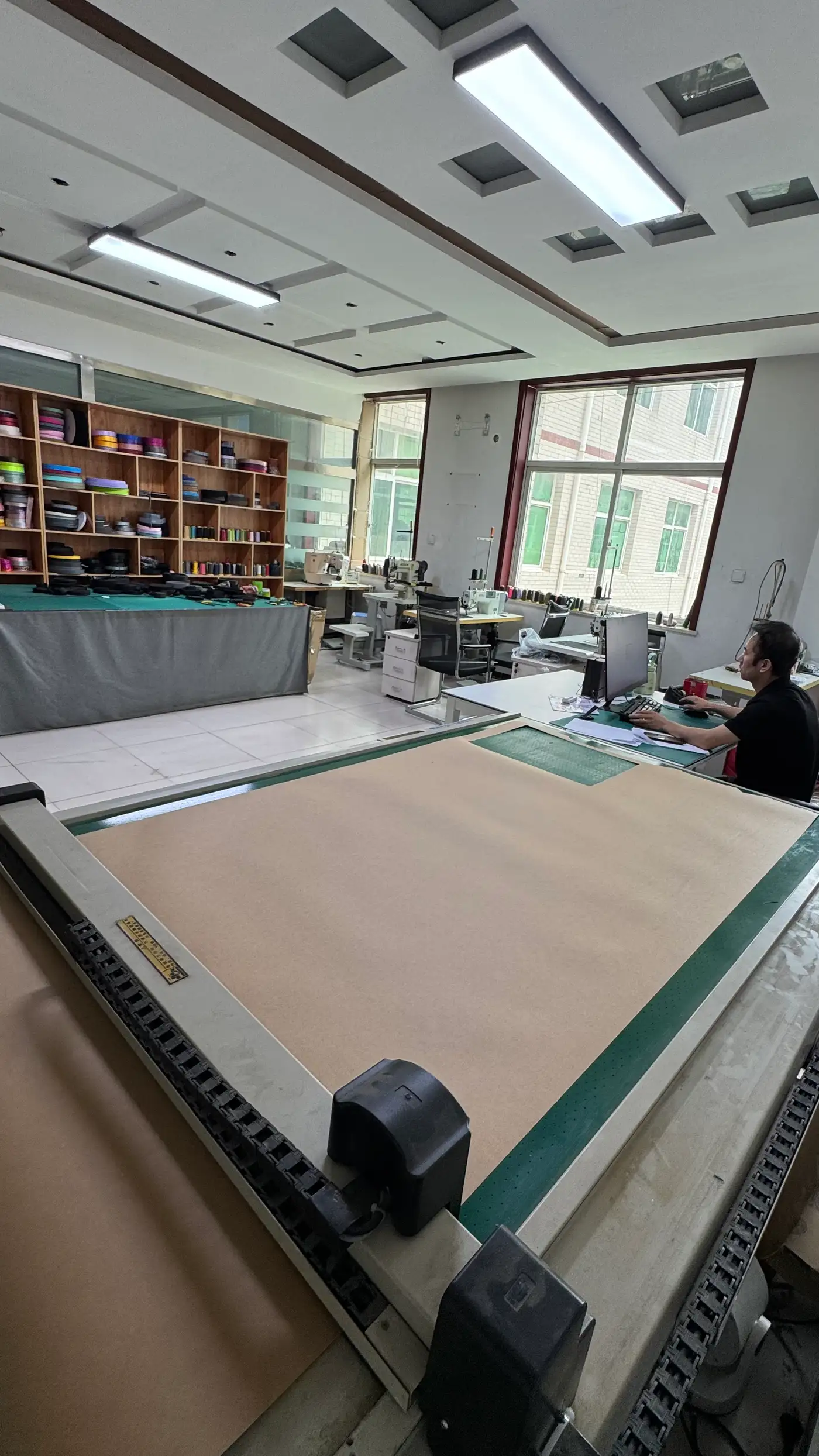 Pattern pieces plotted full-size on card for the sample cutter. The digital file is versioned; the version number is printed on every piece.
What Is the First Sample Made From?
Wherever possible, from the production fabric in the production colour. If a custom colour is not yet dyed, the first sample is made in the nearest stock shade with a lab dip attached. Making a sample in a substitute fabric of a different weight is a false economy - the drape, the stiffness and even the pocket dimensions change with the fabric, and the buyer signs off a bag that bulk cannot reproduce.
What Should You Check on a Backpack Sample?
A sample is approved against measurable points, not a general impression. The list we send with every sample:
- Finished height, width and depth at three points each, against the spec (tolerance +/- 1 cm on body, +/- 0.5 cm on pockets)
- Volume by bead fill
- Every zipper: opens and closes single-handed for the full length; slider does not catch on the lining; pull orientation
- Shoulder straps: length range on the adjuster (school bags: 45-85 cm), foam thickness, mesh side out
- Strap anchor: type of reinforcement, stitch count on the bartack
- Laptop sleeve: fits the stated device with 10 mm clearance each side; suspended off the base by at least 30 mm
- Logo: size, position from two reference edges, colour match to Pantone under D65 light
- Labels: brand label, care label and any compliance label in the specified position and language
- Weight of the empty bag
- Load test: 10 kg static for 24 hours, then strap-drop test (see QC section)
When Is a Sample Ready for Bulk?
When the buyer has signed the sample or a photo of it with written comments, and every open comment has been either incorporated into a revised sample or explicitly waived. We then make two identical "golden samples": one is sealed and goes to the buyer, one stays on the QC desk. Every in-line and final inspection compares against it. A change requested after golden-sample approval is a new sample, a new version number and, if materials are already cut, a cost.
How Are Materials Bought and Prepared for Bulk?
Bulk production begins two to three weeks before the first panel is cut, with purchasing. Fabric mills quote 7-15 days for stock colours and 15-25 days for custom dyeing; zipper makers 10-20 days for branded chain in custom colour; moulded hardware with a logo 20-30 days including the mould. Our production planner works backwards from the delivery date and orders long-lead items first - often before the golden sample is signed, on the buyer's written commitment to the material spec.
Incoming Material Inspection
Every roll, carton and bag of components is checked before it is released to the floor. Fabric is the largest item and gets the most attention.
| Check | Method | Accept / reject |
|---|---|---|
| Shade vs. approved swatch | D65 light box, side by side | Reject if visible difference at 1 m |
| Shade within lot | 3 cuttings per roll compared | Roll segregated if variation visible |
| Width | Tape at 3 points | Reject if under stated width by > 2 cm |
| Weight | GSM cutter and scale, 3 samples | Reject if under spec by > 5% |
| Coating | Visual + tape adhesion pull | Reject on flaking or uneven coating |
| Surface defects | Full-roll inspection on light table, 4-point system | Reject roll over 40 points / 100 m2 |
| Zippers | 50 pcs per lot: run slider full length x 20 | Reject lot on > 2% sticking |
| Webbing | Break test on 3 samples | Reject if under rated load |
| Foam | Thickness and density from 3 sheets | Reject if under spec |
Dye-lot discipline is what buyers see least and benefit from most. Two rolls sold as the same colour can differ by a full shade step. We never cut a single bag from two lots, and if an order needs more than one lot, the lots are assigned to separate colourways or separate shipments so no retail shelf shows the mismatch.
How Is Backpack Fabric Cut in Bulk?
Cutting decides whether every one of 10,000 bags has the same dimensions. It happens in a dedicated cutting room in three steps: spreading, cutting and bundling.
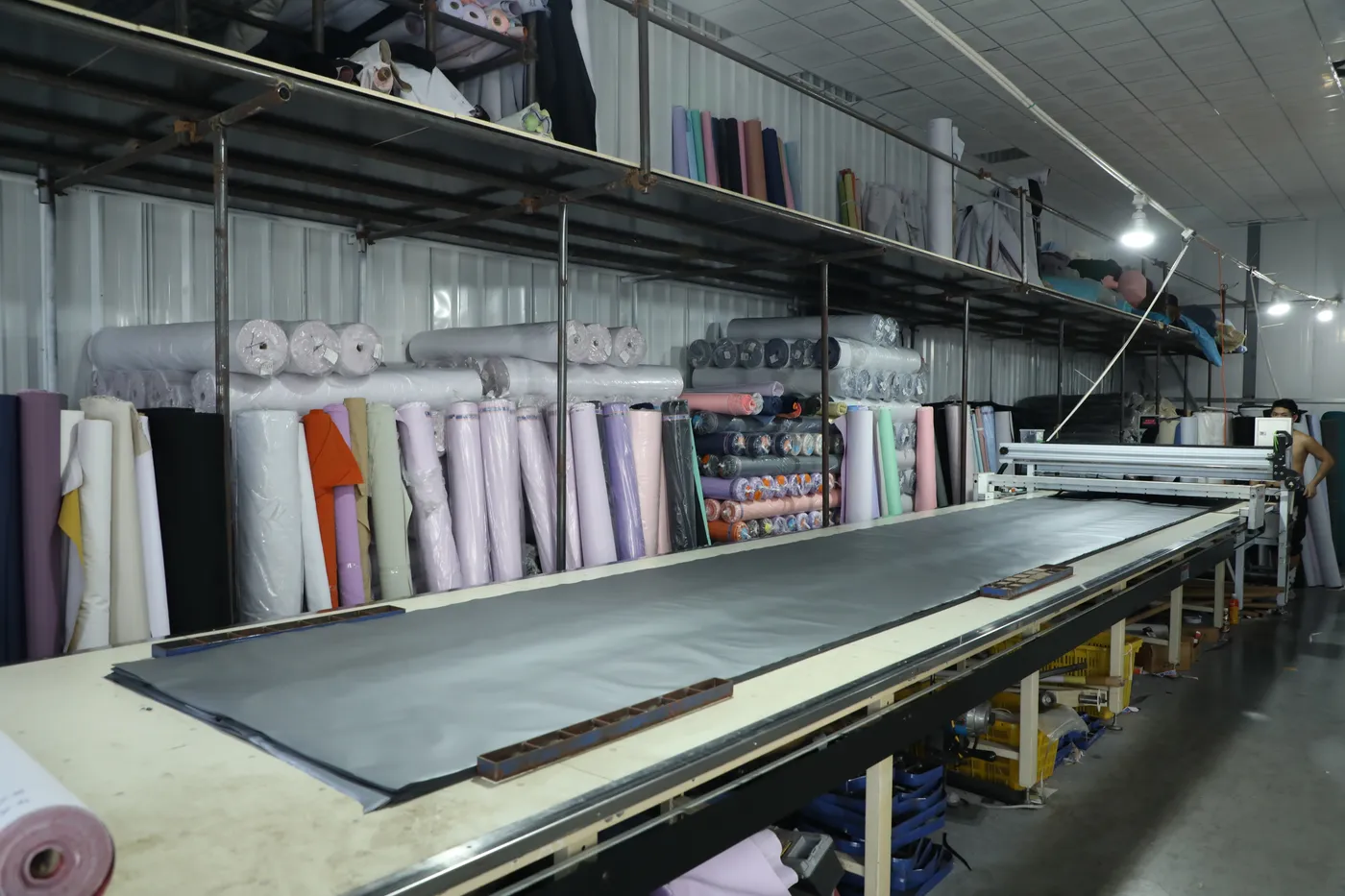 The automatic spreader lays 600D polyester in 40-60 plies under constant tension. Uneven tension in the spread is the most common cause of panels cut 5 mm short.
Spreading
Fabric is laid from the roll onto a 12-metre cutting table in multiple plies - 40-60 layers for 600D, 20-30 for 1680D, 80-100 for lining. The spreader keeps tension constant so the fabric is neither stretched (panels shrink after cutting) nor slack (panels wander). Coated fabrics are spread face-to-face in pairs so the PU sides do not stick. Directional fabrics - prints, camouflage, ripstop grids - are spread one-way and the marker is planned to keep the pattern upright on every visible panel.
CNC Cutting
Body panels, pockets, lining and mesh are cut on a vacuum-bed CNC cutter driven directly by the CAD pattern. The marker (the layout of pattern pieces across the fabric width) is optimised by software for utilisation; a good marker for a school backpack uses 82-86% of the fabric, and every percentage point is roughly 0.03 USD per bag. The cutter holds +/- 1 mm across the spread, which is why bulk bags from a CNC line measure closer to the sample than sample bags from a hand cutter.
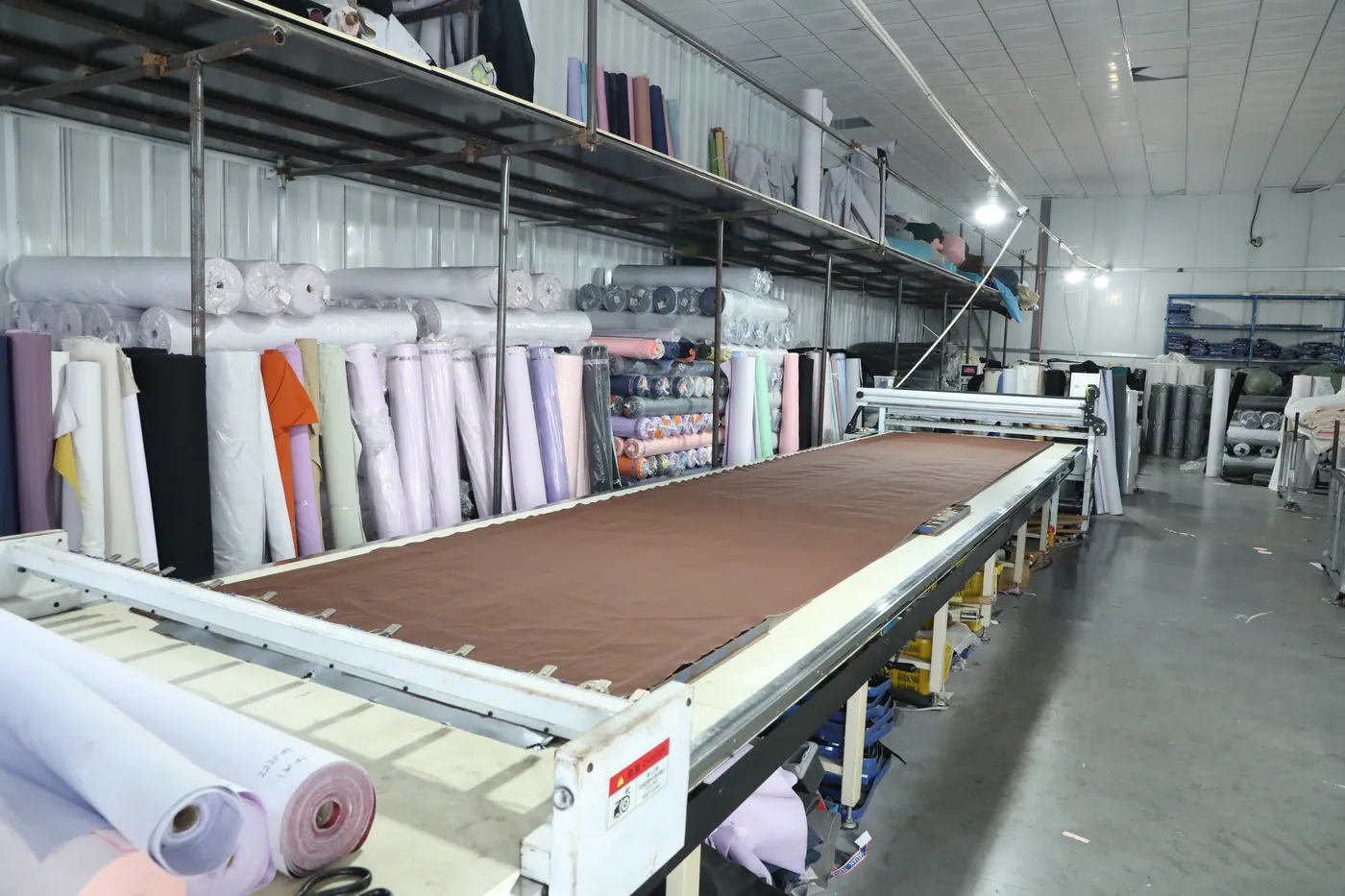 CNC cutting a 50-ply spread. The vacuum bed holds the stack flat; the blade is checked and changed every 2,000 linear metres.
Die Cutting
Small, high-count pieces - webbing tabs, zipper garages, foam strap inserts, pull tabs, reinforcement patches - are cut on hydraulic presses with steel-rule dies. A die costs 30-80 USD and cuts 20-50 pieces per stroke with no dimensional variation, so it pays back on the first 500 bags. Foam and EVA are always die-cut; a CNC blade drags in closed-cell foam.
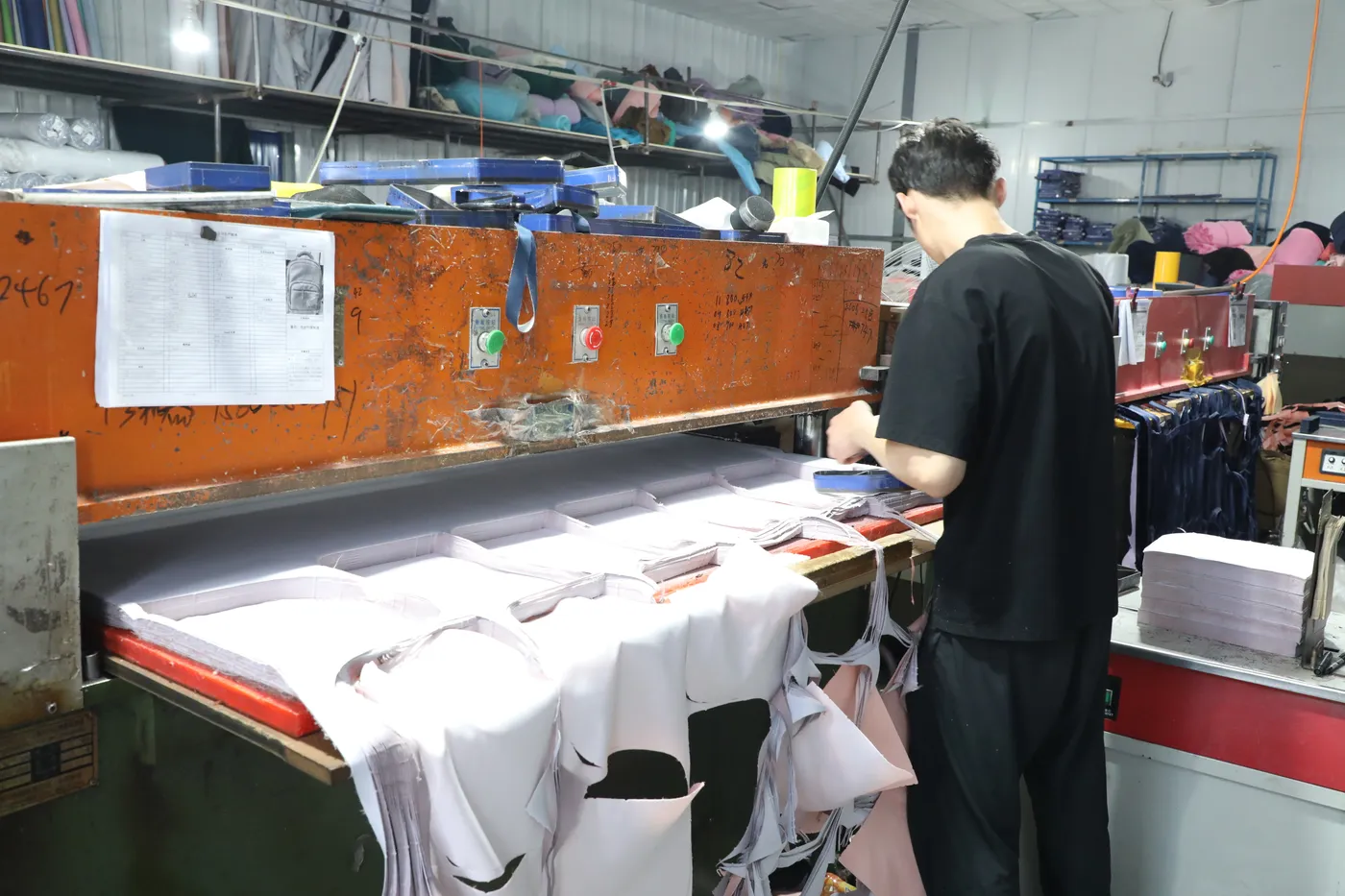 Die cutting strap foam and webbing tabs. Each press stroke produces a stack of identical pieces, which is why small components never vary.
Bundling and Ticketing
Cut pieces are bundled by panel, by size and by colour lot, and each bundle carries a ticket with the order number, style, colour, lot, panel name and piece count. A sewing operator receives a complete kit for a fixed number of bags - typically 20 or 50 - and cannot pick up a piece from another lot by accident. Bundles are staged on racks in the sequence the sewing line will consume them.
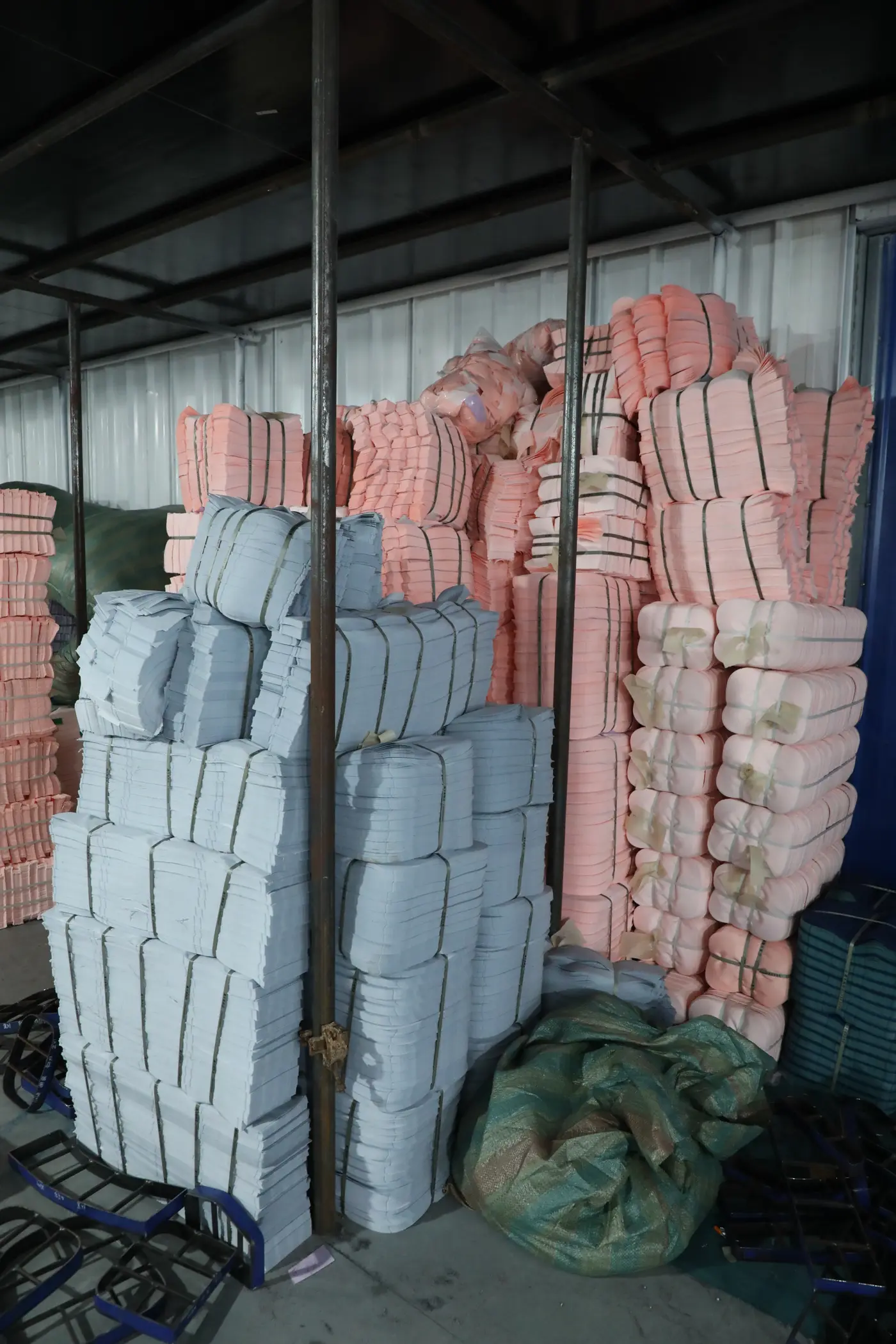 Ticketed bundles waiting for the branding and sewing lines. The ticket follows the bundle to final inspection, so any defect can be traced to a roll and a cutter.
| Cutting method | Used for | Accuracy | Speed | Best at |
|---|---|---|---|---|
| CNC vacuum cutter | Body, pockets, lining, mesh | +/- 1 mm | 40-60 plies per pass | Any quantity; complex shapes |
| Hydraulic die press | Foam, tabs, patches, webbing | +/- 0.5 mm | 20-50 pcs per stroke | Repeat orders; small parts |
| Hand cutter (sample) | Samples, one-off | +/- 3 mm | Single ply | Prototypes only |
| Laser cutter | Nylon, mesh edges (sealed) | +/- 0.5 mm | Single ply | Fray-free mesh; perforations |
When and How Is the Logo Applied?
Branding is applied to flat panels before sewing, never to a finished bag. A logo printed on a sewn front panel is fighting seams, curvature and foam; the same logo printed on the flat panel and then sewn is sharper, cheaper and repeatable. The exception is embroidery on a thick foam-backed panel, which is embroidered after the foam is quilted so the stitches do not sink.
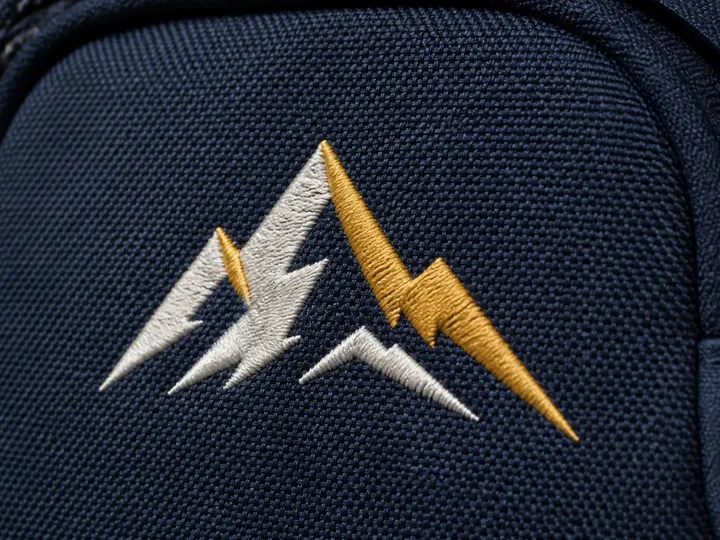 Embroidered logo on 600D shell. Stitch count is fixed at sampling; the digitised file, not the artwork, is the production standard.
| Method | Best for | Colours | Set-up | Per-bag cost (7 x 7 cm logo) | Durability |
|---|---|---|---|---|---|
| Screen print | Solid logos on 600D / 900D; large runs | 1-4 spot | Screen per colour | 0.08-0.25 USD | Excellent; may crack on PVC after years |
| Heat transfer (plastisol) | Photographic or gradient artwork | Unlimited | Transfer sheet | 0.20-0.45 USD | Good; edges lift on textured fabric |
| Embroidery | Premium, textured logos; school crests | Up to 9 threads | Digitising | 0.30-1.20 USD (by stitch count) | Excellent |
| Woven label | Brand labels, size tags | Up to 8 | Loom set-up | 0.05-0.15 USD | Excellent |
| Rubber / PVC patch | Outdoor, tactical, kids | Moulded, multi | Mould 150-300 USD | 0.25-0.60 USD | Excellent |
| Debossed PU patch | Business, heritage | Tone-on-tone | Brass die | 0.30-0.70 USD | Very good |
| Sublimation | All-over prints on polyester | Unlimited | Paper print | 0.60-1.50 USD per panel | Excellent on 100% polyester |
| Reflective print | Safety, school | Silver / grey | Screen | 0.15-0.35 USD | Good; check wash spec |
Placement is specified as distance from two reference edges of the panel, not "centred". A logo that is centred on the flat panel is not centred on the sewn bag once the panel curves over the foam, and the pattern maker adjusts the print position to compensate. This is why we ask for a marked-up photo of the sample rather than a written description.
How Are Backpacks Sewn and Assembled?
Sewing is where most of the labour cost sits: 45-70% of the direct cost of a backpack is operator time. It is organised as a balanced line where each operator performs one or two operations and passes the work on, so a 38-operation school backpack is finished by 20-25 people working in parallel rather than one person making a whole bag.
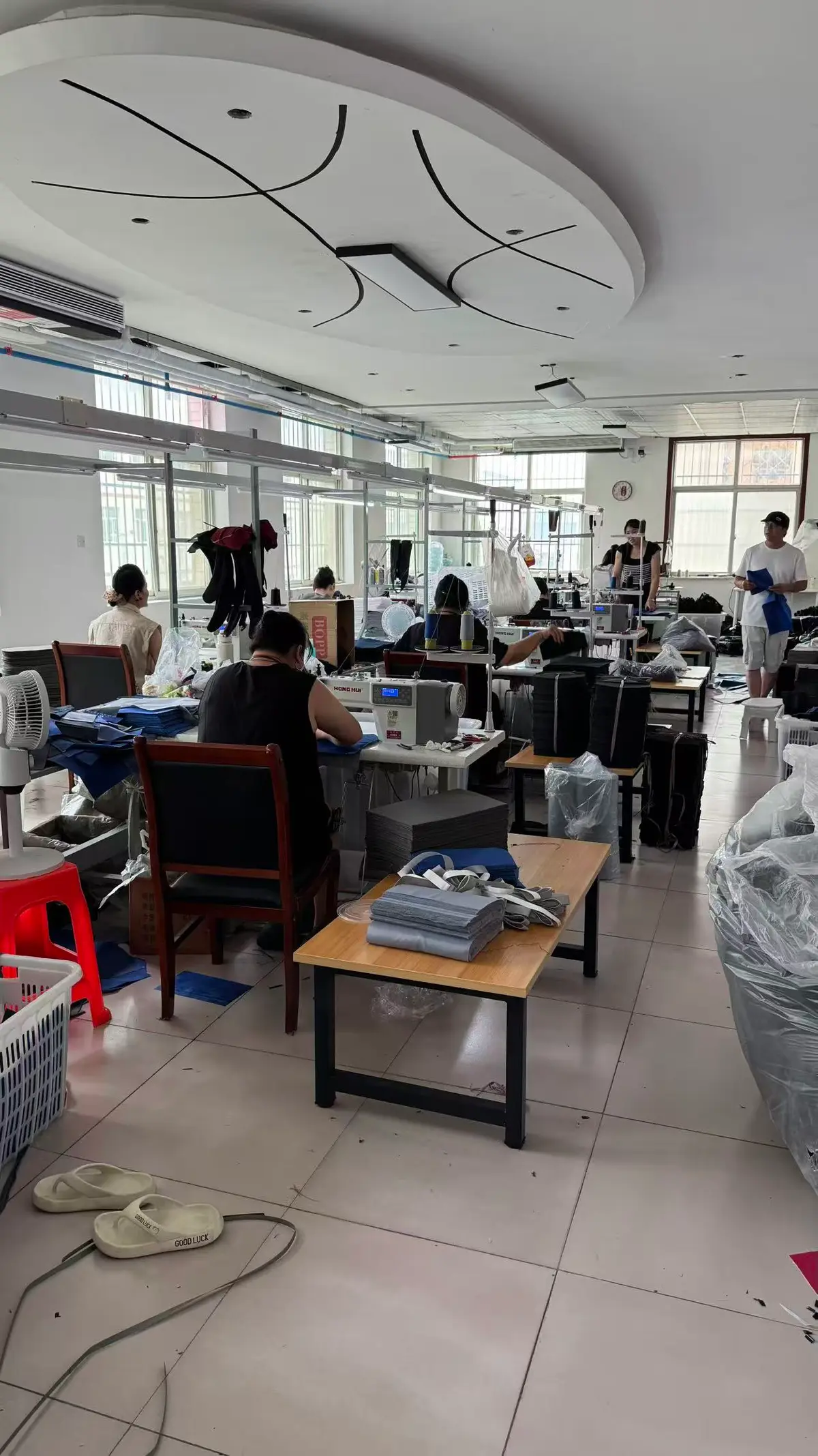 One of 100 sewing lines. Each line is dedicated to one style for the duration of the order; operators do not switch styles mid-shift.
The Assembly Sequence
A typical two-compartment school backpack with a padded back moves through the following operations. The order matters - pockets are always finished before the panel they sit on is joined to anything, and straps are always anchored before the back panel closes.
- Fuse interfacing or PE board to front panel where specified
- Sew front pocket: zipper set into pocket bag, pocket bag to front panel
- Attach side pockets, bottle mesh and binding
- Sew organiser panel (pen loops, card slots) to inner front lining
- Quilt back-panel foam to mesh; attach frame sheet if specified
- Prepare shoulder straps: foam sandwiched between mesh and shell, edges bound, webbing and ladder lock attached
- Prepare top handle: webbing folded, padded, bartacked
- Sew laptop sleeve into main lining
- Attach straps and handle to back panel; box-X and bartack at each anchor
- Set main compartment zipper into gusset
- Join front panel to gusset
- Join back panel to gusset (bag now closed)
- Attach base panel; bind all internal seams
- Turn bag right side out; attach zipper pulls, sternum strap, labels
- Steam and shape; trim threads
- In-line inspection before the bag leaves the line
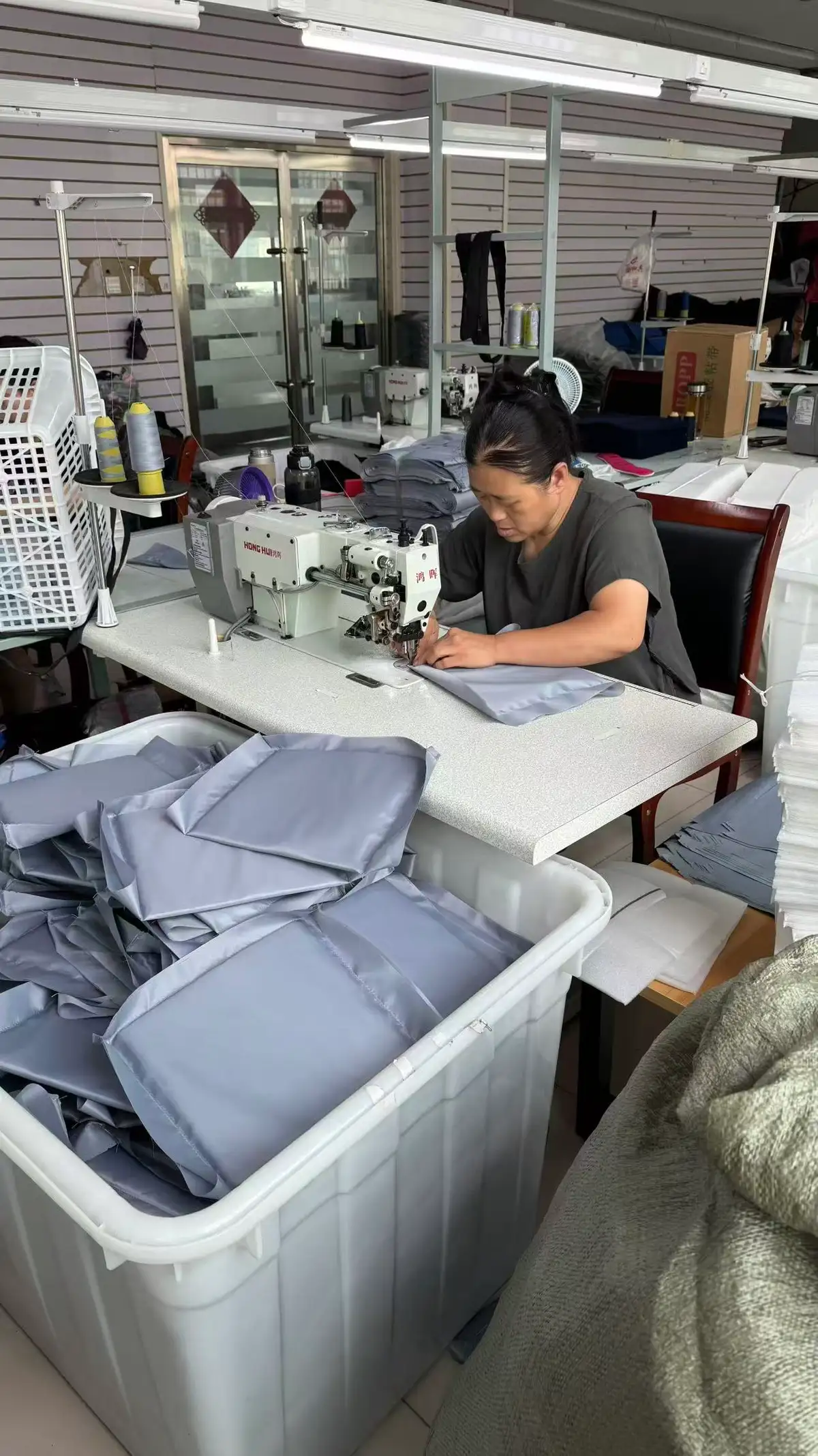 Body panels joined to the gusset. This is the operation that sets the bag's final dimensions; it is checked every 20 bags with a template.
Machines and Stitch Specifications
| Operation | Machine | Needle / thread | Stitch density | Notes |
|---|---|---|---|---|
| Body seams, 600D | Single-needle lockstitch, walking foot | DP x 17 #18, tex 70 | 7-8 SPI | Walking foot prevents ply shift |
| Body seams, 1680D / multi-layer | Heavy-duty lockstitch, compound feed | #21-23, tex 90 | 6-7 SPI | |
| Binding | Binding machine with folder | #18, tex 70 | 7 SPI | 20-25 mm tape |
| Zipper insertion | Single-needle, zipper foot | #16-18, tex 70 | 8 SPI | |
| Strap anchors, handle | Bartack machine, 42 stitches | #21, tex 135 | 42-stitch programme | Box-X first, then bartack over |
| Webbing to strap | Double-needle lockstitch | #21, tex 90 | 7 SPI | Two parallel rows |
| Foam quilting | Long-arm lockstitch or pattern tacker | #18, tex 70 | 5-6 SPI | |
| Binding corners | Post-bed machine | #18, tex 70 | 7 SPI | Reaches inside base corners |
Where Reinforcement Actually Matters
Every backpack has four points where the carried load concentrates: the two upper strap anchors, the handle anchor and the two lower strap anchors. A loaded bag lifted by one strap puts the entire weight on one anchor about 40 mm wide. The reinforcement standard we apply to every bag regardless of price point:
- Upper strap anchor: strap webbing passes under the back-panel seam, box-X stitch through shell, foam and a 40 x 40 mm 600D reinforcement patch, then a 42-stitch bartack across the webbing
- Handle: both ends bartacked through the back panel and a hidden webbing loop that connects to the strap anchors, so the handle load is shared
- Lower strap anchor: webbing bartacked through the base seam, not just the shell
- Zipper ends: zipper garage or 10 mm folded tab to stop the slider running off; bartack at the stress end
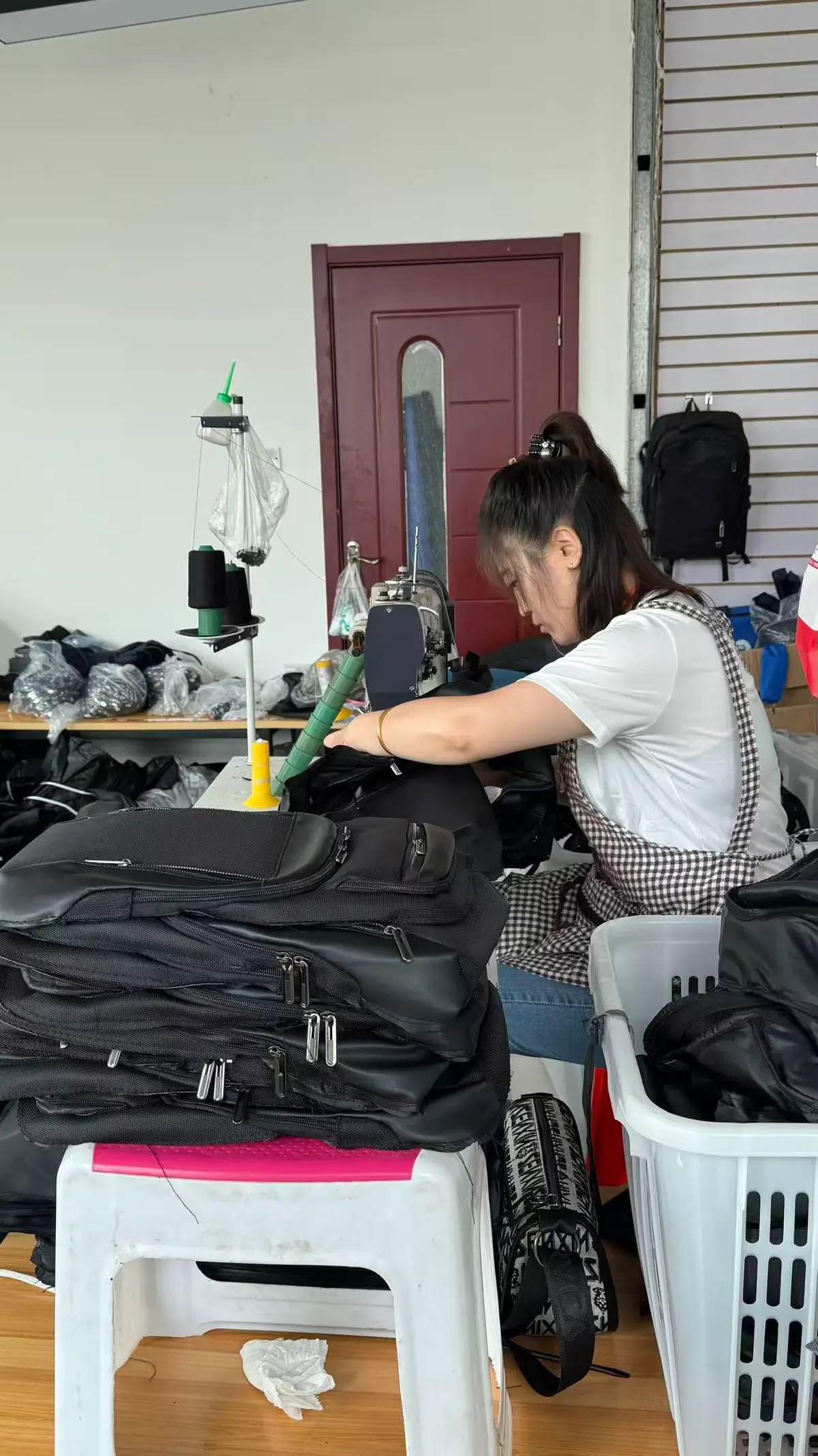 42-stitch bartack over the strap webbing at the upper anchor. This single operation is the difference between a strap that lasts two years and one that lasts two months.
How Does a Line Hold a 20-Day Lead Time?
Line balancing. Before an order starts, the production engineer times each operation on the golden sample, groups operations so each operator has roughly the same cycle time, and assigns operators. A 38-operation bag with a total of 22 minutes of sewing time balanced across 24 operators gives a line output of about 65 bags an hour, or 500-550 a day per line. A 10,000-piece order on two lines is nine to ten working days of sewing, which is what leaves room in a 20-day schedule for cutting before and inspection and packing after. Orders slip when the line is unbalanced - one operation taking three minutes while the others take 50 seconds - not when the factory is slow.
How Is Backpack Quality Controlled?
Quality control is not a final inspection; it is a series of gates, each of which stops a defect from multiplying. A wrong fabric caught at receiving costs one roll. The same fabric caught at final inspection costs the whole order. Our quality process runs six gates on every custom order.
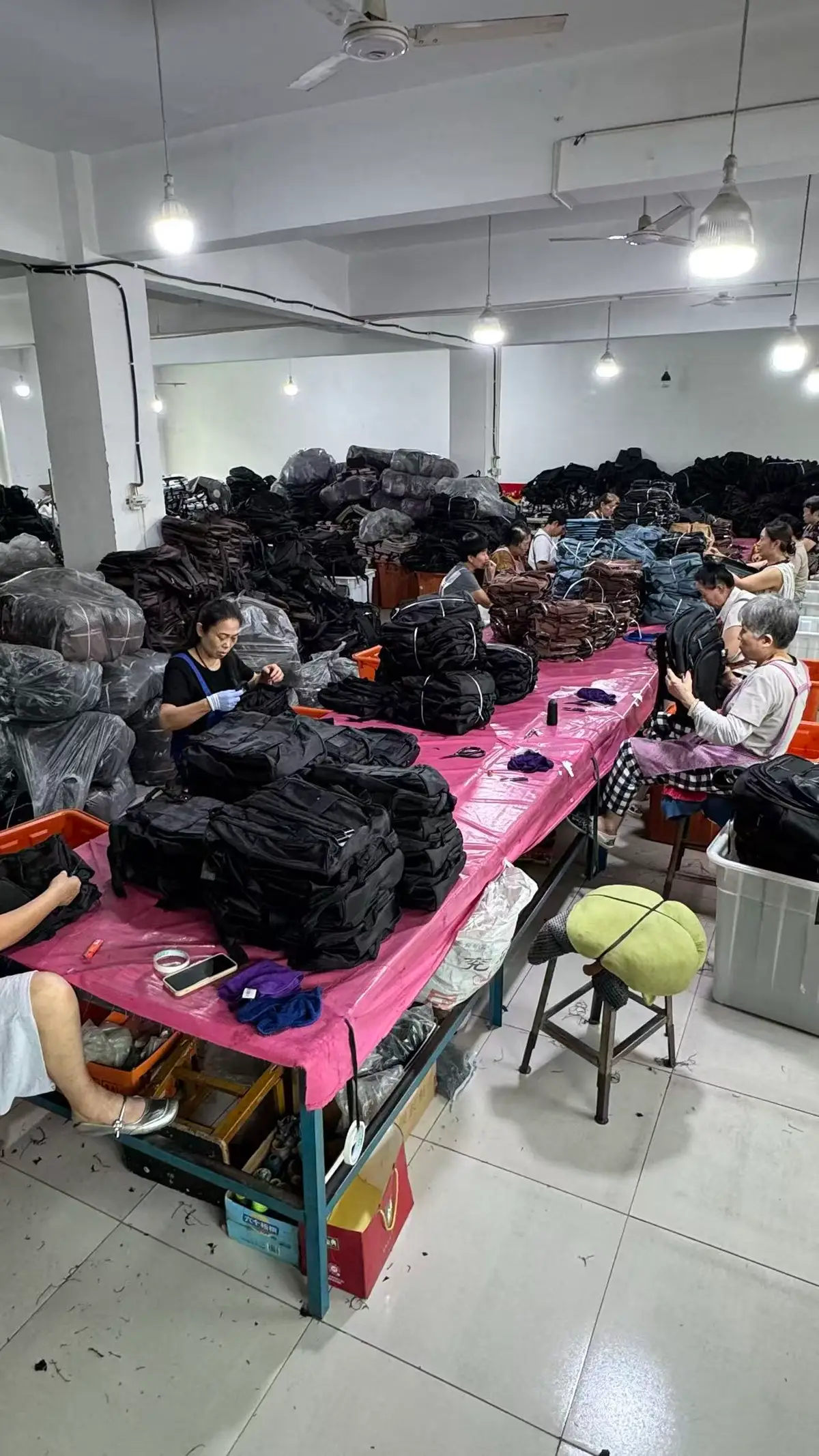 Final inspection: every zipper is run full-length, every strap adjuster cycled, every bag measured against the golden sample.
The Six Gates
| Gate | When | What is checked | Sample size |
|---|---|---|---|
| 1. Incoming material | On delivery | Shade, width, weight, coating, defects, hardware function | Every roll; 50 pcs per hardware lot |
| 2. First-piece | First 5 bags off the line | Full measurement, construction, logo, labels vs. golden sample | 5 of 5, buyer photo approval optional |
| 3. In-line | Continuous | Seam allowance, stitch density, zipper run, anchor bartacks | Every 20th bag by line QC, 100% at three checkpoints |
| 4. Load and function test | Daily from line | Static load, strap-drop, zipper cycle, adjuster slip | 3 bags per line per day |
| 5. Final inspection | Before packing | 100% visual and function; measured sample | 100% visual; AQL 2.5 measurement |
| 6. Pre-shipment | Cartons sealed | Carton count, labels, packing method, random re-open | AQL 2.5 Level II, or buyer's third party |
Load and Function Tests
Backpack testing is simple and does not need a laboratory; it needs discipline. The tests we run on every order, with the pass criteria written on the QC sheet:
- Static load: bag loaded to 1.5x its rated capacity (15 kg on a 10 kg-rated school bag), hung by both straps for 24 hours. Pass: no seam opening, no strap slip greater than 10 mm, no deformation of the anchor.
- Strap drop: loaded bag lifted 30 cm by one strap and dropped, 50 cycles per strap. Pass: no thread break at the bartack.
- Handle lift: loaded bag lifted by the handle, 100 cycles. Pass: no seam opening.
- Zipper cycle: main zipper run full-length 500 times on a reciprocating tester. Pass: slider runs freely, no tooth separation.
- Adjuster slip: strap set to mid-length under 5 kg load, 100 tugs. Pass: slip under 5 mm.
- Colour fastness: crockmeter rub, 10 dry and 10 wet, on shell and any printed area. Pass: grade 4 or better.
- Seam strength (on request): ASTM D1683 on a 50 mm sewn sample of the body seam. Typical result on 600D with tex 70 at 7 SPI: 450-600 N.
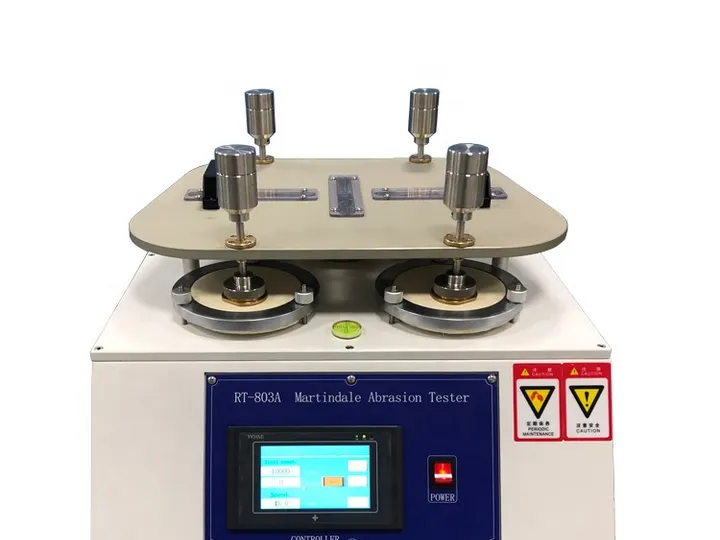 Martindale abrasion test on shell fabric. Run on every new fabric article and on any lot that looks or feels different from the approved swatch.
Common Backpack Defects and How They Are Prevented
| Defect | Root cause | Prevention gate |
|---|---|---|
| Strap tears out at shoulder | Bartack missing or under-stitched; no reinforcement patch | Gate 3 checkpoint at strap attach; Gate 4 strap-drop |
| Zipper slider runs off end | No garage / end tab | Pattern review; Gate 2 |
| Bag measures 1-2 cm small | Spread tension too high; ply shift on unlined seam | Cutting check; walking-foot machines; Gate 2 |
| Shade difference between panels | Two dye lots mixed in one kit | Lot segregation at bundling |
| Logo off-centre on sewn bag | Printed centred on flat panel without curvature offset | Sample mark-up; Gate 2 |
| Foam visible through mesh | Foam cut oversize; mesh too open | Die size check; material spec |
| Puckered seams | Thread tension; wrong needle for coated fabric | Machine set-up per material; Gate 3 |
| Lining pulls out of zipper | Insufficient seam allowance on lining | Pattern; Gate 3 |
How Are Backpacks Packed and Shipped?
Packing protects the bag and determines the freight cost. Both are decided at quotation, not after sewing, because carton dimensions feed the CBM calculation that sets the sea freight price.
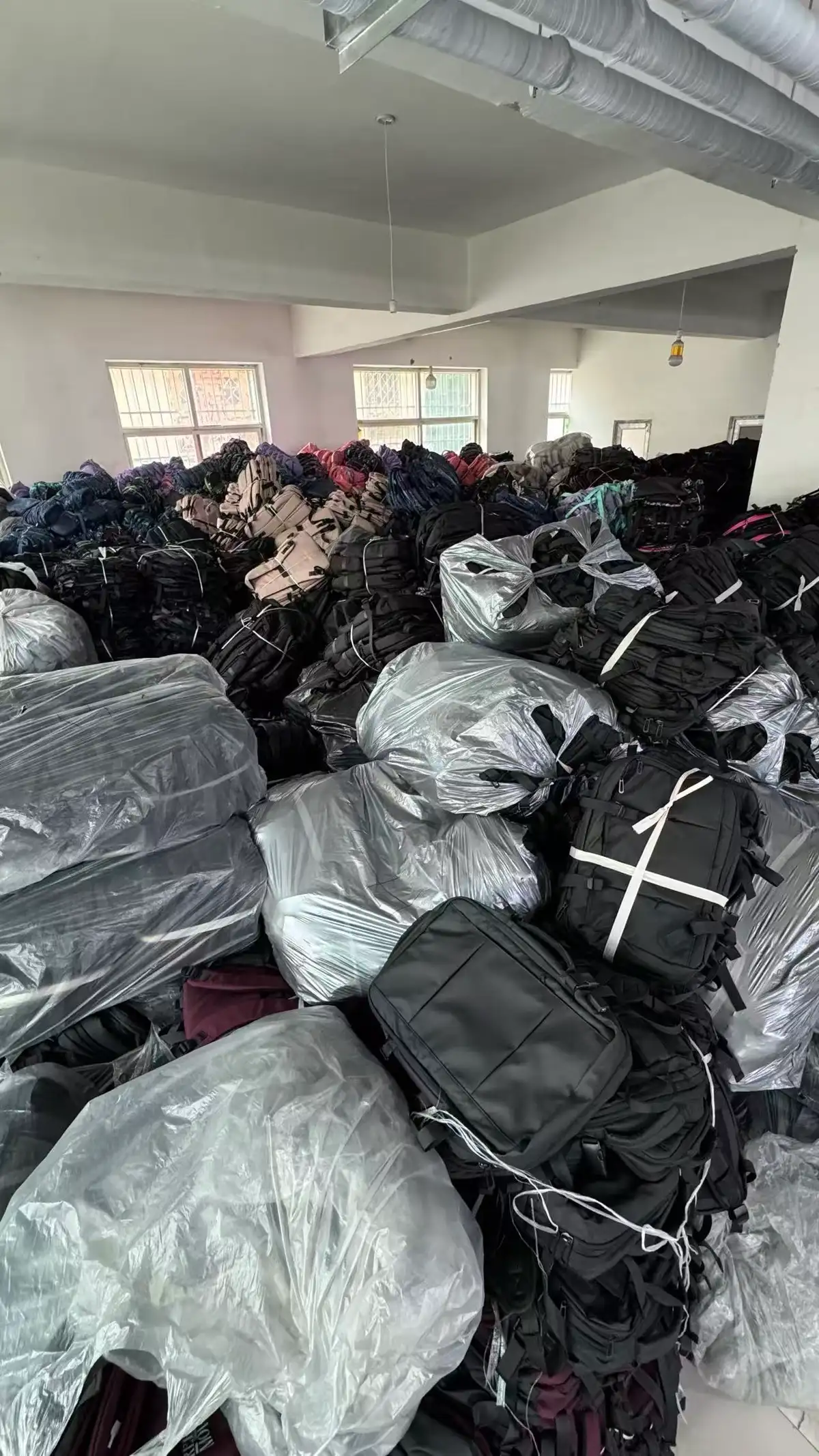 Inspected bags individually poly-bagged with the hang tag inside. Bags are stuffed with tissue only if the buyer specifies it; most retail buyers prefer flat-packed.
Individual Packing
The standard is a clear LDPE polybag (0.04-0.06 mm) with a suffocation warning printed in the destination market's language, hang tag attached to the handle or zipper pull, and the bag folded flat with straps tucked. Upgrades: printed polybag with the brand, non-woven dust bag, or a folding retail box with a window. Each adds 0.05-0.80 USD per bag and, in the case of boxes, 30-60% to the carton volume.
Carton Packing
| Bag type | Packing | Bags per carton | Carton size | CBM per 1,000 bags |
|---|---|---|---|---|
| School backpack 18 L, flat | Polybag, 1 in 1 | 40 | 60 x 40 x 50 cm | 3.0 |
| Laptop backpack 25 L, padded | Polybag, 1 in 1 | 20 | 60 x 45 x 55 cm | 7.4 |
| Hiking pack 40 L, frame sheet | Polybag, 1 in 1 | 12 | 70 x 50 x 60 cm | 17.5 |
| Drawstring pack | Polybag, 10 in 1 | 200 | 60 x 40 x 40 cm | 0.5 |
| Any, in retail box | Box, 1 in 1 | 12-20 | 60 x 45 x 55 cm | 7.4-12.4 |
Cartons are 5-ply corrugated, 200 lb burst, with the buyer's shipping marks, carton number, style, colour, quantity and gross/net weight on two sides. Every carton is weighed; a carton more than 3% off the expected weight is opened.
Loading and Documents
A 40' HC container holds 68 CBM, or roughly 22,000 flat-packed school backpacks. Loading photos are taken at four stages - empty container, half loaded, fully loaded, sealed - and sent to the buyer with the container and seal numbers on the day of loading. Export documents follow: commercial invoice, packing list, bill of lading, certificate of origin and, where required, a form for the destination's preferential tariff. For GCC destinations we prepare the SASO / SABER conformity file when requested.
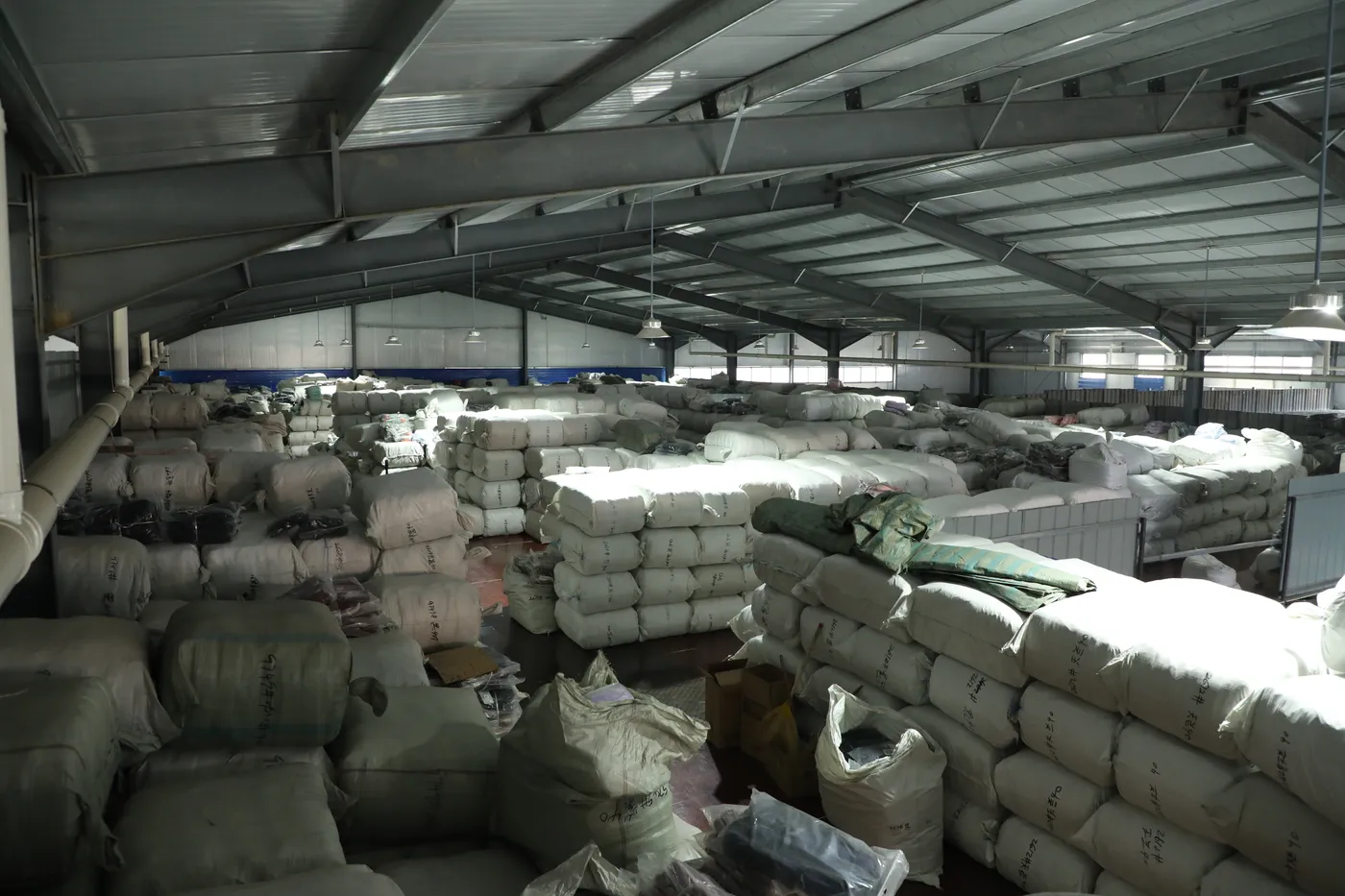 Order staged at the loading bay. Cartons are counted against the packing list before the container arrives.
What Determines Cost, MOQ and Lead Time?
Where the Money Goes
A useful way to read a backpack quotation is to know roughly how it breaks down. For a 600D two-compartment school backpack at 1,000 pieces:
| Cost element | Share of FOB | Notes |
|---|---|---|
| Shell, base, lining fabric | 22-28% | Roughly 1.1 m of 600D, 0.4 m lining |
| Zippers | 8-12% | Two #8 coil, one #5; SBS brand |
| Foam, mesh, webbing, binding, thread | 10-14% | |
| Hardware and labels | 3-6% | |
| Branding | 2-8% | Screen print low; embroidery high |
| Cutting and sewing labour | 30-38% | 38 operations, 22 min |
| Packing materials | 2-4% | |
| Overhead, QC, margin | 8-12% |
The two largest levers are fabric (choose the right denier for the job, not the heaviest) and labour (fewer pockets, fewer operations). A single extra zippered pocket adds 4-6 operations and 0.30-0.50 USD; three of them can add 10% to the bag.
MOQ
Our MOQ for custom backpacks is 100 pieces per style in stock fabric colours. The number is set by the cutting room, not by pricing: 100 school backpacks is about 110 m of 600D, which is one full roll and one CNC spread. Below 100 pieces the spread is too thin to run efficiently and the price per bag rises steeply. Custom-dyed fabric moves the practical minimum to 300-500 pieces per colour (the mill minimum). Moulded logo hardware and printed lining have their own minimums of 1,000-3,000 pieces, but can be waived by paying the tooling or the mill minimum outright.
Lead Time
| Stage | Stock fabric, standard trims | Custom fabric or hardware |
|---|---|---|
| Quotation | 1-2 working days | 2-3 working days |
| First sample | 3-5 working days | 7-10 working days (after lab dip / mould) |
| Revised sample | 2-3 working days | 3-5 working days |
| Material purchasing | 5-10 days | 20-30 days |
| Cutting, branding, sewing | 10-15 days for 1,000-5,000 pcs | Same |
| Inspection and packing | 2-3 days | Same |
| Bulk lead time from deposit | 20 days typical | 35-45 days |
| Sea freight to Jebel Ali / Dammam | 18-22 days | Same |
| Sea freight to Rotterdam / Hamburg | 30-35 days | Same |
The single biggest schedule risk on a first order is sample approval time on the buyer's side. A sample that waits two weeks for comments pushes the whole calendar two weeks; the factory's 20 days do not start until the golden sample is signed and the deposit received.
Frequently Asked Questions
What is the minimum order for custom backpacks?
100 pieces per style in a stock fabric colour. The MOQ is a cutting-room minimum: 100 school backpacks use about one roll of 600D and one CNC spread. Custom-dyed fabric raises the minimum to 300-500 pieces per colour because that is the mill's dyeing minimum.
How long does a custom backpack sample take?
3-5 working days from confirmed materials for a standard pack; 7-10 for complex designs with frame sheets, custom hardware or welded seams. Add courier time (3-5 days to the GCC or Europe) and the buyer's review time.
Can I get a sample before paying for bulk?
Yes. We make a free sample for qualified buyers with a defined project; the buyer covers courier cost. The sample fee, where one applies, is credited against the first bulk order. Details are on the free sample page.
What fabric should I choose for a school backpack?
600D polyester with PU backing is the right default: widest colour stock, prints well, lasts two to three school years. Upgrade the base panel to 1680D and specify 35 kg/m3 strap foam. For hot markets use PU, not PVC, backing. Our 600D vs 900D vs 1680D guide covers the trade-offs in detail.
Do you use YKK zippers?
On request. Our default on school and promotional bags is SBS #8 coil, which performs comparably in our cycle tests at about half the cost. For retail lines in Europe and North America we quote YKK as standard, adding roughly 0.60-1.20 USD per bag.
What is the difference between a sample and a golden sample?
A sample is any bag made during development. A golden sample is the final approved bag, signed by the buyer, of which two identical copies are made: one for the buyer, one sealed on our QC desk. All bulk inspection compares to it; any later change is a new version.
How do you prevent colour differences between bags in one order?
Every fabric roll is shade-checked against the approved swatch under D65 light and assigned to a dye lot. Cut bundles are ticketed by lot and a sewing kit never mixes lots. If an order needs more than one lot, lots are assigned to separate colourways or shipments.
Can you make backpacks from recycled fabric?
Yes. RPET 600D and 900D are stock articles with a GRS transaction certificate available per lot. Cost is 15-30% above virgin polyester at the fabric level, roughly 4-8% at the finished bag.
How much does a custom backpack cost?
A 600D two-compartment school backpack at 1,000 pieces typically lands at 4.50-7.50 USD FOB depending on zippers, foam and branding. A 900D laptop backpack with organiser and padded sleeve runs 9-16 USD. A 1680D or 1000D nylon hiking or tactical pack with frame sheet and hydration sleeve runs 18-35 USD. Every quotation is itemised so you can see what each feature costs.
What tests do you run before shipping?
Static load (1.5x rated, 24 h), strap-drop (50 cycles per strap), handle lift (100 cycles), zipper cycle (500), adjuster slip, colour fastness by crockmeter, plus 100% visual and function final inspection and AQL 2.5 measurement. Seam strength to ASTM D1683 and any third-party lab testing (REACH, CPSIA, Prop 65) are available on request.
Can I visit the factory or have a third-party inspection?
Both. We are in Baigou, Hebei, 90 minutes from Beijing Daxing airport, and host buyer visits weekly. SGS, Intertek, BV and QIMA inspect on our floor regularly; book the inspection for the day after our internal final inspection so any rework is complete.
What happens if bags arrive defective?
Every carton carries a lot ticket that traces back to the cutting spread, sewing line and inspector. Defects within the agreed AQL are replaced or credited on the next order; defects above AQL are our cost, including freight for replacements. In practice, the load and function tests at Gate 4 mean that structural failures in the field are rare - the defects that reach a buyer are almost always cosmetic.
If you have a sketch, a reference bag or a full tech pack, send it through the inquiry form and a sales engineer will return an itemised quotation and a sampling plan within 24 hours. You can also tour the cutting room, the pattern room and the stock warehouse online before you get in touch.
Written by
Senszx production team
Sales engineers, pattern makers and QC staff at a BSCI & ISO certified bag factory in Baigou, China, since 2006.
Get in Touch
Get a Custom Bag Quote from Our China Factory
Our sales team is online around the clock and usually replies within the hour.
Email
[email protected]Factory
Qinzheng Road No.89, New Industry Zone, Baigou Town
Baoding City, Hebei Province 074004, China