How to Prepare a Custom Bag RFQ: The Complete B2B Sourcing Guide for Accurate, Comparable Factory Quotes
Master the art of preparing a professional custom bag RFQ. Learn how to specify materials, dimensions, hardware, logos, packaging, and commercial terms to receive accurate, comparable factory quotations without hidden costs or production surprises.
In the global luggage, backpack, and sewn-goods manufacturing industry, the commercial success, profitability, and delivery schedule of a production run are determined long before the first roll of textile is loaded onto automated fabric spreading tables. They are decided during the very first engineering and commercial exchange: the Request for Quotation (RFQ).
For brand founders, procurement managers, technical apparel designers, and private-label e-commerce directors, issuing a custom bag RFQ frequently begins with what seems like a simple inquiry: sending several reference photographs, stating a target order volume, attaching a vector logo file, and asking the OEM factory for its "best FOB price."
However, when three different bag factories receive that identical, loosely defined message, their respective cost estimators will inevitably conceptualize three completely different products in their costing spreadsheets:
- Supplier A calculates costs based on stock commercial 600D polyester with cheap PVC backing, unbranded zinc alloy zipper sliders, unreinforced open-cell sponge padding, bulk polybags, and EXW factory-gate terms—omitting all third-party social compliance and lab chemical testing.
- Supplier B builds a quotation around custom-dyed 500D high-tenacity nylon with dual-pass polyurethane (PU) backing, genuine SBS or YKK reverse-coil zippers, high-density closed-cell EVA foam, 0.05 mm LDPE retail packaging with scannable barcode labels, and standard FOB seaport terms.
- Supplier C prices boutique 1000D Cordura nylon with custom metal badge hardware, premium multi-color 3D rubber patches, individual rigid gift box packaging, and air freight DDP terms.
The buyer subsequently receives quotes of $5.40, $7.85, and $12.30 per unit. Comparing these raw figures without a standardized technical baseline is virtually impossible. The buyer who instinctively selects the lowest $5.40 quote will almost invariably suffer from post-deposit price renegotiations, substituted inferior fabrics, catastrophic seam tearing during distribution, high consumer return rates, and delayed product launches.
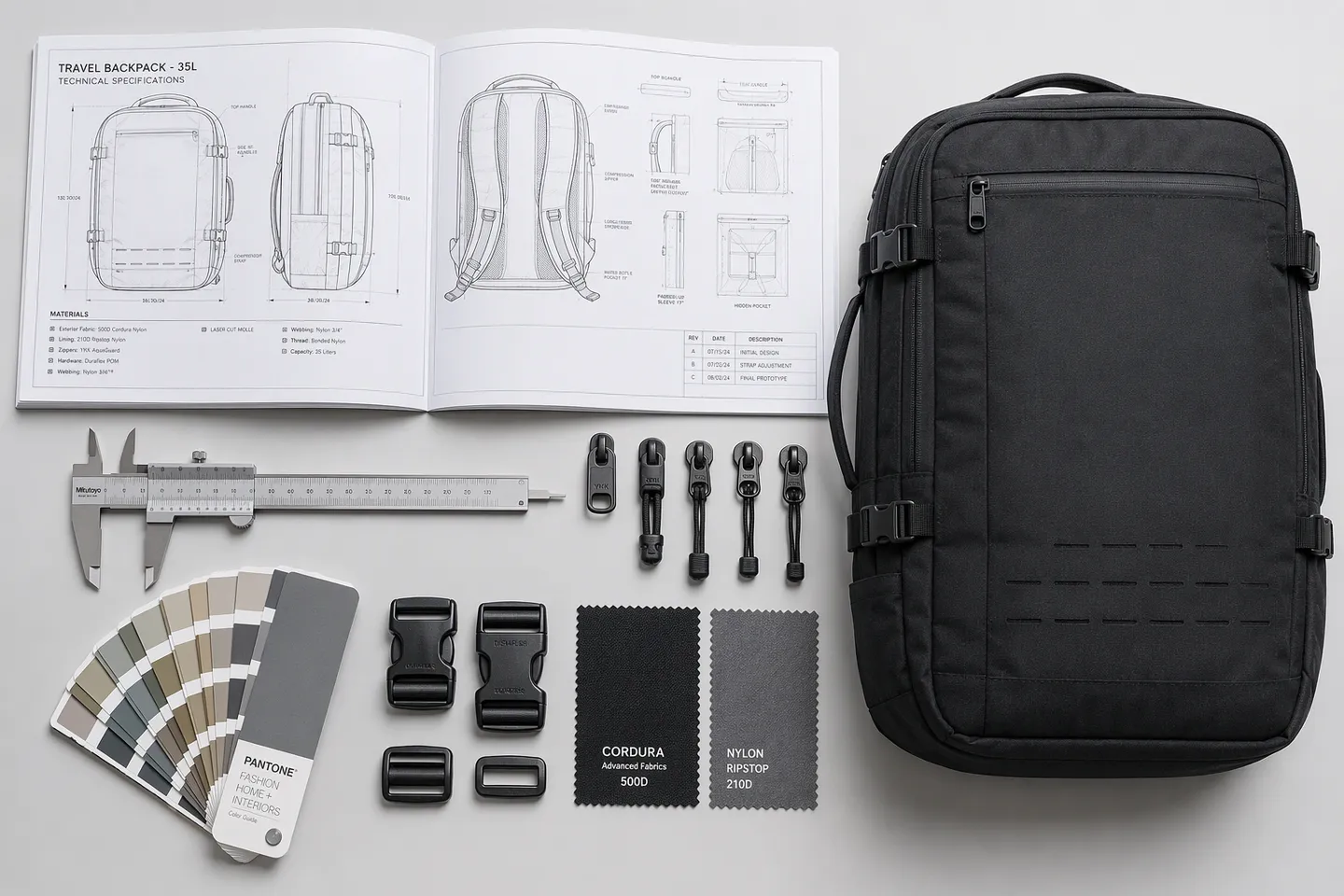
At Senszx, with over 18 years of specialized OEM and ODM luggage and backpack manufacturing experience at our advanced facility in Baigou, China, our cost engineering department reviews thousands of commercial RFQ packages annually. We have seen first-hand how a well-structured technical RFQ accelerates prototyping from weeks to days, eliminates hidden cost multipliers, and locks in rock-solid production pricing.
This comprehensive B2B sourcing guide provides an exhaustive engineering framework for preparing, structuring, and evaluating a custom bag RFQ. Whether you are drafting a detailed custom backpack tech pack, calculating production margins with our custom backpack cost breakdown, evaluating performance textiles in our custom fabric catalog, navigating our custom zipper pulls and buckles directory, exploring silhouette varieties in our types of backpacks guide, mastering bulk manufacturing in our guide to manufacturing custom backpacks, or selecting a verified OEM custom backpack manufacturing partner, this guide will transform your procurement strategy into an impenetrable competitive advantage.
1. What Is a Custom Bag RFQ and Why Is It the Foundation of B2B Sourcing?
A Request for Quotation (RFQ) in the custom sewn-goods industry is far more than a basic price check. It is a legally binding technical and commercial specification brief that translates your brand's aesthetic vision and functional requirements into the exact mathematical parameters required for industrial mass manufacturing.
When a professional bag manufacturer receives an RFQ, the technical department breaks down the project across five primary cost centers:
- Direct Material Costs (DMC): Precise mathematical yields for every component—shell fabric, secondary contrast panels, lining, foam padding, structural plastic reinforcement boards, binding tapes, webbing, zippers, sliders, pullers, buckles, eyelets, Velcro, and logo embellishments.
- Direct Labor Costs (DLC): The Standard Allowed Minutes (SAM) or Standard Allowed Hours (SAH) required across every production stage—computer-guided fabric spreading, laser cutting, screen printing or embroidery sub-assembly, sewing workstation assembly lines, edge binding, bar-tacking, thread trimming, inspection, and cartoning.
- Non-Recurring Engineering (NRE) & Tooling: One-time capital expenditures including custom injection molds (for custom zipper pullers, rubber patches, or proprietary plastic buckles), embroidery digitizing templates, silkscreen film plates, and steel clicker dies.
- Quality Control & Regulatory Compliance: In-line inspection gates, drop-testing jigs, tensile pull fixtures, needle detection scanning, laboratory chemical compliance testing (CPSIA, REACH, California Prop 65), and social audit compliance maintenance (BSCI, ISO 9001).
- Logistics, Packaging & Trade Overhead: Primary protective packaging, barcode thermal labeling, master export carton corrugated grades, palletization, inland container trucking, export terminal handling fees, and Incoterms distribution.
| Cost Center Pillar | Primary Manufacturing Components & Activities | Typical Share of Total FOB Cost |
|---|---|---|
| 1. Direct Materials (DMC) | Shell fabrics, lining, foam padding, zippers, sliders, buckles, webbing straps, binding tape | 50% – 65% |
| 2. Direct Sewing Labor (DLC) | Fabric spreading, laser cutting, embroidery/print sub-assembly, sewing lines, QC trimming | 20% – 30% |
| 3. Non-Recurring Tooling (NRE) | Custom injection molds (pullers, rubber patches), screen plates, steel clicker dies | One-Time Amortized |
| 4. Quality Assurance & Testing | In-line inspection gates, tensile load testing, needle detection, chemical lab compliance | 3% – 5% |
| 5. Packaging & Logistics | Individual polybags, GS1 barcodes, hangtags, 5-ply master export cartons, FOB handling | 5% – 8% |
1.1 The Anatomy of Quotation Discrepancies: Why Factories Quote Different Prices
Why do reputable manufacturers provide wildly divergent quotations for the exact same bag? The answer lies in the information gap. When an RFQ omits critical engineering variables, cost estimators must make unilateral assumptions to complete their calculations.
Consider the real-world manufacturing variables that alter unit economics:
- Fabric Backing Formulation: Standard 600D polyester backed with 0.25 mm PVC costs approximately $1.10 per meter, while the identical 600D polyester with dual-pass environmental polyurethane (PU 1500mm) coating costs $1.85 per meter. If your RFQ simply states "600D polyester," one factory will quote the heavy, chemical-smelling PVC backing while another will price the lightweight, cold-crack resistant PU coating.
- Zipper Teeth and Slider Integrity: A generic unbranded #5 nylon coil zipper costs $0.12 per meter with a $0.03 zinc slider. An authentic SBS #5 reverse-coil water-repellent zipper costs $0.38 per meter with an auto-lock slider ($0.15), and a world-standard YKK AquaGuard #5 zipper costs over $1.40 per meter. Across a complex commuter backpack requiring 2.8 meters of total zipper chain and 5 sliders, zipper selection alone creates a $3.50+ USD variance per bag.
- Sewing Assembly Reinforcements: Standard single-row chain stitching without internal binding requires 18 minutes of sewing labor. Industrial double-needle lockstitching with reinforced 42-stitch bar-tacks on all load-bearing anchors (shoulder straps, haul handles, compression straps) and full 210D polyester interior seam binding requires 38 minutes of skilled labor. That labor difference represents a 100%+ increase in factory manufacturing time.
| RFQ Submission Quality | Factory Costing Behavior | Prototyping Accuracy | Production Lead Time | Cost Volatility Risk |
|---|---|---|---|---|
| Vague Photo Inquiry | Arbitrary assumptions; assumes cheapest materials to win bid | Poor (Requires 4–6 revision cycles) | Highly Delayed (45–60 days) | Extreme (20–45% price spikes post-sample) |
| Basic Visual Sketch | Assumes standard mid-tier stock fabrics and generic trims | Moderate (2–3 revision cycles) | Standard (30–40 days) | Moderate (10–15% adjustments) |
| Comprehensive Engineering RFQ | Mathematical BOM yields; precise automated labor calculation | Superior (Approved on 1st or 2nd sample) | Rapid (20-day production) | Zero (Fixed, binding commercial pricing) |
2. What Must Be Included in a Professional Custom Bag RFQ?
A production-ready Custom Bag RFQ package must provide an unambiguous, 360-degree technical and commercial blueprint. It should contain nine foundational pillars:
- Project Identification & Commercial Profile: Project codename, target consumer demographics, intended retail channel (DTC, Amazon FBA, retail brick-and-mortar, corporate gift), and target MSRP / target FOB ceiling.
- Dimensional Blueprint & Geometric Tolerance Thresholds: Exact external and internal measurements (W × H × D in millimeters), volumetric capacity in liters, tare weight limits, and acceptable manufacturing tolerance bands.
- Comprehensive Bill of Materials (BOM): Granular textile breakdown for primary shell, secondary contrast panels, bottom abrasion panels, internal lining, interlinings, structural stiffeners, and multi-layer foam padding.
- Hardware, Zippers, and Fasteners Specification: Exact zipper gauge (#3, #5, #8, #10), coil geometry (standard coil, reverse-coil, molded tooth, waterproof tape), slider puller alloy and finish, buckle resin polymer (100% virgin POM), and webbing tensile strength.
- Logo Branding & Embellishment Guidelines: Detailed vector artwork files, millimeter sizing, Pantone (PMS) color formulas, placement coordinate offsets, and construction methodology (3D silicone patch, embroidery, screen print, debossed leather, metal badge).
- Order Quantity & Granular SKU Matrix: Total production volume broken down by colorway, pattern, and size variant, alongside requests for multi-tier pricing brackets (e.g., 500, 1,000, 3,000, 5,000 units).
- Packaging, Labelling, and Barcode Protocols: Individual polybag gauge, printed suffocation warnings, silica gel desiccant packs, custom retail hangtag stocks, scannable GS1/FNSKU barcode labeling, master carton corrugated board grades, and gross weight ceilings.
- Quality Assurance & Regulatory Compliance: Designated Acceptable Quality Limit standards (AQL 2.5 Major / 4.0 Minor per ISO 2859-1), mechanical stress testing protocols (strap pull tests, drop tests), and regulatory compliance mandates (BSCI, CPSIA, REACH, Prop 65).
- Commercial Incoterms & Milestone Schedule: Explicit trade delivery terms (FOB Port, EXW Factory, DDP Warehouse), payment milestones, quotation validity windows, physical prototype sample deadlines, and mass manufacturing delivery gates.
3. Defining Product Dimensions, Capacity, and Critical Geometric Fitment
Dimensions represent the starting point of all pattern engineering. In bag manufacturing, finished measurements govern fabric roll nesting efficiency, cutting die layouts, foam die-cutting, continuous zipper lengths, and the volumetric efficiency of ocean shipping containers.
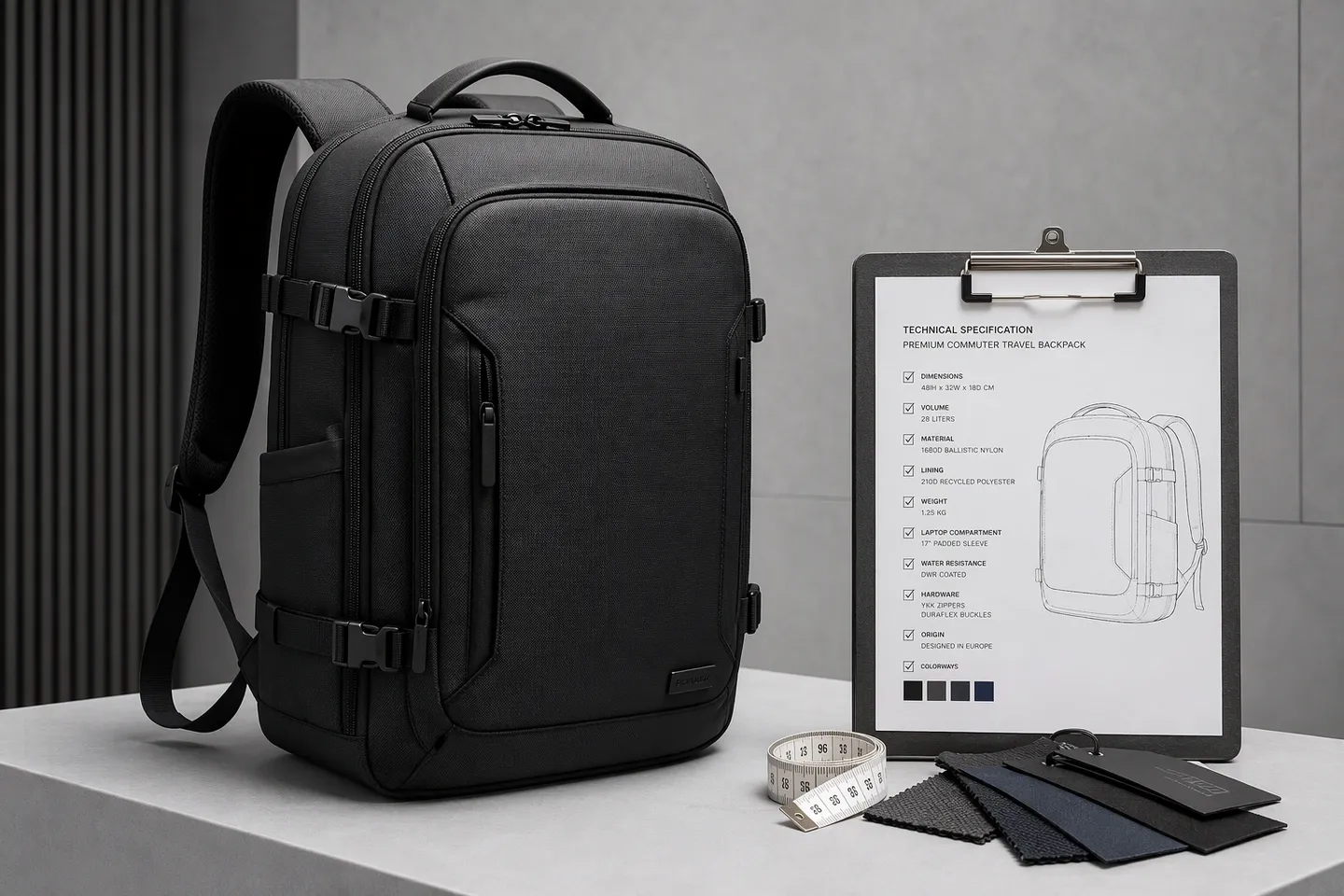
3.1 Standard Dimensional Conventions
Always express dimensions in metric millimeters (mm) or centimeters (cm) following the strict industrial standard: Width (Left to Right) × Height (Top to Bottom) × Depth (Front to Back).
- Width (W): Measured across the widest points of the main body panel, excluding side water bottle pockets.
- Height (H): Measured from the bottom base seam to the top crown seam, excluding the top haul handle.
- Depth (D): Measured from the front exterior pocket face to the padded back panel seam when the bag is fully packed to capacity.
- Internal Volume: Calculated in Liters (L) using the standard geometric displacement formula: $(W \times H \times D) / 1000$ with volumetric correction factors for rounded corners and tapered gussets.
| Bag Category | Typical Dimensions (W × H × D) | Typical Volume Range | Target Dry Weight | Common Sourcing Use-Cases |
|---|---|---|---|---|
| Urban Everyday Carry (EDC) Daypack | 290 × 420 × 140 mm | 16–20 Liters | 650–850 grams | Daily tech commute, 14-inch laptop carry, minimalist urban travel |
| Executive Modular Laptop Backpack | 320 × 460 × 180 mm | 24–28 Liters | 850–1,150 grams | Business travel, 16-inch laptop cradle, tech organizer panels |
| Weekend Travel & Carry-On Pack | 350 × 520 × 220 mm | 35–42 Liters | 1,200–1,600 grams | IATA airline maximum carry-on, clamshell opening, shoe compartment |
| Outdoor Trekking & Trail Rucksack | 340 × 580 × 240 mm | 45–55 Liters | 1,400–1,950 grams | Internal aluminum stay frame, load lifters, hydration bladder sleeve |
| Gym & Sports Modular Duffel | 520 × 280 × 260 mm | 35–40 Liters | 750–1,050 grams | Wet/dry separation pocket, ventilated footwear tunnel, duffel straps |
| Structured Commuter Tote Bag | 380 × 360 × 130 mm | 18–22 Liters | 500–750 grams | Padded tablet pocket, zippered security top closure, dual shoulder drop |
Explore specialized silhouettes and construction variations in our custom travel bags guide, custom gym bags catalog, custom tactical bags directory, and our custom tote bags manufacturing hub.
3.2 Defining Critical Fitment Zones and Tolerance Thresholds
If your bag must house specific electronic devices, camera gear, or sports equipment, these must be explicitly noted in the RFQ as Critical Fitment Zones.
A finished bag is a soft, flexible sewn product; unlike machined metal, sewing textiles will experience minor natural expansion and contraction during seam assembly. Therefore, your RFQ must establish clear Tolerance Thresholds:
- Main Body Dimensions: Standard manufacturing tolerance is ±5.0 mm (±0.5 cm).
- Internal Device Sleeves (Laptop/Tablet): Strict tolerance is +5.0 mm / -0.0 mm (a laptop sleeve must never be undersized).
- Suspended Cradle Height: The protective foam bottom of the laptop compartment must remain suspended 20 mm to 30 mm above the bag's exterior base to protect sensitive electronics when the backpack is dropped onto hard concrete floors.
- Shoulder Strap Symmetry: Left vs. Right shoulder strap length tolerance must be held within ±2.0 mm to ensure balanced ergonomic weight distribution.
3.3 Visual Reference Files: Annotating Photos, Sketches, and Tech Packs
When submitting reference materials without a complete CAD engineering pack, visual annotations provide immediate clarity to factory pattern makers:
- Orthographic View Angles: Include clear Front Elevation, Rear Suspension, Left Profile, Right Profile, Top View, Bottom Base, and Internal Isometric Exploded views.
- Explicit "Keep vs. Change" Callouts: If submitting a photograph of an existing reference sample, clearly tag features:
- KEEP Overall silhouette, curved shoulder strap contour, and clamshell main zipper opening.
- DELETE Side mesh water bottle pockets, external bungee cord system, and decorative plastic piping.
- UPGRADE Replace 600D polyester shell with 500D high-tenacity nylon; upgrade standard coil zipper to #8 reverse-coil waterproof zipper; add dedicated suspended 16-inch fleece-lined laptop sleeve.
- Internal Organization Mapping: Annotate internal pocket partitions—pen sleeves, key leash clip, zippered RFID-blocking passport pocket, and elastic mesh cable organizer loops.
4. The Bill of Materials (BOM): Specifying High-Performance Fabrics, Foams, and Linings
The Bill of Materials (BOM) constitutes the financial backbone of your custom bag quotation. Specifying exact fabric constructions, yarn densities, weight in grams per square meter (GSM), and chemical backing layers ensures that all bidding factories price authentic high-performance textiles rather than low-cost commercial imitations.
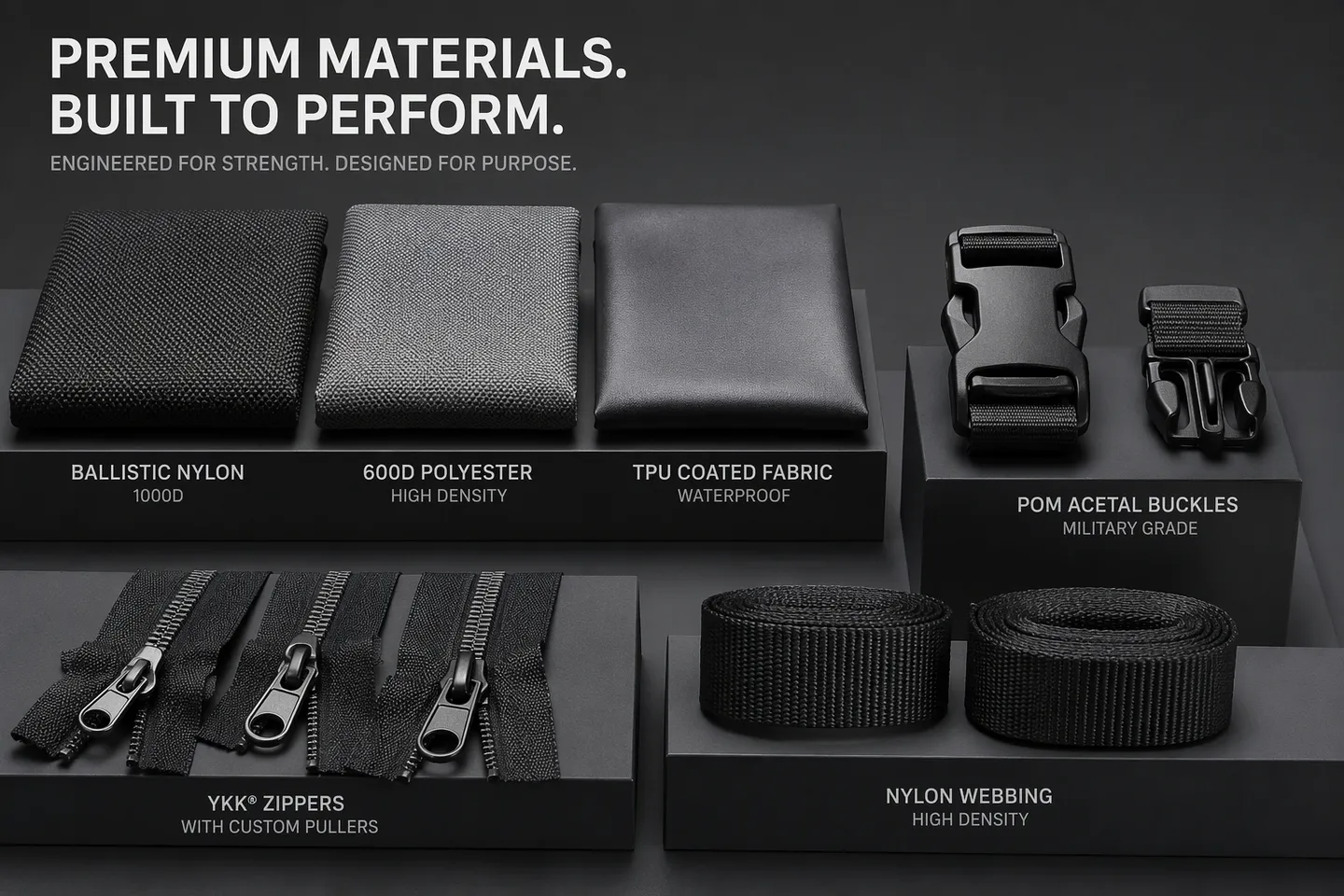
4.1 Shell Textiles: Fiber Polymers, Weaves, and Backing Chemistries
In your RFQ, never list simple trade names without their underlying technical specifications. Below is an engineering breakdown of primary shell textiles utilized in professional B2B bag manufacturing:
| Textile Name & Classification | Yarn Structure & Weave Type | Base Weight (GSM) | Surface Treatment | Backing Chemistry | Tensile Tear Strength (N) | Cost Index Factor |
|---|---|---|---|---|---|---|
| Commercial 600D Polyester | 600D × 600D Plain Weave Polyester | 240–260 GSM | Basic DWR (C6) | 0.25 mm Flat PVC Film | Warp: 140N / Weft: 120N | 1.00 (Base) |
| High-Density 900D Twisted Oxford | 900D × 900D Twisted Yarn Oxford | 310–330 GSM | C0 Eco DWR (Fluorine-Free) | Dual-Pass PU Coating (1500mm) | Warp: 220N / Weft: 195N | 1.45 |
| 1680D Ballistic Heavy Polyester | 1680D Dual-Ply Basketweave Oxford | 380–420 GSM | Oil & Water Repellent DWR | Dual-Pass Heavy PU (2000mm) | Warp: 340N / Weft: 310N | 1.85 |
| 500D High-Tenacity Cordura Nylon | Air-Textured High-Tenacity Nylon 6,6 | 245–265 GSM | Mil-Spec Water Repellent | 2-Pass Polyurethane Backing | Warp: 280N / Weft: 260N | 2.60 |
| 1000D Ballistic Mil-Spec Nylon | 1000D × 1000D Continuous Filament | 340–380 GSM | Heavy DWR Fluorocarbon | Double PU Coating (2500mm) | Warp: 420N / Weft: 390N | 3.40 |
| 210D / 420D Diamond Ripstop Nylon | High-Tenacity Nylon with Reinforcing Grid | 140–180 GSM | Silicone / DWR Surface | Thermoplastic TPU Membrane | Warp: 190N / Weft: 175N | 2.15 |
| Heavy-Duty Cotton Duck Canvas | 16 oz (450 GSM) 100% Ring-Spun Cotton | 450–480 GSM | Optional Waxed / Water-Resistant | Natural Breathable Finish | Warp: 310N / Weft: 280N | 2.20 |
To understand the precise performance trade-offs between denier ratings, explore textile testing standards in our messenger bag fabric durability testing guide, explore military-grade ballistic nylon in our Cordura fabric guide, or learn how to select a reliable partner in our bag manufacturer guide.
4.2 Interior Linings and Specialized Substrates
Internal lining fabrics undergo constant friction as users insert and remove laptops, chargers, keys, and accessories. Specifying resilient lining fabrics prevents early internal tearing:
- Standard Lightweight Lining: 210D Polyester Oxford (100% polyester, 110 GSM, single-pass clear PU backing for water resistance, available in stock charcoal, black, and navy).
- Executive Branded Lining: 150D or 300D Twill Polyester (145 GSM) with custom all-over continuous rotary screen print or digital dye-sublimation brand repeat pattern.
- Anti-Scratch Optical & Tech Lining: 220 GSM high-pile polyester microfiber fleece, laminated to protective pockets for sunglasses, smartphone screens, and delicate camera lenses.
- Internal Seam Binding Ribbon: 19 mm or 25 mm high-density herringbone polyester binding tape (folded and stitched across all raw interior seam edges to prevent fraying and structural seam slippage).
- Waterproof Wet-Pocket Liner: 70D Nylon Taffeta laminated with 0.15 mm transparent TPU film, fully taped with hot-air seam sealing tape to contain wet swimwear, gym apparel, or toiletries.
4.3 Foam Padding Architecture and Ergonomic Load Distribution
The structural rigidity, tactile hand-feel, and carrying comfort of a backpack depend directly on its internal foam engineering. Never write "padded straps" in an RFQ. Always specify the exact foam composition, density, and thickness in millimeters:
| Ergonomic Zone | Layer Architecture & Material Specification | Density & Functional Role |
|---|---|---|
| Shoulder Harness Straps | • Outer Layer: 8 mm High-Recovery Open-Cell PU Foam • Core Layer: 4 mm High-Density Closed-Cell EVA Foam • Underside Contact: 350 GSM 3D Honeycomb Air-Mesh | • 65 kg/m³ density for anti-collapse load bearing • Moisture-wicking ergonomic shoulder contouring |
| Back Panel Suspension | • Core Cushion: 10 mm Perforated Closed-Cell EVA Foam • Internal Frame: 1.5 mm High-Density Polyethylene (HDPE) Sheet • Lumbar Anchor: Anatomical High-Density Foam Block | • Integrated multi-channel spinal heat dissipation • Torsional rigidity preventing lumbar fatigue |
| Tech Compartment Sleeve | • Front & Rear Walls: 6 mm Closed-Cell EPE Foam • Bottom Base Cradle: 8 mm High-Resilience EVA Foam | • 360-degree shock absorption for laptops • Suspended 25 mm above exterior base |
4.4 Lab Dip Protocols and Color Approvals
If your custom bag requires custom-dyed fabrics or custom-matched webbing, your RFQ must define the Color Approval Standard:
- Color Reference: Standardized Pantone Matching System (Pantone FHI Cotton TCX or Polyester TSX).
- Lab Dip Options: Factory must provide 3 physical lab dip swatches (A, B, C) per color under standard D65 artificial daylight viewing booths.
- Spectral Delta E Threshold: Maximum acceptable color variance must be $\Delta E \le 0.8$ against the master Pantone standard.
5. Specifying Zippers, Sliders, Webbing, and Hardware Fasteners
A custom bag's mechanical components—zippers, buckles, ladder-locks, and webbing straps—endure thousands of dynamic stress cycles during their operational lifespan. A single broken zipper slider or fractured buckle renders the entire bag unusable.
| Hardware Component | Industrial Engineering Specification | Recommended Manufacturing Tiers | Performance Benchmark |
|---|---|---|---|
| Main Compartment Zippers | #8 or #10 Reverse-Coil Water-Repellent PU Tape | YKK AquaGuard / SBS Waterproof / Senszx Certified | Lateral burst strength > 850 N |
| Exterior Access Pockets | #5 Reverse-Coil High-Tensile Nylon Coil | YKK / SBS / Senszx Industrial Standard | Lateral burst strength > 550 N |
| Interior Organizer Pockets | #3 Continuous Nylon Coil with Auto-Lock Slider | Standard OEM Certified Grade | Smooth low-profile snag-free travel |
| Zipper Sliders & Pullers | High-Tensile Electroplated Zinc Alloy (Auto/Non-Lock) | Custom 3D Molded Brand Pullers / Paracord 550 | Pull tab torque breaking strength > 25 kg |
| Structural Plastic Buckles | 100% Virgin POM (Polyoxymethylene / Acetal) Resins | Duraflex / ITW Nexus / Woojin Plastic | Impact resistant from -40°C to +90°C |
| Load-Bearing Webbing Straps | High-Density Seatbelt Weave Filament Polyester | 20 mm / 25 mm / 38 mm / 50 mm Widths | Tensile breaking strength > 450 kg (1,000 lbs) |
| D-Rings & Swivel Hooks | Die-Cast Zinc Alloy or Heavy-Duty Acetal | Matte Black / Electroplated Gunmetal | Dynamic drop load tested > 35 kg |
5.1 Zipper Engineering Parameters
When detailing zippers in your RFQ, specify five distinct parameters:
- Gauge & Size: #3 (delicate interior pockets), #5 (front organizer pockets, water bottle pockets), #8 (main laptop and travel compartments), #10 (heavy-duty luggage and duffel main openings).
- Coil Geometry: Standard exposed nylon coil, reverse-coil (where the teeth are oriented inwards to expose a sleek, flat matte tape face), or waterproof PU-laminated tape (matte black or high-gloss reflective).
- Slider Mechanism: Non-lock sliders (standard for luggage), auto-lock sliders (essential for pockets that must not self-open under load), or interlocking security eyelet sliders (for TSA padlock insertion).
- Puller Execution: Standard zinc alloy pullers, high-strength 550 paracord pullers with textured rubber end-caps, or custom-tooled zinc alloy pullers featuring your 3D debossed brand identity.
- Cross-Chain Lateral Tensile Strength: Minimum burst strength requirement of > 550 N for #5 zippers and > 850 N for #8/10 zippers per ASTM D2061.
Browse custom puller options and buckle specifications in our custom zipper pulls and buckles directory.
5.2 Plastic Fasteners and Webbing Tensile Standards
Plastic hardware must never be specified as generic "plastic." Recycled polypropylene or inferior ABS plastic becomes brittle at sub-zero temperatures and shatters under high drop impacts.
Always mandate 100% Virgin POM (Polyoxymethylene / Acetal) resin:
- Side Release Buckles: 25 mm dual-side adjustable virgin POM buckles (rated tensile breaking load > 65 kg / 143 lbs).
- Ladder-Lock Sliders: 25 mm high-friction textured ladder-locks for shoulder strap adjustment (holding webbing securely without dynamic slippage under a 25 kg load).
- Sternum Strap Buckles: Integrated elastic shock-cord loop and emergency whistle buckle in virgin POM.
- Webbing Architecture: Specify high-tenacity seatbelt weave polyester or mil-spec nylon webbing. Standard 25 mm shoulder strap webbing must provide a certified breaking strength exceeding 450 kg (1,000 lbs) with heat-sealed ultrasonic cut ends to prevent unraveling.
6. Logo Branding and Custom Embellishment Specifications
"With our logo" is the single most common phrase that ruins quotation precision. The cost delta between different branding methodologies can exceed 1,000%, and non-recurring tooling molds must be amortized accurately across production volumes.
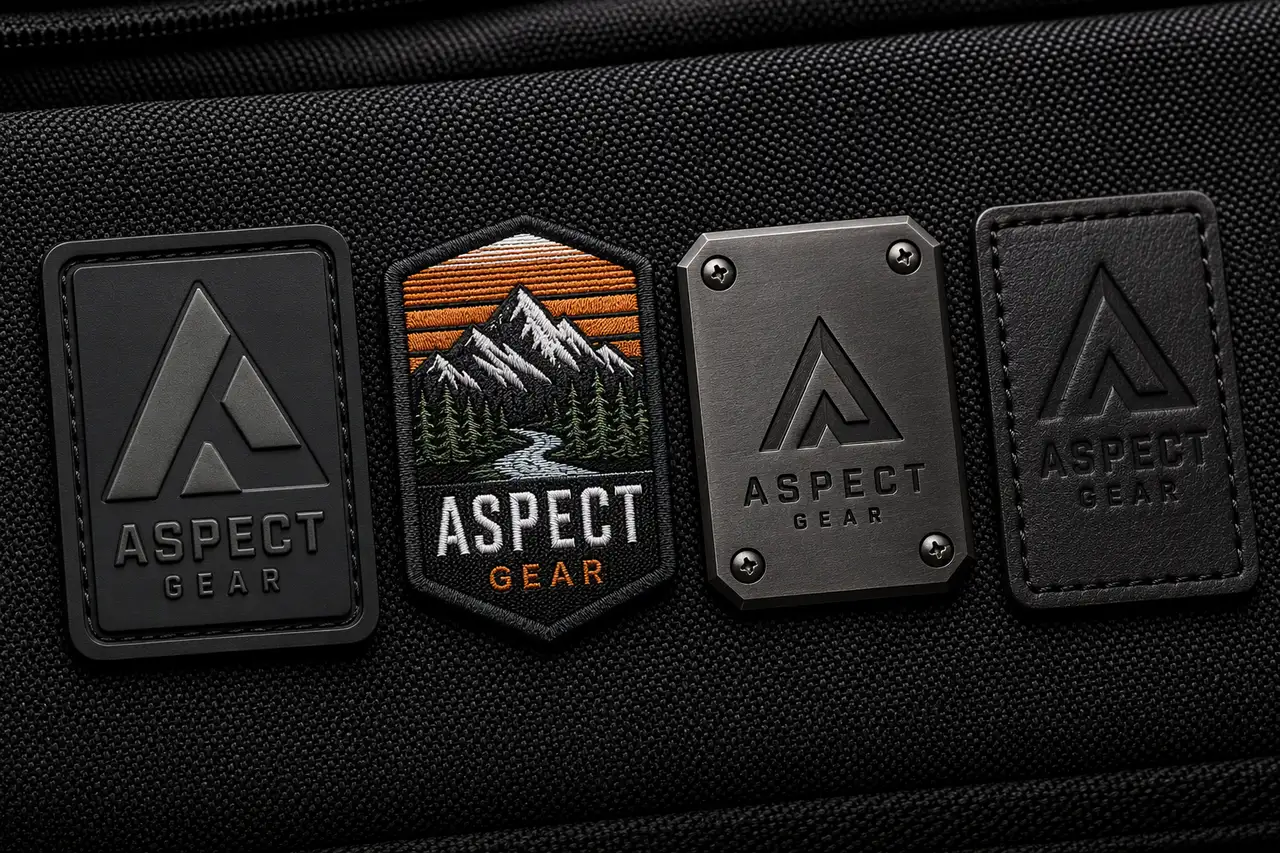
6.1 The Sourcing Master Branding Matrix
| Branding Methodology | One-Time Tooling / NRE Fee | Unit Cost Range (500–5,000 pcs) | Production Lead Time Impact | Visual & Tactile Aesthetic | Recommended Bag Category |
|---|---|---|---|---|---|
| Silkscreen Printing | $20–$35 per screen color | $0.10–$0.35 / unit | +1 business day | Clean, bold, flat graphic finish; best for promotional bags | Promotional Backpacks & Tote Bags |
| High-Density 3D Embroidery | $30–$50 digitizing tape | $0.45–$0.95 / unit | +2 business days | Classic, textured, high-thread-count heritage embroidery | School Backpacks & Sports Bags |
| Molded 3D Silicone / PVC Patch | $120–$220 steel mold | $0.40–$0.85 / unit | +3 business days (Sample tooling) | Modern, tactile, rugged, 100% waterproof, multi-tier relief | Tactical Packs & Outdoor Backpacks |
| Debossed Genuine / Vegan Leather Patch | $80–$140 brass heat stamp | $0.35–$0.75 / unit | +2 business days (Sample tooling) | Executive, vintage, luxury tactile warmth; blind or foil deboss | Executive Laptop Packs & Travel Duffels |
| Die-Cast Zinc Alloy Metal Badge | $180–$350 CNC steel die | $0.65–$1.50 / unit | +5 business days (Sample tooling) | Ultra-luxury, automotive-grade electroplated gunmetal/chrome | Luxury Designer Bags & Private-Label Luggage |
| Woven Jacquard Seam Label | $25–$40 setup fee | $0.08–$0.20 / unit | +1 business day | Refined, minimalist, subtle side-seam brand identifier | Universal across all product lines |
6.2 Essential Information Required for Logo Quotations
To lock in binding logo pricing without post-quote revisions, include the following in your RFQ:
- Vector Production Files: Provide native Adobe Illustrator (
.AI), Encapsulated PostScript (.EPS), or vector.PDFfiles with all typography converted to outlined paths. - Exact Dimensions: Millimeter length × height (e.g., Primary Chest Badge: 65.0 mm (W) × 28.0 mm (H) × 3.0 mm (Thickness)).
- Color Standards: Reference official Pantone Matching System (PMS Solid Coated) formulas (e.g., Background: Pantone 19-4008 TCX Meteorite; Lettering: Pantone 14-0848 TCX Mimosa).
- Anchor Coordinates: Clearly specify the placement benchmark (e.g., Centered horizontally on front pocket exterior, exactly 55 mm below top pocket zipper seam).
7. Order Volume, Granular SKU Matrix, and Pricing Tiers
In custom industrial manufacturing, volume is the primary lever that unlocks material yield optimization and labor productivity. However, quoting an aggregate volume without a colorway breakdown creates severe distortions.
7.1 Single-Track OEM/ODM MOQ and Multi-Tier Pricing
At Senszx, our standardized manufacturing baseline is 500 pieces per style/colourway. When issuing your RFQ, always request pricing across four standardized volume tiers to evaluate how unit costs scale:
| Volume Tier Bracket | Order Scale (Pieces) | Production Efficiency & Yield Characteristics | Cost Optimization Impact |
|---|---|---|---|
| Tier 1 (Factory Baseline) | 500 Units (MOQ) | Baseline single-line setup; absorbs custom fabric dye-lots, custom webbing runs, and initial tooling amortization | Standard Baseline Unit FOB Price |
| Tier 2 (Optimized Run) | 1,000 Units | Multi-line parallel sewing; improved cutting table fabric nesting yield; reduced dye-lot surcharges | 5% – 10% unit cost reduction |
| Tier 3 (High-Efficiency) | 3,000 Units | Dedicated automated cutting and continuous specialized sewing workstations; wholesale raw material bulk discounts | 12% – 18% unit cost reduction |
| Tier 4 (Enterprise Scale) | 5,000+ Units | Maximum CNC material nesting efficiency; automated robotic bar-tacking; direct mill master vat dye-lot pricing | 20% – 28% unit cost reduction |
7.2 The Granular SKU Matrix: Why Dye-Lots and Trims Matter
Textile mills dye fabric in master vats with standard dye-lot minimums (typically 1,000 to 1,500 meters per custom color). If an order of 3,000 bags is divided into 10 different custom colors (300 bags per color), the factory will incur massive dye-lot surcharge penalties and extensive cutting-table scrap waste.
Always provide the granular SKU breakdown in your RFQ:
| Style Ref | Style Description | Colourway Name | Shell Fabric Code | Tier 1 (MOQ) | Tier 2 (Target) | Tier 3 (Scale) | Tier 4 (Enterprise) |
|---|---|---|---|---|---|---|---|
| BP-2026 | Apex Commuter 28L | Matte Stealth Black | 500D Nylon #BLK-01 | 300 pcs | 600 pcs | 1,800 pcs | 3,000 pcs |
| BP-2026 | Apex Commuter 28L | Storm Slate Grey | 500D Nylon #PMS-425C | 100 pcs | 250 pcs | 750 pcs | 1,250 pcs |
| BP-2026 | Apex Commuter 28L | Military Ranger Green | 500D Nylon #PMS-7770C | 100 pcs | 150 pcs | 450 pcs | 750 pcs |
| TOTALS | — | — | — | 500 pcs | 1,000 pcs | 3,000 pcs | 5,000 pcs |
For brand founders and enterprise pilot projects requiring validation runs under 500 units, learn how our Development Fee Model operates in our private label backpack manufacturer guide.
8. Primary Packaging, Retail Labelling, and Export Master Cartons
Packaging is a critical component of product cost, logistics efficiency, and retail presentation. Omitting packaging specifications from your RFQ will result in basic industrial polybags that fail Amazon FBA or premium retail compliance.
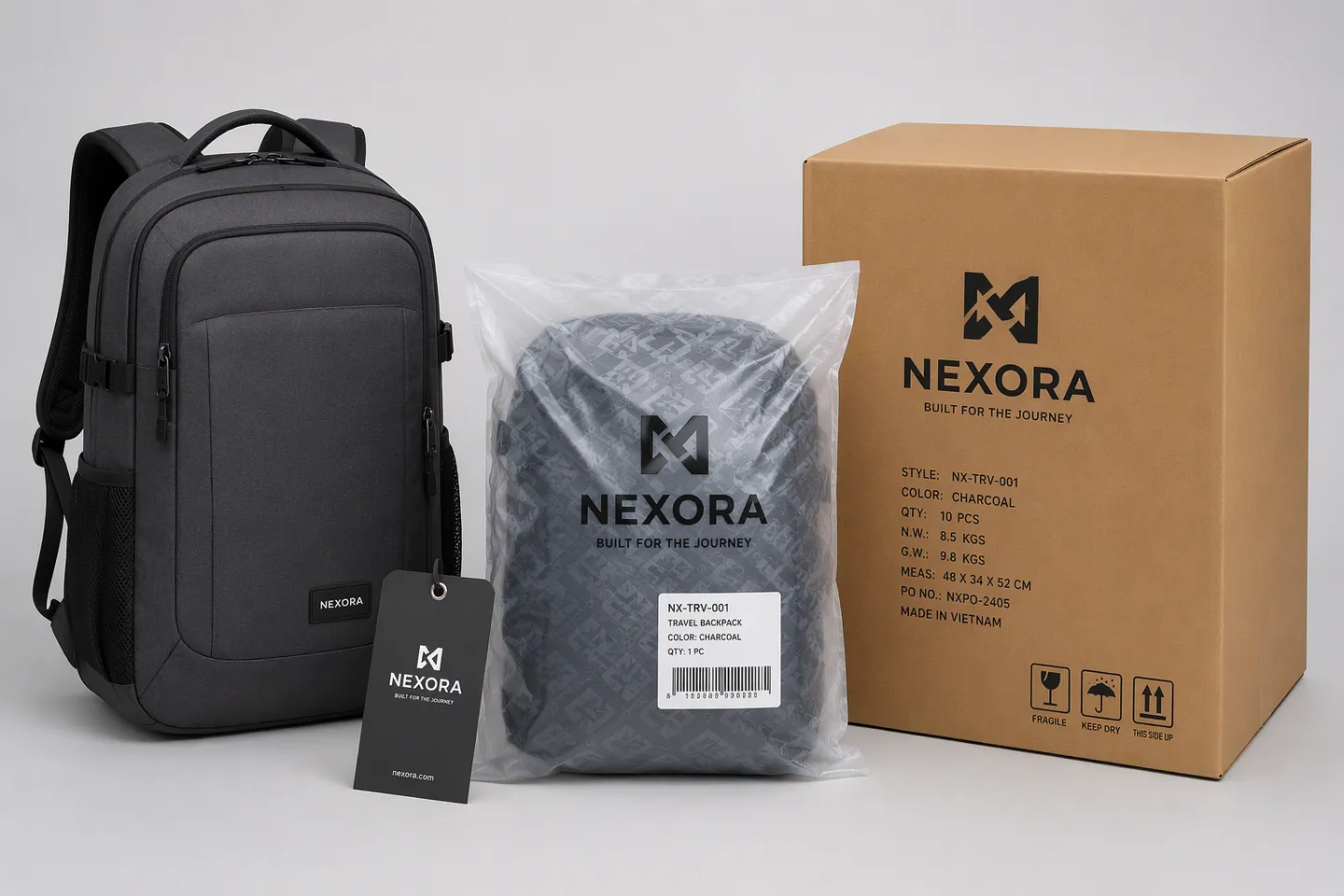
8.1 Primary Protective Packaging Specifications
- Individual Polybags: Specify 0.05 mm (50-micron) virgin or GRS-certified recycled LDPE polybags, featuring multi-language printed child suffocation warnings and micro-ventilation punch holes.
- Moisture Protection: Specify 2g or 5g pharmaceutical-grade non-toxic silica gel desiccant packs inside each bag compartment to prevent mold growth during trans-oceanic container transit.
- Retail Hangtags: Declare hangtag dimensions and cardstock weight (e.g., 350 GSM FSC-certified matte coated art board, 50 × 120 mm, 4-color dual-side print, nylon hanging cord with custom molded matte seal tag).
- Inventory Barcoding: Specify scannable GS1-128, UPC-A, or Amazon FNSKU thermal transfer barcode stickers (60 × 40 mm) affixed to the lower-right quadrant of the polybag.
- Dust Bags & Specialty Presentation: For executive leather goods and luxury travel bags, specify breathable 120 GSM non-woven polypropylene or 100% natural cotton drawstring dust bags with single-color brand screen printing.
8.2 Secondary Export Packaging and Container Palletization
- Corrugated Master Cartons: Mandate heavy-duty 5-ply double-wall corrugated kraft paperboard (export grade, Edge Crush Test ECT > 45 lbs/in, bursting strength > 275 lbs/sq.in).
- Carton Pack Ratios & Gross Weight: Establish a maximum gross weight ceiling of 15.0 kg (33 lbs) per carton to comply with international courier safety and Amazon fulfillment standards.
- Master Carton Markings: Require 4-sided black stencil shipping marks including Buyer PO Number, Item Style Code, Carton Number (e.g., Carton 1 of 67), Gross/Net Weight in kg, Carton Dimensions (L × W × H in cm), and Country of Origin mark ("Made in China").
- Palletization Standards: Require heat-treated ISPM-15 compliant wooden pallets (1200 × 1000 mm Euro/Standard) with heavy-duty stretch film wrap and corner edge protectors for LCL ocean cargo.
9. Quality Assurance, Compliance Standards, and Mechanical Testing Protocols
Quality cannot be inspected into a bag after it is sewn—it must be engineered into the specification from day one. Replace subjective statements like "first-class workmanship" with measurable engineering and testing standards.
| Quality & Inspection Gate | Mandatory Testing Standard | Factory Acceptance Criteria | Engineering Objective |
|---|---|---|---|
| 1. Sampling & Inspection Standard | ISO 2859-1 / ANSI/ASQ Z1.4 Level II | Single sampling normal plan | Statistically sound batch verification |
| 2. Allowable Defect Thresholds | AQL Matrix per Batch Size | • Critical: 0.0 (Zero tolerance) • Major: AQL 2.5 • Minor: AQL 4.0 | Elimination of safety and functional defects |
| 3. Static Load Seam Pull Test | In-house calibrated static rig | 45 kg (100 lbs) suspended for 4 hours | Zero seam separation or stitch popping |
| 4. Dynamic Drop Shock Test | Cyclical free-fall test fixture | 20 kg load dropped 30 cycles from 1.2 m | Zero buckle fracture or corner blowouts |
| 5. Chemical Safety & Compliance | Third-party lab certification | CPSIA (Lead < 90ppm), REACH SVHC, Prop 65 | Full regulatory compliance for US & EU markets |
9.1 Acceptable Quality Limit (AQL) Defect Classification
In your RFQ, mandate compliance with ISO 2859-1 (ANSI/ASQ Z1.4) General Inspection Level II:
- Critical Defects (AQL 0.0 Allowed): Any safety hazard including broken needle fragments (mandatory 100% metal/needle detection scanning), exposed sharp metal burrs on zipper pullers, mold/mildew contamination, or missing mandatory legal/country-of-origin labels.
- Major Defects (AQL 2.5): Seam opening under moderate tension, structural seam slippage, broken or skipping zipper teeth, non-functional hardware buckles, dimensional deviation exceeding ±5.0 mm, upside-down or misspelled brand logos, or missing internal compartments.
- Minor Defects (AQL 4.0): Uncut loose threads longer than 5.0 mm, removable surface chalk marks, minor carton tape wrinkles, or slight non-critical cosmetic shade delta within approved lab-dip tolerances.
9.2 Mechanical Stress Testing Protocols in Detail
Require bidding manufacturers to verify performance across standard laboratory tests:
| Test Protocol | Test Standard / Method | Performance Requirement | Engineering Significance |
|---|---|---|---|
| Shoulder Strap Tensile Pull Test | Static load suspension fixture | > 45 kg (100 lbs) static pull force held for 4 hours without seam failure | Prevents shoulder strap tear-out when overloaded with books or tech gear |
| Dynamic Drop Test | Cyclical drop machine (1.2 m height) | 20 kg payload dropped 30 consecutive cycles without seam or buckle failure | Simulates aggressive baggage handling and daily drops onto hard asphalt |
| Zipper Cross-Tension Durability | ASTM D2061 continuous cycling | > 5,000 opening/closing cycles under 15N cross-lateral tension | Ensures zipper teeth and sliders do not split or jam during product life |
| Fabric Hydrostatic Head | AATCC 127 / ISO 811 | > 1,500 mm H₂O pressure for water-resistant coated textiles | Guarantees internal electronics remain dry during heavy rainstorms |
| Colorfastness to Crocking | AATCC 8 / ISO 105-X12 | Grade 4.0 dry crocking; Grade 3.5 wet crocking minimum | Prevents dark bag dyes from rubbing off onto user white clothing |
Review our comprehensive factory quality control protocols in our quality assurance guide and our backpack CPSIA compliance and testing handbook.
10. Commercial Incoterms, Milestone Schedules, and Quotation Conditions
Establishing the commercial parameters of your RFQ eliminates unexpected freight surcharges, currency conversion disputes, and production scheduling bottlenecks.
10.1 Standard Commercial Incoterms and Payment Conditions
- Incoterms 2020 Standard: Request quotes based on FOB Tianjin Port / FOB Qingdao / FOB Shenzhen (where the factory covers all inland trucking, export customs clearance, and terminal handling fees) or EXW Factory (if you manage your own designated freight forwarder).
- Payment Terms Structure: Standard industrial OEM terms: 30% deposit upon Purchase Order (PO) release and Pre-Production Sample (PPS) sign-off; 70% balance payable upon issuance of the formal final third-party AQL inspection certificate prior to bill of lading dispatch.
- Quotation Validity Window: Require bidding factories to maintain quoted prices for a minimum of 30 to 60 calendar days to allow thorough sample evaluation and internal procurement approvals.
- Intellectual Property (IP) Protection: Expressly declare that all drawings, tech packs, logos, and proprietary tooling remain the exclusive intellectual property of the buyer, protected under mutual Non-Disclosure Agreements (NDA).
10.2 Industrial Project Timeline Benchmarks
A realistic B2B custom bag project timeline spans the following critical path milestones:
| Production Phase | Standard Working Duration | Key Gateways & Deliverables |
|---|---|---|
| Phase 1: RFQ Review & Technical Costing | 24–48 Hours | Comprehensive BOM yield costing and formal quotation sheet |
| Phase 2: Master Pattern Drafting & Prototyping | 3–5 Business Days | 1st Physical prototype constructed in master sample room |
| Phase 3: Sample Transit & Engineering Review | 3–5 Days | International DHL/FedEx courier delivery and buyer fitment sign-off |
| Phase 4: Pre-Production Sample (PPS) Approval | 3–5 Days | Final "Golden Sample" countersigned; Purchase Order (PO) issued |
| Phase 5: Raw Material Weaving & Custom Dyeing | 7–10 Days | Bulk fabric dye-lots tested; POM hardware batches molded |
| Phase 6: Automated Cutting & Sewing Mass Production | 20 Calendar Days | CNC automated cutting, 100 sewing lines, 100% in-line QC gates |
| Phase 7: Final AQL Audit & Container Loading | 2–3 Days | AQL 2.5 final audit sign-off; container loading at factory bay |
11. Complete Custom Bag RFQ Master Template (Ready to Copy & Deploy)
Below is an enterprise-grade, ready-to-use Custom Bag RFQ template. Copy this structured markdown template directly into your procurement briefs, spreadsheets, or factory communications:
| RFQ Specification Section | Required Parameter & Field | Factory Engineering Benchmark / Standard Input |
|---|---|---|
| 1. Buyer & Project Profile | • Brand / Company Name • Primary Sourcing Contact • Style Codename & Target Channel • Target Retail MSRP / FOB Budget | • Your Company Name • Name, Email, WhatsApp / Phone • Apex 28L Modular Commuter Backpack (DTC / Retail) • Target MSRP: $120.00 USD / Target FOB: $18.50–$22.00 USD |
| 2. Dimensions & Capacity | • External Finished Dimensions • Internal Capacity & Target Weight • Critical Device Fitment • Manufacturing Tolerances | • 320 mm (W) × 460 mm (H) × 180 mm (D) • 26.5 Liters / Target dry tare weight < 950 grams • Suspended sleeve fitting 16" MacBook Pro (360 × 250 × 20 mm) • Main Body: ±5.0 mm / Internal Sleeve: +5.0 mm / -0.0 mm |
| 3. Bill of Materials (BOM) | • Primary Exterior Shell Fabric • Secondary Contrast Panels • Bottom Base Abrasion Panel • Interior Lining & Interlinings • Foam Padding Architecture | • 500D High-Tenacity Nylon, C0 DWR, Dual-Pass PU (2000mm) • 900D Twisted Oxford Polyester, PU 1500mm • 1680D Ballistic Heavy Polyester with 0.30mm PU Backing • 210D Polyester Oxford (110 GSM) Charcoal Grey + 220 GSM Fleece • Dual-layer 8mm Open-Cell PU + 4mm EVA (65 kg/m³) + 10mm Perforated EVA |
| 4. Hardware & Zippers | • Main Compartment Zipper • Exterior & Interior Pockets • Custom Pullers & Sliders • Structural Buckles & Webbing | • #8 Reverse-Coil Water-Repellent Nylon Zipper (YKK / SBS) • #5 Reverse-Coil (Exterior) / #3 Nylon Coil (Interior) • Custom 3D Matte Gunmetal Zinc Alloy Pullers with debossed logo • 100% Virgin POM Buckles (Duraflex) + 25/38mm Seatbelt Webbing (>450 kg) |
| 5. Logo & Branding | • Primary Exterior Logo • Secondary Brand Identifier • Mandatory Internal Labels • Production Vector Files | • 3D Molded Silicone Rubber Patch (60 × 25 × 3.0 mm, Pantone TCX matched) • Woven Jacquard Seam Flag Label (15 × 25 mm) on right shoulder harness • High-density woven satin care, fiber content & origin label • Outlined vector files attached ( .AI / .EPS / .PDF) |
| 6. Volume & SKU Matrix | • Production Volume Brackets • Granular Colourway Matrix | • Multi-tier quotes: 500 pcs (MOQ), 1,000 pcs, 3,000 pcs, 5,000 pcs • 60% Stealth Black / 20% Slate Grey / 20% Ranger Green |
| 7. Packaging & Labeling | • Primary Protective Packaging • Retail Hangtag & Barcode • Secondary Master Export Carton | • 0.05 mm Recycled LDPE polybag with suffocation warning + 5g desiccant • 350 GSM FSC matte art hangtag + GS1 / FNSKU thermal sticker • 5-ply double-wall corrugated carton (ECT > 45 lbs/in, Max 14.5 kg gross) |
| 8. Quality & Compliance | • Inspection Standards & AQL • Mechanical Testing Protocols • Regulatory Chemical Mandates | • ISO 2859-1 Level II (Critical: 0.0 / Major: AQL 2.5 / Minor: AQL 4.0) • Static strap pull > 45 kg (4 hours) / Dynamic drop 20 kg (30 cycles, 1.2m) • US CPSIA (Lead < 90ppm, Phthalate-free), EU REACH SVHC, CA Prop 65 |
| 9. Commercial Incoterms | • Delivery & Trade Incoterms • Payment Milestones • Deliverable Quotation Requirements • Quotation Validity & Deadlines | • FOB Tianjin Port / FOB Shenzhen Port (Incoterms 2020) • 30% Deposit upon PO & PPS sign-off / 70% Balance upon AQL Inspection • Itemized Unit FOB price, sample prototyping fee/lead time, tooling fees • Minimum 60 calendar days price validity |
12. How to Analyze, Normalize, and Audit Supplier Quotations
When quotation sheets arrive from prospective manufacturers, never evaluate them based on raw unit price alone. You must conduct a systematic Quotation Normalization Audit to uncover hidden charges, omitted specifications, and commercial risk factors.
12.1 The Supplier Quote Normalization Case Study
Below is an empirical analysis of three competing factory quotations submitted for a 1,000-unit custom commuter backpack:
| Cost & Engineering Element | Supplier A (Low Bidder) | Supplier B (Senszx Verified Baseline) | Supplier C (High Bidder) | Critical Normalization Finding |
|---|---|---|---|---|
| Quoted Unit Price (1,000 pcs) | $8.40 USD | $10.85 USD | $14.20 USD | Apparent $5.80 USD delta between bids |
| Commercial Trade Term | EXW (Factory Gate) | FOB Tianjin Port | FOB Shenzhen Port | Supplier A omits $0.90/unit inland freight & export fees |
| Shell Fabric Specification | Generic 600D Polyester PVC | 500D High-Tenacity Nylon DWR | 1000D Ballistic Cordura | Supplier A downgraded fabric from Nylon to heavy PVC |
| Zipper Hardware Quality | Generic Unbranded #5 | Genuine SBS #8 Reverse-Coil | Branded YKK #8 Metal-Look | Supplier A uses low-torque sliders prone to burst |
| Shoulder Strap Foam | 6mm Single-Layer EPE Sponge | Dual-Layer 8mm PU + 4mm EVA | 12mm Ergonomic Dual EVA | Supplier A foam will collapse after 2 weeks of use |
| Logo Tooling / NRE Cost | $350 (Built into unit price) | $160 (One-time itemized) | $250 (One-time itemized) | Supplier A charges tooling on every reorder |
| Sample Lead Time & Cost | 12–15 Days ($180 USD) | 3–5 Days (Credited to PO) | 7–10 Days ($220 USD) | Senszx delivers 3-5 day prototyping with full credit |
| Retail Packaging & Barcodes | Thin bulk bag (No barcodes) | 0.05mm LDPE + Barcode + Hangtag | Custom rigid gift box pack | Supplier A excludes retail packaging ($0.45/unit) |
| Compliance & Social Audits | Unverified / No Audits | BSCI, ISO9001, ISO14001, CE | BSCI, ISO9001 | Supplier A poses catastrophic brand ESG & safety risks |
| TRUE NORMALIZED UNIT COST | $11.15 USD (Extreme Risk) | $10.85 USD (Verified Lowest) | $14.20 USD (Overpriced) | Senszx delivers the true lowest Total Cost of Ownership |
12.2 Critical Post-Quote Engineering Questions to Ask Suppliers
Before accepting any quotation or issuing a physical sample deposit, ask bidding manufacturers the following five clarifying questions:
- "What specific manufacturing assumptions were made in this price calculation?" (Identifies whether standard lining, generic hardware, or unbranded packaging was priced).
- "What is the single largest cost driver in this design, and how can it be value-engineered?" (An experienced OEM engineer will point out complex sewing operations, custom hardware molds, or wasteful pattern nesting).
- "Which component has the highest MOQ or longest raw material lead time?" (Discovers custom-dyed webbing or custom metal badge bottlenecks before production).
- "Are all sample development and mold fees credited against our initial 500+ unit bulk purchase order?" (Ensures non-recurring development costs do not erode product margins).
- "Can you provide physical lab-dip swatches and raw material component sample swatches prior to sample dispatch?" (Verifies raw material supply chain transparency).
13. Pre-Flight Checklist: 10 Final Checks Before Issuing Your Bag RFQ
Before clicking "Send" on your RFQ procurement package, verify every item on this 10-point industrial checklist:
- 1. Vector Artwork Files Attached: Are all logos in native
.AI,.EPS, or vector.PDFformat with all fonts converted to outlines? - 2. Metric Dimensions & Tolerances Defined: Are external dimensions expressed in metric millimeters ($W \times H \times D$) with realistic $\pm 5.0\text{ mm}$ tolerance bands?
- 3. Precise Textile Specifications Declared: Are fiber polymer, denier, weave construction, DWR finish, and PU backing thickness (in mm/mm H₂O) explicitly stated?
- 4. Hardware Resin Grade Mandated: Is 100% virgin POM (Acetal) resin mandated for all plastic buckles and ladder-locks?
- 5. Zipper Gauge & Style Selected: Are zipper teeth sizes (#5, #8, #10), coil styles (reverse-coil), and slider locking mechanisms defined?
- 6. Granular SKU Matrix Provided: Is order volume broken down by specific colorway rather than an aggregate total number?
- 7. Separate NRE Tooling Line Items Requested: Are custom mold fees and sample prototyping charges itemized separately from recurring FOB unit costs?
- 8. Packaging & Barcode Specifications Included: Are polybag thickness (0.05 mm), hangtags, barcodes, and master carton gross weight ceilings ($\le 15\text{ kg}$) detailed?
- 9. Measurable Quality Standard Designated: Is ISO 2859-1 (ANSI/ASQ Z1.4) AQL 2.5 Major / 4.0 Minor established as the formal inspection threshold?
- 10. Open Engineering Decisions Tagged: Are flexible specifications clearly identified so factory engineers can propose cost-saving manufacturing alternatives?
14. Partner with Senszx for Rapid, Precision Custom Bag Manufacturing
Preparing a professional Custom Bag RFQ is the single most powerful step you can take to protect your product margins, guarantee uncompromised quality, and ensure on-time delivery.
At Senszx, we provide world-class OEM and ODM custom bag manufacturing tailored to the demanding standards of global brands, outdoor retailers, tactical gear suppliers, and corporate enterprises:
- 18+ Years Industrial Heritage: Founded in 2006 in Baigou, China—the epicentre of global luggage and bag manufacturing.
- Massive Production Capacity: 100 in-house parallel computerized sewing lines, automated CNC laser and ultrasonic cutting systems, and 100% in-line quality auditing.
- Rapid Prototyping Velocity: Physical master samples engineered and dispatched in just 3 to 5 business days.
- High-Efficiency Mass Production: Standard 20-calendar-day bulk manufacturing lead time for 500 to 5,000 unit production runs.
- Transparent Sourcing Policies: Single-track 500 pcs/style MOQ, with 100% development fee crediting for new brand pilot runs.
- Global Social & Quality Certifications: Fully certified under BSCI, ISO 9001 (Quality), ISO 14001 (Environmental), ISO 45001 (Safety), and CE standards.
Whether you have a fully rendered technical tech pack or are developing a new concept from initial sketches and physical reference samples, our technical engineering team is ready to analyze your requirements and provide a binding, transparent quotation within 24 to 48 hours.
Start your custom bag manufacturing project today:
- Explore Our Product Lines: Custom Backpacks | Custom Travel Bags | Custom Gym Bags | Custom Tactical Bags | Custom Tote Bags | Complete Product Catalog
- Submit Your RFQ Package: Send your specifications, tech packs, or reference photos directly to our engineering team at [email protected] or connect via WhatsApp at +86 17331531825.
- Experience Our Craftsmanship: Apply for our Free Sample Proofing Program today.
About the Author: Senszx Bag Manufacturer
With over 18 years of specialized industrial experience in OEM and ODM luggage, backpack, and sewn-goods manufacturing, Senszx is a premier B2B manufacturing partner based in Baigou, China. Serving global brands, defense supply contractors, outdoor equipment retailers, and private-label e-commerce enterprises across North America, Europe, and worldwide, Senszx adheres to the highest international standards of quality, ethical manufacturing (BSCI), and precision engineering.
Hi, I'm Senszx Bag Manufacturer, Hope You Like This Blog Post.
With more than 20 years of experience in OEM/ODM/Custom luggage and bag, I'd love to share with you the valuable knowledge related to luggage and bag products from a top-tier Chinese supplier's perspective.
Senszx Factory
Est. 2006 · Baigou, China
Related articles
How to Choose the Right Materials for Travel Bags: The Complete Manufacturer Guide
A comprehensive B2B engineering guide to selecting travel bag materials: comparing polyester, nylon, Oxford, canvas, TPU coatings, hardware, and structural interlinings across durability, GSM, abrasion, and manufacturing cost.
Bulk Backpacks: The Complete Wholesale Buying Guide for 2027
How brands, distributors, schools and charities buy backpacks in bulk: sourcing paths, styles, fabrics, customization, unit price drivers, MOQ, lead times, QC and shipping.
Wholesale Toiletry Bags: The Complete Sourcing Guide for 2027
How travel brands, grooming labels, retailers and distributors source toiletry bags in bulk: styles, materials, customization, MOQ, pricing, QC and shipping.
Get a Custom Bag Quote from Our China Factory
Our sales team is online around the clock and usually replies within the hour.
Email
[email protected]Factory
Qinzheng Road No.89, New Industry Zone, Baigou Town
Baoding City, Hebei Province 074004, China