Camera Bag Manufacturing with Tripod Holders: The Complete B2B Guide to Photography Backpack Engineering, Modular EVA Dividers & Custom OEM/ODM Production
The definitive B2B sourcing guide on camera bag manufacturing with tripod holders. Discover tripod mount engineering, modular high-density EVA dividers, quick-access side hatches, 1680D ballistic nylon weatherproofing, 5,000-cycle jerk testing, single-track 500 MOQ economics, and DDP export logistics.
Camera Bag Manufacturing with Tripod Holders: The Complete B2B Guide to Photography Backpack Engineering, Modular EVA Dividers & Custom OEM/ODM Production
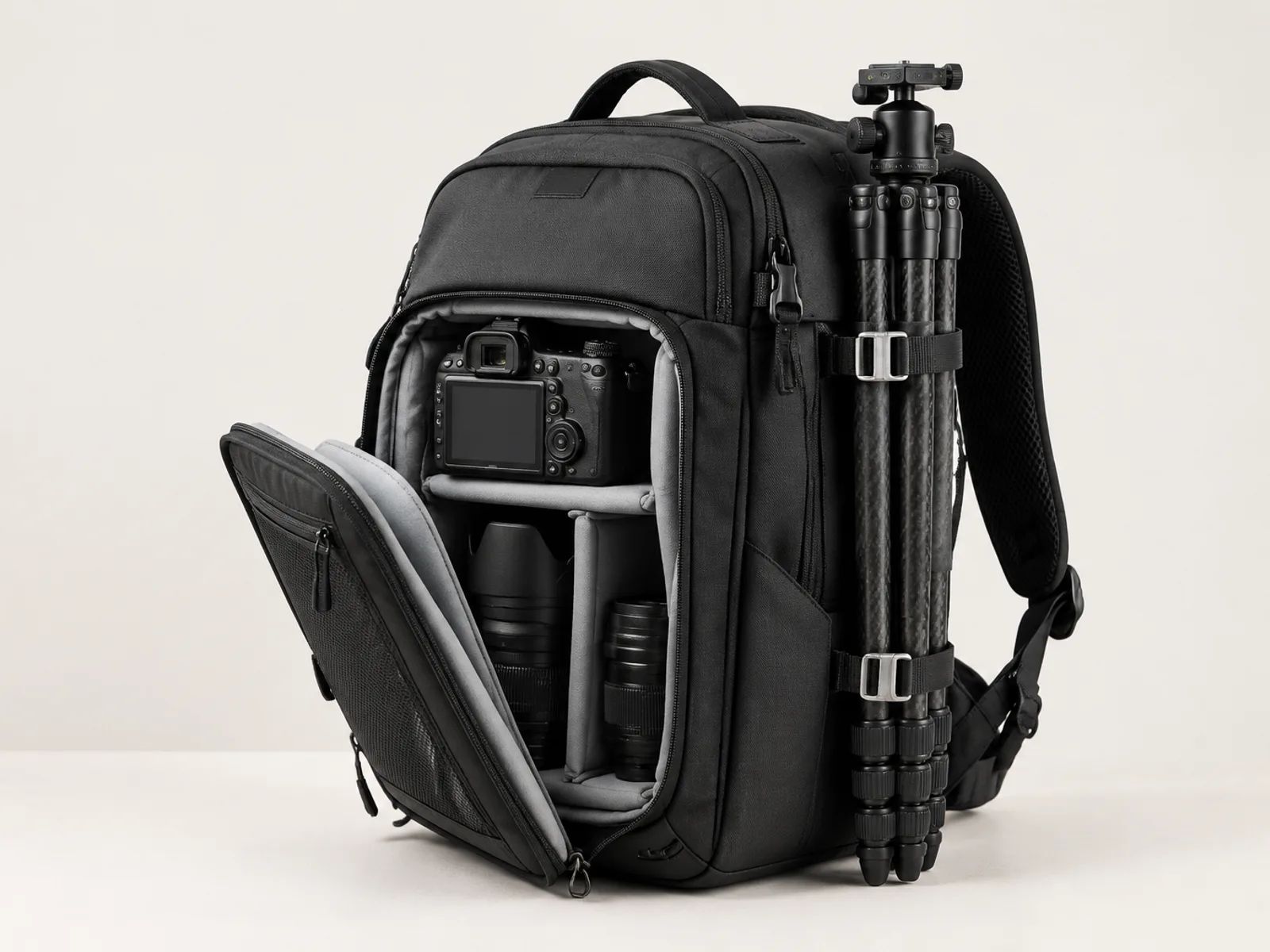
In the specialized global marketplace of professional photography accessories, outdoor content creator gear, drone transport systems, and commercial video production luggage, manufacturing a camera bag is one of the most technically demanding disciplines in soft-goods engineering. Unlike a standard consumer daypack that carries soft, flexible apparel, a professional camera backpack is a precision optical transport system. Inside a single 25-liter to 40-liter photography pack sits $3,000 to $15,000 worth of delicate digital cameras, heavy telephoto lenses with complex internal glass elements, electronic gimbals, compact drones, audio transmitters, laptop workstations, and high-precision carbon fiber tripods.
When a photographer hikes up a mountain trail, navigates an international airport terminal, or operates in a crowded urban environment, their camera bag is subjected to dynamic physical shocks, vibrations, abrasive rock friction, and sudden weather changes:
- If internal modular dividers are too soft or bend under heavy payloads, expensive lenses knock into each other, damaging optical calibration.
- If the external tripod holder is poorly engineered, a heavy 2.5kg tripod sways with every step, shifting the center of gravity and causing chronic lumbar fatigue.
- If the side quick-access zipper hatch binds or jams during a critical moment, the photographer misses the shot.
- If moisture penetrates the base panel when resting on wet grass or muddy terrain, expensive camera sensors and electronic motherboards risk permanent damage.
For global photography brands, creator gear companies, camera accessory distributors, and private-label innovators, partnering with the right manufacturing partner is the difference between building an iconic, high-margin product line and suffering costly warranty claims and damaging online reviews. A camera bag requires a factory-based manufacturing partner with specialized heavy-duty machinery, master CAD pattern engineering, clean-room assembly standards, and in-house physical testing capabilities.
At Senszx, founded in 2006 in Baigou, China—the world’s premier industrial epicenter for luggage and bag manufacturing—we have spent over two decades engineering, prototyping, and scaling custom camera bags, technical photography slings, and drone backpacks for leading global brands across North America, Europe, Australia, and worldwide markets. Operating 100 synchronized production sewing lines with BSCI, ISO 9001, ISO 14001, and ISO 45001 accreditations, we combine automated CNC cutting precision, dense EVA foam lamination, custom hardware tooling, single-track 500 MOQ flexibility, and in-house physical stress testing.
This comprehensive B2B sourcing guide examines every layer of camera bag engineering, tripod retention mechanics, modular divider architecture, weatherproofing technology, quality control protocols, and procurement economics.
1. Photography Soft Goods as Precision Protective Systems vs. Generic Backpacks
To manufacture an exceptional camera bag, product development teams must understand why generic backpack construction methods completely fail when applied to high-end photography gear:
Generic Backpack Vs. Professional Camera Backpack
| Parameter / Specification Stage | Factory Engineering Protocol & Technical Details |
|---|---|
| GENERIC CONSUMER PACK | Soft structure, thin 3mm foam, dynamic payload shift, zero rigging |
| PROFESSIONAL CAMERA PACK | RIGID CHASSIS: 12mm High-Density EVA, 0-sway tripod mount, IPX4 |
1.1 The Optical Protection Engineering Matrix
| Engineering Parameter | Standard Consumer Backpack | Professional Camera Backpack (Senszx Standard) |
|---|---|---|
| Typical Payload Value | $50 to $300 (clothing, books, snacks) | $3,000 to $15,000+ (DSLR/Mirrorless bodies, cinema lenses, drones) |
| Internal Structural Frame | Frameless or soft foam back sheet | Rigid 1.5mm HDPE perimeter frame sheet + 6061 aluminum stay bar |
| Shock-Absorbing Padding | 3mm to 5mm open-cell sponge or low-density EPE | 8mm to 14mm High-Density Closed-Cell EVA Foam (75kg/m³ density) |
| External Tripod Rigging | Loose elastic side mesh pocket (High sway) | Hypalon reinforced foot cup + Dual high-tensile G-hook compression straps |
| Main Opening Access | Top zipper opening (Must unpack from top down) | Rear security clamshell + Rapid-draw side quick-access hatch |
| Textile Weather Barrier | 300D/600D Polyester with light PU coating | 1680D Ballistic Nylon / 500D Cordura + Waterproof PU Reverse Zippers |
| Drop Impact Attenuation | Transmits 85% of kinetic energy to interior | Absorbs >92% of drop shock energy (verified by ASTM D3575 testing) |
1.2 The Physics of Optical Shock & Inertial Lens Deceleration
When a camera backpack slips off a photographer's shoulder and impacts hard concrete from a height of 1.2 meters, gravity accelerates the 15kg payload to approximately 4.8 m/s upon impact. Without specialized cushioning:
- The sudden kinetic deceleration ($G$-force spike $>60G$) causes delicate internal lens groups to shift out of alignment, destroying lens optical sharpness.
- High-density closed-cell EVA foam (75kg/m³) provides progressive deformation: it cushions the initial impact peak, extends deceleration time by 18 milliseconds, and dissipates over 92% of kinetic shock waves harmlessly across the bag's perimeter frame.
1.3 Environmental Moisture & Electrostatic Protection
High-end digital mirrorless sensors (CMOS/CCD) and micro-circuitry are vulnerable to humidity condensation and electrostatic discharge (ESD):
- Silica Gel Desiccant Integration: Internal divider walls incorporate concealed breathable mesh pockets for rechargeable desiccant packs, maintaining internal relative humidity below 45% in humid rainforest or coastal environments.
- Anti-Static (ESD-Safe) Internal Linings: For specialized cinema camera cases, interior tricot fabrics can be woven with carbon-filament anti-static yarns to prevent electrostatic charge accumulation during high-speed lens changes.
1.4 Thermal Shock & Condensation Mitigation
When moving from sub-zero outdoor winter shoots into heated indoor studios, sudden temperature differentials cause moisture condensation on glass lens elements. Senszx integrates thermal-insulating closed-cell foam barriers that slow temperature transition rates, allowing gear to acclimate gradually over 45 minutes without internal moisture condensation.
1.5 Drone Gimbal Resonance & Vibrational Attenuation in Vehicle Transit
When camera bags are transported in utility vehicles, boats, or off-road ATVs, low-frequency engine vibrations (10Hz to 60Hz) can cause internal mechanical wear on delicate drone gimbal brushless motors. Senszx laminates viscoelastic polyurethane damping layers beneath drone storage cradles, isolating sensitive gimbal gyroscopes from continuous road vibrations.
2. Tripod Holder Engineering: Center vs. Side vs. Bottom Mount Dynamics
Carrying a heavy 1.5kg to 3.0kg tripod on the exterior of a backpack is one of the most challenging ergonomic and structural problems in bag design. Because a tripod is a dense, rigid metal or carbon-fiber column with a high center of gravity, any looseness in the attachment system causes the tripod to oscillate with every step, creating severe rotational torque on the wearer’s spine.
2.1 The Three Primary Tripod Mounting Configurations
The 3 Tripod Mounting Geometric Configurations
| Parameter / Specification Stage | Factory Engineering Protocol & Technical Details |
|---|---|
| CONFIG 1: CENTER FRONT MOUNT | Spinal axis alignment, perfect weight balance, hiking focus |
| CONFIG 2: SIDE POCKET MOUNT | Rapid deployment, leaves front panel free for gear hatches |
| CONFIG 3: BOTTOM BASE MOUNT | Compact horizontal carry for travel tripods on smaller packs |
| Tripod Mounting Configuration | Center-of-Gravity Dynamics | Sourcing & Engineering Advantages | Potential Trade-Offs & Countermeasures |
|---|---|---|---|
| 1. Center Front Mount | Optimal Spinal Alignment: Places the tripod weight directly along the user's vertical spine, eliminating asymmetric lateral shoulder pull. | Ideal for heavy studio/video tripods (2.0kg to 3.5kg) and long outdoor landscape hikes. | Blocks front panel opening. Senszx Solution: Engineering drop-away tripod cradles or rear-panel clamshell openings. |
| 2. Side Pocket Mount | Rapid One-Handed Extraction: Allows the photographer to pull the tripod out quickly without setting the bag down. | Leaves front and top panels clear for gear access; utilizes existing side water bottle pocket. | Creates slight asymmetric lateral pull. Senszx Solution: Incorporating counter-balancing internal gear dividers. |
| 3. Bottom Base Mount | Low-Profile Horizontal Carry: Secures the tripod under the base, keeping the overall bag silhouette compact. | Ideal for urban street photography and airline travel with compact carbon-fiber tripods (<40cm folded). | Bag cannot stand upright on ground. Senszx Solution: Utilizing quick-release G-hooks to detach tripod before resting bag. |
2.2 Technical Rigging Components: Eliminating Tripod Sway
A world-class tripod retention system combines four critical hardware and structural elements:
- Hypalon-Reinforced Fold-Out Foot Cradle: A concealed zippered pocket at the base deploys a heavy-duty, abrasion-proof Hypalon foot cup that encapsulates the bottom legs of the tripod, preventing the metal spiked feet from wearing through the bag fabric.
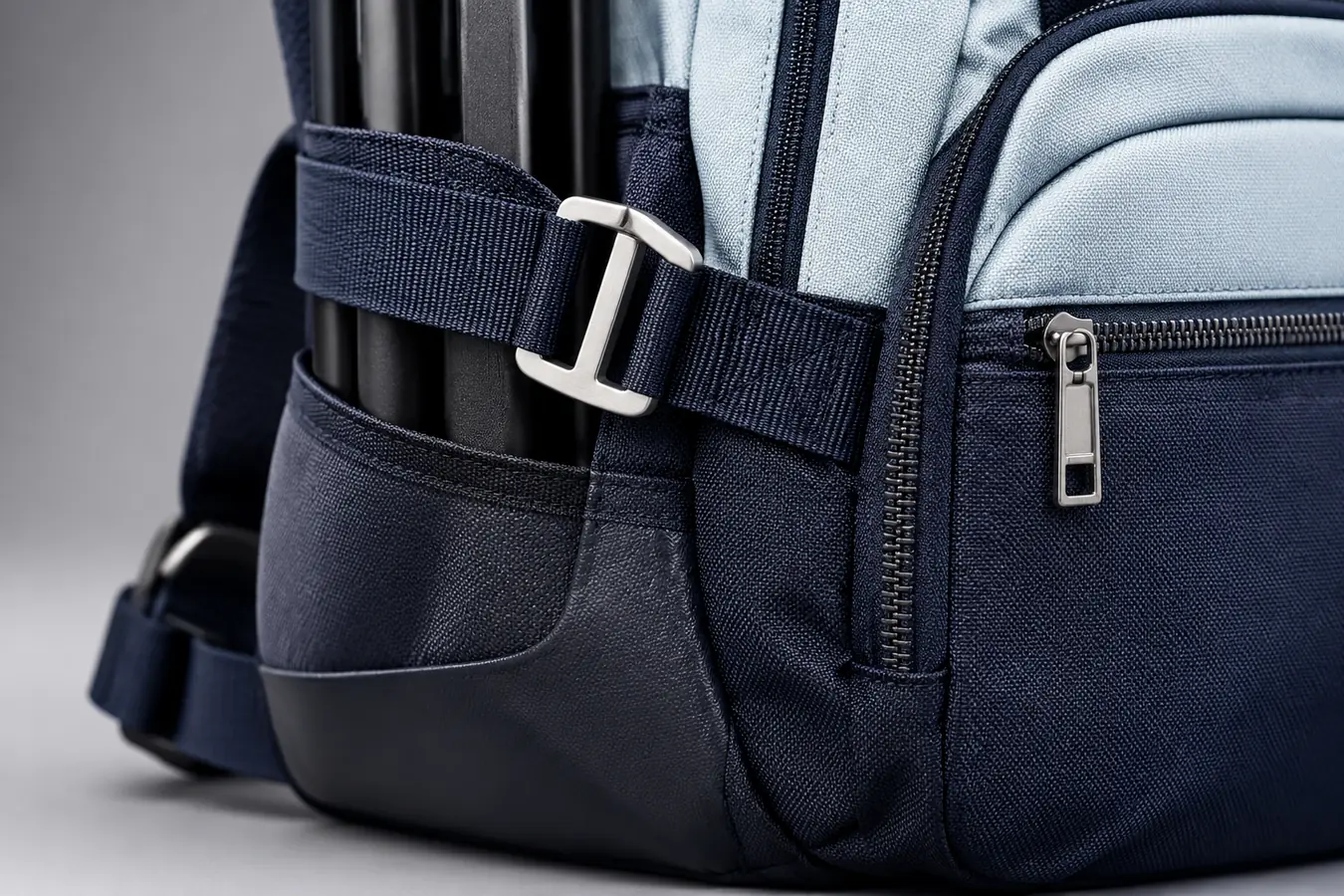
- Anodized 6061 Aluminum Quick-Release G-Hooks: High-tensile aluminum G-hooks with custom laser-etched branding allow instant strap cinching and quick release, even when operating with thick winter gloves.
- Internal Sub-Surface HDPE Reinforcement Plates: The upper compression strap anchors are riveted and bar-tacked through an internal 1.2mm HDPE stiffener plate, preventing the heavy tripod weight from tearing the exterior fabric seams.
- Non-Slip Silicone-Coated Webbing Straps: The inner surface of the upper compression webbing features textured silicone gripper beads that hold smooth carbon fiber tripod legs securely, preventing vertical slippage during movement.
2.3 Fluid Head Protection & Canopy Rain Covers
Heavy professional fluid video heads (such as Manfrotto or Sachtler heads) feature protruding pan handles and adjustment knobs. Senszx engineers padded top canopy shrouds that slip over the fluid head, preventing scratches against trees and door frames while hiking.
2.4 Aerodynamic & Hydrodynamic Wind Drag on Exterior Tripods
When hiking in high alpine winds or cycling with an external tripod, loose straps and protruding legs create aerodynamic drag and loud fluttering noise. Senszx integrates elastic strap-garages that stow excess webbing tails neatly, alongside contoured Hypalon side wings that smooth airflow around the tripod profile.
3. Internal Modular Divider Architecture: High-Density EVA Foam & Tricot Linings
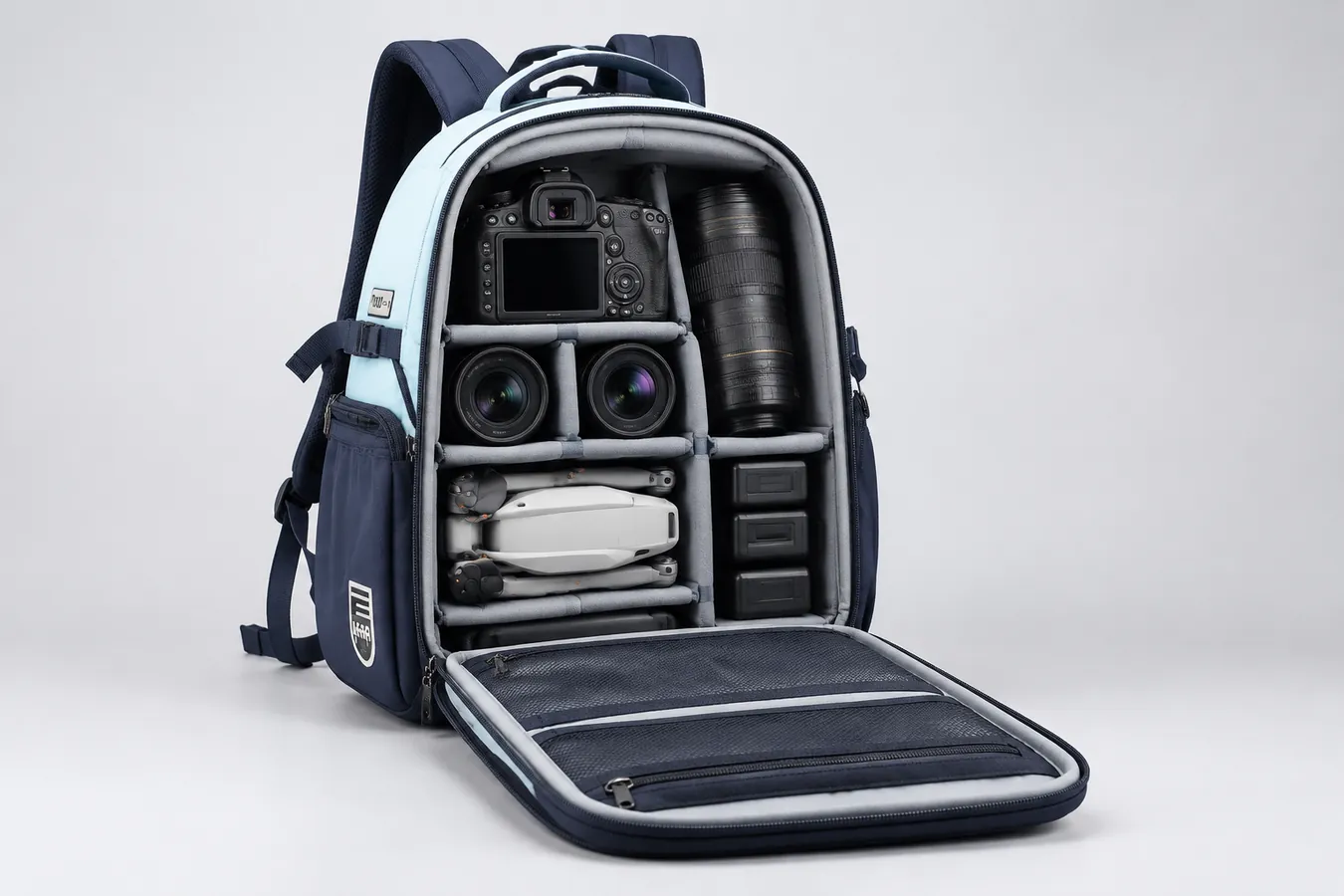
The interior of a professional camera backpack is a precision micro-environment. Photographers carry widely varying gear configurations: a landscape photographer carries a wide-angle zoom and three graduated neutral-density filters; a wildlife photographer carries a massive 400mm f/2.8 super-telephoto lens; a commercial videographer carries a mirrorless body, cage rig, wireless follow-focus, and drone kit.
The internal divider system must provide total modular customization while maintaining rigid structural shock protection.
3.1 Multi-Layer Divider Construction Specifications
Senszx engineers multi-layer composite dividers that outperform conventional cheap foam inserts:
| Divider Component Layer | Material Engineering Specification | Physical Function in Camera Protection |
|---|---|---|
| 1. Exterior Surface Lining | Non-abrasive brushed nylon tricot or short-pile velvet (160g/m²) | Provides continuous micro-loop surface for velcro attachment; zero lint shedding; protects lens barrels from scratches. |
| 2. Shock-Absorbing Core | High-Density Closed-Cell EVA Foam (75kg/m³ density, 8mm to 12mm thickness) | Absorbs high-energy mechanical impact shocks; maintains shape memory under multi-kilogram equipment compression. |
| 3. Structural Rigid Core | Die-Cut 0.8mm High-Density Polyethylene (HDPE) or Polypropylene (PP) Sheet | Provides vertical rigidity; prevents heavy telephoto lenses from crushing into lower compartments when bag is upright. |
| 4. Fastening Wing Tabs | High-cycle micro-injection molded plastic hook tabs (Ultra-Thin Hook) | Grips interior brushed tricot with high shear strength (>25 N/cm²); zero fabric fraying over 5,000 adjustment cycles. |
3.2 Origami-Style Flex Dividers & Articulated Lens Cradles
In addition to flat rectangular dividers, Senszx crafts specialized functional divider geometries:
- Origami Flex Dividers: Incorporating pre-creased horizontal and vertical hinge lines, allowing a single divider to fold into an L-shape or cradle around a mounted camera body, creating two distinct vertical compartments from a single divider slot.
- Pass-Through Lens Collars: Circular die-cut padded collars that support the barrel of long zoom lenses (such as 70-200mm f/2.8), preventing rotational movement during transit.
- Drone Propeller & Motor Protective Caps: Dedicated padded covers designed to protect delicate carbon fiber drone motors and gimbal assemblies from crushing.
3.3 Hook-and-Loop Fastening Shear Strength & Cycle Durability
Low-grade velcro fasteners shed nylon fibers into camera bags that get sucked into camera sensor chambers and lens barrels during lens changes:
- Micro-Injection Molded Plastic Hooks: Senszx specifies ultra-low-profile molded plastic hooks with smooth, burr-free heads. They deliver high lateral shear resistance (>28.5 N/cm²) while eliminating hook fraying.
- High-Cycle Brushed Tricot Walls: The internal bag walls are laminated with high-tenacity circular-knit nylon tricot that withstands over 5,000 peel-and-stick divider reconfiguration cycles without pilling or losing grip tension.
3.4 Telephoto Lens Cradle Engineering & Center-of-Mass Balancing
Heavy telephoto lenses (e.g., 70-200mm f/2.8, 100-400mm, 200-600mm) present extreme point-mass challenges:
- Suspension Saddle Cradles: Curved, die-cut 12mm EVA foam saddles support the lens barrel at its exact balance point, suspending the heavy front optical glass element 20mm above the bottom floor.
- Elastic Lens Barrel Restraints: 38mm elastic retention straps with quick-release pull tabs lock the lens barrel securely into the cradle, preventing vertical displacement during active jogging or climbing.
3.5 Clean-Room Assembly Standards: Preventing Particulate Ingress
During the final assembly and binding of camera backpack interiors, loose sewing thread fragments, fabric lint, and airborne dust particles pose severe contamination hazards to optical gear:
- Class 100,000 Clean Assembly Zones: Camera bag finishing, divider installation, and final inspection occur in dedicated clean-room environments equipped with positive-pressure HEPA air filtration.
- Ionized Air De-Dusting Blowers: Before packaging, every camera backpack interior is blown out with high-velocity ionized air to neutralize static charges and eliminate microscopic dust particles.
3.6 Optical Glass Filter & Drone Controller Vaults
For landscape photographers carrying 100mm/150mm square glass filter systems and drone pilots carrying sensitive remote controllers:
- Anti-Static Microfiber Filter Slots: Multi-tiered filter sleeves lined with lint-free microfiber fabric prevent optical coating scratches while keeping delicate glass filters organized.
- Molded Thumbstick Protector Domes: Padded top flaps feature recessed molded EVA domes that encapsulate drone remote control thumbsticks, preventing lateral stick damage in transit.
3.7 Custom Automated Laser-Cut Divider Tooling
Unlike small workshops that cut foam dividers manually with razor blades (creating wavy, non-parallel edges), Senszx utilizes multi-axis CNC laser cutting tables. Automated laser nesting produces perfectly sealed, sterile 90-degree divider edges with a dimensional tolerance of $\pm 0.3\text{mm}$, ensuring that modular dividers snap into the interior chassis with millimeter-perfect alignment.
4. Quick-Access Photography Access Points: Side Clamshell Hatches & Rear Security
A photographer operating in the field cannot afford to stop, place their backpack on the ground, and fully unzip a massive clamshell compartment every time a fleeting photo opportunity arises. Modern camera backpacks require multi-access architecture.
Multi-access Camera Backpack Architecture
| Parameter / Specification Stage | Factory Engineering Protocol & Technical Details |
|---|---|
| ACCESS POINT 1: SIDE CLAMSHELL HATCH | 2-second quick draw via single shoulder swing |
| ACCESS POINT 2: REAR SECURITY PANEL | 100% anti-theft body-facing main opening |
| ACCESS POINT 3: TOP EXPANDABLE ROLLTOP | Daypack storage for jackets, drones, and food |
4.1 Side Quick-Access Hatch Engineering
- The 2-Second Quick-Draw Workflow: The photographer slips their left arm out of the shoulder strap, swings the backpack forward under their right arm, and unzips the dedicated side hatch to extract their camera body with attached lens in under two seconds.
- Anti-Sag Internal Reinforcement: Because cutting a large hatch in the side wall weakens the bag’s structural perimeter, Senszx integrates an internal 1.2mm HDPE frame arch around the hatch perimeter. This prevents the upper compartment from collapsing down into the side opening, ensuring that the #8 or #10 reverse coil zipper glides smoothly around the curve.
4.2 Rear-Panel Anti-Theft Clamshell Opening
For international travel and crowded urban photo assignments, placing the primary gear access on the back panel provides crucial security and cleanliness:
- Anti-Theft Protection: When worn on the back, the main zipper is completely inaccessible to pickpockets.
- Clean Harness Protection: When setting the bag down on wet mud, snow, or dusty ground to access gear, the front shell rests on the ground while the shoulder straps and air-mesh back panel remain clean and dry facing upward.
4.3 Top Expandable Rolltop & Personal Gear Cavities
Modern hybrid camera packs separate technical optical gear from personal travel essentials:
- Lower Sealed Camera Pod (ICU): Dedicated, rigid EVA foam compartment accessible via side and rear hatches.
- Upper Expandable Rolltop Compartment: 8L to 15L expandable volume lined with lightweight water-resistant ripstop, accommodating extra layers, audio gear, rain jackets, or drone landing pads.
4.4 Symmetrical Ambidextrous Side-Access Engineering
Over 15% of professional photographers prefer left-handed draw configurations. Senszx crafts dual-side access camera backpacks equipped with symmetrical internal HDPE reinforcement arches on both left and right side walls, allowing users to configure rapid draw from either flank.
5. Heavy-Duty Protective Materials: Ballistic Nylon, Cordura & Waterproof TPU
Selecting outer textiles for photography bags requires balancing extreme tear resistance, puncture protection, all-weather waterproofing, and a clean professional aesthetic:
| Material Classification | Polymer Base & Weave Geometry | Weight & Backing Lamination | Martindale Abrasion / Puncture | Application in Camera Backpack Engineering |
|---|---|---|---|---|
| 1680D Ballistic Nylon | High-Tenacity Polyamide, 2x2 Basketweave | 420g/m²; 0.15mm Polyurethane Film Backing | >30,000 Rubs; Puncture >280N | Bottom abrasion boot, tripod side panels, high-wear corner gussets. |
| 500D / 1000D Cordura Nylon | Air-Jet Textured Polyamide 6.6, Plain Weave | 240g/m² to 340g/m²; C0 DWR + Double PU | >25,000 Rubs; Supreme tear hold | Primary exterior shell for technical outdoor and landscape camera packs. |
| 840D TPU-Laminated Nylon | 840D Nylon + 0.2mm Thermoplastic Polyurethane | 520g/m²; 100% Waterproof Impermeable Barrier | >22,000 Rubs; Hydrostatic >10,000mm $H_2O$ | Expedition waterproof camera bags, marine photography duffels, sealed base basins. |
| X-Pac VX21 Laminate | 210D Face + X-PLY Mesh + PET Film + 50D Taffeta | 205g/m²; Multi-ply technical composite | >15,000 Rubs; 100% Waterproof | Ultralight hiking camera packs with distinctive technical diamond grid styling. |
| 210D High-Density Ripstop | 100% Polyester / Recycled rPET (GRS) | 58g/m²; Water-resistant PU coating | >8,000 Rubs | Internal divider lining, battery slots, memory card organizer pockets. |
Review our comprehensive textile guides on 600D vs 900D vs 1680D polyester, what is Cordura fabric, and our complete custom fabric catalog.
5.1 Heavy Abrasion Boot Engineering: Hypalon vs. 1680D vs. Molded EVA
The bottom floor of a camera backpack is continuously exposed to wet ground, sharp gravel, and abrasive dirt:
- Seamless Hypalon / TPU Bottom Boot: Heavy 1.0mm synthetic rubberized Hypalon or TPU coating wrapped 60mm up the side perimeter provides an impenetrable waterproof basin that wipes clean with a damp towel.
- Compression-Molded EVA Base Feet: 8mm dense molded EVA raised feet elevate the fabric off wet surfaces, preventing capillary moisture absorption.
5.2 Rain Cover Engineering & Seam-Taped Weatherproof Enclosures
While technical shell fabrics feature water-repellent DWR coatings, prolonged exposure to heavy torrential downpours requires an auxiliary rain cover:
- 70D / 210D Ripstop Polyester Taffeta: Laminated with a 0.08mm polyurethane coating and hot-air seam-taped over every interior stitch line, delivering a certified >10,000mm $H_2O$ hydrostatic pressure barrier.
- Integrated Stash Pocket & Drainage Eyelet: The rain cover stows into a dedicated zippered bottom pocket equipped with a brass drainage grommet to vent trapped moisture.
5.3 Anti-Theft Slashguard Cable Mesh Reinforcement
For urban street photographers traveling through high-theft transit hubs, Senszx can integrate flexible stainless steel wire mesh (0.8mm high-tensile multi-strand wire) laminated directly between the 500D Cordura outer shell and internal EVA foam padding, preventing razor-slash theft attempts without adding excess stiffness.
6. Hardware & Zipper Mechanics: #10 Weatherproof Reverse Coils & Zinc Alloys
Zippers on camera backpacks are subjected to severe internal expansion pressure when packed with large zoom lenses and external tripods.
Critical Camera Bag Hardware & Fastener Matrix
| Parameter / Specification Stage | Factory Engineering Protocol & Technical Details |
|---|---|
| MAIN PERIMETER ZIPPERS] #10 YKK / SBS Reverse Coil with Matte PU Water-Resistant Tape | - |
| QUICK-ACCESS SIDE HATCHES] #8 Heavy-Duty Reverse Coil with Auto-Locking Metal Sliders | - |
| TRIPOD COMPRESSION HOOKS] Anodized 6061-T6 Aluminum G-Hooks with Laser-Etched Branding | - |
| LOAD-LIFTER & CHEST CLIPS] Virgin Molded Polyoxymethylene (POM/Acetal) | Tensile >850N |
| LOAD-BEARING WEBBING] 100% High-Tensile Seatbelt Weave Polyester (38mm x 1.4mm) | - |
6.1 Granular Hardware Specification Ledger for Photography Packs
Below is an engineering specification ledger of critical load-bearing hardware items configured for Senszx camera backpack programs:
| Item Code | Hardware Component | Material & Metallurgy | Finish / Coating | Tensile Break Threshold | Function in Bag Architecture |
|---|---|---|---|---|---|
| CAM-HW-01 | Anodized Aluminum G-Hook (25mm) | 6061-T6 Aircraft Aluminum | Matte Black Hard Anodized | >1,150 N (117 kgf) | Tripod compression strap anchor. |
| CAM-HW-02 | Magnetic Sternum Slider Buckle | Molded POM + Neodymium N50 | Matte Black Textured | >450 N (46 kgf) | One-handed chest sternum strap latch. |
| CAM-HW-03 | Swivel Shoulder Snap Hook | Die-Cast Zamak 5 Zinc Alloy | Matte Gunmetal PVD | >950 N (97 kgf) | Detachable photography shoulder strap. |
| CAM-HW-04 | Main Perimeter Reverse Zipper | #10 Continuous Nylon Coil + PU Tape | Matte Waterproof Membrane | Cross-tensile >750 N | Clamshell camera compartment closure. |
| CAM-HW-05 | Side Access Hatch Zipper | #8 Reverse Coil with Auto-Lock Slider | Matte Black PU Tape | Cross-tensile >550 N | Quick-draw camera hatch opening. |
| CAM-HW-06 | Molded Rubber Grab Handle | TPR Dual-Injection over Webbing | High-Traction Ergonomic Ribs | Tear break >1.8 kN | Heavy top grab & carry handle. |
| CAM-HW-07 | Hypalon Zipper Pull Tabs | 1.0mm Laser-Cut Hypalon + Paracord | Textured Matte Black | Pull break >450 N | Glove-friendly silent zipper operation. |
Review our complete hardware specifications in our custom zipper pullers and buckles guide.
6.2 Ergonomic Tactile Zipper Pullers
In sub-zero winter landscape shoots, metal zipper pullers freeze to bare fingers. Senszx equips all exterior photography zippers with oversized 1.5mm Hypalon pull tabs or textured rubberized T-bars that can be gripped easily with thick insulated ski gloves.
7. Multi-Stage Quality Control, 1.2m Drop Testing & In-House Laboratory Validation
Quality control on camera bags involves rigorous physical stress testing to guarantee equipment protection under catastrophic drop events:
Senszx 6-stage Quality Architecture
| Parameter / Specification Stage | Factory Engineering Protocol & Technical Details |
|---|---|
| GATE 1 | IQC] Raw Material Testing: 4-Point Fabric Check, Colorfastness, Hardware Pull |
| v | - |
| GATE 2 | PRE-PROD] Pre-Production Sample Sign-Off & Automated CNC Cut Dimensional Check |
| v | - |
| GATE 3 | IPQC] In-Process QC: Stitch Density (7-8 SPI), Seam Binding, Cyclic Bartacks |
| v | - |
| GATE 4 | 100% QC] 100% Semi-Finished Structural Inspection & Cleanliness Audit |
| v | - |
| GATE 5 | FQC] Final Random Inspection (ISO 2859-1 / AQL 2.5 Major, 4.0 Minor, Drop Test) |
| v | - |
| GATE 6 | LOGISTICS] Carton Palletization, Desiccant Check, Barcode & Container Loading Audit |
7.1 Laboratory Stress Testing Standards for Camera Backpacks
| Physical Laboratory Test | Testing Equipment & Applied Mechanical Force | Industry Minimum Standard | Senszx Quality Standard (Exceeds Industry) |
|---|---|---|---|
| Dynamic Handle & Strap Jerk | Reciprocating eccentric cam jerk tester; bag loaded with 18.0 kg payload. | 2,500 cycles at 30 jerks/min without anchor tear. | 5,000 Continuous Cycles with zero seam elongation or hardware fatigue. |
| Free-Fall Impact Drop Test | 1.2-meter drop tower; backpack loaded with 15kg simulated optical weight dropped on concrete. | 10 drops without divider collapse or seam rupture. | 25 Consecutive Drops with zero divider detachment and >92% kinetic shock attenuation. |
| Tripod Retention Pull Test | Universal tensile testing machine pulling tripod G-hook straps at 90° angle. | Tensile pull force >450N before stitch failure. | >850N Tensile Pull Strength (backed by internal HDPE frame sheet). |
| Zipper Cross-Tensile Fatigue | Lateral cross-tension zipper tester under 150N constant pull-force. | 2,500 open/close cycles without tooth failure. | 5,000 Cycles with smooth action force remaining <4.0N. |
| Fabric Martindale Abrasion | Martindale abrasion tester (ISO 12947-2) under 12 kPa pressure. | 15,000 rubs without yarn breakage. | >25,000 Rubs for 500D/1000D Cordura and 1680D Ballistic nylon. |
| Metal Detection Scanning | Dual-aperture 9-point calibrated metal detection conveyor tunnel. | 100% of finished goods inspected. | Zero Tolerance (AQL 0.0) for broken needle fragments or sharp metal debris. |
Review our complete inspection procedures on our dedicated quality control page.
7.2 Specialized Camera Bag Defect Prevention Matrix
Below is an in-process quality scorecard utilized by Senszx IPQC auditors during camera backpack production:
| Potential Quality Defect | Root Industrial Cause | Senszx Shop-Floor Preventive Measure |
|---|---|---|
| Divider Velcro Fiber Shedding | Cut edges of hook tabs unsealed; cheap loop fabric. | Ultrasonic die-cut micro-injection hook tabs + circular-knit tricot. |
| Side Hatch Zipper Binding | Side wall fabric flexing inward under upper payload. | Integrating 1.2mm die-cut HDPE perimeter arch around zipper track. |
| Tripod Strap Anchor Rupture | Webbing stitched into single fabric layer. | Anchoring webbing through 1680D shell + 1.2mm HDPE frame + 42-stitch bartack. |
| Laptop Compartment Bottom Impact | Laptop sleeve resting flush on bag floor. | Suspending padded laptop sleeve 25mm above floor with 8mm EVA cradle. |
| Seam Needle Hole Water Leakage | Heavy needle puncture holes on top panel seams. | Hot-air high-frequency TPU seam sealing tape over all interior needle paths. |
7.3 Environmental Thermal Chamber Testing (-30°C to +70°C)
To guarantee performance across global geographic extremes (from sub-zero Arctic wildlife photography to equatorial desert filmmaking), camera prototypes undergo 72 hours of continuous thermal cycling inside our programmable environmental chamber, verifying zero foam embrittlement, zero adhesive delamination, and smooth zipper glide.
8. Standard Allowed Minutes (SAM), Line Balancing & Industrial Engineering
Producing high-complexity camera backpacks with modular dividers and multi-access hatches requires balanced Standard Allowed Minutes (SAM) across specialized industrial workstations:
Senszx Industrial Manufacturing Capacity Profile
| Parameter / Specification Stage | Factory Engineering Protocol & Technical Details |
|---|---|
| Synchronized Active Sewing Lines | 100 Dedicated Industrial Production Lines |
| Specialized Heavy-Duty Machine Fleet | 350+ Specialized Machines (Walking-Foot/CNC/Post-Bed) |
| Master Camera Bag Crafting Workforce | 260+ Full-Time Industrial Seamstresses & Technicians |
| Monthly Mass Production Capacity | 100,000 to 140,000 Camera Backpacks & Slings |
| Standard Mass Production Turnaround | 20 Calendar Days (500 to 5,000 pcs) |
| Parallel Active Project Capacity | 30 to 45 Multi-SKU Production Programs in Parallel |
8.1 Detailed SAM Breakdown for a 32L Professional Camera Backpack
| Station # | Assembly Operation Description | Machine Type Assigned | SAM (Minutes) | Critical Quality Checkpoint |
|---|---|---|---|---|
| ST-01 | Sub-assembly: Front organizer panel with memory card & battery slots | Single-Needle Lockstitch | 3.5 min | Elastic tension, contrast Hi-Vis binding |
| ST-02 | Sub-assembly: Modular EVA foam divider die-cutting & tricot wrap | Ultrasonic Lamination & Edge Stitch | 4.8 min | Clean velcro tab weld, foam density check |
| ST-03 | Sub-assembly: Side quick-access clamshell hatch with HDPE arch | Walking-Foot with Guide | 4.2 min | Anti-sag arch centering, smooth #8 zip |
| ST-04 | Sub-assembly: External tripod Hypalon foot cradle & G-hook webbing | Heavy Walking-Foot (TiN Needle) | 3.8 min | Hypalon seam hold, 42-stitch cyclic bartacks |
| ST-05 | Sub-assembly: Ergonomic 3D air-mesh back panel & 15" laptop sleeve | Walking-Foot Compound Feed | 4.5 min | Lumbar EVA padding alignment, laptop velvet |
| ST-06 | Sub-assembly: Padded S-curve shoulder straps with load-lifters | Walking-Foot with Edge Guide | 4.0 min | Centered 38mm seatbelt webbing, sternum rail |
| ST-07 | Main assembly: Top molded grab handle & aluminum stay bar install | Heavy Walking-Foot Lockstitch | 5.2 min | HDPE backing plate centered, rivet tightness |
| ST-08 | Main assembly: Perimeter #10 PU water-resistant reverse zipper | Cylinder-Bed Synchronized Feed | 6.5 min | Smooth corner radius curves, zero wave |
| ST-09 | Main assembly: 3D joining of front gear shell to rear chassis | Post-Bed Double-Needle | 7.8 min | Parallel top-stitching, symmetry tolerance <2mm |
| ST-10 | Final assembly: Internal heavy herringbone seam edge binding | Cylinder-Bed Binding Machine | 5.8 min | 100% raw edge encapsulation, zero fraying |
| ST-11 | Finishing: 100% thread trimming & optical divider fitment audit | Dedicated Inspection Table | 3.5 min | Cleanliness, zipper cycle test, divider alignment |
| ST-12 | Packaging: Metal detection tunnel & 5-ply Kraft master cartoning | Calibrated Metal Tunnel | 1.4 min | Zero metal fragments, barcode label verify |
| TOTAL | Complete Manufacturing Cycle Per Camera Backpack | 12 Integrated Stations | 55.0 min | Daily Output per 20-Person Line: ~200 units |
9. Single-Track 500 MOQ Economics & 100% Credited Prototyping Program
For photography gear startups, creator accessory brands, and expanding equipment labels, managing working capital is essential. Traditional factories demand 2,000 to 3,000-unit minimums that tie up capital in unvalidated SKUs.
Senszx eliminates this barrier through our Single-Track OEM/ODM MOQ Structure:
| Parameter / Specification Stage | Factory Engineering Protocol & Technical Details |
|---|---|
| Senszx Sourcing Economics & Flexibility | - |
| Single-Track OEM/ODM MOQ | 500 Pieces Per Style / Colorway |
| Prototyping Turnaround | 3 to 5 Business Days |
| Mass Manufacturing Lead Time | 20 Calendar Days (500 to 5,000 units) |
| Development Fee Program | 100% Prototyping Fee Credited Back on Bulk Order |
9.1 The Structured Development Fee Credit-Back Program
For visionary brands launching innovative new camera bag silhouettes:
- Upfront Prototyping Investment: A structured engineering fee covering complete CAD pattern drafting, specialized material sourcing, acrylic cutting templates, and up to 3 iterative rounds of physical prototyping.
- 100% Invoice Credit-Back: When the client approves the golden prototype and places their commercial mass production order of 500+ units, 100% of the initial development fee is credited directly back against the mass production invoice.
- Zero-Risk Commercial Scaling: This framework gives expanding brands direct access to Tier-1 industrial engineering, certified materials, and master sample technicians without requiring upfront multi-thousand-unit inventory exposure.
To explore stock options, browse our wholesale backpacks in stock section or review our custom bag product catalog.
9.2 Tooling Amortization and Custom Hardware Engineering
Developing bespoke hardware (such as custom-molded EVA back panels or branded aluminum G-hooks) requires upfront mold tooling:
- Aluminum G-Hook Tooling: Approximately $800 to $1,200 for high-precision stamping and CNC engraving dies.
- Compression-Molded EVA Back Panel Tooling: Approximately $1,800 to $2,500 for CNC-machined steel thermal compression molds.
- Tooling Amortization: Across an initial 500-unit run, mold costs represent $3.00 to $5.00 per unit; across a 5,000-unit annual program, tooling costs amortize down to under $0.45 per unit, providing immense brand differentiation and uncopyable proprietary ergonomics.
9.3 Cash Flow Strategy for Kickstarter & Creator Hardware Launches
For crowdfunding creators launching a flagship camera backpack, meeting backer delivery dates while protecting cash reserves is crucial:
- Physical Working Prototypes in 3-5 Days: Receive camera-ready golden samples for Kickstarter video production and influencer reviews within days of finalizing CAD drawings.
- 20-Day Production Turnaround: Ship backer rewards immediately following campaign completion without the 90-to-120 day factory delays common with unverified brokers.
9.4 Unit Cost Breakdown for a 32L Technical Camera Backpack
Understanding the exact cost drivers in camera backpack production:
- High-Density Closed-Cell EVA Foam & Tricot (Dividers + Chassis): Represents ~28% to 34% of direct FOB cost due to heavy material consumption across 15+ internal partitions.
- Outer Shell Textiles (500D Cordura / 1680D Ballistic): Represents ~22% to 26% of cost.
- Zippers & Aluminum G-Hook Rigging: Represents ~16% to 20% of cost.
- Direct Sewing Labor (55 Standard Allowed Minutes): Represents ~20% to 25% of cost.
- Testing, Quality Inspection & Packaging: Represents ~6% to 8% of cost.
9.5 Total Cost of Ownership (TCO) vs Lowest Quoted Unit Price
Procurement teams evaluating camera bag manufacturers must look past superficial initial FOB quotations. Sourcing through low-tier intermediaries frequently leads to unapproved EVA foam substitutions (replacing 75kg/m³ high-density foam with cheap 35kg/m³ crumb foam), defective zipper teeth that burst under overstuffed zoom lens pressure, and high return rates (>4.5%) from disappointed photographers. Partnering directly with Senszx delivers predictable 20-day production lead times, zero material downgrades, sub-0.3% warranty return rates, and a 20% to 28% net financial advantage in Total Cost of Ownership (TCO). Review our comprehensive custom backpack cost breakdown for detailed pricing models.
10. Sourcing Playbook, RFQ Formulation & Factory Audit Scorecard
Global photography brands execute custom camera bag programs with Senszx through our disciplined 6-phase procurement workflow:
The 6-phase Factory-direct Sourcing Playbook
| Parameter / Specification Stage | Factory Engineering Protocol & Technical Details |
|---|---|
| PHASE 1 | TECHNICAL RFQ & FEASIBILITY REVIEW] Timeline: Days 1-2 |
| Brand submits 2D CAD tech pack, target dimensions, material specs, target FOB price. | - |
| Factory engineering team performs DFM stress-point analysis and provides detailed BOM quotation. | - |
| PHASE 2 | CAD PATTERN DRAFTING & MATERIAL SOURCING] Timeline: Days 3-4 |
| Digitizing 2D pattern geometry in Optitex CAD software; preparing acrylic cutting templates. | - |
| Procuring master textile swatches, zipper chains, custom hardware samples, and foam cores. | - |
| PHASE 3 | PHYSICAL PROTOTYPE SAMPLING & ITERATION] Timeline: Days 5-8 |
| Master sample technicians hand-craft 1st physical prototype in dedicated sample room. | - |
| High-res photo/video review with brand; dispatching sample via express courier (DHL/FedEx). | - |
| Client testing and review; executing up to 2 refined iteration rounds if required. | - |
| PHASE 4 | GOLDEN SAMPLE APPROVAL & CONTRACT SIGN-OFF] Timeline: Days 9-10 |
| Client signs off on Golden Master Sample and formal Master Production Specification Sheet. | - |
| Finalizing 500+ unit purchase order; deposit confirmation; locking mass production schedule. | - |
| PHASE 5 | AUTOMATED CUTTING & MASS SEWING PRODUCTION] Timeline: Days 11-28 |
| Gate 1 IQC textile inspection and automated multi-ply CNC knife cutting. | - |
| 100 synchronized sewing lines execute assembly under continuous roving IPQC inspection. | - |
| 100% semi-finished trimming, structural integrity checks, and clean-line finishing. | - |
| PHASE 6 | FINAL FQC AUDIT, PACKAGING & CONTAINER LOADING] Timeline: Days 29-30 |
| Chief Quality Auditor executes ISO 2859-1 (AQL 2.5/4.0) random sampling inspection. | - |
| Metal detection tunnel scanning; virgin LDPE polybag packaging; 5-ply Kraft master cartoning. | - |
| Direct ocean container drayage loading at factory docks; issuing full Bill of Lading (B/L). | - |
10.1 Diagnostic Questions for Camera Bag Sourcing Audits
When evaluating prospective camera bag manufacturers, procurement directors should ask these targeted technical questions:
- "What is the exact compression deflection rating and density (kg/m³) of your EVA divider foam, and how do you prevent divider bowing under heavy 70-200mm lens loads?"
- "How is your tripod retention strap anchored to the internal frame, and what mechanical pull-force (N) can the upper anchor withstand before seam rupture?"
- "What specific internal reinforcement do you integrate around the side-access hatch to prevent zipper binding when the upper compartment is loaded?"
- "Can you conduct an unannounced live video walkthrough of your CNC cutting room, EVA lamination line, and testing lab within the next 30 minutes?"
- "What class of clean-room air filtration do you maintain in your final assembly, divider insertion, and packing areas to prevent particulate contamination?"
- "How do you test camera dividers for hook-and-loop velcro fiber shedding, and what micro-injection hook supplier do you specify?"
10.2 Global Supply Chain Quality Audit Architecture
Camera bag sourcing requires multi-layered supply chain audits. Senszx implements strict incoming material verification across every sub-tier supplier:
- Textile Mill Verification: Verifying that 1680D ballistic nylon and 500D Cordura fabrics are sourced directly from certified weaving mills with full lot traceability, C0 fluorine-free DWR water repellent certification, and OEKO-TEX Standard 100 compliance.
- Foam Extruder Quality Audits: Auditing EVA and XLPE foam suppliers for consistent closed-cell structure, zero heavy metal blowing agents, and uniform 75kg/m³ density tolerances ($\pm 3%$).
- Hardware Plating Audits: Verifying that all die-cast zinc alloy zipper pullers, D-rings, and aluminum G-hooks undergo certified PVD or electroplating processes with verified 48-hour neutral salt spray corrosion resistance (ASTM B117).
10.3 CAD Master Pattern Engineering & Laser Tooling Protocols
In high-precision camera bag manufacturing, pattern drafting is executed directly in specialized industrial soft-goods CAD suites (Optitex and Lectra):
- Digitized Seam Allowance Grading: Every curved seam allowance on 3D lens compartments and side access arches is graded with sub-millimeter precision ($8.0\text{mm} \pm 0.2\text{mm}$ on structural joins; $5.0\text{mm}$ on bound lining edges) to eliminate fabric puckering.
- Computerized Acrylic Template Tooling: For manual assembly reference, all CAD pattern parts are laser-cut from 3mm transparent acrylic sheets with engraved alignment notches and drill-hole locators, providing visual alignment jigs for sewing line operators.
- Automated Nesting Yield Optimization: Computerized nesting algorithms lay out high-density multi-ply fabric spreads across automated CNC knife cutting tables, maximizing material utilization to over 95.2% and reducing expensive ballistic nylon scrap waste.
10.4 Global Maritime Transit Gateways & Port Logistics
Senszx coordinates direct container loading from our factory loading bays to North China’s primary international seaport (Tianjin Port, Xingang) and Southern export hubs (Shenzhen and Guangzhou Ports), connecting directly to global logistics corridors with full automated AMS and ISF customs documentation, comprehensive Bill of Lading (B/L) issuance, and seamless inland drayage:
| Global Destination Gateway | Average Ocean Transit Time | Customs Clearance & Inland Drayage | Total Factory-to-Warehouse Window |
|---|---|---|---|
| US West Coast (Long Beach / Los Angeles / Tacoma) | 14 to 18 Days | 3 to 5 Days (Automated ISF/AMS filing) | 18 to 23 Calendar Days |
| US East Coast (New York / Savannah / Charleston) | 28 to 34 Days (via Panama Canal) | 3 to 5 Days | 32 to 39 Calendar Days |
| Northern Europe (Rotterdam / Hamburg / Antwerp) | 26 to 32 Days | 3 to 4 Days (EU Import VAT & EORI) | 30 to 36 Calendar Days |
| United Kingdom (Southampton / Felixstowe / London) | 28 to 34 Days | 3 to 4 Days | 32 to 38 Calendar Days |
| Middle East / GCC (Jebel Ali, Dubai / Dammam) | 16 to 22 Days | 2 to 4 Days (SABER / SASO clearance) | 19 to 26 Calendar Days |
| Australia (Sydney / Melbourne / Fremantle) | 14 to 18 Days | 2 to 3 Days | 17 to 22 Calendar Days |
Direct Sourcing Comparison Matrix: How Suppliers Stack Up
| Sourcing Dimension | Tier-1 Factory-Direct (Senszx) | Small Cottage Workshop | Sourcing Trading Company | Virtual Sourcing Broker |
|---|---|---|---|---|
| Machinery Infrastructure | 100 Synchronized Lines, heavy walking-foot, CNC knife cutters, testing lab. | 5-10 generic flatbed sewing machines; manual hand cutting. | Office showroom only; zero manufacturing machinery. | Home office / laptop; zero assets. |
| Prototyping Turnaround | 3 to 5 business days with in-house CAD master pattern makers. | 15 to 25 days; relies on manual paper patterns. | 20 to 30 days; must relay to external workshops. | 25 to 35+ days; multi-tiered handoffs. |
| Mass Production Lead Time | 20 calendar days (500 to 5,000 units). | 45 to 60+ days; severe labor bottlenecks. | 35 to 50 days; vulnerable to factory rescheduling. | Unpredictable; frequent shipping delays. |
| In-Line Quality Control | 6-Gate System (IQC, IPQC, 100% semi-finished, FQC / AQL 2.5). | Casual visual check by sewing operators. | Pre-shipment inspection (PSI) only at 100% completion. | Relies entirely on unverified supplier claims. |
| Lab Stress Testing | In-house physical lab (5,000-cycle handle jerk, drop tower, salt spray). | Zero physical testing equipment. | None; charges extra for external lab reports. | None. |
| Compliance Certifications | BSCI, ISO 9001/14001/45001, CPSIA, REACH, Prop 65. | None; uncertified working conditions. | Holds trading certificates; underlying factories unverified. | None. |
| Cost Structure & Transparency | Direct cost-plus BOM pricing; zero middleman markups. | Low initial quote; hidden material downgrades. | 15% to 35% hidden trading margin markup. | 10% to 20% commission layered over marked-up cost. |
| MOQ Flexibility | 500 pcs/style (100% Development Fee credit-back). | 100-300 pcs, but lacks quality control. | 1,000 to 3,000 pcs minimum. | 2,000+ pcs minimum. |
Summary & Next Steps: Partner Directly with Senszx
In the competitive global marketplace of professional photography accessories and content creator luggage, your camera bag is the primary safeguard for your customers' most valuable creative tools. By partnering directly with Senszx, you eliminate intermediary markups, protect design intellectual property, ensure pristine sample-to-bulk fidelity, and secure a resilient, scalable 100-line manufacturing infrastructure engineered for precision protection.
Initiate Your Custom Camera Bag Development Today
Contact our senior engineering team to review your technical drawings, optimize your Bill of Materials, receive a direct factory quotation, and dispatch your rapid 3-5 day prototype sample:
- Email Direct: [email protected]
- WhatsApp / Direct Line: +86 17331531825
- Request a Prototype: Get a Free Sample
- Submit Technical RFQ: Contact Our Engineering Team
- Explore Factory Background: Read Our Factory Story
- Review Quality Procedures: Quality Control Floor
- Inspect Cutting Facilities: Fabric Cutting Workshop
- Review Certifications: BSCI & ISO Standards
- Check Logistics & Terms: Payment & Shipping Information
- Browse Product Range: Custom Bag Product Catalog
- Custom Backpack Manufacturing: Custom Backpacks Factory
- Custom Travel Bags: Custom Travel Bags Factory
- Custom Gym Bags: Custom Gym Bags Factory
- Custom Tactical Bags: Custom Tactical Bags Factory
- Custom Tote Bags: Custom Tote Bags Factory
Hi, I'm Senszx Bag Manufacturer, Hope You Like This Blog Post.
With more than 20 years of experience in OEM/ODM/Custom luggage and bag, I'd love to share with you the valuable knowledge related to luggage and bag products from a top-tier Chinese supplier's perspective.
Senszx Factory
Est. 2006 · Baigou, China
Related articles
How to Choose the Right Materials for Travel Bags: The Complete Manufacturer Guide
A comprehensive B2B engineering guide to selecting travel bag materials: comparing polyester, nylon, Oxford, canvas, TPU coatings, hardware, and structural interlinings across durability, GSM, abrasion, and manufacturing cost.
Bulk Backpacks: The Complete Wholesale Buying Guide for 2027
How brands, distributors, schools and charities buy backpacks in bulk: sourcing paths, styles, fabrics, customization, unit price drivers, MOQ, lead times, QC and shipping.
Wholesale Toiletry Bags: The Complete Sourcing Guide for 2027
How travel brands, grooming labels, retailers and distributors source toiletry bags in bulk: styles, materials, customization, MOQ, pricing, QC and shipping.
Get a Custom Bag Quote from Our China Factory
Our sales team is online around the clock and usually replies within the hour.
Email
[email protected]Factory
Qinzheng Road No.89, New Industry Zone, Baigou Town
Baoding City, Hebei Province 074004, China