How to Choose a Bag Manufacturer for Retail Programs: The Complete B2B Sourcing, SKU Control & Production Guide
The definitive B2B sourcing guide on how to choose a bag manufacturer for retail programs. Discover technical supplier evaluation protocols, multi-SKU barcode matrices, retail-ready packaging optimization, sample-to-bulk quality control, CPSIA/REACH compliance, and single-track 500 MOQ economics for multi-door retail distribution.
How to Choose a Bag Manufacturer for Retail Programs: The Complete B2B Sourcing, SKU Control & Production Guide
For retail merchandisers, brand founders, vice presidents of product development, and global sourcing directors, taking a custom bag collection from initial design concepts into multi-door brick-and-mortar retail chains or high-velocity omnichannel distribution is one of the most demanding operational challenges in modern consumer commerce. In the commercial retail sector, manufacturing excellence is not measured merely by whether a factory can stitch an attractive golden prototype in a quiet sample room. It is defined by whether that manufacturing partner can repeatedly produce tens of thousands of identical, zero-defect production units, package them in barcode-verified retail-ready master cartons, comply with rigorous multinational chemical safety standards, and deliver them to regional fulfillment centers precisely on schedule.
A single operational oversight—such as an unscannable UPC barcode on a master shipping carton, a 2% color shift on a second-run fabric dye lot, a substandard zipper slider that jams under retail floor handling, missing bilingual suffocation warnings on individual polybags, or an unreinforced shoulder strap anchor—can trigger catastrophic retailer chargebacks, delayed floor sets, canceled purchase orders, and irreversible damage to brand reputation.
| Product Engineering | Retail-Ready Supply | Quality & Compliance |
|---|---|---|
| DFM & CAD Pattern Drafting • Material performance matrix • High-stress reinforcement engineering • Single-track 500 MOQ economics | Multi-SKU Barcode Matrix • GS1-128 & EDI compliance • Carton drop test & palletizing • Landed cost optimization | 7-Stage IQC / IPQC / FQC • CPSIA / REACH / Prop 65 certification • AQL 1.5 / 2.5 final audits • Master spec & golden sample lock |
The global market for sewn goods—spanning everyday commuter backpacks, executive laptop bags, travel weekenders, technical tote bags, functional cosmetics organizers, and specialized sports bags—has entered an era of intense consumer and retailer scrutiny. Today's retail buyers and private-label managers require suppliers that combine industrial mass-manufacturing capacity with deep technical literacy in retail vendor compliance manuals.
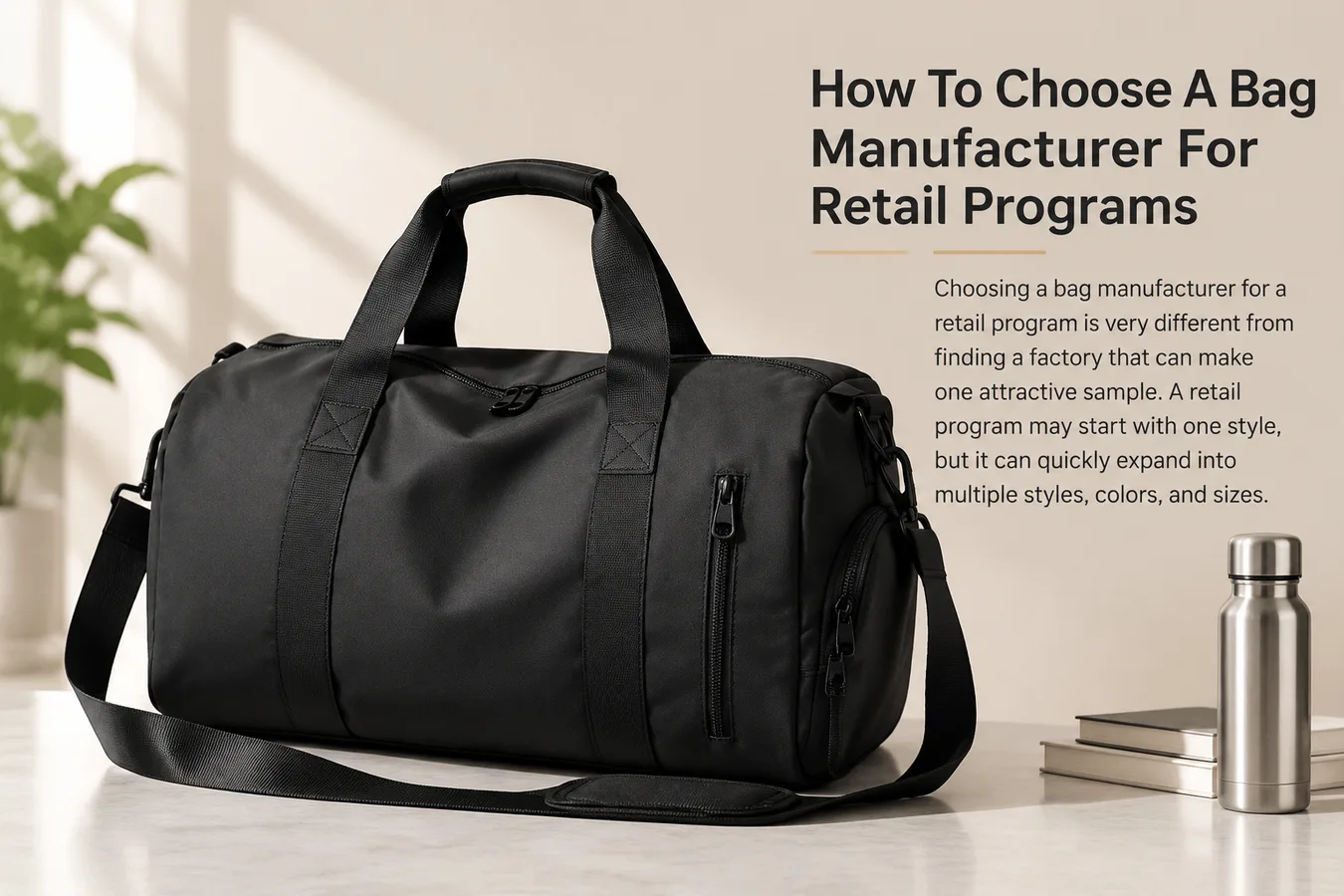
At Senszx, established in 2006 in Baigou, China—the world's capital of luggage and bag industrial manufacturing—we operate 100 dedicated sewing lines backed by BSCI, ISO 9001, ISO 14001, ISO 45001, and CE certifications. We engineer, prototype, and mass-manufacture high-performance custom sewn bags for private-label brands, global distributors, boutique multi-door retail chains, and enterprise merchandise programs worldwide.
This comprehensive technical treatise provides the definitive B2B sourcing and execution manual for selecting, vetting, auditing, and scaling with a professional retail bag manufacturer.
Whether you are preparing your initial custom bag RFQ specification, compiling an industrial backpack tech pack, calculating unit economics with our custom backpack cost breakdown, evaluating specialty silhouettes in our types of backpacks guide, auditing consumer safety in our backpack CPSIA compliance and safety testing guide, exploring private-label scaling strategies in our private label backpack manufacturer guide, sourcing specialized luggage in our bag manufacturer for travel brands guide, reviewing technical textiles in our custom fabric catalog, selecting heavy-duty hardware in our zipper pullers and custom buckles guide, examining our factory-wide quality control protocols, exploring custom designs in our custom backpack manufacturing section, or launching a complete private label bag collection, this guide provides the exact blueprints required to safeguard your retail launch.
1. The Anatomy of a Retail-Ready Bag Manufacturer
When evaluating potential manufacturing partners across overseas industrial hubs, the most dangerous assumption a sourcing team can make is treating all bag factories as interchangeable cut-and-sew operations. In textile manufacturing, factories develop specialized operational reflexes based on the customer base they serve. A factory optimized for low-cost promotional giveaways operates with completely different tolerances, machinery, and quality mindsets than a factory built for premium commercial retail distribution.
| Factory Classification | Primary Output Focus | Equipment & Engineering Profile | Suitability for Commercial Retail Programs |
|---|---|---|---|
| Promotional & Give-Away Plants | Flat shopping totes, non-woven bags, basic drawstrings | Lightweight single-needle machines, piece-rate transient labor, zero mechanical testing lab | Unsuitable: Inadequate stitch density (4-5 SPI), lack of structural bar-tacking, severe sample-to-bulk drift, no barcode verification. |
| Boutique Fashion Workshops | Small-run leather clutches, luxury evening bags | Hand-skiving tools, edge-paint stations, low daily unit output | Very Low: High per-unit labor cost, lack of automated computerized cutters, incapable of meeting multi-door retail volume schedules. |
| Generic Domestic Jobbers | Unbranded domestic market commodity backpacks | Basic flatbed sewing machines, manual hand-cutting tables, visual-only QC | Low: High variance between production lots, no chemical compliance tracking (CPSIA/REACH), incapable of EDI packaging compliance. |
| Industrial Retail-Ready Manufacturers (Senszx Standard) | Technical backpacks, travel duffels, multi-SKU retail lines | Automated laser/die cutters, heavy-duty walking-foot machines, in-house tensile/drop testing lab, barcode validation | Ideal (Full Retail Fit): Rigorous 7-stage QC, comprehensive SKU matrix control, vendor manual compliance, single-track 500 MOQ economics. |
1.1 Beyond Cut-and-Sew: The Retail Fulfillment Ecosystem
A commercial retail program requires a manufacturing partner that views itself as an integral extension of your retail fulfillment chain. When an order of 10,000 backpacks leaves the factory floor, the success of that shipment depends equally on the mechanical integrity of the sewing and the structural integrity of the logistics packaging.
| Manufacturing Stage | Core Operational Benchmarks | Key Retail Deliverables |
|---|---|---|
| Stage 1: Physical Craftsmanship | • High-tenacity filament yarn selection • Strict 7–8 Stitches Per Inch (SPI) • Automated 42-stitch X-box bar-tacking • Synchronized internal seam piping | Zero-defect structural assembly; high tear and pull resistance exceeding $>800\text{N}$. |
| Stage 2: Retail Logistics Precision | • 100% GS1-128 barcode optical scanning • Bilingual polybag suffocation compliance • ISTA-1A master carton drop testing • Palletization & 40HQ container cubing | Complete EDI vendor manual adherence; zero warehouse receiving chargebacks. |
| Stage 3: Verified Commercial Delivery | • Dual sealed master counter-samples • Third-party Pre-Shipment Inspection (PSI) • Turnkey DDP fulfillment to regional DCs | 100% audited retail shipment ready for immediate multi-door retail floor distribution. |
A true retail bag manufacturer manages four critical operational pillars:
- Design for Manufacturing (DFM) Optimization: Engineering pattern geometry and seam sequences to eliminate unnecessary labor operations, reduce fabric yield waste, and strengthen structural stress points without inflating unit BOM costs.
- Deterministic Quality Control: Implementing formal Incoming Quality Control (IQC), In-Process Quality Control (IPQC), and Final Quality Control (FQC) protocols mapped to international Acceptable Quality Limit (AQL) 1.5/2.5 standards.
- Retail-Ready Packaging (RRP) & Logistics Precision: Generating ANSI-compliant barcode labeling, SKU-segregated master carton packing, bilingual warning labels, and pallet-optimized carton dimensions that seamlessly clear automated retail distribution center scanning tunnels.
- Regulatory and Chemical Safety Compliance: Sourcing virgin raw materials certified free of hazardous heavy metals, lead, banned phthalates, and formaldehyde, backed by third-party laboratory test reports.
1.2 DFM Pattern Geometry, Seam Sequencing & Yield Optimization
Before a single yard of fabric is unrolled on the cutting table, Senszx's pattern engineering department subjects your design to rigorous Design for Manufacturing (DFM) analysis. The primary objective is to optimize production feasibility, structural durability, and raw material utilization:
- Nesting Yield Optimization: Computerized nesting software arranges pattern pieces across standard fabric roll widths (58 to 60 inches), increasing material efficiency from typical manual cutting yields of 82% up to 92–94%. On a 5,000-unit retail production run, a 10% reduction in fabric scrap translates to hundreds of dollars in direct BOM cost savings.
- Seam Sequence Deconfliction: Complex bags with multiple three-dimensional gussets, padded laptop partitions, and hidden security pockets require strategic assembly sequencing. If seams are layered incorrectly, sewing operators are forced to perform awkward manipulation maneuvers under the machine needle, resulting in uneven stitch tension and puckering. Our engineers map out step-by-step sub-assembly workflows that ensure every seam is stitched flat and stable.
- Radius and Corner Geometry: Acute sharp interior corners in fabric panels create extreme stress concentration points prone to seam bursting under heavy payload. DFM engineering rounds sharp 90-degree internal corners to smooth 12mm to 15mm radii, allowing continuous, high-speed automated piping attachment without bunching or weak spots.
2. Sample-to-Bulk Consistency: The Core Vulnerability
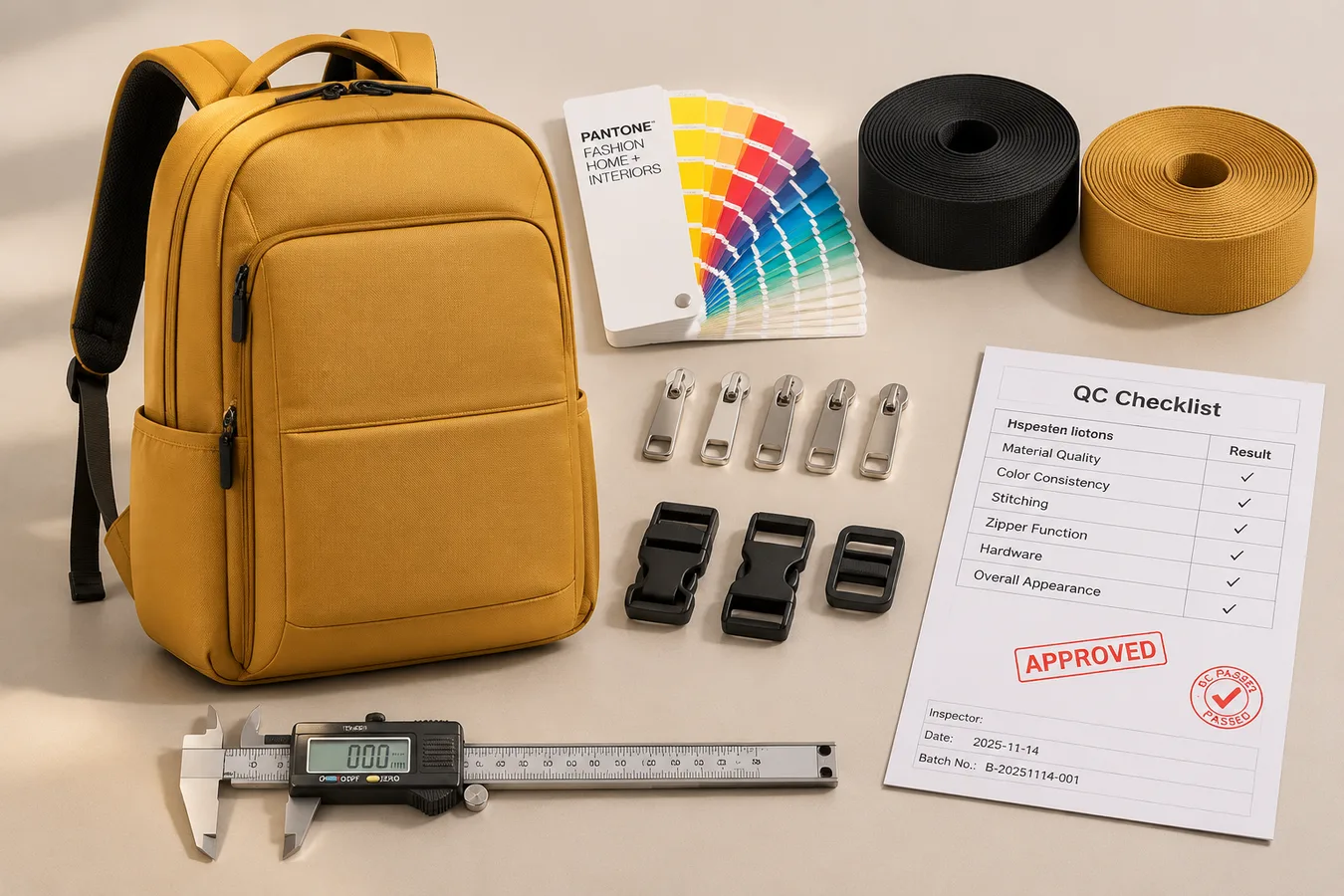
The single most frequent point of failure in overseas manufacturing relationships is the phenomenon known as Sample-to-Bulk Drift. A factory's master sample room crafts an impeccable golden prototype: perfectly tensioned stitches, flawless edge binding, vibrant custom-dyed fabric, and ultra-smooth zipper operation. However, when the mass production order of 3,000 units arrives at your distribution center four months later, the goods display uneven stitch density, substituted interior lining, brittle zipper pullers, and loose seam allowances.
2.1 Why Sample-to-Bulk Drift Occurs in Mass Production
Sample-to-Bulk Drift is rarely the result of intentional malice; rather, it stems from structural disconnects between sample rooms and mass production sewing lines:
- The Master Craftsman Bias: Prototype samples are constructed by master pattern makers with 20+ years of individual tailoring experience, working on standalone machines with infinite time to adjust seam alignments. Mass production is executed by assembly line operators working under strict cycle-time targets across 20 to 40 distinct sub-assembly stations.
- Component Lot Variance: Fabric mills produce sample yardage (10–50 meters) on pilot lab machinery, whereas bulk fabric runs (2,000–10,000 meters) are processed in high-speed industrial dye vats where temperature and tension fluctuations can alter yarn density, coating thickness, and color shade.
- Sub-Tier Supplier Substitution: When raw material costs fluctuate between sample approval and bulk PO release, unvetted factories may silently substitute lower-grade zipper coils, recycled zinc hardware, or lighter-weight filler-backed backing fabrics to protect internal margins.
2.2 The Senszx Counter-Sample Protocol
To guarantee absolute fidelity between the approved prototype and mass-manufactured bulk inventory, Senszx enforces a closed-loop Master Counter-Sample Protocol:
| Protocol Stage | Target Execution & Timeline | Verification Criteria & Deliverables |
|---|---|---|
| Stage 1: Prototype (PP1) | • 3–5 Business Days • Up to 3 iterative sample rounds | Initial pattern verification, silhouette review, volume balance, pocket accessibility, and ergonomic fit. |
| Stage 2: Pre-Production (PPS) | • Active bulk line manufacturing • Mass production tooling setup | Actual bulk fabric lot validation, production branding badges, custom zipper pullers, and final DFM sign-off. |
| Stage 3: Counter-Sample Lockout | • 3 identical sealed & stamped samples • Binding MPSD document | • Factory Master Sample: Mounted directly at the head of the production line. • Client Golden Sample: Delivered to client HQ for final sign-off. • Archival Control Sample: Stored in temperature-controlled QC vault. |
- Dual Sealed Golden Samples: When the Pre-Production Sample (PPS) is approved, three identical physical units are manufactured on the active mass production line using the exact bulk fabric lot. One is sent to the client's quality team, one is sealed in the factory QC Vault, and one is mounted directly at the head of the production line as the visual and physical benchmark for line supervisors.
- Master Production Specification Document (MPSD): We compile an exhaustive engineering document defining every measurable tolerance:
- Dimensional Tolerances: Maximum allowable variance of $\pm 3\text{mm}$ on primary exterior dimensions; $\pm 2\text{mm}$ on internal laptop/tablet sleeves.
- Stitch Density: Mandatory $7 \text{ to } 8 \text{ Stitches Per Inch (SPI)}$ across all structural seams using continuous polyester filament high-tenacity thread (Tex 70 / 210D/3).
- Color Consistency: Spectrophotometer verification ensuring bulk fabric lots maintain a color variation threshold of $\Delta E < 1.0$ against approved Pantone TPX/TCX swatches.
- Hardware & Zipper Pull Force: Minimum cross-seam zipper tensile strength of $>800\text{N}$ and buckle break strength of $>650\text{N}$.
3. Retail-Ready Packaging, SKU Control & Barcode Integrity
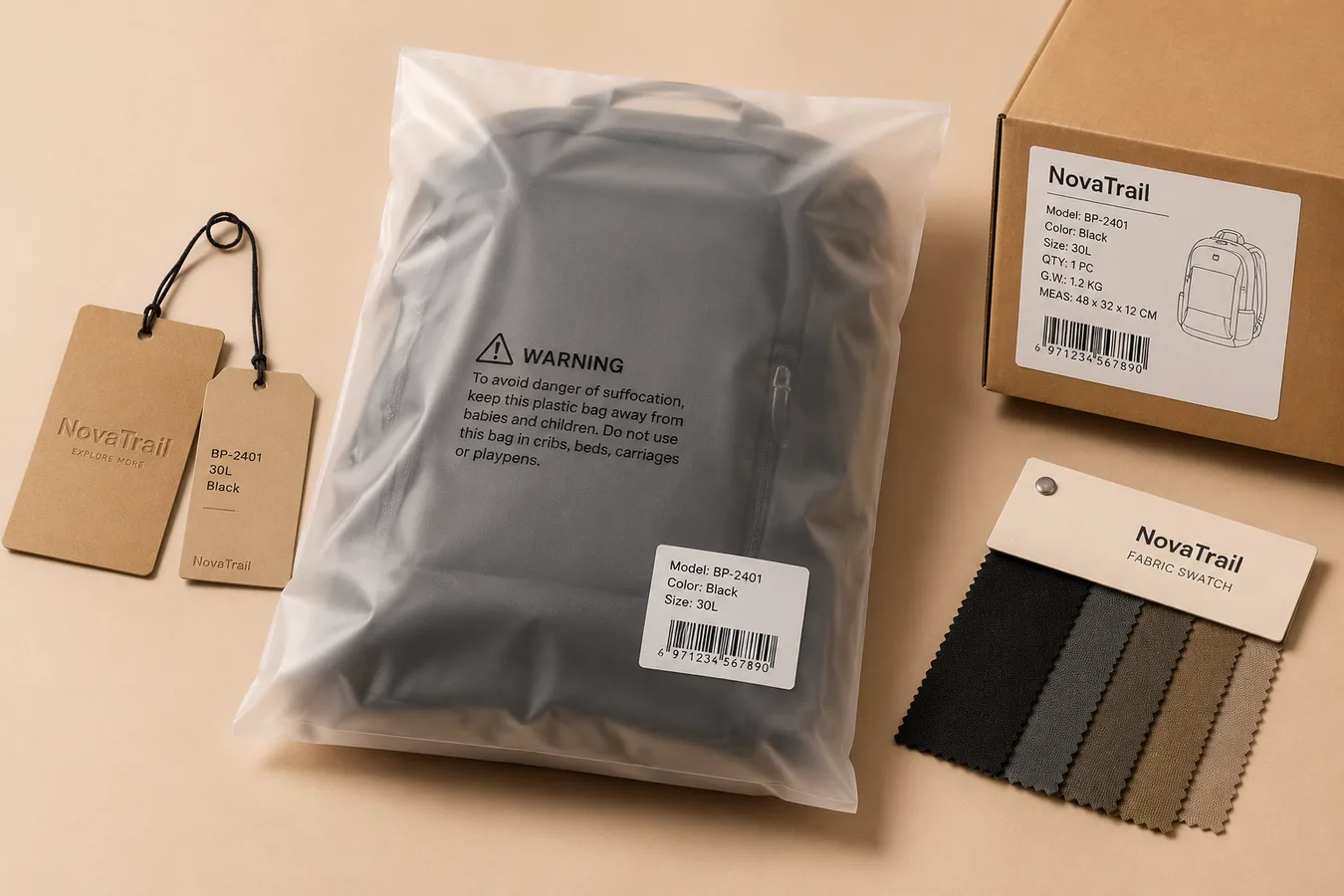
In direct-to-consumer (DTC) e-commerce, a minor packaging defect is an inconvenience; in commercial multi-door retail distribution, packaging non-compliance is an immediate operational disaster. National retail chains (such as Target, Walmart, Nordstrom, REI, and major European department stores) operate automated distribution centers equipped with high-speed optical barcode scanners and conveyor weight sorters. Any deviation from the retailer's published Vendor Compliance Manual triggers automated financial chargebacks ranging from $$5.00$ to $$50.00$ per carton, or total rejection of the shipment at the inbound receiving dock.
3.1 The Multi-SKU Master Control Matrix
As a retail bag program expands across multiple styles, colorways, and seasonal iterations, SKU complexity multiplies rapidly. A core program featuring 3 silhouettes, 4 seasonal colorways, and 2 hardware finishes generates 24 distinct active SKUs. If you manufacture 1,000 units per SKU, your supply chain must manage 24,000 finished bags, 24,000 distinct retail hangtags, 24,000 individual polybag barcode stickers, and 1,200 master shipping cartons without a single cross-contamination error.
| SKU Control Field | Technical Specification Requirement | Verification Protocol | Risk Mitigated |
|---|---|---|---|
| Retail Hangtag | 350gsm coated art card, soy ink print, nylon string with safety pin / micro-kimble tag | Visual color match to Pantone master, copy-proofed against brand artwork | Missing price point, incorrect MSRP display, retailer rejection. |
| UPC / EAN Barcode | GS1-compliant 100% ANSI Grade A or B optical readability, minimum 80% magnification | 100% optical scan test using handheld laser barcode verification terminal | Automated distribution center scanner fault, warehouse sorting delay. |
| Polybag Packaging | 0.05mm (2 mil) virgin transparent PE/PP, micro-perforated for air egress | Micrometer thickness test, 6mm laser vent holes | Trapped moisture causing mold, burst polybags during pallet stacking. |
| Safety Warning Labels | Warning text in English/French/Spanish: "WARNING: To avoid danger of suffocation..." | Min. 24pt bold typography for bags $>30\text{ inches}$ total circumference | Retail safety violation, regulatory fines, legal liability. |
| Anti-Mold Protection | Micro-Pak enhanced desiccant sticker / clay desiccant pouch (DMF-free) | Certified non-toxic, moisture absorption rate $>25%$ | Mildew, fabric odor, humidity damage during 30-day ocean transit. |
| Master Carton Specs | 5-ply double-wall corrugated Kraft board (ECT 44 / 275# burst strength) | ISTA-1A drop test certified (10-drop sequence from 30 inches) | Crushed cartons, damaged product zippers, pallet collapse during transit. |
| GS1-128 Outer Label | Standard 4x6 inch thermal shipping label displaying PO#, SKU#, Qty, Carton X of Y | High-contrast thermal printing, verified scan before palletization | Inbound receiving lockouts, lost inventory in automated retail DC. |
3.2 The Anatomy of an Unstoppable Barcode System
Barcode failures are among the most common causes of retailer chargebacks. Optical scanners in automated fulfillment hubs scan cartons moving along conveyor belts at speeds exceeding 2.5 meters per second.
To achieve 100% first-pass scan rates:
- Quiet Zone Protection: A minimum unprinted white margin (Quiet Zone) of at least 3.5mm must be maintained on both sides of the barcode lines.
- Substrate Contrast: Barcodes must always be printed using pure high-density black ink on clean white background stock. Avoid printing barcodes directly onto Kraft brown carton fiber, transparent polybags without a white backing block, or textured hangtag paper.
- Thermal Transfer Durability: Carton labels must be generated via direct thermal transfer printers using resin-enhanced wax ribbons to prevent smearing, scratching, or fading caused by ocean container humidity and pallet friction.
3.3 Retail Vendor Manuals, Chargeback Structures & EDI 850/856 Integration
Enterprise retail supply chains operate on strict Electronic Data Interchange (EDI) protocols. When a major retailer issues an EDI 850 Purchase Order, your manufacturing partner must format production outputs to align perfectly with the corresponding EDI 856 Advanced Shipping Notice (ASN):
- Serialized Shipping Container Codes (SSCC-18): Every master carton requires a globally unique 18-digit SSCC identifier embedded in the GS1-128 barcode. When the distribution center scanner reads this code, the warehouse management system instantly matches the carton to its electronic manifest without opening the box.
- Chargeback Defense Matrix: Retailers penalize non-compliance systematically:
- Incorrect Carton Dimensions / Weight Discrepancy: $$250\text{ administrative fee} + $5\text{ per non-conforming carton}$.
- Unscannable / Missing Barcode: $$15\text{ per unit relabeling fee}$.
- Non-Compliant Pallet Overhang / Broken Pallet: $$50\text{ per pallet re-stacking fee}$.
- Mixed SKUs without Inner Partition Labeling: Immediate dock rejection or $$500\text{ penalty per shipment}$.
- Senszx EDI Verification Protocol: We perform a full pre-shipment ASN dry-run, generating electronic packing manifests that cross-reference physical carton counts against EDI data structures, completely insulating our clients from vendor chargebacks.
3.4 Mandatory US FTC & Global Care Labeling Regulations
Under the US Federal Trade Commission (FTC) Textile Fiber Products Identification Act (16 CFR Part 303) and Care Labeling Rule (16 CFR Part 423), all sewn bags sold at retail must carry permanent woven or printed satin labels disclosing:
- Fiber Content: Accurate generic fiber percentage declarations (e.g.,
Shell: 100% Polyester / Lining: 100% Nylon). - Country of Origin: Clear, prominent origin statement (e.g.,
Made in China). - Manufacturer Identification: Registered Identification Number (RN) or Wool Products Label (WPL) issued by the FTC, or the legal corporate name of the brand.
- Care Instructions: Standardized ASTM D5489 or ISO 3758 care symbols specifying cleaning methods (e.g.,
Spot Clean with Damp Cloth / Do Not Machine Wash / Do Not Tumble Dry / Do Not Iron).
4. Engineering Quality Control: The 7-Stage Inspection Architecture
A world-class quality management system does not inspect quality into a product at the final packing table; it builds quality into every stage of the manufacturing sequence. At Senszx, our 100 dedicated sewing lines operate under a structured 7-stage quality control architecture designed to catch and eliminate manufacturing deviations before they propagate across bulk inventory.
| Quality Inspection Phase | Primary Inspection Checkpoints | Production Safeguards & Standards |
|---|---|---|
| 1. Incoming Quality Control (IQC) | Raw material roll testing: Martindale abrasion ($>20,000$ cycles), hydrostatic water resistance ($>1,500\text{mm}$), zipper tensile strength, hardware salt spray (48h). | Full roll lot rejection and supplier return prior to warehouse receipt if specifications fail. |
| 2. Pre-Production Setup (PPS) | Machine tension calibration, needle gauge alignment, thread color match ($\Delta E < 0.5$) under D65 standard lighting. | Production line lockout until master counter-sample parameters are 100% matched. |
| 3. Automated Cutting Audit | Computerized CNC laser / oscillating knife precision, notch alignment, grain direction matching. | Maximum pattern dimensional variance $\le \pm 1\text{mm}$; zero edge fraying. |
| 4. In-Process Sewing (IPQC) | Continuous stitch density audits ($7\text{–}8\text{ SPI}$), seam margin consistency ($7\text{mm}\pm 1\text{mm}$), 42-stitch automated bar-tacks. | Real-time operator feedback; 100% sorting of preceding 2-hour sub-assembly batch. |
| 5. Semi-Finished Sub-Assembly | Symmetrical pocket alignment ($\le \pm 2\text{mm}$), shoulder harness static pull tests ($>450\text{N}$), laptop partition cushion fit. | Disassembly and re-stitching before final main body joining. |
| 6. Final Quality Control (FQC) | 100% thread trimming with electric burners, interior debris vacuuming, cosmetic symmetry, AQL 1.5/2.5 audits. | Zero allowable major defects; full lot sorting for any non-conforming carton batch. |
| 7. Packing Quality Control (PQC) | 100% optical barcode scan validation, retail hangtag placement, carton gross weight verification ($\pm 200\text{g}$), ISTA-1A drop testing. | Guaranteed zero barcode receiving chargebacks; heavy-duty 5-ply export carton protection. |
4.1 Stage-by-Stage Quality Control Protocol
| QC Stage | Primary Inspection Parameters & Physical Testing | Target Tolerance / Standard | Non-Conformance Action |
|---|---|---|---|
| 1. Incoming Quality Control (IQC) | Fabric yarn count, PU/PVC backing adhesion, color fastness, zipper burst strength, hardware salt spray | Martindale abrasion $>20,000$ cycles; Water resistance $>1,500\text{mm H}_2\text{O}$; Salt spray 48h no rust | Full roll lot rejection; supplier return before warehouse receipt. |
| 2. Pre-Production Setup (PPS) | Machine tension calibration, needle gauge alignment, thread color match under D65 lighting | Thread color match $\Delta E < 0.5$; Line balance check across 25 stations | Production lockout until master sample parameters matched. |
| 3. Automated Cutting Audit | CNC laser / knife cutting precision, notch alignment, fabric grain direction matching | Pattern dimensional variance $\le \pm 1\text{mm}$; Zero fraying on cut edges | Recalibration of CNC optics; re-cutting of affected fabric bundles. |
| 4. In-Process Quality Control (IPQC) | Stitch density verification, seam margin width, tension balance, bar-tack cycle counts | $7\text{ to }8\text{ SPI}$; Seam margin $7\text{mm} \pm 1\text{mm}$; 42-stitch automated bar-tacks | Operator re-training; 100% re-inspection of preceding 2-hour batch. |
| 5. Semi-Finished Sub-Assembly | Front pocket zipper alignment, shoulder harness anchor tensile strength, padded divider fit | Symmetrical alignment $\le \pm 2\text{mm}$; Harness pull test $>450\text{N}$ static load | Sub-assembly disassembly and re-stitching before final joining. |
| 6. Final Quality Control (FQC) | 100% thread trimming, loose particle vacuuming, cosmetic symmetry, AQL 1.5/2.5 audit | Major defects: 0% allowable; Minor cosmetic defects: $\le \text{AQL } 2.5$ | 100% sorting and manual rework of non-conforming carton lots. |
| 7. Packing Quality Control (PQC) | 100% barcode optical scan, retail hangtag placement, carton gross weight, drop test | Barcode scan rate 100%; Carton weight variance $\le \pm 200\text{g}$; ISTA-1A drop | Relabeling of failed cartons; carton replacement if crushed. |
4.2 Mechanical Stress Testing for Commercial Retail Goods
In our on-site testing laboratory, retail bag models undergo grueling physical stress tests designed to simulate 3 to 5 years of aggressive consumer use:
- Dynamic Handle Oscillation (Jerk Test): The bag is loaded with 15kg to 25kg of steel shot weight and suspended by its primary grab handle or shoulder straps. A motorized pneumatic arm lifts and drops the bag through a continuous stroke of 100mm at a rate of 30 cycles per minute for 2,500 consecutive cycles. Zero seam tearing, webbing fraying, or hardware distortion is permitted.
- Zipper Fatigue Resistance: Zipper tracks are mounted in a mechanical cycling fixture that opens and closes the slider under a transverse tension load of 50N for 5,000 cycles. Sliders must operate smoothly without tooth disengagement or coil separation.
- Colorfastness to Crocking (AATCC 8): Both wet and dry crocking tests are performed on exterior shell fabrics to ensure intense dye colors do not rub off onto a consumer's light-colored clothing (such as white shirts or coats). A minimum rating of Grade 4.0 on the AATCC Gray Scale is mandatory.
5. Material Engineering: Fabrics, Hardware & Zippers
A retail bag's perceived luxury, hand-feel, structural durability, and warranty return rate are fundamentally determined by its raw material bill of materials (BOM). Choosing the optimal textile and hardware balance ensures that the product meets retail price-point expectations while maintaining robust structural margins.
5.1 Technical Shell Fabrics Comparison
| Textile Material | Denier & Weave | Weight ($\text{g/m}^2$) | Tear Strength ($\text{N}$) | Water Resistance Coating | Typical Retail Bag Application |
|---|---|---|---|---|---|
| 600D Polyester Oxford | 600D $\times$ 600D Plain | ~220 gsm | ~180 N | Double PU Coating ($800\text{mm}$) | Everyday school backpacks, promo bags, budget organizers. |
| 900D Ballistic Polyester | 900D $\times$ 900D Dense | ~310 gsm | ~320 N | Double PU Coating ($1,500\text{mm}$) | Premium commuter daypacks, retail weekenders, camera bags. |
| 1680D Ballistic Nylon | 1680D $\times$ 1680D Basket | ~420 gsm | ~580 N | Heavy PU / TPU Backing ($2,000\text{mm}$) | Executive travel luggage, heavy-duty duffels, tactical gear. |
| 500D Cordura® Nylon | 500D Air-Textured Nylon | ~260 gsm | ~420 N | DWR + Double PU ($1,500\text{mm}$) | Military packs, outdoor technical daypacks, motorcycle bags. |
| 420D Diamond Ripstop | 420D Nylon Diamond Grid | ~190 gsm | ~240 N | Silicone / PU Laminate ($2,000\text{mm}$) | Ultralight hiking packs, foldable daypacks, running vests. |
| 16oz Waxed Cotton Canvas | 100% Cotton Heavy Duck | ~450 gsm | ~290 N | Paraffin / Beeswax Infused | Heritage travel duffels, vintage messenger bags, tote bags. |
| 500D Waterproof Tarpaulin | 500D PVC / TPU Coated | ~550 gsm | ~480 N | 100% Impermeable Hydrostatic | Dry bags, courier messenger bags, heavy marine duffels. |
5.2 Hardware and Fastener Mechanical Benchmarks
| Hardware Component | Base Material & Grade | Manufacturing Process | Minimum Tensile Break Strength | Environmental & Salt-Spray Resistance |
|---|---|---|---|---|
| Heavy-Duty Swivel Snap Hook | High-Density Zinc Alloy (#3 Zamak) | Precision High-Pressure Die Casting | $>750\text{ N}$ | 48-Hour Salt Spray (ASTM B117) with zero corrosion. |
| Side-Release Buckle | Virgin Polyoxymethylene (POM / Acetal) | High-Precision Injection Molding | $>650\text{ N}$ | Operational from $-30^\circ\text{C}$ to $+80^\circ\text{C}$; zero brittle fracture. |
| Ladder Lock / Tri-Glide | Virgin POM / Nylon 66 Composite | Automated Injection Molding | $>550\text{ N}$ | High-friction tooth grip; zero strap slipping under 25kg load. |
| #10 Main Body Zipper | Nylon Continuous Spiral Coil | Precision Woven onto Polyester Tape | $>850\text{ N}$ (Cross-seam) | Reverse PU waterproof lamination; 5,000 cycle durability. |
| #5 Pocket Zipper | Electroplated Metal / Nylon Coil | Zinc Teeth on Heavy Weft Tape | $>500\text{ N}$ (Cross-seam) | Auto-locking slider; lead-free galvanic electroplating. |
5.3 PU vs TPU Backing Chemistry, Hydrolysis Resistance & Jungle Testing
The coating applied to the underside of synthetic bag fabrics defines their water resistance, structure, and lifespan:
- Polyurethane (PU) Coating: The global standard for commercial bags. Applied in 2 to 3 micro-layers (PUx2 or PUx3), providing hydrostatic resistance from 800mm to 2,000mm. Standard PU coatings can suffer from hydrolysis (chemical breakdown and peeling) after 3–5 years in hot, humid climates. Senszx utilizes polyether-based anti-hydrolysis PU formulations that pass the Jungle Test (70°C temperature at 95% relative humidity for 7 consecutive days) without stickiness, delamination, or odor.
- Thermoplastic Polyurethane (TPU) Lamination: A thin extruded membrane heat-laminated to the textile substrate. TPU provides 100% waterproof barrier protection (>10,000mm hydrostatic head), exceptional flex-fatigue resistance in sub-zero temperatures, and zero plasticizer migration, making it the premier choice for high-end technical backpacks and waterproof gear.
- Polyvinyl Chloride (PVC) Backing: A heavy, rigid coating historically used for cheap luggage. Due to high phthalate concentrations, heavy weight, and tendency to crack in cold weather, Senszx has completely phased out standard PVC in favor of eco-friendly, REACH-compliant TPU and PU alternatives.
5.4 High-Tenacity Thread Engineering & Seam Reinforcement Physics
The structural longevity of any sewn bag depends on the mechanical properties of the sewing thread. We specify continuous filament high-tenacity polyester threads (Tex 70 / 210D/3) across all structural seams:
- Stitch Density Balancing: Stitch density is strictly controlled at 7 to 8 Stitches Per Inch (SPI). Increasing stitch density beyond 9 SPI creates excessive needle perforations that weaken the fabric substrate (creating a "postage stamp" tear line), while dropping below 6 SPI allows seam gaping and catastrophic thread pull-out under load.
- Automated 42-Stitch Bar-Tacking: High-stress junction points—such as the top attachment point of shoulder harness straps, side compression strap anchors, and top carry handle anchors—are reinforced with computerized programmable bar-tackers. Each bar-tack executes a dense 42-stitch cycle distributing tensile loads across an internal 1.2mm High-Density Polyethylene (HDPE) backing plate.
6. Regulatory Compliance & Global Product Safety Standards
For retail brands distributing goods across the United States, Canada, the European Union, the United Kingdom, and Australia, regulatory compliance is not an optional marketing badge—it is a strict legal requirement. Retailers require comprehensive General Certificates of Conformity (GCC) or Children's Product Certificates (CPC) backed by ISO 17025 accredited laboratory test reports (from agencies such as SGS, TÜV SÜD, Intertek, or Bureau Veritas) before issuing payment or receiving inventory.
| Regulatory Domain | Core Legal Standards & Testing Limits | Certified Compliance Scope |
|---|---|---|
| United States (CPSC & FTC) | • CPSIA: Total lead in accessible substrates $<100\text{ ppm}$ ($<90\text{ ppm}$ in coatings); 8 restricted phthalates $<1,000\text{ ppm}$ (0.1%). • California Prop 65: Safe harbor lead and phthalate exposure thresholds. • FTC 16 CFR Part 303: Woven care and fiber composition labeling. | General Certificate of Conformity (GCC) and Children's Product Certificate (CPC) supported by ISO 17025 accredited lab test reports. |
| European Union (ECHA & CEN) | • REACH Annex XVII: Exhaustive SVHC screening across 230+ restricted substances; zero banned azo dyes. • EU POPs Regulation: Prohibition of short-chain chlorinated paraffins (SCCPs). • EN 71-3 & CE: Heavy metal migration and electrical safety for tech/USB bags. | Full REACH declaration of conformity and laboratory verification for multi-door EU retail distribution. |
| Social & Environmental Audits | • BSCI: Tier-1 social compliance, fair living wages, safe working conditions, zero child labor. • ISO 9001: Certified industrial quality management system. • ISO 14001 & ISO 45001: Environmental and workplace safety management. | Fully audited facility clearing all Tier-1 vendor onboarding and corporate social responsibility (CSR) audits. |
6.1 Key Regulatory Frameworks for Bag Programs
- CPSIA (Consumer Product Safety Improvement Act - USA):
- Lead in Accessible Substrates: All metal zippers, sliders, eyelets, buckles, and coated fabrics must contain less than 100 ppm total lead content (under 90 ppm for surface coatings and paints).
- Phthalates Restriction: Primary plasticizers (including DEHP, DBP, BBP, DINP, DIBP, DPENP, DHEXP, and DCHP) in PVC coatings, synthetic leather, and TPU laminates must not exceed 0.1% (1,000 ppm).
- California Proposition 65:
- Mandates strict limits or clear warning labels on products containing chemicals known to the State of California to cause cancer or reproductive toxicity. For sewn bags, this primarily governs lead content in brass/zinc hardware and phthalate concentrations in vinyl and synthetic leather trims.
- EU REACH Regulation (EC No 1907/2006):
- Restricts Substances of Very High Concern (SVHC). Requires exhaustive screening for over 230 restricted substances, including azo dyes (which release aromatic amines), cadmium compounds, nickel release from metal parts in direct contact with skin, and Per- and Polyfluoroalkyl Substances (PFAS) commonly used in legacy Durable Water Repellent (DWR) fabric treatments.
- Social & Ethical Audit Compliance (BSCI / SMETA / ISO 9001):
- Tier-1 retail chains will not onboard vendors whose manufacturing partners fail social compliance audits. Senszx maintains active BSCI certification, ensuring fair living wages, safe working conditions, prohibition of child/forced labor, and strict environmental management under ISO 14001.
7. The Economics of Retail Manufacturing: MOQ, Capacity & Cost
Achieving commercial profitability in retail requires balancing production unit costs (FOB), minimum order quantities (MOQs), development investments, and inventory holding risk. Many brand founders become trapped in an "All-or-Nothing" dilemma: high-volume mega-factories demand MOQs of 3,000 to 5,000 units per colorway, while low-MOQ print-on-demand suppliers charge exorbitant per-unit prices that leave zero margin for wholesale retail margins.
7.1 The True Nature of Layered MOQs
When a factory quotes a minimum order quantity of "500 pieces," a professional sourcing director must analyze the four distinct MOQ tiers operating beneath that number:
| MOQ Layer | Industry Baseline Minimum | Senszx Single-Track Optimization Strategy |
|---|---|---|
| Tier 1: Sewing Line Balancing | 500 Units / Style / Colorway | Senszx Single-Track Standard: Direct 500-unit batch scheduling across 100 dedicated lines without minimum surcharges. |
| Tier 2: Outer Shell Fabric Dyeing | 1,000–1,500 Linear Yards | Strategic Core Stock Program: Master rolls of 600D, 900D, 1680D, and 210D in classic core colors eliminate small-lot dyeing fees. |
| Tier 3: Custom Hardware Tooling | 2,000–5,000 Casted Pieces | Tooling Vault Buffer: Upfront production of 2,000–3,000 custom pullers; unallocated units stored in factory vault for reorders. |
| Tier 4: Retail Packaging Printing | 3,000 Offset Sets | Universal Trim Standardization: Universal hangtags and packaging plates amortized across multi-SKU retail collections. |
7.2 How Senszx Solves the Multi-Tier MOQ Equation
To enable emerging brands and mid-tier retail programs to launch bespoke custom collections at a single-track MOQ of 500 pieces per style/colorway, Senszx deploys three strategic manufacturing techniques:
- Strategic Raw Material Stock Programs: We stock massive master rolls of high-demand, pre-tested technical fabrics (such as 600D Oxford, 900D Ballistic Polyester, 1680D Nylon, and 210D Lining) in classic core colors (Matte Black, Slate Grey, Navy Blue, and Coyote Brown). This eliminates the 1,000-yard custom mill dyeing requirement for initial 500-unit production runs.
- Universal Component Standardization: By engineering product collections to share identical structural components (such as interior foam densities, edge binding tape, zipper coil gauges, and webbing straps), total accessory purchasing volumes meet supplier minimums while allowing the exterior shells to vary across colorways.
- Amortized Tooling & Packaging Sourcing: For custom metal zipper pullers and embossed silicone patches, we manufacture 2,000 to 5,000 hardware units upfront (at minimal incremental cost) and store the balance in our temperature-controlled hardware vault for seamless deployment across subsequent reorders.
7.3 Development Fee Program: Zero-Risk Prototyping
For brand teams that require physical proof-of-concept, merchant line review samples, or retail buyer sign-off before committing to a 500-unit mass production purchase order, Senszx offers our Development Fee Program:
- Upfront Development Fee: Covers comprehensive DFM engineering, CAD pattern drafting, material sourcing, and up to 3 iterative sample revisions.
- 100% Invoice Credit: When the client approves the golden sample and issues the mass production PO (minimum 500 units), 100% of the initial development fee is credited directly against the mass production invoice deposit.
- Rapid Turnaround: Physical prototypes are completed and dispatched within 3 to 5 business days.
8. Landed Cost Engineering, Incoterms & Container Freight Optimization
In global retail distribution, a product's price is not finished when it rolls off the sewing line; it is finished when it is unloaded onto your distribution center pallet. For bulky sewn goods like backpacks and duffels, ocean freight, tariffs, and domestic fulfillment volume charges can represent 15% to 35% of total landed costs.
| Cost Component | Key Operational Elements | Landed Cost Optimization Lever |
|---|---|---|
| 1. Factory Unit FOB Cost | Raw material BOM + direct cut-and-sew labor + retail packaging + 7-stage quality control. | DFM pattern nesting (92–94% yield) and single-track 500 MOQ efficiency. |
| 2. Ocean & Air Freight | Container CBM volume rate + bunker adjustment factors + origin drayage & chassis fees. | Precision flat-folding, vacuum compression, and elimination of master carton empty headspace. |
| 3. Customs Tariffs & Duties | US HTS Chapter 42 classification + merchandise processing fees + customs brokerage. | Strategic DFM textile composition engineering to optimize applicable import duty brackets. |
| 4. DC Receiving & Warehousing | Pallet de-vanning + GMA palletization + barcode intake scanning + carton drop protection. | ANSI Grade A/B scannable labels and ECT 44 double-wall master cartons preventing receiving rejections. |
8.1 Incoterms Responsibility & Risk Allocation
| Incoterm (2020 Rules) | Point of Risk Transfer | Export Clearance | Ocean / Air Freight | Import Clearance & Duties | Best Suited For |
|---|---|---|---|---|---|
| EXW (Ex Works) | Factory warehouse floor | Buyer | Buyer | Buyer | Large multinational buyers with dedicated consolidation hubs in China. |
| FOB (Free on Board) | Ship's rail at loading port (Tianjin/Shenzhen) | Factory (Senszx) | Buyer | Buyer | Industry Standard: Brands with nominated freight forwarders controlling ocean space. |
| CIF (Cost, Insurance & Freight) | Named destination seaport | Factory (Senszx) | Factory (Senszx) | Buyer | Buyers wanting factory to manage ocean freight but handling domestic customs in-house. |
| DDP (Delivered Duty Paid) | Buyer's retail distribution center dock | Factory (Senszx) | Factory (Senszx) | Factory (Senszx) | Turnkey Solution: Brands wanting zero logistics friction; 100% fixed landed cost. |
8.2 Packaging Engineering to Maximize Container CBM
A standard 40ft High Cube (40HQ) ocean container has an internal usable volume of approximately 68 cubic meters (CBM) and a maximum payload capacity of 26,500 kilograms. Because sewn bags are lightweight relative to their volume, shipping containers almost always "cube out" (fill with air) long before they reach maximum weight capacity.
| Packaging Technique | Method & Execution | Impact on Master Carton Volume | Impact on 40HQ Container Capacity | Gross Freight Savings |
|---|---|---|---|---|
| Traditional Stuffed Pack | Bags shipped fully stuffed with paper/air pillows to maintain shape | $0.045 \text{ CBM per bag}$ (Large carton, low unit count) | ~1,500 units per 40HQ container | Baseline (Most Expensive) |
| Precision Flat-Fold | Bags engineered with strategic fold creases, flat-packed in polybags | $0.022 \text{ CBM per bag}$ (50% reduction in carton height) | ~3,100 units per 40HQ container | ~48% Reduction in Per-Unit Freight |
| Cardboard Collar Nested Pack | Cardboard internal collar protects front profile while collapsing base | $0.026 \text{ CBM per bag}$ (Maintains retail aesthetics) | ~2,600 units per 40HQ container | ~42% Reduction in Per-Unit Freight |
| Vacuum Compression Packaging | Unstructured soft duffels and totes vacuum-sealed in heavy polybags | $0.012 \text{ CBM per bag}$ (Eliminates trapped internal air) | ~5,500 units per 40HQ container | ~72% Reduction in Per-Unit Freight |
By optimizing master carton dimensions to eliminate empty interior headspace and engineering carton aspect ratios that eliminate pallet overhang, Senszx routinely saves clients between $$0.65$ and $$1.80$ per unit in ocean freight and domestic fulfillment overhead.
8.3 Master Carton Palletization Geometry, Ti-Hi Ratios & Edge Protection
When shipping goods to North American retail distribution centers, master cartons must conform to standard Grocery Manufacturers Association (GMA) 4-way wooden pallets ($48 \times 40\text{ inches} / 1219 \times 1016\text{ mm}$):
- Ti-Hi Optimization: The Tie (cartons per layer) and High (layers per pallet) must be calculated to prevent carton overhang. Even a 0.5-inch carton overhang over the pallet perimeter reduces corrugated box compressive strength by up to 32%, leading to bottom-layer carton crushing during warehouse stacking.
- Stretch Wrapping & Corner Edge-Boards: All palletized shipments are reinforced with 3-ply vertical Kraft edge-board protectors and wrapped with 80-gauge (20 micron) pre-stretched polyethylene film with a minimum of 4 bottom wraps and 3 top wraps to prevent transit shifting.
8.4 US HTS Customs Classification & Duty Rate Optimization
Import duties significantly influence total landed cost. In the United States, bags and backpacks are classified under Chapter 42 of the Harmonized Tariff Schedule (HTS):
- HTS 4202.92.31: Travel, sports, and similar bags with outer surface of textile materials (predominantly man-made fibers like polyester and nylon) typically carry a general duty rate of 17.6%.
- HTS 4202.92.15 / 4202.92.20: Bags with outer surface of cotton carry a duty rate of 6.3% to 7.0%.
- HTS 4202.11.00: Executive briefcases and luggage with outer surface of genuine leather carry a duty rate of 8.0%.
- Senszx Tariff Engineering: During the DFM prototyping phase, our engineering team advises clients on minor material composition adjustments (such as the balance of synthetic vs natural fibers or pocket arrangements) that can legally optimize customs tariff classification and reduce import duty liability.
9. Managing Reorders, SKU Expansions & Long-Term Scalability
The true measure of a world-class manufacturing partner is not how they handle the initial purchase order when enthusiasm is high—it is how they manage the fifth reorder eighteen months later. As a retail program achieves commercial traction, buyers face rapid replenishment deadlines, seasonal colorway updates, hardware refreshes, and SKU proliferation.
| Control Pillar | Operational Execution Protocol | Quality & Scalability Guarantee |
|---|---|---|
| 1. Digital Master Revision Lock | Locked CAD vector cutting patterns (DXF/AAMA), version-controlled BOMs, and digital artwork vector master archives. | Eliminates manual pattern grading drift and ensures 100% dimensional consistency across repeat orders. |
| 2. Bulk Fabric Lot Continuity | Retained master lab-dip swatches, spectrophotometer color audits ($\Delta E < 1.0$), and batch tracking records. | Guarantees identical fabric hand-feel, coating adhesion, and colorway fidelity across seasonal replenishment runs. |
| 3. Reserved Production Capacity | Dedicated sewing lines reserved for active brand reorders, with priority access to warehouse raw material reserves. | Reliable 20-day production lead time, eliminating stock-out risk and protecting retail floor-set dates. |
9.1 Protecting the Digital Master Product Record
To prevent the subtle degradation of specifications that often occurs when orders are placed months apart, Senszx maintains a permanent, digitally archived Product Master Record for every manufactured style:
- Locked CAD Vector Patterns: Digital cutting files stored in proprietary DXF/AAMA formats, preventing manual grading errors.
- Master Dye-Lot Archive: Physical fabric swatches from every production run are sealed in our climate-controlled archive to verify color consistency across seasonal reorders.
- Standardized Hardware Finishes: Electroplating chemical formulas and matte powder-coat specifications are cataloged to prevent hardware finish drift between manufacturing batches.
9.2 The 100-Point Factory Audit Checklist for Retail Brands
Before signing a master manufacturing agreement or wiring an initial deposit to an overseas supplier, your sourcing team should conduct a rigorous on-site or third-party factory audit.
| Audit Category (Weight) | Mandatory Core Verification Criteria | Scoring Threshold |
|---|---|---|
| 1. Production Machinery & Tooling (25%) | Automated computerized laser or CNC knife cutting systems; Heavy-duty walking-foot programmable lockstitch machines; Automated programmable bar-tacking stations; Ultrasonic welding and hot-air seam taping equipment. | Min. 90/100 to pass. |
| 2. Quality Assurance Infrastructure (25%) | Independent QC department reporting directly to executive management; On-site mechanical testing lab (Jerk, Tensile, Abrasion); D65 standard light boxes for spectrophotometer color audits; Formal AQL 1.5/2.5 inspection logs. | Min. 95/100 to pass. |
| 3. Retail Packaging & Barcode Systems (20%) | Automated barcode verification scanners at packing lines; Thermal transfer label printers with resin ribbon setups; Certified carton drop testing apparatus (ISTA-1A standard); Multi-SKU sorting and segregation staging areas. | Min. 90/100 to pass. |
| 4. Social & Regulatory Compliance (15%) | Active BSCI, SMETA, or ISO 9001 third-party audit reports; Verified CPSIA / REACH chemical safety compliance records; Strict fire safety, emergency exits, and PPE compliance. | Pass / Fail Mandatory. |
| 5. Raw Material Supply Chain (15%) | Direct partnerships with tier-1 yarn, zipper, and hardware mills; Climate-controlled raw material warehouse with IQC staging; Traceable lot numbering on incoming fabrics and components. | Min. 85/100 to pass. |
9.3 Managing Product Line Extensions & Cross-Category Synergy
When a retail brand expands from an initial hero backpack into adjacent categories—such as matching travel packing cubes, dopp kits, sling crossbody bags, or padded laptop sleeves—manufacturing complexity can easily fragment your supply chain. Senszx provides centralized cross-category manufacturing synergy:
- Colorway and Fabric Harmonization: We ensure that the 900D Matte Black fabric and Gunmetal zinc pullers on your main weekender bag match the 210D ripstop packing cubes and toiletry bags with 100% color and hardware continuity.
- Consolidated Container Shipments: Multi-category products are consolidated into shared 40HQ ocean containers at our Baigou facility, dramatically lowering freight overhead for accessory lines that would otherwise ship via expensive LCL (Less-than-Container Load) freight.
10. Frequently Asked Questions (FAQ)
What should retail buyers look for first when evaluating a bag factory?
Retail buyers should prioritize demonstrated category specialization and retail vendor manual compliance over generic factory scale. A facility that primarily produces millions of flat cotton promotional totes lacks the heavy walking-foot sewing machinery, multi-layer foam padding expertise, automated bar-tacking infrastructure, and mechanical testing equipment required to construct durable retail backpacks, travel weekenders, and technical gear. Look for active BSCI/ISO9001 certifications, an in-house physical testing laboratory, automated laser cutting tables, and proven experience managing multi-SKU barcode matrices.
What is the Minimum Order Quantity (MOQ) at Senszx?
Senszx operates a transparent single-track OEM/ODM minimum order quantity of 500 pieces per style/colorway. For expanding retail brands, startup programs, or boutique collections requiring physical market validation before placing full-scale production runs, we offer our Development Fee Program: an upfront prototyping fee covering CAD pattern engineering, material sourcing, and up to 3 iterative sample rounds, where 100% of the development fee is credited back directly against your mass production invoice deposit.
How long does prototype development and mass production take?
Physical sample prototyping takes 3 to 5 business days once technical packs, CAD patterns, and material swatches are finalized (custom zinc hardware molds or injection tooling add 5 to 7 days for CNC tooling). Following Pre-Production Sample (PPS) sign-off and deposit receipt, mass manufacturing of 500 to 5,000 retail-ready units is completed within 20 calendar days across our 100 dedicated sewing lines.
How do you prevent sample-to-bulk quality drift?
Sample-to-bulk consistency is strictly maintained through our Master Counter-Sample Protocol. We produce three identical Pre-Production Samples on the active mass production line using bulk fabric lots: one is sent to the client, one is sealed in our QC Vault, and one is mounted at the production line head. We enforce a binding Master Production Specification Document defining strict tolerances ($\pm 3\text{mm}$ dimensional variance, $7\text{-}8\text{ SPI}$ stitch density, $\Delta E < 1.0$ Pantone color accuracy, and $>800\text{N}$ zipper tensile strength).
What retail packaging and barcode compliance services do you provide?
We provide full end-to-end retail packaging and vendor compliance fulfillment, including:
- 100% ANSI Grade A/B scannable UPC/EAN barcodes.
- Custom 4-color offset printed retail hangtags and branded backing cards.
- Bilingual suffocation warning polybags (0.05mm virgin PE/PP with laser air vents).
- Micro-Pak anti-mold desiccant stickers.
- Heavy-duty 5-ply double-wall corrugated master cartons (ECT 44 / 275# burst strength).
- GS1-128 compliant master carton shipping labels.
What international safety and chemical certifications do your materials meet?
All raw materials, fabrics, coatings, zippers, and metal hardware utilized at Senszx are certified compliant with:
- US CPSIA: Lead content $<90\text{ ppm}$, 8 specified phthalates $<1,000\text{ ppm}$.
- California Proposition 65: Safe harbor heavy metal and plasticizer thresholds.
- EU REACH (EC No 1907/2006): Complete SVHC screening, azo dye restrictions, and nickel release limits.
- Facility Certifications: BSCI social compliance, ISO 9001 (Quality Management), ISO 14001 (Environmental Management), and ISO 45001 (Occupational Health & Safety).
How can retail brands optimize master carton packing to reduce shipping costs?
Because sewn bags contain significant empty volume, packaging engineering directly impacts gross profit margins. Senszx optimizes dimensional weight through precision flat-folding methods, structural cardboard collar inserts that maintain product display shape without adding exterior bulk, and vacuum compression packaging for unstructured soft goods. Master cartons are dimensioned to eliminate empty headspace and maximize 40ft High Cube container palletization density, saving clients up to 48% in ocean freight and domestic fulfillment charges.
What are the standard B2B payment terms and shipping options?
Standard manufacturing payment terms are a 30% deposit upon Purchase Order (PO) and PPS approval, with the remaining 70% balance payable against Bill of Lading (B/L) copy following third-party Pre-Shipment Inspection (PSI). We support all standard Incoterms, including EXW, FOB (Tianjin / Qingdao / Shenzhen), CIF, and turnkey DDP (Delivered Duty Paid) air and sea freight directly to your regional retail fulfillment centers across North America, Europe, and Australia.
11. Partner with Senszx: Your Retail Manufacturing Solution
Building a successful, highly profitable retail bag brand requires more than good design—it demands an unshakeable manufacturing foundation. At Senszx, we combine two decades of industrial bag engineering with state-of-the-art automated machinery, rigorous 7-stage quality control, single-track 500 MOQ economics, and flawless retail compliance execution.
Whether you are launching your first 500-unit retail line or scaling an established multi-door private-label collection across thousands of global storefronts, our engineering team is ready to transform your vision into market-dominating physical products.
| Onboarding Milestone | Action & Responsibility | Timeline & Output |
|---|---|---|
| Step 1: Submit Tech Pack / RFQ | Client provides sketches, tech packs, dimensions, or benchmark samples. | Within 24 Hours: Itemized engineering BOM quotation & DFM review. |
| Step 2: Prototype Development | Senszx drafts CAD patterns and builds physical prototypes. | 3–5 Business Days: Rapid sample delivery under 100% Credited Development Fee. |
| Step 3: PPS Approval & PO Release | Client signs off golden sample; issues formal PO & 30% deposit. | Immediate Lockout: Master counter-samples sealed & bulk materials IQC verified. |
| Step 4: Mass Manufacturing | 100 dedicated sewing lines execute production with 7-stage QC audits. | 20 Calendar Days: Zero-defect manufacturing, barcode scanning, and carton audit. |
| Step 5: Global Retail Delivery | Goods cleared for export and dispatched via nominated freight or DDP. | On-Time Delivery: Turnkey delivery directly to domestic retail distribution centers. |
Ready to Launch Your Next Retail Bag Program?
Contact our technical engineering and sourcing team today to review your tech pack, request material swatches, or initiate physical prototype development:
- Official B2B Contact Email: [email protected]
- Direct WhatsApp / Corporate Phone:
+86 17331531825 - Headquarters & Industrial Facility: Senszx Industrial Park, Baigou, Hebei Province, China
- Explore Our Capabilities: Custom Backpack Manufacturing | Private Label Bag Services | Quality Control Standards | Custom Fabric Catalog | Hardware & Pullers Catalog | Contact Engineering Team
Hi, I'm Senszx Bag Manufacturer, Hope You Like This Blog Post.
With more than 20 years of experience in OEM/ODM/Custom luggage and bag, I'd love to share with you the valuable knowledge related to luggage and bag products from a top-tier Chinese supplier's perspective.

Senszx Factory
Est. 2006 · Baigou, China
Related articles
How to Choose the Right Materials for Travel Bags: The Complete Manufacturer Guide
A comprehensive B2B engineering guide to selecting travel bag materials: comparing polyester, nylon, Oxford, canvas, TPU coatings, hardware, and structural interlinings across durability, GSM, abrasion, and manufacturing cost.
Bulk Backpacks: The Complete Wholesale Buying Guide for 2027
How brands, distributors, schools and charities buy backpacks in bulk: sourcing paths, styles, fabrics, customization, unit price drivers, MOQ, lead times, QC and shipping.
Wholesale Toiletry Bags: The Complete Sourcing Guide for 2027
How travel brands, grooming labels, retailers and distributors source toiletry bags in bulk: styles, materials, customization, MOQ, pricing, QC and shipping.
Get a Custom Bag Quote from Our China Factory
Our sales team is online around the clock and usually replies within the hour.
Email
[email protected]Factory
Qinzheng Road No.89, New Industry Zone, Baigou Town
Baoding City, Hebei Province 074004, China