How to Choose a Bag Manufacturer for Travel Brands: The Complete B2B Sourcing, Audit & Production Guide
The definitive B2B sourcing guide on how to choose a bag manufacturer for travel brands. Discover technical factory audit protocols, travel bag material engineering (ballistic nylon, Cordura, Oxford), stress-point reinforcements, sample testing protocols, single-track 500 MOQ economics, and mass production quality control for weekenders, duffels, and travel backpacks.
How to Choose a Bag Manufacturer for Travel Brands: The Complete B2B Sourcing, Audit & Production Guide
For founders, sourcing directors, product development leaders, and global supply chain managers in the luggage and travel lifestyle sectors, choosing the right manufacturing partner is the single most critical strategic decision in establishing brand equity, customer satisfaction, and long-term commercial profitability. A travel bag is not an ordinary consumer accessory; it is a high-stress mechanical tool. When a modern consumer purchases a weekender duffle, an expandable carry-on backpack, a rolling garment carrier, or an executive travel organizer, they are trusting that product with their wardrobe, expensive technology, professional reputation, and personal mobility across global transit networks.
Unlike fashion handbags, promotional tote bags, or casual daypacks that experience light, intermittent use, travel gear is subjected to relentless environmental and mechanical abuse. A typical 45-liter travel duffle is packed with 12 to 20 kilograms of dense payload, hoisted abruptly by a single grab handle, dropped onto abrasive airport tarmac, wedged into pressurized aircraft overhead bins, subjected to sub-zero temperatures in airline cargo holds, and dragged through torrential rain. If a zipper track bursts open in an international airport terminal or a shoulder strap anchor tears off on a train platform, the traveler does not blame the overseas factory—they blame the brand whose logo is on the exterior badge.
The global travel goods market has experienced a profound shift toward technical premiumization. Discerning travelers no longer accept generic, flimsy luggage. They demand ultralight yet indestructible technical textiles, modular interior dividers, dedicated ventilated shoe tunnels, waterproof wet/dry separation compartments, RFID-blocking security sleeves, and seamless luggage trolley pass-through sleeves.
Meeting these sophisticated consumer expectations requires partnering with an industrial manufacturer that possesses deep engineering know-how, advanced computerized cutting and sewing machinery, multi-stage in-process quality control protocols, and robust raw material supply chain integration.
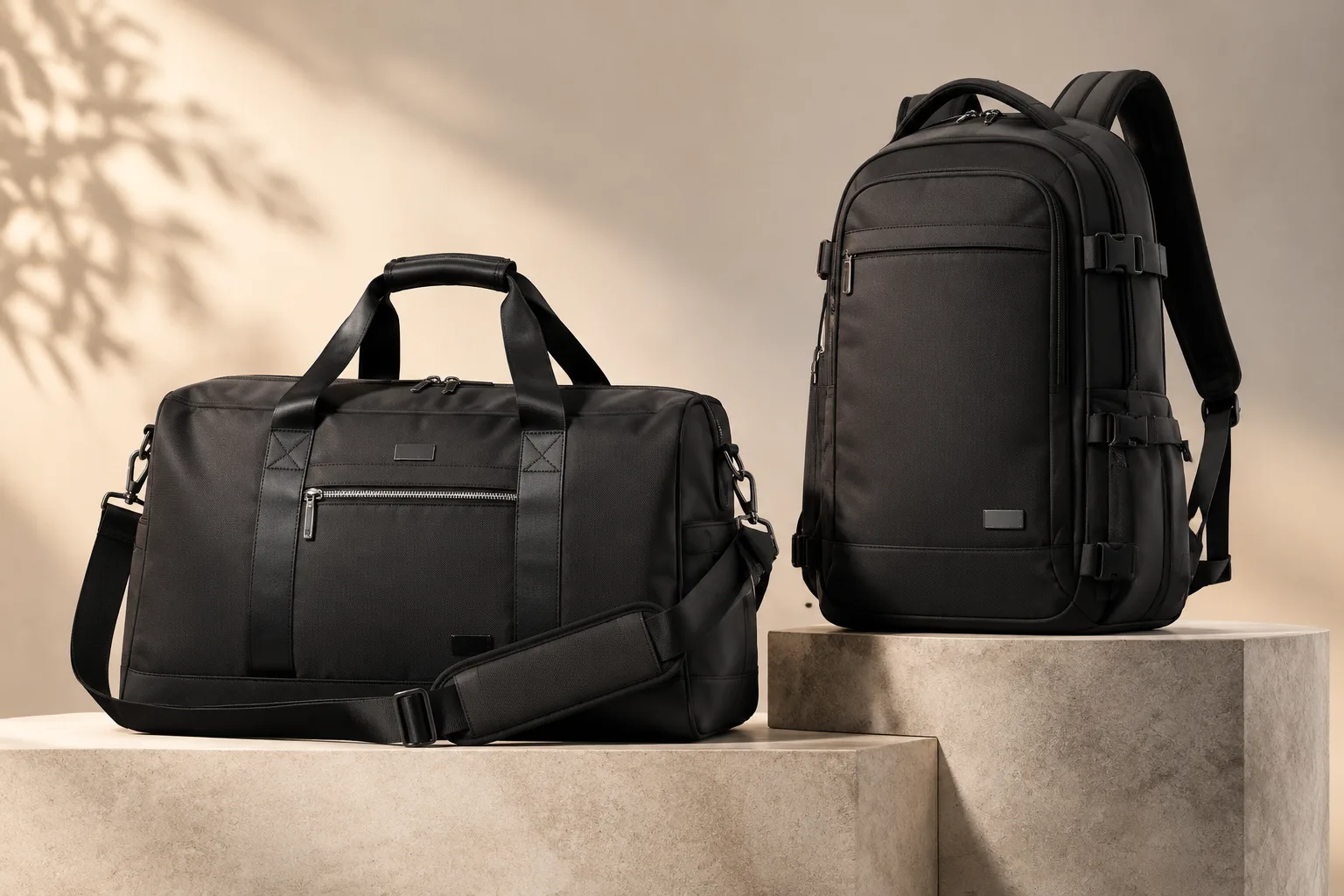
At Senszx, founded in 2006 in Baigou, China—the global epicenter of luggage manufacturing—we have spent over two decades engineering, prototyping, and mass-manufacturing high-performance travel bags, weekenders, technical backpacks, and travel accessories for leading private-label brands, retail chains, and enterprise merchandise programs worldwide. Operating 100 dedicated production sewing lines with BSCI, ISO 9001, ISO 14001, and ISO 45001 certifications, we transform rough sketches, digital tech packs, and physical reference samples into flawless, export-ready travel goods.
This comprehensive technical treatise delivers the definitive B2B roadmap for travel brands seeking to evaluate, audit, sample, and scale production with an overseas bag manufacturer.
Whether you are preparing your initial custom bag RFQ specification, drafting a comprehensive luggage tech pack, calculating FOB cost structures with our bag manufacturing cost breakdown, exploring technical textiles in our custom fabric catalog, reviewing premium hardware in our zipper pullers and buckles guide, evaluating diverse silhouettes in our types of backpacks guide, mastering custom travel bags with logo manufacturing, or partnering directly with our certified OEM travel bag factory, this technical treatise delivers the precise engineering frameworks needed to build a durable, profitable luggage brand.
1. The Travel Sourcing Dilemma: Product Fit vs. Factory Scale
One of the most persistent and costly errors made by emerging travel brands is evaluating potential suppliers based solely on superficial metrics such as total square footage, gross worker counts, or broad marketing claims like "We Make All Kinds of Bags." In modern textile manufacturing, extreme specialization is the primary driver of production efficiency, dimensional tolerance, and build quality.
| Factory Category | Core Product Focus | Machinery & Workmanship Profile | Suitability for Travel Brands |
|---|---|---|---|
| Promotional Soft-Goods Plants | Drawstring bags, flat cotton totes, non-woven shopping sacks | Lightweight flatbed single-needle machines, basic binding attachments, low-skilled piece-rate labor | Zero (Unsuitable): Inadequate stitch density, lack of heavy walking-foot machines, no structural backing capabilities. |
| Fashion Handbag Workshops | Women's PU purses, evening clutches, fashion shoulder bags | Table-top skiving machines, edge-inking stations, light cardboard stiffeners, cosmetic assembly | Very Low: Focuses on exterior cosmetic finish; lacks knowledge of dynamic load-bearing engineering, heavy webbing, and high-tensile hardware. |
| Heavy-Duty Industrial / Luggage Plants | Structured travel duffels, weekenders, carry-on backpacks, tactical packs | Programmable computerized pattern cutters, heavy-duty walking-foot lockstitch machines, bar-tackers, ultrasonic welding, physical testing lab | Ideal (High Product Fit): Deep expertise in heavy-denier textiles, multi-layer composite structures, structural foam, and mechanical stress distribution. |
1.1 Why Travel Bags Demand Specialized Engineering Logic
A standard travel duffle or carry-on backpack is an assembly of 40 to 80 distinct pattern pieces, 6 to 12 hardware components, multiple foam densities, and several types of binding and zipper tapes. The manufacturing sequence is highly sensitive to pattern tolerance and assembly geometry:
- Multi-Planar Load Distribution: Unlike a tote bag where weight hangs vertically from two simple straps, a travel bag experiences rotational and shear forces when carried via top grab handles, side haul handles, or detachable diagonal shoulder straps. When lifted rapidly off an airport carousel, the kinetic force exerted on the handle anchors is up to 3.5 times the static gravitational mass of the bag's payload.
- Dynamic Volumetric Expansion: When a traveler overpacks a weekender, internal pressure pushes outward against every seam, zipper track, and corner curve simultaneously. If the factory uses standard commercial sewing thread instead of bonded continuous-filament nylon thread (such as #69 / Tex 70), seams will burst under transit pressure.
- Hardware & Substrate Integration: Attaching a heavy-gauge zinc alloy D-ring to an outer shell requires distributing the load across an underlying high-density polyethylene (HDPE) or ethylene-vinyl acetate (EVA) support plate, backed by continuous high-tensile nylon webbing. Without this sub-surface architecture, the metal hardware will tear through the fabric weave within a few travel cycles.
1.2 The Illusion of "One-Stop" Giant Sourcing Agencies
Large sourcing conglomerates often present glossy showrooms exhibiting hundreds of bag styles. However, behind the sales facade, these agencies frequently sub-contract orders to fragmented third-tier workshops lacking unified quality management systems.
When you partner directly with an established, vertically integrated manufacturer like Senszx, you gain direct access to our in-house pattern makers, dedicated material sourcing teams, synchronized cutting workshops, and accredited physical testing laboratories—ensuring total transparency from initial CAD drafting to container loading.
1.3 The Lifecycle Cost of Subcontracted Production
When a sourcing broker or non-specialized factory takes on a travel bag project, they invariably face production bottlenecks that result in emergency shortcuts:
- Inconsistent Sewing Gauges: Subcontractors utilize differing needle gauges (from 110/18 to 140/22) across unsupervised sewing lines, creating visible discrepancies in stitch length and seam tightness across the same production lot.
- Adhesive Degradation: Non-specialized workshops use low-grade water-based contact adhesives for foam-to-fabric lamination that delaminate and bubble under high humidity or temperature fluctuations in cargo containers.
- Unmonitored Sub-Assembly Inspections: Defects in hidden internal pocket seams or shoe tunnel liners remain undetected until final retail customers put heavy shoes or wet clothing inside the bag.
2. Market Search Demand & Sourcing Intelligence (Real-Time Semrush Data)
To build a commercially viable luggage line, travel brands must align their product development with verified commercial search intent and buyer acquisition economics. Based on our real-time Semrush market intelligence for the United States (US) market:
| Core Sourcing Keyword | US Monthly Search Volume | Keyword Difficulty (KD%) | Primary Search Intent | Average Google CPC ($) | Sourcing Strategy & Application |
|---|---|---|---|---|---|
| travel bag manufacturer | 50 | 25% | Commercial | $1.88 | Direct B2B supplier discovery; high conversion intent. |
| custom travel bag | 390 | 15% | Commercial | $1.72 | Prime target for DTC custom luggage programs and corporate gifting. |
| custom travel bags | 720 | 19% | Commercial | $1.72 | Plural high-intent commercial keyword; low ranking barrier. |
| customized travel bags | 140 | 20% | Commercial | $1.76 | High-affinity commercial modifier for branded luggage. |
| duffle bag manufacturer | 70 | 17% | Commercial | $2.82 | High commercial bid value; strong B2B manufacturing intent. |
| duffle bag manufacturers | 50 | 17% | Commercial | $2.82 | Volume procurement keyword for sports and travel brands. |
| personalized travel bags | 590 | 22% | Commercial / Info | $0.63 | Top-of-funnel boutique brand and merchandise demand. |
| personalized travel bag | 590 | 19% | Commercial | $1.72 | High-margin individual customization and small-batch OEM. |
2.1 Category Volume & Consumer Demand Clusters
In addition to direct B2B factory search queries, downstream consumer demand clusters reveal massive commercial expansion opportunities for travel bag lines:
- Travel Backpacks: 6,900 monthly US searches ($2.10 CPC) — highlighting the growing convergence between business commuter packs and carry-on luggage.
- Packing Cubes & Organizers: 4,800 monthly US searches — representing an essential high-margin modular accessory suite to accompany primary travel bags.
- Weekender Bags: 3,500 monthly US searches — reflecting strong demand for 35L to 45L short-haul lifestyle duffels.
- Customized Duffle Bags: 1,300 monthly US searches — targeted by fitness, corporate, and lifestyle brands.
- Duffle Bags Wholesale: 1,000 monthly US searches — bulk wholesale and institutional procurement demand.
2.3 Sourcing Opportunity Analysis & SERP Intent Mapping
The low Keyword Difficulty (15% to 25% KD) across all major travel bag manufacturing terms indicates an open market opportunity: overseas buyers actively seek direct, reliable factory partnerships with transparent MOQ terms and verifiable technical expertise.
When searching for queries such as travel bag manufacturer or custom travel bag, commercial procurement managers and brand founders are looking for concrete engineering evidence—including factory machinery audits, seam reinforcement standards, physical drop-test protocols, and verified social compliance credentials. By addressing these technical criteria in depth, travel brands can establish high topical authority on Google search while converting visiting buyers into long-term manufacturing contracts.
The low Keyword Difficulty (15% to 25% KD) across all major travel bag manufacturing terms indicates an open market opportunity: overseas buyers actively seek direct, reliable factory partnerships with transparent MOQ terms and verifiable technical expertise.
3. Technical Anatomy of Travel Bags: Materials, Foams & Hardware
A world-class travel bag begins with an uncompromising bill of materials (BOM). Travel brands must possess a thorough technical understanding of synthetic and natural textiles, backing coatings, structural foams, and hardware metallurgy to specify products that outlast competing market offerings.
| Material Component | Technical Specification | Key Performance Attributes | Recommended Travel Application |
|---|---|---|---|
| Ballistic Polyester | 900D – 1680D with Double 0.4mm PU Backing | High tensile strength, extreme puncture resistance, matte luxury texture | Main outer shell for executive weekenders, rolling duffels, and premium travel backpacks. |
| High-Tenacity Nylon | 420D – 1000D Cordura / Invista Nylon 6,6 | Exceptional Martindale abrasion resistance (>50,000 cycles), superior tear strength, lightweight | Technical adventure travel duffels, mountaineering travel packs, heavy-duty base panels. |
| Waxed Cotton Canvas | 16 oz – 20 oz Heavy Duck Canvas + Paraffin Wax Finish | Heritage vintage aesthetic, self-healing surface scratches, natural water repellency | Luxury lifestyle weekenders, heritage duffel bags, boutique resort luggage collections. |
| Waterproof TPU Tarpaulin | 500D – 840D Polyester / Nylon with Double-Sided TPU / PVC Coating | 100% waterproof barrier, wipe-clean surface, high chemical and oil resistance | All-weather expedition duffels, marine travel bags, wet/dry separation interior compartments. |
| Internal Lining | 210D – 300D Oxford Polyester / 190T High-Density Ripstop | Smooth tactile finish, tear-resistant, prevents interior fraying, water-repellent coating | Interior compartment lining, divider walls, shoe tunnel liners, zippered accessory pockets. |
| Structural Foam | 5mm – 12mm High-Density Closed-Cell EVA / Cross-Linked EPE Foam | Shock absorption, dimensional recovery under compression, moisture-resistant | Base panel padding, ergonomic shoulder strap core, laptop/tablet protective compartments. |
| Load-Bearing Webbing | 25mm – 50mm High-Density Seatbelt Polyester / Nylon Webbing | Tensile break strength >1,200 kg, smooth glide through tri-glides, snag-resistant edges | Primary shoulder straps, grab handles, side compression straps, trolley sleeve anchors. |
| Main Zipper Tracks | #8 / #10 Reverse PU Waterproof Coil or Continuous Nylon Coil | Burst strength >1,000N, smooth curve navigation, airtight water resistance | Main top-loading openings, clamshell perimeter zippers, heavy luggage expansion gussets. |
| Load-Bearing Hardware | Electroplated Die-Cast Zinc Alloy / Virgin POM (Acetal) | Anti-corrosion salt-spray tested (48h), break strength >800N, zero brittle fracture at -20°C | Swivel snap hooks, D-rings, luggage foot studs, quick-release side buckles, ladder locks. |
3.1 The Science of Fabric Backings: PU vs. PVC vs. TPU
Raw woven fabric is naturally porous. To transform woven yarn into a weatherproof, structurally stable travel bag shell, a backing layer must be applied to the interior face:
- Polyurethane (PU) Coating: The gold standard for premium travel bags. Applied in 2 to 4 micro-layers (PU 1,000mm to PU 3,000mm hydrostatic head), PU provides excellent water resistance while preserving fabric drape, flexibility, and lightweight characteristics. It remains supple in sub-zero aircraft cargo holds down to -25°C.
- Polyvinyl Chloride (PVC) Backing: A heavy, rigid coating that creates a fully waterproof barrier at low cost. However, standard PVC adds substantial dead weight, emits chemical odors if phthalate plasticizers are unregulated, and tends to stiffen and crack over time when exposed to cold weather. Senszx recommends eco-friendly phthalate-free 0.25mm PVC only for structured utility base panels.
- Thermoplastic Polyurethane (TPU) Lamination: An advanced, eco-conscious lamination that fuses a solid elastic film to the textile. TPU offers unmatched puncture resistance, lifetime hydrolysis resistance, zero toxic emissions, and full compliance with stringent California Prop 65 and EU REACH regulations.
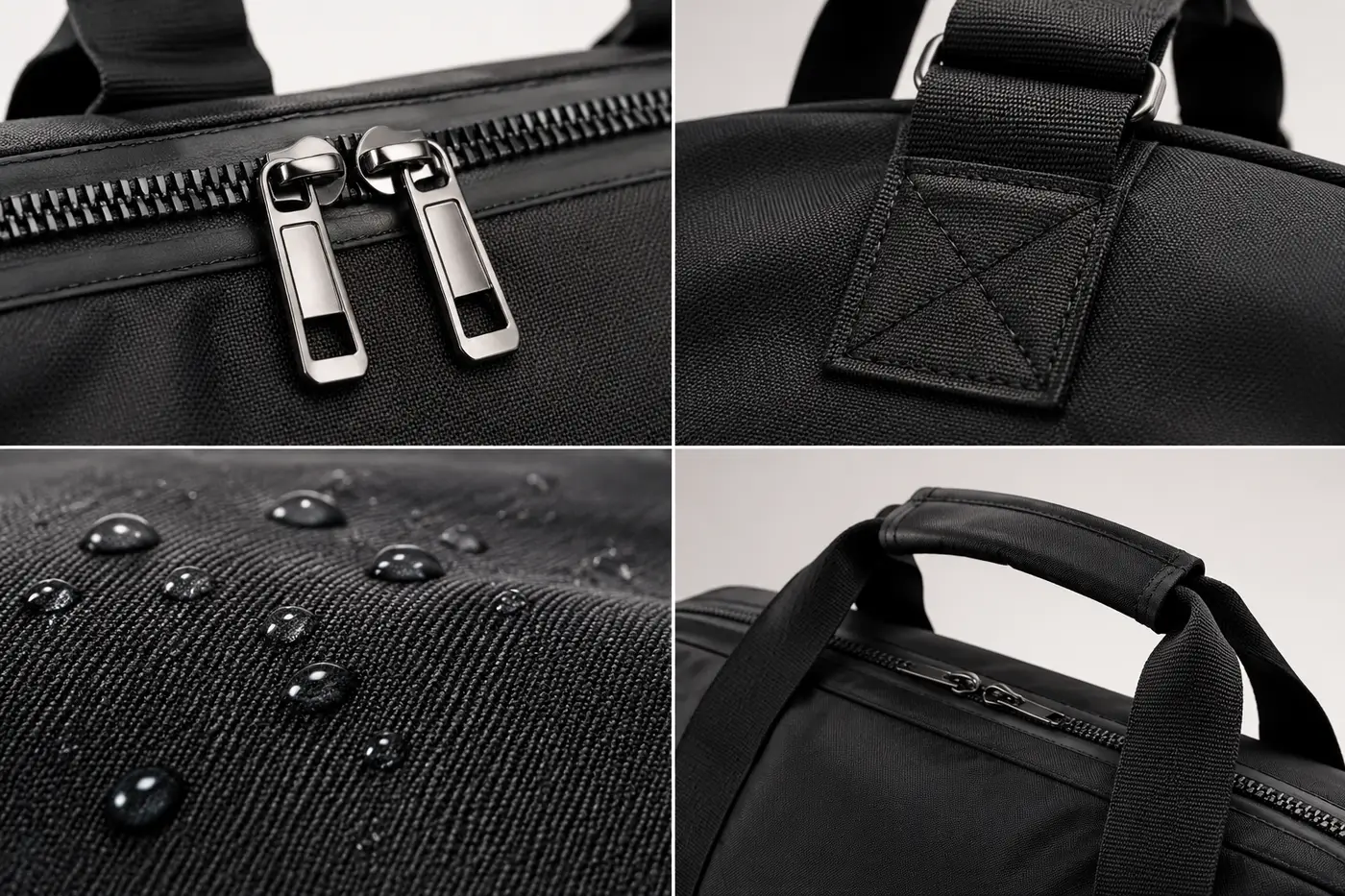
3.2 Hardware Metallurgy and Durability Benchmarks
Hardware failures—such as a snapped shoulder hook or a cracked buckle—are the fastest way to trigger a 1-star product review. Travel brands must specify hardware materials based on mechanical stress requirements:
- Die-Cast Zinc Alloy (Zamak 3 / Zamak 5): Delivers smooth, luxurious metallic finishes (matte gunmetal, brushed nickel, antique brass, electroplated matte black) with high dimensional precision. Must undergo a 48-hour neutral salt spray test (ASTM B117) to guarantee zero surface oxidation or pitting in humid tropical climates.
- Virgin Polyoxymethylene (POM / Acetal Plastic): For technical and outdoor travel bags where weight savings are paramount, POM engineering plastic offers incredible tensile resilience, high impact strength, and extreme fatigue endurance across temperatures ranging from -40°C to +90°C. Never permit a factory to mix in recycled regrind plastic, which drastically lowers impact resistance.
4. Engineering Critical Stress Points: Preventing In-Transit Failures
The true mark of a master bag manufacturer lies in what is hidden beneath the lining. When a travel bag is subjected to dynamic motion, mechanical force concentrates entirely along seams, hardware anchors, and handle junctions.
An inexperienced factory simply stitches through the exterior fabric; a specialized manufacturer builds an internal structural skeletal system to distribute that force across the entire bag chassis.
4.1 The Anatomy of High-Stress Failure Modes and Engineering Solutions
| High-Stress Location | Common Field Failure Mode | Root Manufacturing Cause | Senszx Industrial Engineering Countermeasure |
|---|---|---|---|
| Top Grab Handle Base | Seam tearing out of shell fabric under 15kg+ dynamic lifting shock. | Sewing directly onto unsupported single-layer fabric; low stitch density. | Double-box-and-cross ("X-box") lockstitching backed by an internal 1.2mm HDPE load-dispersal anchor plate and continuous bottom webbing cradling. |
| Shoulder Strap D-Ring Tab | Tab ripping away from side seam; metal ring deforming or breaking. | Narrow webbing tab inserted into standard seam allowance without bar tacks; weak zinc alloy. | 50mm folded seatbelt webbing tab anchored across main side seam, secured with two 42-stitch automated CNC bar tacks; 800N-rated solid zinc alloy D-rings. |
| Luggage Trolley Pass-Through | Sleeve seam splitting when pulled across airport curbs; sleeve sagging. | Single-stitched vertical seams; sleeve dimensions too loose, causing bag to tilt. | Double-needle lockstitching with heavy twill binding tape; internal 25mm webbing reinforcement along top and bottom edges; calibrated sleeve width (20cm - 22cm) for snug handle fit. |
| Main Perimeter Zipper | Zipper tape tearing along corner curves; slider teeth separating (bursting). | Radius of corner curve too tight (<40mm), causing excessive tooth tension when packed full. | CAD-optimized corner radii (≥60mm); heavy-gauge #8 or #10 continuous coil zippers installed with synchronized walking-foot guides; edge-reinforced binding tape. |
| Ventilated Shoe Tunnel | Shoe compartment liner tearing away from main cavity divider; odor leakage. | Lightweight 190T taffeta lining without taped seams; single stitch row connecting to base. | Heavy-duty 210D PU-coated ripstop nylon shoe tunnel; dual brass-grommet ventilation eyelets; double-stitched reinforced perimeter bounding seam. |
| Base Panel Corners | Fabric abrasion holes wearing through after repeated placement on tarmac. | Single-layer fabric resting directly on ground without protective elevation. | Dual-layer 1680D ballistic base panel reinforced with internal 6mm high-density EVA foam and 4 to 6 molded abrasion-resistant thermoplastic rubber (TPR) base feet. |
4.2 Thread Science: Stitch Per Inch (SPI) and Tensile Strength
Stitch density is a vital quality indicator in luggage manufacturing. If the stitch per inch (SPI) is too low (e.g., 4-5 SPI), the seam will gap open under tension, allowing water and dust penetration. If the SPI is too high (e.g., 10-12 SPI), the sewing needle acts as a perforating blade, cutting the fabric yarns and weakening the seam:
- Optimal Travel Bag Seam Standard: 7 to 8 Stitches Per Inch (SPI) using bonded continuous-filament nylon thread (#69 / Tex 70) for primary load-bearing structural seams.
- Secondary Interior Lining Seams: 6 to 7 SPI using Tex 40 polyester core-spun thread with enclosed binding tape to prevent edge fraying.
5. OEM vs. ODM Engagement Models: Choosing the Right Development Path
Travel brands approach manufacturing at different stages of development. Deciding between an Original Equipment Manufacturer (OEM) or an Original Design Manufacturer (ODM) model depends on your internal design capabilities, timeline, and product differentiation strategy.
5.1 Pure OEM Manufacturing: Tailored for Proprietary Innovations
In an OEM engagement, the brand retains complete ownership of proprietary designs, unique silhouettes, and custom-tooled components.
- Best Suited For: Established luggage brands, funded DTC startups with in-house industrial designers, and enterprise clients with strict engineering specifications.
- Factory Responsibilities: Precision CAD pattern digitizing, exact material sourcing per the brand's approved BOM, custom mold fabrication (for zipper pulls, metal badges, or molded EVA panels), multi-stage physical prototyping, and rigid production tolerance adherence.
- Key Senszx Advantage: Our dedicated engineering team directly ingests Adobe Illustrator vector files, Clo3D digital apparel models, and tech packs, generating physical first-round prototypes within 3 to 5 business days.
5.2 Value-Added ODM Manufacturing: Accelerated Time-to-Market
In an ODM engagement, the brand leverages the manufacturer's established library of proven luggage chassis, pre-engineered internal organization systems, and verified patterns.
- Best Suited For: Corporate gifting programs, boutique fitness lifestyle brands, sports franchises, and e-commerce entrepreneurs looking to launch a market-validated collection rapidly without investing tens of thousands of dollars in initial R&D.
- Customization Levers: Brands customize outer shell textiles (e.g., switching from standard polyester to 100% recycled RPET Cordura or waxed canvas), custom Pantone colorways, bespoke zipper pullers, custom interior lining prints, 6 distinct branding techniques (embroidery, rubber patches, debossed leather, silk screen, heat transfer, woven labels), and bespoke packaging.
- Key Senszx Advantage: We maintain an extensive catalog of pre-engineered, drop-tested travel bag silhouettes—including 35L weekenders, 45L carry-ons, 60L wheeled duffels, and modular packing cube suites—reducing product development cycles from 6 months down to 2 weeks.
6. Prototyping & Physical Sample Testing: The Pre-Production Validation Protocol
A flawless sample resting on an office table proves nothing about how that product will perform in an international transit network. Travel brands must establish an aggressive physical testing protocol before signing off on Pre-Production Samples (PPS).
6.1 The 5 Essential Physical Laboratory Stress Tests
At Senszx's in-house quality testing facility, travel bag prototypes and pre-production units undergo five rigorous mechanical and environmental stress tests:
| Testing Protocol | Equipment / Method | Testing Parameters | Acceptance Standard |
|---|---|---|---|
| Dynamic Drop Load Test | Free-fall drop tester with quick-release mechanism. | Bag packed with 20 kg distributed payload; dropped 30 consecutive times from 1.0 m height onto hard steel plate. | Zero seam breakage, zero zipper bursting, zero corner puncture, structural shape preserved. |
| Handle Oscillation / Jerk Test | Automated pneumatic handle jerk testing rig. | Bag loaded with 15 kg payload; suspended by top grab handle; jerked dynamically for 2,500 continuous cycles at 30 cycles/min. | Zero stitch elongation (<1mm), zero anchor plate cracking, handle padding intact. |
| Shoulder Strap Tensile Pull Test | Universal mechanical tensile strength tester. | Static tensile force applied to shoulder strap swivel hooks and D-ring anchors. | Must withstand continuous static load of >50 kg (500N) for 4 hours without hardware deformation or seam tear. |
| Martindale Fabric Abrasion Test | Multi-head Martindale abrasion tester (ASTM D4966). | Standard wool abradant rubbed against outer shell textile under 12 kPa pressure. | >20,000 cycles for standard polyester; >50,000 cycles for ballistic nylon/Cordura without yarn breakage or backing delamination. |
| Hardware Salt Spray Corrosion Test | Cyclic salt fog chamber (ASTM B117 / ISO 9227). | 5% neutral NaCl saline solution fog at 35°C continuous exposure for 48 hours. | Zero white rust (zinc corrosion), zero red rust (steel oxidation), smooth swivel action. |
6.2 Functional Real-World Fit & Volumetric Packing Audits
Beyond mechanical lab testing, physical samples must undergo practical ergonomic and volumetric audits:
- Dimensional Carry-On Compliance: Measuring exact external dimensions when the bag is fully packed to maximum volume. For international carry-on bags, dimensions must strictly adhere to IATA and major airline limits (typically 55 x 35 x 20 cm or 56 x 45 x 25 cm / 22" x 14" x 9" including exterior handles and base feet).
- Shoe Tunnel Volume Encroachment: Inserting US Men's Size 12 (EU 46) athletic shoes into the shoe compartment while verifying that at least 70% of the primary compartment volume remains accessible for folded garments.
- Weight Distribution & Center of Gravity: Checking that the shoulder strap pivot geometry keeps the bag flush against the wearer's lumbar region without tilting backward when carried on one shoulder.
7. End-to-End Quality Assurance: Process Control vs. End-of-Line Checking
A common sourcing myth is that hiring a third-party inspection agency to perform a random final check right before container loading guarantees quality. In reality, once 3,000 bags are completely sewn and boxed, critical structural defects—such as an omitted internal reinforcement plate or a misaligned zipper track—are virtually impossible to rectify without destroying the product.
True quality assurance is achieved through rigorous in-process defect prevention across every stage of the manufacturing workflow.
7.1 The Four Pillars of Travel Bag Quality Control
1. Incoming Quality Control (IQC)
Before a single roll of fabric enters the cutting room:
- Fabric rolls are inspected on backlit fabric-inspection machines to identify weaving defects, yarn snags, uneven coating, and color shading variations across rolls.
- Dye lot consistency is measured using spectrophotometers against master Pantone standards, enforcing strict ΔE < 1.0 tolerance.
- Webbing tensile strength, zipper slider glide torque, and hardware plating thickness are validated in the laboratory.
2. In-Process Quality Control (IPQC)
During component fabrication and sub-assembly:
- Automated computerized laser and die cutting ensure pattern piece dimensional tolerances within ±1.0mm.
- Panel-level branding (silk screen printing, embroidery, rubber patches, debossed leather badges) is audited for positioning precision (±1.5mm from CAD datum lines).
- Intermediate sub-assemblies—such as pocket zip insertions, handle strap cross-stitching, and shoe tunnel linings—are verified before being enclosed into the main shell.
3. 100% Final Quality Control (FQC)
As assembled bags leave the 100 parallel sewing lines:
- Every individual bag is placed on a dedicated inspection table to verify overall symmetry, clean thread trimming (zero loose thread tails >2mm), stain removal, and smooth zipper operation across 5 consecutive open/close cycles.
- Metal detector wand sweeps are performed on 100% of finished bags to guarantee zero broken needle tips remain embedded in interior seams.
4. Outgoing Quality Control (OQC) & Pre-Shipment Audit
Prior to container loading:
- Random statistical sampling is performed in accordance with international ANSI/ASQ Z1.4 (ISO 2859-1) / AQL 1.5 Major / 2.5 Minor standards.
- Master export cartons undergo standard ASTM carton drop tests (10-drop sequence on corners, edges, and faces) to verify packaging integrity during ocean transport.
7.2 Travel Bag Defect Classification Matrix
| Defect Category | Definition & Field Impact | Specific Examples in Travel Bags | Factory Action Required |
|---|---|---|---|
| Critical Defect (AQL 0.0) | Poses safety hazard to user or causes catastrophic transit failure. | Broken sewing needle tip inside bag; sharp metal burr on zipper pull; toxic chemical odor (CPSIA violation); shoulder strap detaching completely under light load. | Immediate 100% batch quarantine; re-inspection of entire production run; root-cause machine audit. |
| Major Defect (AQL 1.5) | Significantly impairs functionality, durability, or retail commercial value. | Main zipper slider jamming or jumping teeth; missing internal reinforcement plate; crooked exterior brand logo (>3mm off-center); open structural seam; wrong Pantone colorway. | Defective units returned to rework line; replacement of sub-assembly components; verification against golden sample. |
| Minor Defect (AQL 2.5) | Slight cosmetic imperfection that does not affect performance or durability. | Loose thread tail (>3mm); minor washable chalk mark from pattern layout; slight packaging wrinkle on interior dust bag; minor packaging tape misalignment. | Instant on-table rectification by finishing team; thread trimming and surface wipe-down. |
8. Decoding Sourcing Economics: Single-Track 500 MOQ, Landed Costs & Development Fees
Understanding how a factory structures its Minimum Order Quantities (MOQ), unit pricing, and development fees allows travel brands to negotiate effectively, forecast cash flow, and avoid hidden post-order cost increases.
8.1 The Single-Track 500 MOQ Philosophy vs. Fragmented Minimums
In the luggage manufacturing industry, MOQ is often dictated by raw material suppliers rather than the sewing factory. A fabric dyeing mill typically requires 1,000 to 2,000 meters of textile to run a custom color batch, while specialized metal zipper puller molders require 2,000 pieces per casting.
- The Senszx Single-Track Advantage: Senszx operates a clear, unified single-track OEM/ODM MOQ of 500 pieces per style/colorway.
- How We Make 500 Pieces Feasible: By leveraging our extensive raw material purchasing volume across 100 active sewing lines, we maintain deep stockpiles of premium stock textiles (black, navy, charcoal, olive, coyote brown, slate grey in 600D, 900D, 1680D, and Cordura) and standard high-grade hardware. This enables our brand partners to launch professional 500-unit runs without paying punitive custom-dye surcharges.
8.2 The Development Fee Credit Mechanism
For emerging brands needing to test market reception before committing to a full 500-unit mass production order, Senszx offers a structured, transparent Development Fee Program:
- Upfront Development Investment: An upfront fee ($150 to $300 depending on construction complexity) covers dedicated CAD pattern drafting, material sourcing, precision laser cutting, master artisan sewing, and up to 3 iterative revision rounds.
- 100% Invoice Credit: Upon placement of your mass production order of 500+ pieces, 100% of the development fee is credited back directly against your mass production commercial invoice, effectively making your sample development 100% free of charge.
8.3 Evaluating Landed Cost: FOB vs. DDP Freight Optimization
Sourcing executives must calculate the true Landed Cost Per Unit, which includes factory FOB unit price, ocean/air freight, import tariffs, customs clearance, and domestic warehousing:
| Cost Component | Typical Share of Landed Cost | Critical Cost Driver in Travel Bags | Sourcing Optimization Strategy |
|---|---|---|---|
| Factory FOB Unit Price | 55% – 65% | Fabric denier, stitch complexity, hardware metallurgy, branding technique. | Standardize non-visible internal lining and hardware finishes across multiple SKUs. |
| International Freight (Ocean/Air) | 15% – 25% | Volumetric CBM ratio; carton dimensional dead space. | Implement custom flat-fold packaging engineering to increase 40ft HQ container loading density by 25-35%. |
| Import Tariffs & Duties | 8% – 15% | Harmonized Tariff Schedule (HTS) classification codes (HTS 4202.92). | Work with experienced customs brokers to ensure accurate material declaration (e.g., polyester vs. nylon). |
| Port Handling, Customs & Inland Drayage | 5% – 8% | Demurrage risks, pallet handling, domestic trucking distance. | Select full DDP (Delivered Duty Paid) shipping terms for guaranteed door-to-door cost certainty. |
Because travel bags are high-volume, lightweight items, international ocean freight is heavily influenced by volumetric weight (CBM). Senszx's packaging engineering team designs custom flat-folding techniques and high-density master carton configurations that directly reduce per-unit shipping costs for our US and European partners.
9. Managing Multi-SKU Luggage Collections & Global Logistics
As a travel brand expands from a single flagship weekender into a full luggage collection—encompassing carry-on backpacks, toiletry organizers, garment carriers, and packing cubes—supply chain complexity multiplies exponentially.
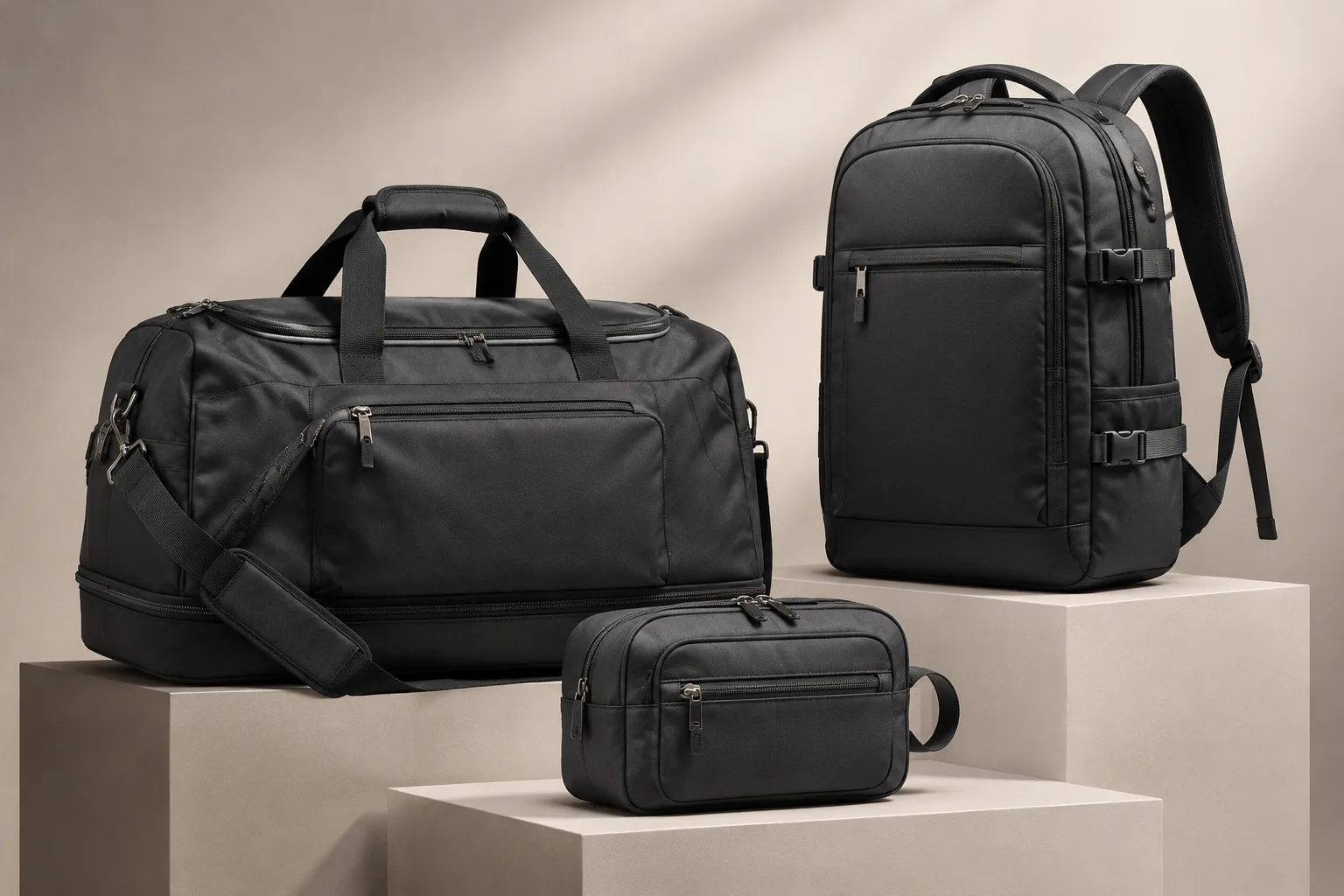
9.1 Modular Component Standardization: Slashing MOQs and Costs
To launch 5 distinct travel bag silhouettes across 4 seasonal colorways (creating 20 distinct SKUs) without triggering massive raw material MOQs, Senszx implements Modular Component Standardization:
- Standardized Non-Visible Substrates: Use identical 210D PU-coated interior lining fabric, #5 interior pocket zippers, 1.2mm internal PE stiffener boards, 8mm EVA shoulder strap foam, and 25mm interior edge binding tape across all SKUs.
- Unified Hardware Ecosystem: Specify a single, cohesive hardware finish (e.g., electroplated matte gunmetal) and universal hook geometries across the entire product family, allowing hardware orders to be consolidated into high-volume pricing tiers (>10,000 units).
- Isolate Surface Customization: Restrict color variations exclusively to the exterior shell textile and exterior zipper pull accents.
| Collection SKU Silhouettes | Standardized Core Components | Unique Exterior Features | Total Raw Material MOQ Efficiency |
|---|---|---|---|
| 45L Executive Weekender Duffle | 210D Charcoal Lining, Gunmetal Hardware, #10 Main Zipper, 8mm EVA Foam | 1680D Ballistic Shell, Integrated Shoe Tunnel, Trolley Sleeve | +40% MOQ Reduction via shared internal substrate inventory. |
| 32L Clamshell Travel Backpack | 210D Charcoal Lining, Gunmetal Hardware, #10 Main Zipper, 8mm EVA Foam | 900D Oxford Shell, Padded 17" Laptop Compartment, Chest Sternum Strap | +40% MOQ Reduction via shared internal substrate inventory. |
| 55L Wheeled Rolling Duffle | 210D Charcoal Lining, Gunmetal Hardware, #10 Main Zipper, 8mm EVA Foam | Molded Skid Plate Chassis, Telescopic Aluminum Trolley Handle | +35% MOQ Reduction via shared internal substrate inventory. |
| 6L Modular Toiletry / Dopp Kit | 210D Charcoal Lining, Gunmetal Hardware, #8 Water-Resistant Zipper | Waterproof TPU Interior Pocket, Stowable Hanging Swivel Hook | +50% MOQ Reduction via shared internal substrate inventory. |
9.2 Master Carton Packaging and Container Loading (CBM) Optimization
Poor export packaging can result in crushed bags, permanent fabric creasing, and exorbitant freight bills:
- 5-Ply Double-Wall Corrugated Cartons: Master cartons are built from 275# burst-strength Kraft paper (ECT 44) with moisture-resistant outer coatings, capable of withstanding high humidity in ocean container transit.
- Internal Structural Collars: High-density cardboard collar inserts are placed inside structured weekenders to preserve panel geometry during stacking without adding unnecessary volumetric bulk.
- Palletization & Container Stuffing Calculations: Prior to production, our logistics engineers calculate exact carton dimensions to perfectly fill standard 20ft GP (28 CBM), 40ft GP (58 CBM), and 40ft High Cube (68 CBM) shipping containers, eliminating expensive empty dead space.
10. Supplier Due Diligence: Factory Red Flags & 100-Point Audit Scorecard
Before signing a commercial contract or transferring a financial deposit, travel brand sourcing directors should perform systematic due diligence using our standardized 100-Point Factory Evaluation Scorecard.
10.1 Sourcing Red Flags: Warning Signs During Factory Audits
| Factory Red Flag | What It Really Means Behind the Scenes | Commercial & Operational Risk |
|---|---|---|
| Vague or Instant Affirmations ("Yes, we can do anything at half the price") | The supplier has not analyzed your tech pack, seam complexity, or material costs; they plan to cut corners during bulk production. | Extreme risk of sample-to-bulk degradation, substandard fabric substitution, and surprise price hikes mid-production. |
| No In-House Physical Testing Lab | The factory does not own tensile testers, drop test rigs, or salt spray chambers; quality checks are purely visual. | Undetected seam burst failures, broken hardware under transit loads, and expensive consumer warranty claims. |
| Reluctance to Do Live Video Facility Tours | The entity is a trading intermediary or broker operating out of a residential office rather than a real manufacturing plant. | 15% to 30% broker markups, zero direct communication with pattern makers, and total loss of quality control. |
| Unwillingness to Sign IP & Quality Agreements | The factory may share your proprietary CAD patterns and designs with third-party competitors or list them on public B2B marketplaces. | Loss of brand design exclusivity; direct intellectual property counterfeiting. |
| Missing Social Compliance Certifications | The facility has not undergone independent third-party audits for fair labor, safe working conditions, or environmental management. | Legal import rejection, customs seizure, and severe public relations damage if exposed by investigative journalists. |
10.2 The 100-Point Factory Audit Scorecard
| Evaluation Pillar | Max Points | Specific Factory Audit Criteria | Passing Benchmark |
|---|---|---|---|
| 1. Technical Product Fit | 25 pts | Dedicated travel/luggage sewing lines (10 pts); heavy walking-foot machines & computerized laser cutters (8 pts); specialized in-house pattern engineers (7 pts). | ≥ 20 pts |
| 2. Material & Supply Chain | 20 pts | Direct partnerships with certified fabric mills (Cordura/Oxford) (8 pts); strict IQC spectrophotometer testing (6 pts); eco-friendly chemical compliance (REACH/CPSIA) (6 pts). | ≥ 16 pts |
| 3. Quality Assurance & Lab | 25 pts | In-house physical testing lab (drop, tensile, abrasion) (10 pts); documented 4-stage IQC/IPQC/FQC/OQC procedures (8 pts); clear defect AQL standards (7 pts). | ≥ 21 pts |
| 4. Operational & Compliance | 15 pts | Active BSCI, ISO 9001, ISO 14001, ISO 45001 audits (8 pts); transparent ERP order tracking & revision control (7 pts). | ≥ 12 pts |
| 5. Commercial Terms & Logistics | 15 pts | Clear 500 MOQ policy with development fee credit (5 pts); 3-5 day sampling & 20-day production lead times (5 pts); advanced CBM packaging optimization & DDP shipping (5 pts). | ≥ 12 pts |
| TOTAL SCORE | 100 pts | Comprehensive Supplier Competency Rating | ≥ 81 pts (Approved) |
11. Why Senszx is the Premier OEM/ODM Partner for Global Travel Brands
For international travel brands, corporate merchandising directors, and luggage innovators seeking a dependable, high-precision manufacturing partner in China, Senszx provides an unmatched combination of industrial capability, engineering precision, and commercial flexibility.
11.1 The Senszx 7-Step Manufacturing Workflow
From the moment you transmit your initial project briefing to final destination delivery, our integrated manufacturing pipeline guarantees complete transparency and zero surprises:
- Engineering Review & DFM Analysis (Day 1): Our senior pattern engineers audit your CAD tech pack or reference photos, providing Design for Manufacturability (DFM) feedback to optimize seam strength, reduce material waste, and lower production costs.
- Rapid Physical Prototyping (Days 2–5): In our dedicated sample room, master artisans draft digitized patterns, laser-cut components, and assemble your physical prototype within 3 to 5 business days.
- Physical Lab & Fit Testing (Days 5–7): The sample undergoes dynamic drop load testing, tensile pull testing, and airline carry-on dimensional verification in our accredited lab.
- Pre-Production Sample (PPS) Sign-Off (Days 8–10): The refined prototype is shipped via DHL/FedEx for your hands-on evaluation. Upon your approval, a master "Golden Sample" is sealed and logged into our production ERP system.
- Precision Mass Production (Days 10–30): Bulk fabric lots are spread and cut via automated computerized cutters. 100 parallel sewing lines execute precision assembly under continuous IPQC inspection.
- 100% Final Inspection & Metal Detection (Days 28–30): Every finished bag is hand-inspected for cosmetic perfection, zipper glide torque, and thread trimming, followed by 100% metal detector safety sweeps.
- Custom Export Packaging & Global Shipping: Finished goods are flat-packed in high-density 5-ply Kraft cartons, palletized, and dispatched via ocean, air, or DDP direct-to-warehouse logistics.
Technical Summary & Decision Matrix
To streamline your manufacturer evaluation process, the following decision matrix synthesizes the critical criteria required at each stage of the sourcing journey:
| Evaluation Stage | Key Technical Deliverables | Critical Questions to Ask Potential Factories | Senszx Guaranteed Standard |
|---|---|---|---|
| Initial Sourcing & RFQ | Detailed Tech Pack, 2D/3D CAD vector artwork, target BOM. | "What specific travel bag silhouettes have you produced in the last 12 months? Can you show physical samples?" | Direct access to 20+ years of luggage manufacturing archives and technical DFM analysis within 24 hours. |
| Sampling & Prototyping | Physical prototype, material swatch cards, dimensional test report. | "Do you build patterns in-house? What is your sample turnaround time and revision policy?" | In-house CAD pattern makers; 3 to 5 business days sample turnaround; up to 3 iterative revision rounds with 100% development fee rebate. |
| Stress & Lab Validation | Dynamic drop test logs, tensile pull charts, salt spray test certificates. | "Can you perform 20kg drop testing and >50kg static strap pull testing in your own facility?" | Fully equipped in-house physical testing laboratory with video-documented test verification. |
| Commercial Terms & MOQ | Formal FOB/DDP quotation sheet, raw material lead-time schedule. | "What is your strict MOQ per style/colorway? Are there hidden custom-dye surcharges?" | Single-track 500 MOQ per style/colorway; transparent cost breakdowns with zero hidden fees. |
| Mass Manufacturing | In-process inspection logs, FQC defect reports, metal detection certificates. | "How do you control quality during sewing? What AQL standards do you enforce?" | 100 parallel sewing lines; 4-stage IQC/IPQC/FQC/OQC quality management; strict AQL 1.5/2.5 pre-shipment audit. |
| Logistics & Export | Master carton CBM calculations, palletization plans, customs documentation. | "How do you optimize carton dimensions to maximize 40ft HQ container loading density?" | Advanced CBM packaging engineering reducing freight volume by 25-35%; complete DDP/FBA export logistics support. |
Detailed Appendix: Technical Formulas, Sourcing Glossary & Material Conversion Charts
Appendix A: Key Engineering Formulas for Travel Bag Sourcing
- Fabric Yarn Denier to Metric Weight Conversion: $$\text{Weight in Grams per Square Meter (GSM)} \approx \frac{\text{Denier} \times \text{Weft Density (threads/inch)}}{100} \times \text{Coating Factor (1.15 to 1.35)}$$
- Master Carton Volumetric Weight (Air vs. Ocean CBM): $$\text{Air Freight Volumetric Weight (kg)} = \frac{\text{Length (cm)} \times \text{Width (cm)} \times \text{Height (cm)}}{5,000 \text{ or } 6,000}$$ $$\text{Ocean Container Volume (CBM)} = \frac{\text{Length (cm)} \times \text{Width (cm)} \times \text{Height (cm)}}{1,000,000}$$
- Total Manufacturing Capacity Utilization Rate: $$\text{Capacity Utilization (%)} = \left( \frac{\text{Actual Output (Units)}}{\text{Maximum Operating Line Capacity (Units)}} \right) \times 100%$$
Appendix B: Sourcing & Industrial Glossary for Luggage Buyers
- AQL (Acceptable Quality Limit): The maximum percentage of defective units in a production lot that can be considered acceptable during random pre-shipment sampling inspection.
- Bar Tack: A series of tight, closely spaced zigzag stitches (typically 28 to 42 stitches) sewn perpendicularly across high-stress seam joints and webbing anchor points.
- BOM (Bill of Materials): A comprehensive, itemized list of raw materials, components, hardware, linings, threads, labels, and packaging materials required to construct one complete unit of a bag.
- CBM (Cubic Meter): The standard unit of volume used in international freight forwarding to calculate ocean and air container stuffing capacity.
- DFM (Design for Manufacturability): The engineering practice of refining product blueprints and patterns to make manufacturing more efficient, durable, and cost-effective.
- DWR (Durable Water Repellent): A chemical fluorocarbon or silicone polymer finish applied to the exterior face of woven fabrics to cause liquid water to bead up and roll off the surface.
- HTS (Harmonized Tariff Schedule): Standardized numerical classification codes used by international customs authorities to determine import tariffs, taxes, and duties.
- IQC / IPQC / FQC / OQC: The four sequential stages of industrial quality assurance: Incoming Quality Control, In-Process Quality Control, Final Quality Control, and Outgoing Quality Control.
- Martindale Abrasion: An international standardized mechanical test that measures the wear and abrasion resistance of textiles by rubbing a standardized abradant in a Lissajous motion.
- POM (Polyoxymethylene / Acetal): A high-performance engineering thermoplastic characterized by high stiffness, low friction, and exceptional dimensional stability across extreme temperatures.
- PPS (Pre-Production Sample): The definitive physical prototype manufactured using actual bulk mass production materials and tooling, signed off by the brand as the golden standard for mass sewing.
- SPI (Stitches Per Inch): The numerical count of individual lockstitches per linear inch of seam, determining tensile holding strength and fabric perforation thresholds.
- Tex / Ticket Number: Standardized metric measurement systems defining the linear density and physical thickness of sewing threads.
Ready to Engineer Your Next Market-Leading Travel Bag Collection?
Whether you are launching a bespoke private-label weekender collection, engineering an indestructible tactical travel pack, or seeking a reliable high-capacity OEM/ODM luggage manufacturing partner to scale your business, the engineering team at Senszx is ready to transform your vision into market-dominating reality.
Contact our international business and technical engineering team today to receive a comprehensive DFM review, material swatch consultation, and an itemized production quotation:
- Official Website: https://senszxfactory.com/
- Explore Our Travel Line: Senszx Custom Travel Bags & Duffels
- Explore Custom Backpacks: Senszx Custom Backpack Manufacturing
- OEM & ODM Capabilities: Senszx OEM & ODM Services
- Request a Development Sample: Senszx Sample Prototyping Program
- Quality Assurance Standards: Senszx Quality Control & Testing
- Direct Business Email:
[email protected] - Direct WhatsApp / Phone:
+86 17331531825 - Factory Headquarters: Industrial Production Zone, Baigou, Hebei Province, China
Hi, I'm Senszx Bag Manufacturer, Hope You Like This Blog Post.
With more than 20 years of experience in OEM/ODM/Custom luggage and bag, I'd love to share with you the valuable knowledge related to luggage and bag products from a top-tier Chinese supplier's perspective.
Senszx Factory
Est. 2006 · Baigou, China
Related articles
How to Choose the Right Materials for Travel Bags: The Complete Manufacturer Guide
A comprehensive B2B engineering guide to selecting travel bag materials: comparing polyester, nylon, Oxford, canvas, TPU coatings, hardware, and structural interlinings across durability, GSM, abrasion, and manufacturing cost.
Bulk Backpacks: The Complete Wholesale Buying Guide for 2027
How brands, distributors, schools and charities buy backpacks in bulk: sourcing paths, styles, fabrics, customization, unit price drivers, MOQ, lead times, QC and shipping.
Wholesale Toiletry Bags: The Complete Sourcing Guide for 2027
How travel brands, grooming labels, retailers and distributors source toiletry bags in bulk: styles, materials, customization, MOQ, pricing, QC and shipping.
Get a Custom Bag Quote from Our China Factory
Our sales team is online around the clock and usually replies within the hour.
Email
[email protected]Factory
Qinzheng Road No.89, New Industry Zone, Baigou Town
Baoding City, Hebei Province 074004, China