How to Manufacture Custom Tote Bags: The Complete Factory Guide
How custom tote bags are manufactured: canvas selection, tech pack, sampling, screen printing, sewing, QC, MOQ, cost drivers and lead times - from a bag factory.
A tote bag is the simplest product a bag factory makes - and the easiest one to get wrong at volume. A basic canvas tote has fewer than ten cut pieces, two handles and no zipper, so almost any workshop can sew one acceptable sample. The difference between a sample and a program shows up at piece 3,000: handles that stretch at different rates, print colours that drift between batches, seams that pucker on heavier canvas, and bags that arrive creased because nobody specified how they should be folded. Buying custom tote bags is not about finding someone who can make the bag - it is about finding a process that makes the same bag every time.
Custom tote bags are manufactured in a fixed sequence: the buyer's artwork and specifications are turned into a costed tech pack; canvas or alternative fabric is selected by weight and weave; a pattern is drafted and a pre-production sample approved; fabric is relaxed, cut in bulk and printed flat before assembly; panels are sewn, handles attached with reinforced stitching, and every bag passes a visual and measurement check before folding and packing. The approved sample and signed-off print swatch are the production standard - everything in bulk is measured against them.
This guide walks through that sequence the way it actually runs on a factory floor, with the decisions a buyer has to make at each stage, the numbers that matter, and the points where tote programs most often fail. It is written for brand owners, promotional products distributors, retailers and corporate buyers who order custom tote bags in bulk and want to understand exactly what they are paying for.
What Do You Need Before a Tote Bag Goes into Production?
Every tote bag project should start with a written specification the factory can quote from, sample from and inspect against. Because totes look simple, buyers often send a logo file and a one-line brief - "1,000 canvas totes with our logo" - and then discover at the sample stage that the factory's idea of a tote and theirs are two different bags. Four sentences of specification prevent three rounds of re-sampling.
A quotable tote bag brief answers these questions:
- Finished size - width x height x gusset depth, in centimetres. A 38 x 40 cm flat shopper and a 35 x 38 x 10 cm gusseted grocery tote are different patterns, different fabric consumption and different prices.
- Fabric and weight - cotton canvas 8 oz or 12 oz, 10 oz recycled cotton, RPET polyester, jute laminate. Weight drives cost more than any other single choice.
- Handle specification - length (hand-carry ~35 cm, shoulder ~65 cm), width (2.5-3.8 cm typical), self-fabric or webbing, and whether handles must hold a stated load.
- Branding - method (screen print, heat transfer, embroidery), number of print colours, print size and placement, one side or both.
- Construction details - interior pocket yes/no, bottom gusset, side gussets, top hem depth, bartack or cross-box handle reinforcement.
- Quantity and colourways - total pieces and split per fabric colour. 2,000 pieces in one colour is one production run; 2,000 across four colours is four small runs sharing tooling.
- Packing - folded flat in polybags, bulk-packed in bales, or boxed per 50 with a barcode label.
If you already run RFQs for other bag categories, the same discipline applies here - our guide on how to prepare a custom bag RFQ and the checklist of what information to send a bag factory for quotation both map directly onto tote projects.
Does a Tote Bag Really Need a Tech Pack?
A full garment-style tech pack is overkill for a stock-shape tote with a one-colour print. A one-page specification sheet with a dimensioned drawing, fabric callout, handle spec and print placement diagram is enough, and any factory can work from it. The moment the bag carries retail expectations - specific Pantone matches, lined interior, zip closure, leather trim, load rating - a proper spec document pays for itself. The structure described in our backpack tech pack guide scales down naturally: keep the measurement table, the bill of materials and the artwork page; drop the sections that only apply to complex multi-panel bags.
The one element you should never skip, even on promotional orders, is the print placement diagram: the artwork positioned on a dimensioned drawing of the bag face, with the print's width and its distance from the top hem stated in centimetres. "Centred" is not a specification - centred between the handles, centred on the panel, and optically centred under the hem are three different positions, and a screen printer will pick whichever is fastest.
Which Fabric Should a Custom Tote Bag Use?
Fabric choice sets the bag's hand feel, print quality, load capacity and roughly 40-55% of its FOB price. The practical range for custom tote bags:
| Fabric | Typical weight | Character | Best for |
|---|---|---|---|
| Cotton sheeting | 4-5 oz (140-170 gsm) | Light, drapey, economical | Giveaway and conference totes |
| Cotton canvas | 8 oz (270 gsm) | Crisp body, prints well | Everyday retail and promo totes |
| Heavy cotton canvas | 10-12 oz (340-410 gsm) | Stiff, structured, premium feel | Retail, grocery, bookstore totes |
| Recycled cotton blend | 8-10 oz | Sustainability story, slight slub | Brands with recycled-content claims |
| RPET 600D polyester | ~300 gsm equivalent | Wipeable, colourfast, holds shape | Reusable shopping programs |
| Jute with laminate | 300-400 gsm | Natural texture, high stiffness | Gift and wine totes |
| Organic cotton canvas | 8-10 oz | Certified fibre story | GOTS-conscious retail brands |
Three practical notes from production:
- Weight is a specification, not a vibe. "Heavy canvas" means nothing in a quote. 10 oz means 10 oz ± 5%, and a factory should be able to show a scale weight on the relaxed fabric. A supplier who swaps 10 oz for 8 oz saves about 18-20% on fabric cost, and most buyers never weigh the bag.
- Natural canvas prints differently from dyed canvas. Unbleached natural cotton carries flecks and a warm base tone; the same navy ink reads darker on it than on bleached white. If colour accuracy matters, approve the print on the actual production fabric, not on a white test swatch.
- Dyed canvas needs a crocking test. Dark dyed cotton - black, navy, bottle green - can transfer colour onto light clothing when rubbed. A dry and wet crocking test (AATCC 8) on the production dye lot takes a day and prevents the single most common retail complaint on dark totes.
For a deeper treatment of how fabric families, deniers and coatings behave across bag categories, see our custom fabrics guide and the companion article on what Cordura fabric actually is - the testing logic transfers directly even though totes rarely use technical nylons.
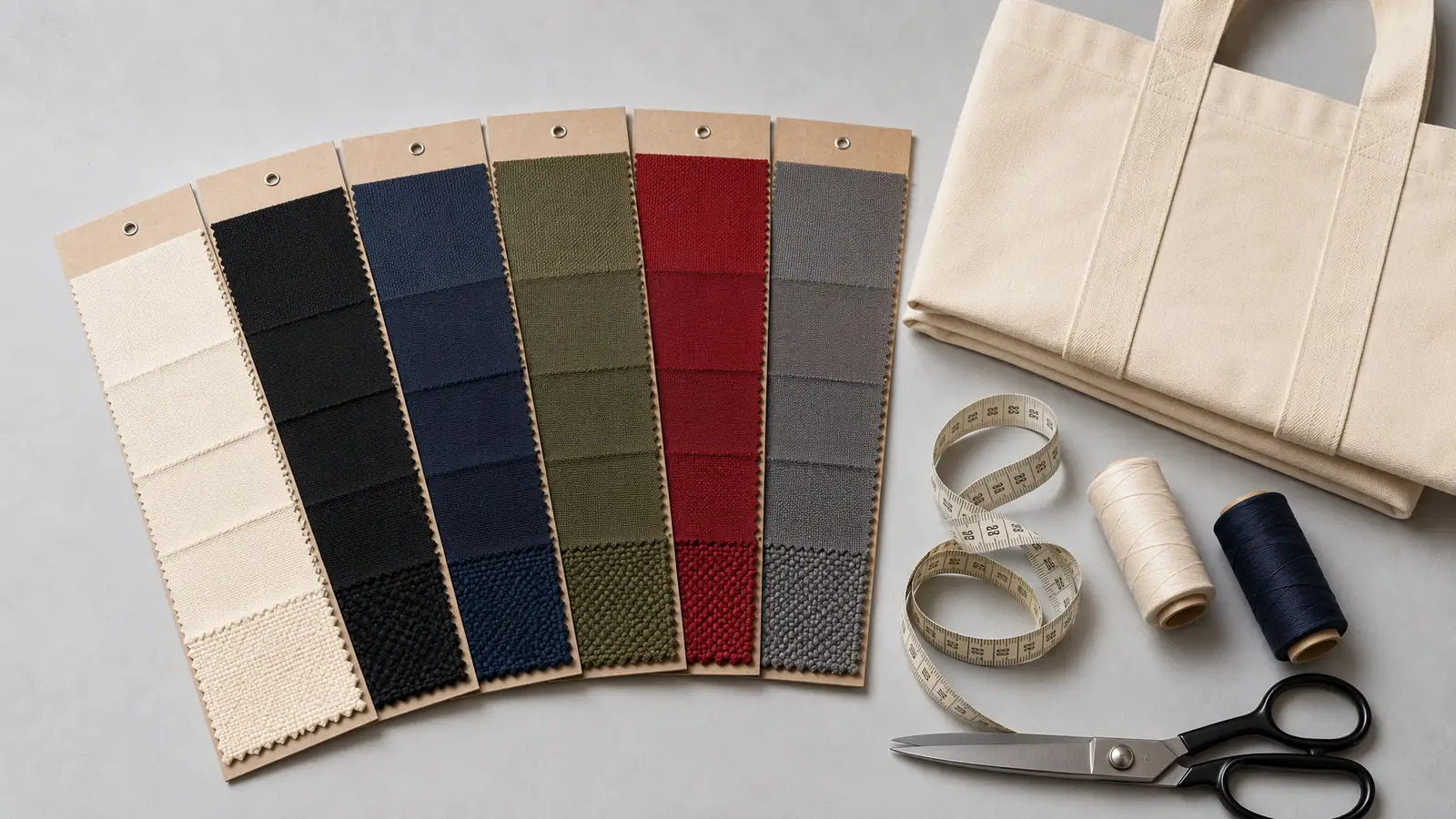
How Does Fabric Weight Change the Bag's Behaviour?
The weight decision is really a structure decision. Below 6 oz, a tote collapses into a soft pouch - fine for a conference handout, wrong for a bag that must stand open at a grocery checkout. From 8 oz, the bag begins to hold a silhouette; at 10-12 oz it stands up empty, takes a crisp screen print, and survives years of machine washing. The cost curve is close to linear with weight, but perceived value is not: in blind handling tests buyers consistently rate a 10 oz tote as "more than twice the quality" of a 5 oz tote, while its FOB difference is typically only $0.60-0.90 on a mid-size shopper. If the bag represents a retail brand, the step from sheeting to mid-weight canvas is the cheapest perceived-quality upgrade available.
What About Handles and Webbing?
Handles fail before panels do, so handle specification deserves more attention than it usually gets:
| Handle type | Construction | Load behaviour | Typical use |
|---|---|---|---|
| Self-fabric, folded x4 | Same canvas, folded and topstitched | Matches body, softens with use | Classic canvas totes |
| Cotton webbing | Woven 2.5-3.8 cm tape | Higher tensile, keeps shape | Grocery and heavy-load totes |
| Polyester webbing | Woven PP/PES tape | Highest tensile, colourfast | RPET and utility totes |
| Rolled leather or PU trim | Stitched rolled handle | Premium look, moderate load | Boutique retail totes |
Two construction rules decide whether handles survive: the attachment stitch and the stitch-back length. A handle sewn with a single straight row across the hem will pull out under a sustained 8-10 kg load. The standard for a bag that claims any load capacity is a cross-box (box-X) stitch over a handle end that extends at least 4 cm below the hem - on heavy grocery totes, the handle webbing should run under the bag base entirely, so the load path is webbing-to-webbing rather than webbing-to-seam. If your program needs certified load claims, say so at RFQ stage: the factory will build the sample to the test, not test the sample it happened to build.
How Does Tote Bag Sampling Work?
Sampling is where a tote program is actually decided. Bulk production only reproduces what the approved sample locked in - it never improves it. A disciplined sampling sequence for custom tote bags has three gates:
- Proto / fit sample (optional for stock shapes). Sewn in available fabric, often unprinted. Its only job is to confirm dimensions, gusset behaviour and handle length. For a standard shopper shape, most buyers skip this and go straight to pre-production.
- Pre-production sample (PPS). Sewn in the production fabric, in the production colour, with the real print in the real position. This is the sample that matters: approve it in writing, photograph it, and keep one counter-sample on each side. Every bulk bag will be judged against it.
- Print strike-off. For multi-colour or Pantone-critical artwork, a flat print test on the production fabric comes before the PPS. Ink opacity, registration between colours and hand feel of the print are approved here, so the PPS round only confirms placement.
A realistic timeline: strike-off in 2-3 days, PPS in 3-5 days, one revision round 3-4 days. Budget two weeks from artwork handoff to signed PPS and the schedule will hold; compress it to three days and the bulk order inherits whatever nobody had time to check. The same staged logic applies across our categories - the free sample program covers how sample costs and courier fees are typically handled and when they are credited back against the bulk order.
What Should You Actually Check on a Tote Sample?
A tote sample review takes fifteen minutes with a tape measure and a kitchen scale. Check, in order:
- Finished width, height and gusset against spec (tolerance ±1 cm)
- Fabric weight - weigh the bag, divide by its area; a 38x40 cm 10 oz tote with 65 cm handles should weigh roughly 180-210 g
- Handle length and symmetry - both handles equal within 0.5 cm, attachment points mirrored
- Handle attachment - cross-box stitch present, stitch-back length ≥4 cm, no raw webbing ends
- Print position against the placement diagram, measured from the hem, not eyeballed
- Print quality - full opacity, clean edges, no pinholes; scratch the print with a fingernail and flex-crack the fabric
- Seam construction - stitches per inch (7-9 SPI is standard on canvas), no skipped stitches, back-tacked seam ends
- Top hem - even depth, no twisting, handle ends fully enclosed
- Interior - threads trimmed, pocket (if any) square and bartacked at corners
- Smell - uncured ink and residual fabric finishes are detectable immediately and will be worse in a sealed carton
Document everything in one approval email with photos. "Approved as per sample received 14 Nov, print position per attached photo" is a production standard; a WhatsApp thumbs-up is not.
What Is the Actual Manufacturing Process for Custom Tote Bags?
Once the PPS is signed, bulk production follows a sequence that is fixed by the physics of fabric and ink, not by factory preference. Understanding it tells you what questions to ask and which shortcuts to watch for.
Step 1: Fabric Inspection and Relaxation
Canvas arrives in rolls that were wound under tension. Cut it straight off the roll and the pieces shrink unevenly over the next day, so panels sewn in the afternoon are smaller than panels sewn in the morning. Production fabric is unrolled and rested for 12-24 hours, inspected on a light table for weaving flaws, slubs and dye streaks, and shade-sorted so that any roll-to-roll colour variation is isolated within cartons rather than within a single bag.
Step 2: Cutting
Relaxed fabric is spread in layers and cut - die press for high volumes of a repeated shape, straight-knife or automated cutter for mixed sizes. The numbers that matter: layer count appropriate to fabric weight (too many layers of heavy canvas and the bottom layer cuts smaller than the top), pattern pieces aligned with the grain so the finished bag hangs straight, and every cut bundle ticketed with its fabric lot. Totes have few pieces - body, gusset, handles, pocket, maybe a base - which is exactly why cutting discipline is cheap insurance: one mis-cut panel shape repeats ten thousand times.
Step 3: Printing Before Assembly
Logos go onto flat panels before sewing, not onto finished bags. A flat panel registers precisely on a printing table; a sewn bag with seams and a gusset does not. This ordering is also why late artwork changes are expensive - once panels are printed, the artwork is in the bag.
The decoration methods that matter for totes:
| Method | Best for | Colours | Durability | Unit cost at 1,000+ |
|---|---|---|---|---|
| Screen printing | Bold flat graphics | 1-4 spot colours | Excellent on canvas | Lowest |
| Heat transfer (vinyl) | Small runs, fine detail | Full colour | Good; can crack over years | Low-mid |
| Digital / DTG print | Photographic artwork | Unlimited | Good; softer hand | Mid |
| Embroidery | Premium texture | Up to ~9 thread colours | Outstanding | Highest |
| Foil / specialty | Metallic accents | 1 | Moderate | Mid-high |
Screen printing dominates custom tote work for a reason: on 8-12 oz canvas, plastisol or water-based ink lays down with full opacity, survives hundreds of washes, and at volume costs cents per placement. Two specification points separate a good print program from a disappointing one. First, name the ink system: water-based ink sinks into canvas with a soft hand and a matte finish; plastisol sits on the surface with sharper edges and higher opacity on dark fabric. Both are correct - but they look different, and the buyer should choose. Second, approve registration tolerance for multi-colour art: ±1 mm is achievable on a proper press; artwork with 0.5 mm trap lines between touching colours is asking for visible misregistration at production speed.
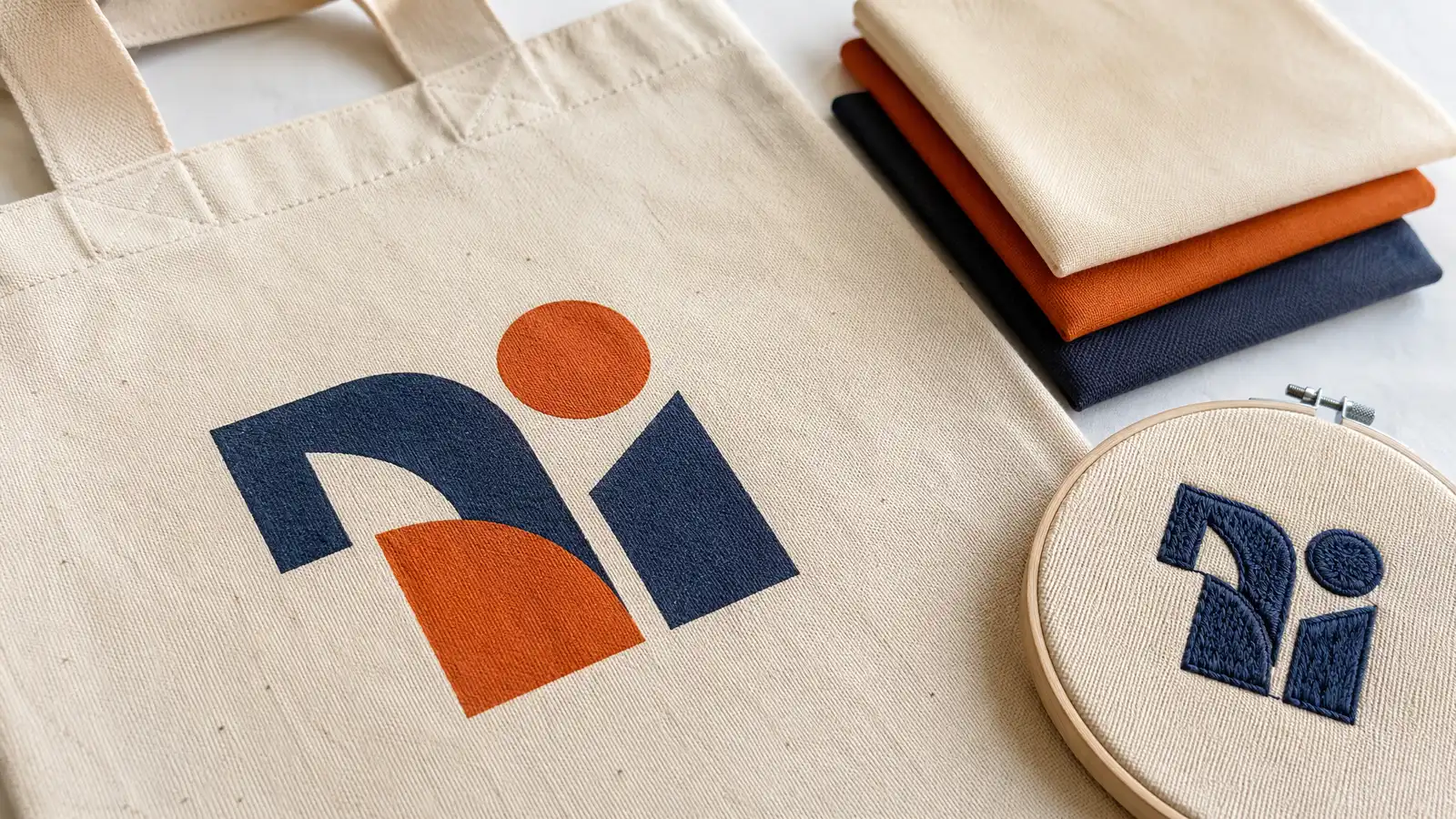
A detailed comparison of these decoration methods across bag categories - including how each behaves on polyester versus cotton - is in our custom travel bags with logo guide, and the branding section of the custom tote bags pillar page shows worked examples on live projects.
Step 4: Sewing and Assembly
Tote assembly on a balanced line runs: hem the top edges, attach printed panels to gussets, close side seams, fold and topstitch handles, position and sew handle attachments with cross-box reinforcement, turn and press. On heavy canvas the machines matter - 12 oz seams need a walking-foot machine and a size 18-21 needle, or the feed dogs push the top layer faster than the bottom and the seam twists. Thread should be bonded polyester in a weight matched to the needle; cotton thread on a heavy canvas seam is the classic cost-cut that surfaces as seam failure in month three.
Seam standards worth writing into the order: 7-9 stitches per inch on structural seams, back-tacks at every seam end, French or overlocked raw edges inside (a raw-edge interior frays visibly after one wash), and handle attachments sewn through both the hem and the body fabric, never through the hem alone.
Step 5: Finishing, Inspection and Packing
Every bag gets threads trimmed, is turned, pressed and inspected. A proper tote inspection is fast - which is why skipping it is inexcusable: silhouette against the counter-sample, measurements on a sampling basis per carton, print position and opacity, handle symmetry, interior cleanliness, and a pull test on one bag per batch where the handles take a loaded-weight hang for 24 hours. Orders shipping to retail get needle-detection as standard; corporate programs usually waive it.
Packing is a specification, not an afterthought. Canvas creases: a bag folded in thirds shows two permanent lines across the print; a bag folded flat once, print outward, shows one soft line that hangs out in a day. State the fold, the polybag (and whether it needs a suffocation warning for retail), units per carton, and carton weight limit - 10 oz canvas is heavy, and a 100-unit carton of large totes exceeds most warehouse manual-handling limits.
The full station-by-station quality system - inline checks, AQL sampling levels, and what a final random inspection report should contain - is documented on our quality control page, and applies to tote programs exactly as it does to backpacks.
What Do Custom Tote Bags Cost, and What Drives the Price?
Tote pricing is transparent once you see the cost stack. For a 38 x 40 x 10 cm gusseted shopper in 10 oz natural canvas with a one-colour screen print, the FOB cost structure at 1,000 pieces typically breaks down as:
| Cost component | Share of FOB | What moves it |
|---|---|---|
| Fabric | 45-55% | Weight, organic/recycled certification, dyed vs natural |
| Cutting and sewing labour | 18-25% | Gussets, pockets, lining, zip closures |
| Printing | 8-15% | Colour count, print size, both sides, ink system |
| Handles and trims | 5-8% | Webbing vs self-fabric, leather trim, labels |
| Packing materials | 2-4% | Polybags, inserts, barcode labels |
| Overhead and margin | 10-15% | Order size, season, factory loading |
Five practical levers move the unit price more than negotiation ever will:
- Fabric weight. The step from 12 oz to 10 oz canvas on a mid-size tote saves roughly 12-15% of FOB with a barely perceptible difference in hand; the step from 10 oz to 8 oz saves another ~12% but is visible in structure. Decide which audience the bag serves before deciding where to land.
- Print colours. Each additional screen colour adds a screen, a setup and a pass through the press. A two-colour logo reduced to a well-designed one-colour version typically saves $0.10-0.18 per bag at 1,000 pieces.
- Natural vs dyed canvas. Natural (unbleached, undyed) cotton skips the dye house entirely - it is usually 8-12% cheaper than the same weight dyed, ships faster, and carries the "eco" look most tote programs want anyway.
- Consolidated colourways. Every fabric colour is its own lot: its own minimum, its own shade approval, its own cutting run. Three colourways at 400 pieces each will always cost more per unit than 1,200 in one colour.
- Order timing. Tote demand spikes before trade-show season (February-April) and year-end gifting (September-October). The same order placed in a trough month frequently lands 5-8% cheaper and two weeks faster.
For context on how these levers behave on more complex constructions, the custom backpack cost breakdown applies the same cost-stack logic to a 40-piece pattern - totes are the simplest case of the same arithmetic.
What Are Realistic MOQs and Lead Times?
For fully custom tote production - your size, your fabric weight, your print - the working MOQ at our factory is 500 pieces per style, with price breaks at 500 / 1,000 / 5,000. Below 500 pieces, projects run under a development-fee model: the setup costs (patterns, screens, sampling) are charged up front and credited back when the bulk order lands. Stock-blank programs with decoration only - printing on ready-made totes - can run lower, but that is a decoration service, not manufacturing, and the fabric and construction are whatever the blank happens to be.
Realistic calendar time for a custom tote program:
| Stage | Duration |
|---|---|
| Quotation from complete spec | 1-2 working days |
| Strike-off + pre-production sample | 3-5 working days |
| Sample revision round (if needed) | 3-4 working days |
| Bulk production (500-5,000 pcs) | ~20 days |
| Needle detection, final inspection, packing | 2-3 days |
| To port / handover | 2-4 days |
Call it 5-6 weeks from signed spec to goods at port for a typical first order, assuming artwork arrives print-ready. Repeat orders skip sampling and compress to roughly 4 weeks. Sea freight, customs and inland delivery sit on top and depend entirely on destination - budget 30-40 days door-to-door for US East Coast sea freight.
How Do You Choose a Tote Bag Manufacturer?
The supplier landscape for custom tote bags splits into three tiers, and most sourcing mistakes come from buying one tier while believing you bought another:
- Decorators print on imported blanks. Fast, low minimums, zero control over construction. Right for one-off events; wrong for retail programs that need a specified fabric weight or load rating.
- Trading companies sit between you and an unnamed factory. Convenient consolidation across categories, but specifications travel through an extra hop, and when a handle fails, accountability is contractual rather than physical.
- Factories cut and sew the bag. Direct control over fabric lots, construction standards and inline inspection - at the price of real MOQs and longer onboarding.
Whichever tier fits your program, the verification steps are the same ones we lay out in how to choose a reliable bag manufacturer: confirm the business licence names a manufacturer, video-walk the sewing floor live, check audit certificates (BSCI, ISO 9001) against the issuing body's database, and order a paid sample before believing anything a PDF says. For retail programs there are additional gates - vendor-manual packing compliance, needle policies, testing protocols - covered in choosing a bag manufacturer for retail programs.
Questions that separate a tote factory from a tote reseller in one phone call:
- "What loom width is your 10 oz canvas, and how do you nest a 38 cm body panel on it?" (A factory answers in seconds; a reseller has to ask someone.)
- "What needle size and SPI do you run on 12 oz seams?" (18-21 and 7-9 are the only right answers.)
- "Show me your last crocking test report on dyed canvas." (Exists or doesn't.)
- "What is your fabric relaxation time before cutting?" (Anything under 12 hours for heavy cotton is a shortcut.)
- "Can I see the print strike-off before the PPS is sewn?" (A yes means their process has gates; a 'we combine them' means it doesn't.)
Which Tote Bag Types Behave Differently in Production?
"Tote bag" covers a family of constructions, and each adds its own manufacturing considerations:
| Tote type | Added construction | Production notes |
|---|---|---|
| Flat shopper | None - two panels, two handles | Cheapest; prints largest |
| Gusseted grocery tote | Bottom + side gussets | Pattern must match print across gusset seam |
| Zip-top commuter tote | Zipper, facing, often lining | Zipper quality decides bag lifespan |
| Lined boutique tote | Full lining, interior pocket | Lining adds ~20-30% labour |
| Heavy-duty utility tote | Webbing under base, double-layer bottom | Load path and bartack placement critical |
| Insulated cooler tote | Foam + waterproof liner | Different machine setup; weld or bind seams |
| Wine/bottle tote | Dividers | Divider height must clear bottle shoulder |
The practical consequence: quote the bag you actually intend to order. A factory quoting a flat shopper cannot "add a zip top later" without re-costing the entire bag - the zipper changes the hem, the facing, the sewing sequence and the inspection standard. If the program might grow into a lined, zippered retail tote, sample that bag now and negotiate the simpler version down, not the other way around.
How Should a Buyer Think About Sustainability Claims on Totes?
Reusable totes carry an environmental story by default, which makes them the category where unsupported claims get noticed fastest. Three rules keep a tote program honest:
- A claim needs a certificate with a scope. "Organic cotton" means a GOTS or OCS transaction certificate covering your order's fibre - not a mill's framed certificate photographed on a wall. "Recycled" means GRS-certified content with a stated percentage. Ask for the certificate number and check it against the issuing registry.
- Weight honesty beats fibre marketing. A 12 oz conventional canvas tote used weekly for five years beats a 4 oz organic tote that frays in a season. Durability is the real environmental lever on this product, and it is specified in ounces, stitch standards and handle reinforcement.
- Compliance is market-specific. Totes sold in California carry Prop 65 implications for printing inks; food-contact grocery totes in the EU need food-safe ink declarations; children's totes in the US fall under CPSIA tracking-label rules - the same framework we describe in the CPSIA compliance guide for backpacks applies to any children's soft goods.
None of this is difficult or expensive at production scale. All of it is impossible to retrofit after the goods land.
What Are the Most Common Tote Bag Production Defects?
Every product category has its own failure signature. On custom tote bags, the defects that surface in final inspection - or worse, in the customer's warehouse - are remarkably consistent. Knowing them in advance turns the inspection standard from a generic checklist into a targeted hunt:
| Defect | Root cause | Prevention | Severity |
|---|---|---|---|
| Print misregistration | Multi-colour art run too fast; screens drifting | Strike-off approval; ±1 mm tolerance in writing | Major |
| Print pinholes / thin ink | Worn screen mesh, single pass on heavy canvas | Specify double-stroke on 10 oz+; opacity check per 200 pcs | Major |
| Handle length asymmetry | Handles cut from different lots; no jig at attachment | Cut handles in one run; attachment jig; ±0.5 cm check | Major |
| Seam pucker on gussets | Feed mismatch on heavy canvas; wrong needle size | Walking-foot machines; size 18-21 needles | Minor-Major |
| Shade variation within carton | Fabric rolls not shade-sorted before cutting | Shade-sort at inspection; one lot per carton | Major |
| Colour crocking (dark canvas) | Dye lot not wash-fixed properly | AATCC 8 crocking test per dye lot | Critical for retail |
| Crease lines across print | Fold pattern not specified; thirds-fold print-inward | Packing spec: flat fold, print outward | Minor but visible |
| Interior thread nests | Trimming station skipped under deadline | Interior check in final inspection sampling | Minor |
| Skewed print placement | "Centred" never defined in cm | Placement diagram with hem distance | Major |
| Handle pull-out | Straight-stitch attachment, no stitch-back | Cross-box spec; 24 h loaded hang test per batch | Critical |
Two patterns are worth noticing in that table. First, almost every defect is prevented at specification or sampling stage, not caught at inspection - inspection only decides who pays for it. Second, the defects that reach end customers (crocking, handle pull-out, crease lines) are exactly the ones a thumbnail-photo approval can never catch. The fifteen minutes with a tape measure and a kitchen scale described earlier is the cheapest quality instrument in the entire program.
How Should Defects Be Classified and Counted?
Write an AQL standard into the order rather than arguing about individual bags after the fact. Standard practice for promotional and retail totes is AQL 2.5 for major defects and 4.0 for minors on a General Inspection Level II sample. Define in one paragraph what counts as critical (safety or legal: needle fragments, failed crocking on children's goods), major (order-spec violations a customer would notice: wrong size, print defects, handle asymmetry) and minor (cosmetic issues inside tolerance: a loose thread, a soft crease). A factory that works to AQL daily will agree in one email; a supplier who has never heard the term is telling you who performs their inspections.
A Worked Example: Costing a Real Tote Program
Abstract percentages become concrete with a worked example. Consider a typical first retail program: 1,000 pieces, 38 x 40 x 10 cm gusseted shopper, 10 oz natural cotton canvas, 65 cm self-fabric handles with cross-box attachment, one-colour navy screen print 24 cm wide on one face, folded flat in individual polybags, 50 per carton.
The quotation arithmetic runs roughly like this. Fabric: the body, gusset and handles of this bag consume about 0.55 linear metres of 160 cm-wide 10 oz canvas per piece; at typical mill pricing for natural cotton duck, that lands fabric cost in the $1.30-1.55 range per bag. Cutting and sewing: a gusseted shopper with hemmed top and reinforced handles takes 11-14 minutes of line time across stations, pricing labour at $0.55-0.75 at coastal-China rates. The single-colour print adds $0.14-0.20 including screen amortisation across 1,000 pieces; polybag and carton materials add $0.08-0.12; and factory overhead plus margin typically close the stack at $2.60-3.20 FOB for this specification.
Now watch the levers move. The same bag in 8 oz canvas quotes $0.35-0.45 lower. Deleting the gusset (flat shopper) removes two seams and re-nests the pattern more efficiently - another $0.30 or so. Printing both faces adds a second registration and pass, +$0.12-0.18. Jumping the order to 5,000 pieces amortises screens and setup across five times the volume and typically lands 8-12% below the 1,000-piece unit price. None of this is negotiation; it is specification arithmetic, which is why a buyer who understands the cost stack writes better RFQs than a buyer who benchmarks three quotes and picks the middle one.
The freight side deserves one paragraph of honesty. A 50-unit carton of this bag weighs about 11 kg and cubes at roughly 0.065 CBM; 1,000 pieces is 20 cartons, 1.3 CBM, 220 kg - LCL territory. At typical trans-Pacific LCL rates the landed addition is $0.25-0.45 per bag to a US warehouse including port fees, varying with season. Air freight for the same consignment multiplies the freight line by roughly six and only makes sense for event deadlines. Build the landed number into the program price from day one - a $2.90 FOB tote is a $3.30 landed tote, and the retail or giveaway budget should be approved against the second number.
Stock Blanks vs Custom Production: The Honest Comparison
The alternative to manufacturing is decorating stock blanks, and for some programs it is genuinely the right answer. The comparison deserves a clear-eyed table rather than a sales pitch:
| Factor | Decorated stock blanks | Custom manufacturing |
|---|---|---|
| Minimum quantity | From ~50 pieces | From 500 pieces |
| Lead time | 1-2 weeks | 5-6 weeks first order |
| Fabric choice | Whatever the blank uses | Specified to the ounce |
| Size and construction | Fixed catalogue shapes | Any pattern |
| Handle load rating | Unknown, untested | Specified and testable |
| Print area | Limited by blank seams | Designed into the pattern |
| Unit cost at 1,000+ | Higher per spec achieved | Lower for equivalent spec |
| Repeatability | Blank supply can change | Same bag for years |
| Compliance documentation | Rarely available | Built into the order |
The crossover point sits around 500-800 pieces for most programs. Below it, blanks win on speed and minimums, and the compromise on fabric control is usually acceptable for single events. Above it, custom production delivers a better bag at a lower unit cost - and critically, a bag that can be reordered identically, which is what turns a one-off giveaway into a brand asset. The expensive mistake is the middle path: paying custom-level prices to a reseller for blanks dressed up as manufacturing, which is why the one-phone-call questions earlier in this guide matter before any money moves.
Frequently Asked Questions About Manufacturing Custom Tote Bags
What is the minimum order quantity for custom tote bags?
For fully custom production - your dimensions, your fabric weight, your print - our working MOQ is 500 pieces per style, with pricing tiers at 500, 1,000 and 5,000. Projects below 500 pieces run under a development-fee model where setup costs are charged up front and credited back against the eventual bulk order. Decoration-only programs on stock blanks can go lower, but you inherit whatever fabric and construction the blank uses.
How long does it take to manufacture custom tote bags?
From a complete specification: 1-2 days to quote, about a week for strike-off and pre-production sample, roughly 20 days for bulk production of 500-5,000 pieces, and 2-3 days for inspection and packing - call it 5-6 weeks to goods at port on a first order, and about 4 weeks on repeats where the approved sample already exists.
Screen printing or heat transfer - which is better for tote bags?
On cotton canvas at volume, screen printing wins on cost, opacity and wash durability for artwork up to four spot colours. Heat transfer makes sense for small runs, photographic artwork or fine detail that screens cannot hold. Embroidery reads as premium and outlasts both, at the highest unit cost. The honest answer is artwork-dependent: send the actual logo and let the factory strike off the two candidate methods on the production fabric.
What fabric weight should I choose for a reusable shopping tote?
10 oz canvas is the workhorse: it stands open when empty, takes a crisp print, and survives years of weekly use and machine washing. Drop to 8 oz for lighter everyday totes, climb to 12 oz for structured retail bags. Below 6 oz you are buying a promotional handout, not a reusable bag - which is a legitimate choice, as long as it is a choice.
Can one tote order include several print designs?
Yes, with arithmetic. Each artwork is its own set of screens and its own setup, so an order of 1,000 pieces across four designs prices like four 250-piece print runs sharing one cutting and sewing program. Keep designs to one shared print position and colour count and the overhead stays small; vary position and colours per design and each one re-registers the press.
How do I verify print colours will match my brand guidelines?
Specify Pantone solid-coated references in the artwork file, then approve a print strike-off on the actual production fabric before the sample is sewn. Ink mixed to a Pantone target reads differently on natural versus bleached canvas, and differently again under plastisol versus water-based systems - the strike-off is the only step that shows the true result. Photograph the approved strike-off next to the Pantone chip and reference that photo in the order.
Do custom tote bags need any compliance testing?
Market-dependent. US general-market totes typically need only honest labelling; children's totes trigger CPSIA tracking labels and lead/phthalate limits on printed components; EU food-shopping totes should carry food-safe ink declarations; California retail adds Prop 65 considerations on ink chemistry. Dyed fabrics should pass crocking tests regardless of market, because colour transfer onto clothing is the top retail complaint on dark totes. A factory running retail programs will have test reports on file - ask before ordering, not after.
Why do handles fail, and how do I prevent it?
Handles fail at the attachment, not in the strap. A single straight stitch row across the hem pulls out under sustained load; the standard is a cross-box stitch over a handle end extending at least 4 cm below the hem, sewn through hem and body together. For genuine heavy-load totes, specify webbing that runs under the base of the bag so the load path never depends on a seam. A 24-hour loaded hang test on one bag per batch catches attachment problems before the container does.
Will my printed totes crease in shipping?
Canvas creases; the question is where. Specify the fold in the packing instructions: folded flat once with the print outward produces one soft line that hangs out within a day of unpacking. Left unspecified, bags get folded in thirds print-inward to maximise carton density, which produces two sharp lines across the artwork that never fully recover. The packing paragraph of the spec costs nothing and decides how the bag looks at retail.
Can I order totes in multiple colours of fabric?
Yes - priced as parallel runs. Each fabric colour is its own dye lot, shade approval, cutting run and carton series, so 2,000 pieces across four colours costs more per unit than 2,000 in one colour. If the program needs colour variety, the efficient pattern is one high-volume core colour plus smaller accent runs, rather than an even split.
Is natural canvas or dyed canvas better for a first program?
Natural (unbleached) canvas is cheaper, faster, hides handling marks, and carries the eco-aesthetic most tote programs want. Dyed canvas delivers brand colour at the cost of dye-lot management and crocking risk on dark shades. First programs overwhelmingly run natural with a strong print - it removes an entire category of colour-management risk while the relationship with the factory is new.
What artwork files does the factory actually need?
Vector files - AI, EPS or PDF with outlined fonts - for screen printing and embroidery, with Pantone references for every colour. A 300 dpi PNG can be redrawn into vector, but redrawing is a service, introduces interpretation, and adds days. Supply the logo at final print size with any minimum-clear-space rules, and state whether pure black prints as ink black or as the fabric's darkest available screen.
How Do You Manage Reorders and Scale a Tote Program?
The first order proves the bag; the reorder structure decides the economics. Three practices turn a one-off purchase into a stable program:
Freeze the standard. After the first production run lands, confirm in writing that the retained counter-sample - not the original PPS - is the standard for all future orders. Production reality always drifts a few millimetres from the sample; freezing the as-produced bag prevents every reorder from relitigating the spec. Keep one sealed reference bag per colourway on each side, replaced only by mutual agreement.
Reorder against the gaps, not the calendar. Tote consumption is event-driven - trade shows, store openings, campaign launches. A reorder placed when stock hits six weeks of forward demand rides the standard 4-week repeat cycle comfortably; a reorder placed when the shelf is empty pays air-freight premiums. Factories also hold patterns, screens and approved swatches indefinitely for active customers, so a repeat order's setup cost is near zero - the economic penalty is entirely in timing, never in tooling.
Scale by consolidating, not fragmenting. Programs that grow well add volume to the proven specification - more pieces, more markets, maybe a second colourway - before adding complexity. Each new size, fabric or construction is effectively a new product with its own sampling cycle and its own defect surface. The strongest tote programs we run are five years old and have changed artwork twice and specification never.
Can the factory match a tote bag I already sell?
Yes - counter-sampling from a physical reference is often faster than developing from drawings. Courier one production piece of the existing bag; the factory reverse-measures the pattern, weighs the fabric, identifies the construction and quotes an equivalent build. Expect the duplicate to be honest about differences: if the original used a fabric blend that is no longer economical, the quote should name the substitute and supply a swatch rather than silently approximating. A reference bag plus a one-paragraph list of desired changes is the highest-signal RFQ a buyer can send.
The Factory's View: What Makes a Tote Program Succeed
Across hundreds of tote programs, the successful ones share a pattern that has nothing to do with order size. They arrive with a one-page specification instead of a logo and a guess. They spend their sampling round on the production fabric with the production print, and approve it in writing with a tape measure in hand. They pick one fabric weight deliberately, pay for the handle construction their load claim requires, and put the packing fold in the order. Then they reorder the same bag for years, because every piece that lands matches the one in their office.
The failed ones compress sampling to save a week, approve by thumbnail photo, discover at landing that "heavy canvas" meant something lighter, and spend the saved week - and several more - negotiating a discount on bags they no longer want to hand out.
A tote bag is the simplest product we make. The process that keeps it identical ten thousand times is not simple, and it is exactly the same process that builds custom backpacks, travel bags and gym bags on the lines next door. If your brand is ready to put its name on a tote, start with the spec - and if you want a factory's eyes on it before you commit, send it over through our contact page or request a free sample and judge the stitching yourself.
Hi, I'm Senszx Bag Manufacturer, Hope You Like This Blog Post.
With more than 20 years of experience in OEM/ODM/Custom luggage and bag, I'd love to share with you the valuable knowledge related to luggage and bag products from a top-tier Chinese supplier's perspective.

Senszx Factory
Est. 2006 · Baigou, China
Related articles
How to Choose the Right Materials for Travel Bags: The Complete Manufacturer Guide
A comprehensive B2B engineering guide to selecting travel bag materials: comparing polyester, nylon, Oxford, canvas, TPU coatings, hardware, and structural interlinings across durability, GSM, abrasion, and manufacturing cost.
Bulk Backpacks: The Complete Wholesale Buying Guide for 2027
How brands, distributors, schools and charities buy backpacks in bulk: sourcing paths, styles, fabrics, customization, unit price drivers, MOQ, lead times, QC and shipping.
Wholesale Toiletry Bags: The Complete Sourcing Guide for 2027
How travel brands, grooming labels, retailers and distributors source toiletry bags in bulk: styles, materials, customization, MOQ, pricing, QC and shipping.
Get a Custom Bag Quote from Our China Factory
Our sales team is online around the clock and usually replies within the hour.
Email
[email protected]Factory
Qinzheng Road No.89, New Industry Zone, Baigou Town
Baoding City, Hebei Province 074004, China