What Information to Send a Bag Factory for an Accurate Quotation: The Complete B2B RFQ, BOM & Costing Guide
The definitive B2B sourcing guide on what information to send a bag factory for an accurate quotation. Discover how to structure RFQ specification packs, engineer detailed Bills of Materials (BOM), specify fabric deniers, zippers, and hardware, avoid hidden cost creep, and navigate single-track 500 MOQ pricing tiers.
What Information to Send a Bag Factory for an Accurate Quotation: The Complete B2B RFQ, BOM & Costing Guide
In the competitive world of custom bag manufacturing, private-label brand building, and corporate merchandise sourcing, receiving a fast, accurate, and commercially reliable factory quotation is the cornerstone of a profitable product launch. Yet, one of the most frustrating experiences for sourcing directors, product developers, and brand founders is the Quotation Disconnect: receiving a preliminary price of $$8.50$ per unit based on an initial photograph, only to see that price escalate to $$14.20$ after physical prototyping begins.
This price inflation is rarely the result of bad faith or sudden factory price gouging. In 95% of cases, the discrepancy occurs because the original Request for Quotation (RFQ) lacked the precise technical data required for deterministic cost engineering. When a factory estimator is handed an ambiguous brief—such as "Please quote 2,000 custom backpacks like this photo"—they must make dozens of unstated assumptions regarding fabric denier, backing chemistry, zipper gauge, internal padding density, seam binding, and structural reinforcement.
| RFQ Maturity Level | Typical Submission Content | Quotation Accuracy & Price Variance Risk |
|---|---|---|
| Ambiguous Photo RFQ | • Generic reference photo with brief note ("Quote 2,000 bags") • Unstated fabric denier, yarn density, and PU coating • Unspecified zipper gauges and hardware alloys • Assumed generic bulk packaging | High Risk ($\pm 35%\text{ to }\pm 60%$ Variance) Factory forced to guess specs; initial price will fluctuate dramatically upon physical sampling. |
| Detailed Specification Sheet | • Exact exterior dimensions ($H\times W\times D$) and volume in liters • Specified outer fabric (e.g., 900D PU) and lining (210D) • Zipper gauges (#10 main, #5 pocket) and hardware types • Defined SKU colorway breakdown and packaging requirements | Controlled Risk ($\pm 5%\text{ to }\pm 10%$ Variance) Factory builds realistic BOM; minor adjustments during physical prototype refinement. |
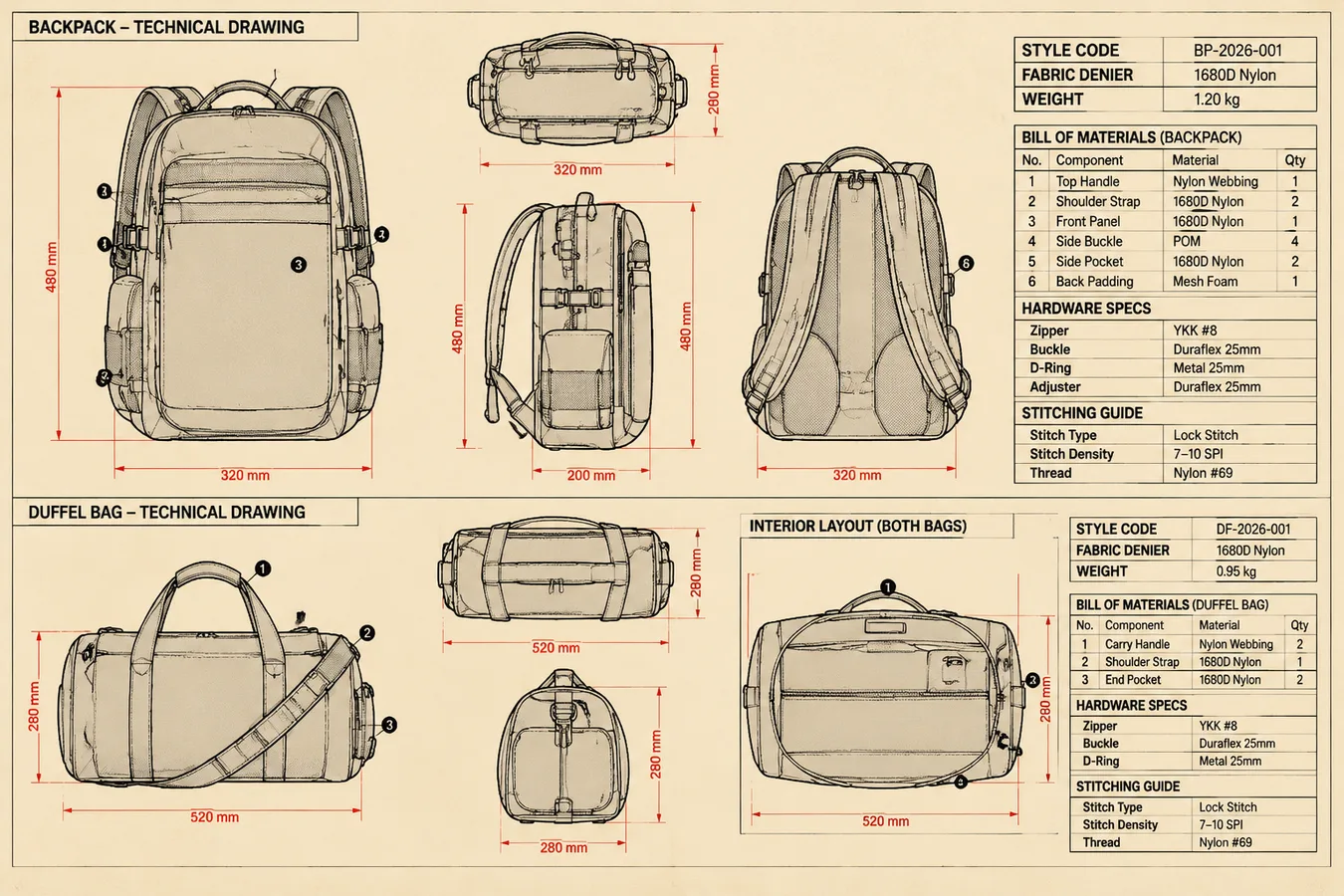
| Full Industrial Tech Pack | • Orthographic CAD vector blueprints with mm tolerances • Fully itemized 35-part Bill of Materials (BOM) • Seam construction, stitch density ($7\text{–}8\text{ SPI}$), and bar-tack specs • Retail-ready GS1 barcode labeling and 5-ply carton specifications | Zero Risk (100% Locked & Binding FOB) Completely deterministic cost engineering; price frozen upon Pre-Production Sample (PPS) sign-off. |
When three different factories receive the same unannotated photograph, one assumes basic 600D polyester with generic zippers, another assumes 900D coated nylon with water-resistant reverse coils, and the third includes heavy-duty retail packaging and internal EVA foam framing. All three provide professional quotations, yet they are pricing three fundamentally different products.
At Senszx, founded in 2006 in Baigou, China—the global epicenter of luggage and bag industrial manufacturing—we operate 100 dedicated sewing lines with BSCI, ISO 9001, ISO 14001, ISO 45001, and CE certifications. Over two decades, our engineering department has quoted, prototyped, and manufactured millions of high-performance bags for leading international private-label brands, retail chains, and enterprise merchandise programs.
This comprehensive technical treatise provides the definitive B2B sourcing guide on what information to send a bag factory for an accurate quotation.
Whether you are preparing your initial custom bag RFQ specification, compiling an industrial backpack tech pack, analyzing unit economics with our custom backpack cost breakdown, evaluating specialty silhouettes in our types of backpacks guide, auditing consumer safety in our backpack CPSIA compliance and safety testing guide, exploring private-label scaling strategies in our private label backpack manufacturer guide, sourcing specialized luggage in our bag manufacturer for travel brands guide, mastering multi-door retail fulfillment in our retail bag manufacturer guide, reviewing technical textiles in our custom fabric catalog, selecting heavy-duty hardware in our zipper pullers and custom buckles guide, examining our factory-wide quality control protocols, exploring custom designs in our custom backpack manufacturing section, or launching a complete private label bag collection, this guide provides the exact engineering blueprints needed to lock in competitive, reliable factory pricing.
1. The Core Information Architecture of a B2B Bag RFQ
To generate a precise, binding manufacturing quotation, an industrial bag factory must calculate two primary financial equations: Direct Material Bill of Materials (BOM) Cost and Direct Cut-and-Sew Labor Operations Cost. Every missing piece of technical information forces the factory to guess, creating pricing instability.
| Cost Foundation | Core Engineering Inputs | Cost Determinants |
|---|---|---|
| 1. Raw Material BOM Cost | Outer shell textiles, interior lining, structural foams (EVA/EPE), zipper chains, sliders, hardware buckles, webbing straps, binding tapes, and reinforcement boards. | Linear meter consumption based on CAD pattern nesting yield (92–94% efficiency) + raw material grade specifications. |
| 2. Cut & Sew Direct Labor | CNC laser/knife cutting, multi-station panel sub-assembly, perimeter gusset joining, synchronized seam binding, and automated bar-tacking. | Standard Allowed Minutes (SAM) required per unit across 20 to 35 assembly stations on dedicated 100-line floor. |
| 3. Packaging & Compliance | 2-mil bilingual warning polybags, anti-mold Micro-Pak desiccants, 350gsm hangtags, GS1 UPC barcodes, and heavy-duty 5-ply export cartons. | Retail vendor manual specifications, palletization Ti-Hi ratios, and carton drop-test standards (ISTA-1A). |
| 4. Factory Operational Margin | Equipment depreciation, facility utilities, export customs documentation, in-house laboratory testing, and sustainable margin (8–12%). | Transparent factory overhead structure delivering stable, repeatable, long-term commercial mass production. |
1.1 The Complete RFQ Information Matrix
The following matrix outlines the fundamental data categories required for accurate bag cost engineering, illustrating practical examples and their direct financial impact:
| RFQ Information Category | Practical Specification Example | Cost & Operational Impact |
|---|---|---|
| 1. Product Silhouette & Use Case | 22-Liter Everyday Commuter Laptop Backpack | Defines base structural geometry, load-bearing requirements, and internal partition complexity. |
| 2. Finished Exterior Dimensions | $460\text{mm (H)} \times 310\text{mm (W)} \times 160\text{mm (D)}$ | Directly dictates outer shell fabric cutting yield, lining consumption, and master carton shipping volume. |
| 3. Primary Outer Shell Fabric | 900D Ballistic Polyester with Double PU Backing ($1,500\text{mm}$) | Represents 25% to 40% of total raw material BOM cost; defines abrasion resistance and water repellency. |
| 4. Interior Lining Textile | 210D High-Density Polyester Lining in Slate Grey | Adds secondary cutting panels and internal seam binding operations across all interior compartments. |
| 5. Structural Foam & Padding | 8mm EVA foam in shoulder straps; 5mm EPE foam in laptop sleeve | Influences shock absorption, ergonomic recovery, operator sewing clearance, and needle puncture mechanics. |
| 6. Zippers & Sliders | Main: #10 Water-Resistant Reverse PU Coil; Pockets: #5 Coil | Significant cost differential between standard nylon coil, molded vislon, and electroplated metal teeth. |
| 7. Hardware, Buckles & Webbing | 25mm Virgin POM Side-Release Buckles; High-Tenacity Seatbelt Webbing | Influences static break strength ($>650\text{N}$) and cycle life; determines webbing width compatibility. |
| 8. Logo & Branding Applications | 60mm Debossed Matte Silicone Patch on front panel; Woven label | Dictates upfront mold tooling fees, vulcanization labor, embroidery stitch counts, or screen setup costs. |
| 9. Total Volume & SKU Split | Total: 3,000 units (Matte Black: 1,800 / Slate Grey: 1,200) | Determines mill fabric dyeing minimums, production line balancing, and setup cost amortization. |
| 10. Retail Packaging & Labeling | Individual 2-mil polybag with suffocation warning, UPC barcode, hangtag | Adds secondary manual packaging labor, carton drop protection, and retail compliance labeling. |
| 11. Target Market & Compliance | United States (US CPSIA, CA Prop 65 lead/phthalate compliance) | Mandates certified virgin raw materials, phthalate-free coatings, and accredited laboratory testing. |
| 12. Incoterm & Delivery Timeline | FOB Tianjin Port; Cargo-ready within 20 days post-PPS sign-off | Defines export handling costs, port trucking, and production scheduling across 100 sewing lines. |
1.2 The Four Pillars of Industrial Bag Costing
When an industrial cost engineer evaluates your RFQ, the total price is constructed across four distinct operational cost pillars:
- Direct Material Costs (BOM): The net raw material cost required to produce one bag, including shell fabric, lining, foams, stiffeners, zippers, pullers, buckles, webbing, binding tapes, threads, and brand badges.
- Cutting and Sewing Labor Costs: Calculated based on Standard Allowed Minutes (SAM) required to cut the fabric panels, assemble sub-components (front pockets, shoulder harness, laptop sleeve), join perimeter gussets, bind internal raw edges, and execute automated bar-tacking.
- Retail Packaging & Logistics Materials: Polybags, desiccants, hangtags, barcodes, carton boxes, inner cartons, and pallet packaging materials.
- Factory Operational Overhead & Margin: Factory depreciation, equipment maintenance, electricity, quality control staffing, export documentation, and sustainable gross manufacturing margin (typically 8% to 12%).
2. Engineering the Bill of Materials (BOM): The Secret to Locked Pricing
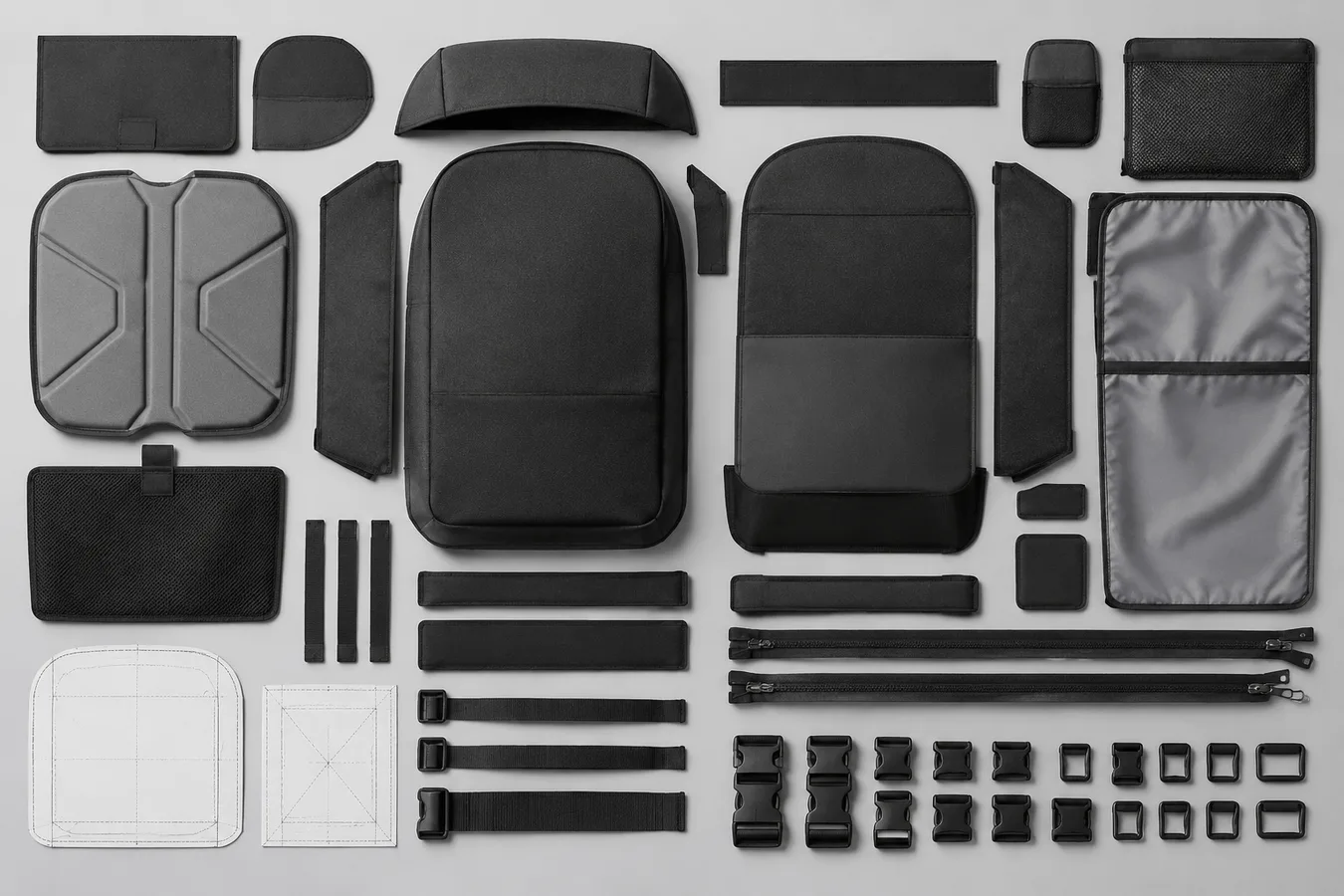
The single most powerful asset you can provide to a bag manufacturer is an itemized Bill of Materials (BOM). In industrial sewing, a bag is not a single entity; it is a precision assembly of 30 to 80 individual cut components, structural layers, fasteners, and trims.
2.1 The Master 35-Part BOM Costing Architecture
When our engineering team at Senszx calculates a formal quotation, we deconstruct the design into seven core component subsystems:
| Subsystem Category | Key Component Elements | Primary Engineering Function |
|---|---|---|
| 1. Exterior Shell Panels | Front, back, side gussets, bottom base panel, top lid flap, and bottle pockets. | Defines aesthetic silhouette, abrasion resistance, and primary hydrostatic water barrier. |
| 2. Interior Lining & Partitions | Main body lining, internal divider walls, laptop/tablet sleeves, and mesh organizers. | Protects contents, organizes device compartments, and isolates internal sub-assemblies. |
| 3. Internal Foams & Framing | High-resilience EVA strap padding ($65\text{ kg/m}^3$), EPE impact foam, and HDPE internal frames. | Delivers ergonomic load distribution, shock absorption, and prevents spinal pack sagging. |
| 4. Fasteners & Closures | #10 water-resistant reverse coils, #5 pocket nylon coils, and custom die-cast zinc pullers. | Provides fluid perimeter access and cross-seam burst resistance exceeding $>850\text{N}$. |
| 5. Hardware & Adjusters | 25mm virgin POM side-release buckles, ladder-lock strap adjusters, and swivel snap D-rings. | Ensures smooth harness adjustment and static break strength exceeding $>650\text{N}$. |
| 6. Webbing & Binding Trims | High-tenacity polypropylene seatbelt webbing, 190T herringbone seam tape, and elastic mesh. | Transmits dynamic carry loads and prevents raw internal fabric edge fraying. |
| 7. Branding & Retail Packaging | Debossed silicone logo patches, woven side flag labels, FTC care labels, and GS1 hangtags. | Establishes private-label identity and guarantees automated retail distribution compliance. |
2.2 Standard Industrial BOM Costing Template
The table below illustrates a standard, fully costed BOM structure for a 22-liter technical commuter backpack. Providing this level of detail eliminates all quotation ambiguity:
| Component Category | Sub-Item Description | Material & Technical Specification | Quantity / Yield per Bag | Key Cost Driver |
|---|---|---|---|---|
| Shell Textile | Front, Side & Lid Panels | 900D Ballistic Polyester / Double PU ($1,500\text{mm}$) | $0.85\text{ linear meters}$ | Fabric denier, yarn density, PU backing thickness. |
| Shell Base | High-Abrasion Bottom Panel | 1680D Ballistic Nylon / Heavy TPU Lamination | $0.22\text{ linear meters}$ | Tear strength ($>580\text{N}$), waterproof barrier. |
| Lining Textile | Interior Body & Partitions | 210D High-Density Polyester / Light PU ($600\text{mm}$) | $1.15\text{ linear meters}$ | Cutting yield waste across multi-panel internal dividers. |
| Padding (Ergonomic) | Shoulder Harness Straps | 8mm High-Resilience EVA Foam ($65\text{ kg/m}^3$) | 2 pieces ($420\times 70\text{mm}$) | High-density EVA vs cheap sponge foam. |
| Padding (Impact) | Laptop & Tablet Compartment | 5mm High-Density EPE Foam ($35\text{ kg/m}^3$) | 2 pieces ($380\times 280\text{mm}$) | Device shock absorption; drop-test survival. |
| Structural Frame | Back Panel Internal Stiffener | 1.2mm High-Density Polyethylene (HDPE) Board | 1 piece ($440\times 290\text{mm}$) | Eliminates spinal sagging under heavy 15kg load. |
| Main Zipper | Perimeter Top-Load Closure | #10 Continuous Nylon Reverse Coil + Water-Resistant PU | $950\text{mm length}$ | Water repellency, cross-seam burst strength ($>850\text{N}$). |
| Secondary Zippers | Front Pocket & Tech Slots | #5 Standard Nylon Spiral Coil on Polyester Tape | $1,250\text{mm length}$ | Smoothness of glide, auto-locking slider mechanism. |
| Zipper Sliders | Custom Branded Pullers | Zamak #3 Zinc Alloy / Electroplated Matte Gunmetal | 4 sets | One-time mold tooling fee ($350) + per-unit casting. |
| Shoulder Buckles | Harness Length Adjusters | 25mm Virgin Polyoxymethylene (POM / Acetal) | 2 pieces | Tensile break strength ($>650\text{N}$), sub-zero flex. |
| Structural Webbing | Shoulder Straps & Top Handle | 25mm High-Tenacity Polypropylene Seatbelt Weave | $2.40\text{ linear meters}$ | Tensile break strength ($>1,200\text{N}$), smooth adjustment. |
| Seam Binding | Internal Raw Edge Finish | 20mm 190T Polyester Herringbone Binding Tape | $6.50\text{ linear meters}$ | Clean seam aesthetic, prevents internal yarn fraying. |
| Exterior Logo | Center Front Panel Badge | 55mm $\times$ 35mm Molded Matte Silicone Patch | 1 piece | CNC mold fee ($180) + automated stitching cycle. |
| Care & Origin | Interior Seam Insert Label | 100% Woven Polyester Satin / Printed Black Ink | 1 piece | US FTC 16 CFR Part 303 legal fiber declaration. |
| Retail Packaging | Individual Unit Bag & Tag | 2-mil Virgin PE Polybag + 350gsm Coated Hangtag | 1 set | Barcode ANSI Grade A/B scannability, suffocation text. |
2.3 Fabric Cutting Yield Mathematics & Nesting Efficiency
A critical component of material costing is understanding fabric cutting efficiency. Fabrics are woven in standard roll widths of 58 inches (147cm) or 60 inches (152cm). When CAD patterns are generated, digital nesting software arranges the irregularly shaped panels across the cutting marker:
$$\text{Nesting Efficiency (%)} = \left( \frac{\text{Total Net Area of Pattern Pieces}}{\text{Gross Fabric Roll Area Utilized}} \right) \times 100$$
- In standard manual cutting setups, nesting efficiency hovers between 78% and 82%, meaning that 18% to 22% of the purchased fabric becomes scrap waste.
- At Senszx, we utilize computerized algorithmic nesting and automated CNC laser / oscillating knife cutters, achieving nesting efficiencies of 92% to 94%. On a 5,000-unit production order, this 12% yield improvement saves thousands of dollars in raw material fabric expenditure.
3. Structural Complexity, Panel Count & Labor Operations
A common misconception among first-time sourcing managers is assuming that bag manufacturing cost is governed primarily by weight or physical size. In reality, direct sewing labor frequently accounts for 35% to 50% of the total unit cost.
Two backpacks with identical exterior dimensions ($450\times 300\times 150\text{mm}$) and identical 600D polyester fabrics can have radically different manufacturing costs:
- Bag A (Minimalist Daypack): Consists of 8 cut panels, 1 main zipper, 1 front patch pocket, unpadded base, and basic single-needle stitched seams. Total sewing assembly time: 14 minutes. Unit FOB Price: $$6.20$.
- Bag B (Technical Commuter Backpack): Consists of 48 cut panels, 4 zipper tracks, a suspended 15.6" padded laptop cradle, molded air-mesh back ventilation channels, internal stretch-mesh organizers, luggage trolley pass-through sleeve, and 16 automated bar-tack reinforcements. Total sewing assembly time: 48 minutes. Unit FOB Price: $$15.80$.
| Bag Complexity Tier | Panel Count Range | Required Sewing Operators | Average Cycle Time (SAM) | Direct Labor Cost Index |
|---|---|---|---|---|
| Minimalist Daypack / Tote | 1–10 Cut Panels | 4–6 Assembly Stations | 10–15 Minutes | Low ($$1.50\text{ to }$2.50$) |
| Standard Everyday Backpack | 11–25 Cut Panels | 8–12 Assembly Stations | 18–28 Minutes | Moderate ($$3.00\text{ to }$4.50$) |
| Technical Commuter Backpack | 26–45 Cut Panels | 16–22 Assembly Stations | 30–45 Minutes | High ($$5.00\text{ to }$7.50$) |
| Multi-Pocket Travel / Tactical Pack | 46+ Cut Panels | 25–35 Assembly Stations | 50–75 Minutes | Premium ($$8.00\text{ to }$14.00+$) |
3.1 Step-by-Step Sewing Line Operations Breakdown
To illustrate how labor is costed, consider the 25 distinct assembly stations required for a technical commuter backpack:
| Sewing Operation Stage | Sub-Assembly Station Task | Machine Type & Tooling | Cycle Time (SAM) |
|---|---|---|---|
| Station 1 - Front Sub-Assembly | Stitch front vertical zipper pocket and attach lining | Single-Needle Lockstitch | 2.5 Minutes |
| Station 2 - Front Organizer | Stitch internal pen slots, card dividers, and key clip | Single-Needle Lockstitch | 3.2 Minutes |
| Station 3 - Front Panel Joining | Join front exterior panel to front organizer lining | Double-Needle Walking Foot | 2.0 Minutes |
| Station 4 - Side Bottle Pockets | Hem elastic binding onto stretch mesh; join to side gusset | Overlock + Single Needle | 2.8 Minutes |
| Station 5 - Side Compression Straps | Position 25mm webbing; stitch dual automated bar-tacks | Computerized Bar-Tacker | 1.5 Minutes |
| Station 6 - Main Zipper Attachment | Stitch #10 reverse waterproof zipper to main top gusset | Piping Walking Foot | 3.0 Minutes |
| Station 7 - Laptop Sleeve Prep | Laminate 5mm EPE foam between 210D lining panels | Heat Press / Edge Stitch | 2.2 Minutes |
| Station 8 - Laptop Partition Joining | Stitch elastic Velcro retention strap to laptop divider | Single-Needle Lockstitch | 1.8 Minutes |
| Station 9 - Shoulder Strap Prep | Insert 8mm EVA foam into contoured 3D air-mesh sleeves | Manual Guide Tooling | 2.5 Minutes |
| Station 10 - Shoulder Harness Finish | Topstitch perimeter webbing and attach 25mm POM buckles | Heavy Walking Foot | 3.5 Minutes |
| Station 11 - Top Grab Handle Prep | Wrap seatbelt webbing around molded EVA core; stitch | Cylinder-Bed Machine | 2.0 Minutes |
| Station 12 - Back Panel Framing | Insert 1.2mm HDPE board into back panel sleeve | Assembly Station | 1.2 Minutes |
| Station 13 - Shoulder Harness Anchor | Anchor shoulder straps & top handle to back panel; X-box | Programmable Pattern Sew | 2.4 Minutes |
| Station 14 - Luggage Pass-Through | Stitch heavy seatbelt trolley sleeve across back panel | Double-Needle Bar-Tack | 1.6 Minutes |
| Station 15 - Main Body Perimeter Join | Join front sub-assembly to center perimeter gusset | Heavy Cylinder Bed | 4.5 Minutes |
| Station 16 - Back Body Perimeter Join | Join back sub-assembly to center perimeter gusset | Heavy Cylinder Bed | 5.0 Minutes |
| Station 17 - Internal Seam Binding | Bind all exposed raw interior seams with herringbone tape | Synchronized Binding Machine | 4.2 Minutes |
| Station 18 - Base Panel Reinforcement | Attach 1680D abrasion-resistant bottom panel | Double-Needle Walking Foot | 2.6 Minutes |
| Station 19 - Critical Bar-Tacking | Execute 16 automated 42-stitch bar-tacks at all anchors | CNC Bar-Tacker | 2.0 Minutes |
| Station 20 - Hardware & Slider Fit | Thread webbing through ladder locks; install zinc pullers | Manual Assembly | 1.5 Minutes |
| Station 21 - Trimming & Thread Clean | 100% manual thread clipping with electric thread burners | Trimming Station | 2.0 Minutes |
| Station 22 - Vacuum & Debris Removal | High-power suction cleaning of all interior compartments | Industrial Vacuum | 1.0 Minute |
| Station 23 - Final QC Inspection | AQL 1.5/2.5 visual, dimensional, and zipper function audit | Inspection Station | 2.5 Minutes |
| Station 24 - Hangtag & Barcode Tagging | Attach 350gsm hangtag with safety pin; scan UPC barcode | Packaging Station | 1.0 Minute |
| Station 25 - Polybagging & Master Carton | Fold, insert desiccant, seal polybag, pack in master carton | Packing Line | 1.5 Minutes |
| TOTAL ASSEMBLY CYCLE TIME | Complete Manufacturing Sequence per Finished Unit | 100 Dedicated Sewing Lines | ~60.0 Standard Minutes |
4. Specifying Fabrics, Hardware & Branding Methods
Using vague terminology such as "high-quality nylon," "metal zipper," or "printed logo" creates significant pricing variance. To lock in an accurate quotation, specify materials using measurable industrial standards.
4.1 Fabric Denier, Yarn Tenacity & Coating Chemistry
| Textile Specification | Technical Definition | Ideal Use Case | Cost Factor vs Standard 600D Poly |
|---|---|---|---|
| 300D Ripstop Polyester | Lightweight plain weave with reinforced grid squares | Packable daypacks, interior organizer pockets | 0.85x (Economical, ultralight) |
| 600D Polyester Oxford | Standard commercial workhorse textile; double PU backing | Everyday school backpacks, promo bags, simple totes | 1.00x (Baseline Benchmark) |
| 900D Ballistic Polyester | High-density twisted yarn; superior tensile strength | Premium commuter bags, retail weekenders, camera bags | 1.35x - 1.50x (High Durability) |
| 1680D Ballistic Nylon | Heavyweight basket-weave nylon; extreme abrasion resistance | Executive luggage, tactical packs, industrial tool bags | 2.20x - 2.60x (Industrial Grade) |
| 500D Cordura® Nylon | Air-textured nylon 6,6; unmatched tear resistance | Military gear, technical alpine packs, motorcycle luggage | 2.80x - 3.40x (Premium Technical) |
| 16oz Waxed Duck Canvas | Heavy 100% cotton canvas infused with paraffin/beeswax | Heritage travel weekenders, vintage messenger bags | 2.40x - 3.00x (Tactile Luxury) |
4.2 Zippers: Gauge, Chain Style & Coating Grades
Zippers represent one of the most critical moving components on any bag. Specifying the wrong zipper grade leads either to excessive BOM cost or premature field failure:
- Zipper Sizing: Use #5 continuous nylon coil for exterior accessory pockets and internal organizers; mandate #8 or #10 heavy-duty continuous coil for main perimeter openings and high-stress laptop compartments.
- Coating Finishes: Standard nylon spiral coil vs Reverse PU Matte Waterproof Lamination. Reverse PU zippers provide a sleek, modern technical aesthetic and splash-proof protection but cost approximately 2.2x more than standard exposed coils.
- Metal vs Molded Plastic (Vislon): Metal zippers (brass, gunmetal, antique silver) provide heritage aesthetic appeal but add significant weight and require galvanic anti-corrosion plating; POM Vislon teeth provide excellent salt-water corrosion resistance for marine and sports bags.
4.3 Hardware Engineering & Electroplating Metallurgy
Hardware failures destroy customer trust faster than almost any other defect. Specifying material grades ensures high performance:
- High-Density Zinc Alloy (Zamak #3): Die-cast zinc alloy delivers pristine cosmetic detail for branded pullers and snap hooks with tensile break strength exceeding 750N.
- Galvanic Electroplating & Salt Spray Resistance: Hardware finishes (Matte Gunmetal, Brushed Nickel, Antique Brass) must undergo clear electrophoretic lacquer coating to pass 48-Hour Salt Spray Testing (ASTM B117) without pitting or corrosion.
- Polyoxymethylene (POM / Acetal) vs Nylon 66: For side-release buckles, virgin POM provides smooth click engagement and zero brittle fracture down to -30°C, outperforming recycled plastics.
4.4 Branding Decoration Techniques & Tooling Economics
| Decoration Technique | One-Time Tooling / Mold Fee | Per-Unit Application Cost | Aesthetic Profile & Best Application |
|---|---|---|---|
| Woven Damask Label | $$0$ (Setup absorbed in run) | $$0.15\text{ to }$0.35$ | Clean, classic, subtle; ideal for side flag labels and internal branding. |
| Direct 3D Embroidery | $$30\text{ to }$60$ (Digitizing tape) | $$0.45\text{ to }$1.20$ | Bold, textured, high-stitch density; best for athletic and outdoor gear. |
| High-Density Screenprint | $$25\text{ per color}$ (Screen mesh) | $$0.20\text{ to }$0.60$ | High visual impact, sharp graphics; best for large flat panel logos. |
| Molded Silicone Patch | $$150\text{ to }$250$ (CNC steel mold) | $$0.50\text{ to }$1.10$ | Modern, matte tactile finish, 100% waterproof; premier choice for tech packs. |
| Die-Cast Zinc Metal Badge | $$300\text{ to }$500$ (Custom die mold) | $$0.80\text{ to }$2.20$ | Luxury executive presentation, electroplated finishes; best for premium travel bags. |
| Debossed / Heat-Stamped | $$80\text{ to }$150$ (Brass heating die) | $$0.25\text{ to }$0.55$ | Subtle, elegant tone-on-tone indentation; ideal for synthetic leather accents. |
5. Order Quantities, SKU Matrices & Tiered Pricing Economics
A common mistake made by buyers is asking a factory for a single unit price without providing a volume context, or requesting a quote for "500 pieces" when their long-term requirement is 5,000 units. In modern industrial manufacturing, unit production cost is intimately tied to volume tiering.
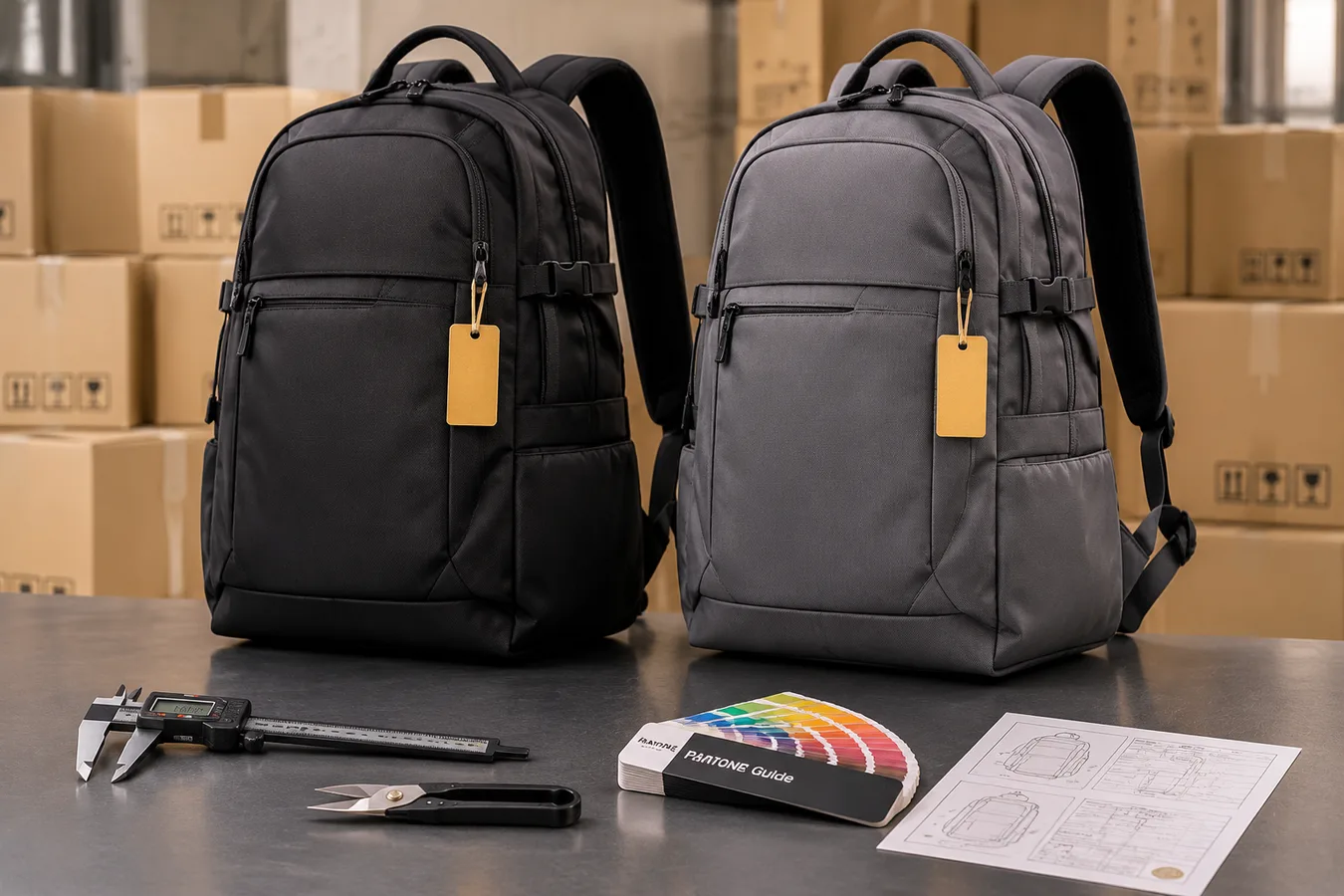
5.1 Why Production Costs Decrease as Volume Increases
When an order scales from 500 units to 2,000 units and 5,000 units, unit FOB costs typically drop by 15% to 30%. This reduction is driven by four structural economic factors:
- Raw Material Volume Discounts: Textile mills require minimum batch sizes (typically 1,000 to 1,500 yards) to operate industrial dye vats. For a 500-unit run, the factory must absorb surcharges for small-lot fabric dyeing or utilize existing warehouse stock. At 3,000+ units, custom lab-dip fabric dyeing is achieved at base mill prices.
- Fixed Setup Amortization: CNC cutting die preparation, pattern laser programming, embroidery digitizing, printing screen exposure, and machine tension calibration represent fixed upfront labor. Amortizing $$600$ of setup overhead over 500 units adds $$1.20$ per unit; over 5,000 units, it adds only $$0.12$ per unit.
- Assembly Line Balancing & Operator Learning Curves: On our 100 dedicated sewing lines, assembly operators achieve peak rhythmic efficiency after stitching the first 200–300 units of a new style. By day 4 of a continuous production run, cycle times per station decrease by 15% to 25%, directly lowering unit labor cost.
- Packaging & Trim Economies: High-speed 4-color offset printing for retail hangtags and master carton flexographic printing have high plate-setup minimums. Unit packaging costs drop by up to 50% when ordering 3,000+ sets.
5.2 The Senszx Multi-Tier Pricing Matrix
The table below illustrates the typical economies of scale across production volume tiers for a mid-tier technical backpack ($25\text{ FOB base}$):
| Production Volume Tier | Raw Material Sourcing Basis | Line Setup & Tooling Amortization | Sewing Line Labor Efficiency | Estimated Unit FOB Price | Commercial Fit |
|---|---|---|---|---|---|
| 500 Units (Single-Track MOQ) | Stock fabric core colors; small-lot zipper orders | $$1.20\text{ to } $1.80\text{ per unit}$ | Baseline learning curve; manual QC focus | $$28.50$ (100% Index) | Emerging brand pilot; boutique retail launch; market test. |
| 1,000 Units | Standard mill fabric orders; volume trim pricing | $$0.60\text{ to } $0.90\text{ per unit}$ | +10% sewing efficiency; dedicated line balance | $$25.20$ (~12% Savings) | Established e-commerce reorder; seasonal collection release. |
| 2,500 Units | Custom mill dye lots; bulk zipper contracts | $$0.25\text{ to } $0.40\text{ per unit}$ | +18% sewing efficiency; automated bar-tacking | $$22.80$ (~20% Savings) | Core retail program; multi-door store replenishment. |
| 5,000+ Units | Direct tier-1 mill contracts; automated cutting | $<$0.15\text{ per unit}$ | Peak 100-line mass manufacturing efficiency | $$20.50$ (~28% Savings) | National retail chain rollout; enterprise merchandise program. |
5.3 Structuring Multi-SKU Colorway Splits
When an order includes multiple colorways, presenting a structured SKU matrix in your RFQ prevents material minimum bottlenecks:
| SKU Identifier | Outer Shell Colorway | Hardware / Zipper Accent | Production Allocation | Strategic BOM Optimization |
|---|---|---|---|---|
| BP-22-BLK | Stealth Matte Black | Gunmetal Zinc Pullers | 1,500 Units (50% Core) | Universal 210D black lining, internal foam, and #10 zipper tracks standardized across all SKUs. |
| BP-22-GRY | Slate Heather Grey | Matte Black POM Pullers | 900 Units (30% Secondary) | Aggregates component purchase volume to 3,000 units, unlocking Tier-1 bulk pricing. |
| BP-22-OLV | Tactical Olive Drab | Coyote Tan Webbing Trims | 600 Units (20% Accent) | Meets individual 500-unit colorway minimums while slashing raw material waste. |
6. Retail-Ready Packaging, Logistics & Incoterms Definition
A complete quotation request must specify the packaging and logistics scope. A bag quotation that omits packaging assumes bulk packing (loose bags stacked in generic brown boxes), which is completely unusable for commercial retail or e-commerce fulfillment.
6.1 Unit Packaging & Master Carton Specifications
Specify your packaging requirements across two distinct tiers:
- Individual Unit Packaging:
- Polybag Specs: 0.05mm (2 mil) virgin transparent polyethylene (PE) or polypropylene (PP); micro-perforated with 6mm laser vent holes to prevent moisture trapping.
- Legal Warning Typography: Prominent bilingual suffocation warning printed in 24pt bold text: "WARNING: To avoid danger of suffocation, keep this plastic bag away from babies and children..."
- Hangtags & Barcodes: 350gsm coated art card hangtag with nylon string safety-pin attachment; GS1-compliant ANSI Grade A/B scannable UPC/EAN barcode sticker applied to polybag exterior.
- Desiccant Protection: Micro-Pak anti-mold enhanced desiccant sticker or clay desiccant pouch (DMF-free) inside each bag.
- Master Shipping Carton Specifications:
- Board Grade: Heavy-duty 5-ply double-wall corrugated Kraft board (ECT 44 / 275# burst strength).
- Pack Density: Specified units per carton (e.g., 15 or 20 units flat-packed per carton) with maximum gross carton weight limited to $<18\text{ kg (40 lbs)}$ to comply with standard retail warehouse ergonomic lifting limits.
- GS1-128 Shipping Marks: 4x6 inch thermal transfer logistics label displaying PO#, Style Name, SKU#, Color, Quantity, Net/Gross Weight, and Serialized Shipping Container Code (SSCC-18).
6.2 Selecting the Optimal Incoterm for Your Business
| Incoterm (2020 Rules) | Factory Responsibility (Senszx) | Buyer Responsibility | Best Suited For |
|---|---|---|---|
| EXW (Ex Works) | Pack goods at Baigou factory dock | Inland China trucking, export customs, ocean freight, import duties, domestic delivery | Large conglomerate buyers with local China consolidation warehouses. |
| FOB (Free on Board - Tianjin/Shenzhen) | Manufacturing, packaging, China inland freight, export customs clearance, loading onto vessel | Ocean / air freight, marine insurance, destination import duties, port handling, final trucking | Industry Standard: Brands with nominated freight forwarders controlling shipping lanes. |
| CIF (Cost, Insurance & Freight) | Manufacturing, export clearance, ocean freight booking, marine cargo insurance to destination port | Destination port handling fees, customs clearance, import tariffs, domestic warehouse trucking | Importers who want factory to book sea freight but have local customs brokers. |
| DDP (Delivered Duty Paid) | 100% Turnkey: Manufacturing, export, ocean freight, customs clearance, import tariffs, final domestic delivery | Unloading cartons at destination fulfillment center dock | Zero Friction: Brands seeking guaranteed landed cost with zero customs or freight complexity. |
7. What Files to Send: From Concept Sketches to Full Tech Packs
You do not need a multi-page professional CAD tech pack to initiate a quotation with Senszx. Our engineering department works across four levels of design maturity:
| Design Asset Maturity Level | Submission Package Components | Engineering Capability & Quotation Output |
|---|---|---|
| Level 1: Concept Sketch | • Hand or digital concept sketches • Rough exterior dimensions ($H\times W\times D$) • General feature and pocket callouts | Preliminary feasibility review and initial budgetary price bracket ($\pm 25%$). |
| Level 2: Benchmark Sample | • Physical reference/competitor bag • Explicit "Keep vs Change" deconfliction brief • Swatch or colorway target references | Highly accurate BOM reverse-engineering and rapid 3–5 day prototype development. |
| Level 3: Annotated Spec Sheet | • 2D vector CAD line drawings • Detailed dimension callouts and pocket depths • Component material & zipper specifications | Accurate quotation ($\pm 5%$) with comprehensive Design for Manufacturing (DFM) feedback. |
| Level 4: Complete Tech Pack | • Orthographic multi-view vector blueprints • Fully itemized 35-part Bill of Materials (BOM) • Pantone TPX/TCX color codes & vector artwork • Measurement tolerance and packaging sheets | 100% Binding FOB Quotation with zero price variance and immediate production scheduling. |
7.1 The 4-Stage Prototyping Lifecycle
When moving from initial quotation into physical product creation, Senszx manages a structured 4-stage prototyping pipeline:
- Prototype 1 (PP1 - First Iteration): Built within 3 to 5 business days using available sample-room materials to verify overall silhouette, volume balance, pocket accessibility, and ergonomic fit.
- Prototype 2 (PP2 - Refinement Iteration): Incorporates client feedback, adjusted dimensions, revised internal divider partitions, and custom hardware fitments.
- Pre-Production Sample (PPS - Golden Sample): Manufactured on the active mass production line using the exact bulk fabric lot, final custom zipper pullers, and production branding badges. PPS approval locks in the final production schedule and FOB price.
- Top of Production (TOP) Sample: Pulled directly from the first 100 units of the mass manufacturing run and dispatched to the client's QA team for final confirmation before full order packing.
7.2 How to Utilize Physical Benchmark Samples
If you are developing a product inspired by an existing market benchmark, sending a physical reference bag to our sample room in Baigou is one of the fastest and most accurate ways to receive a quotation.
When sending a physical sample, always include a Sample Deconfliction Brief:
- Keep Features: "Maintain the overall exterior silhouette, ergonomic shoulder strap contour, and hidden back-panel luggage pass-through sleeve."
- Change Features: "Increase main body depth from 140mm to 170mm; replace 600D polyester with 900D matte ballistic polyester; replace standard nylon coil with #10 reverse waterproof zipper; add internal padded 15.6" laptop partition with 5mm EVA foam."
- Branding & Packaging: "Apply our debossed silicone logo badge to the front pocket; package in individual barcode-labeled polybags."
8. Common Quotation Traps & How to Avoid Hidden Cost Creep
Understanding the common pitfalls in the quotation process protects your budget and prevents costly surprises during mass manufacturing.
8.1 The "Too Good to Be True" Low Quotation Trap
When comparing quotations from multiple suppliers, an outlier quote that is 30% to 40% lower than competing factories is almost always an operational red flag. In modern sewn goods manufacturing, raw material costs (polyester, nylon, foam, zippers, hardware) are globally standardized commodity inputs.
A factory quoting an unrealistically low price is almost certainly planning to:
- Substitute Sub-Standard Materials: Using low-tenacity yarn (e.g., selling low-grade 300D with heavy filler PVC backing as "900D"), recycled zinc alloy hardware prone to brittle snapping, or unbranded zipper coils that split under tension.
- Eliminate Critical Labor Operations: Dropping stitch density from the required 7-8 SPI down to 4-5 SPI to increase sewing speed; omitting internal seam binding tape; skipping automated bar-tacking on handle attachment points.
- Execute Mid-Production Price Extortion: Demanding price increases after raw materials have been cut or holding finished goods hostage at the port claiming "unexpected material cost inflation."
8.2 The Senszx Locked-FOB Guarantee
At Senszx, we believe in radical commercial transparency. Our itemized quotations detail every component, yield calculation, labor operation, and packaging cost. Once a Pre-Production Sample (PPS) is signed off and the formal Purchase Order is issued, our quoted FOB price is 100% locked and legally binding. We never execute mid-production price increases.
8.3 Managing Currency Fluctuations & Raw Material Indexing
For high-volume retail programs spanning multi-quarter replenishment cycles, foreign exchange rate fluctuations (USD vs RMB) can introduce margin uncertainty:
- USD Locked Validity Windows: All initial Senszx quotations carry a standard 30-day fixed USD quotation window.
- Deposit-Triggered Exchange Locking: Upon receipt of the 30% PO deposit, raw material purchasing contracts with tier-1 yarn, zipper, and hardware mills are immediately executed, locking in 100% of the material cost and insulating your order from foreign exchange volatility.
9. The 10-Point Pre-Quotation Checklist for Buyers
Before dispatching your Request for Quotation (RFQ) to our engineering team, review your briefing package against this 10-point checklist:
| Verification Point | Check Item | Status |
|---|---|---|
| 1. Dimensional Framework | Exterior Height, Width, Depth (in mm or inches) clearly defined; volume (liters) estimated. | Verified |
| 2. Primary Outer Textile | Base fiber (polyester/nylon), denier (e.g., 600D/900D/1680D), and coating (PU/TPU) specified. | Verified |
| 3. Interior Lining & Dividers | Lining fabric specified (e.g., 210D polyester); laptop compartment dimensions and foam thickness noted. | Verified |
| 4. Fasteners & Zippers | Zipper size (#5, #8, #10), chain style (standard coil, reverse waterproof, metal), and slider type noted. | Verified |
| 5. Hardware & Webbing | Buckle materials (POM, zinc, aluminum), webbing width (25mm/38mm), and break strength requirements stated. | Verified |
| 6. Logo & Branding Specs | Decoration method (silicone patch, embroidery, woven label, screenprint) and vector artwork provided. | Verified |
| 7. Production Volume & SKU Split | Target total order quantity and breakdown by colorway/SKU clearly defined. | Verified |
| 8. Retail Packaging Requirements | Individual unit packaging (polybag, hangtag, barcode) and master carton specs outlined. | Verified |
| 9. Target Market & Compliance | Destination country (US, EU, UK, GCC) and mandatory compliance standards (CPSIA, Prop 65, REACH) stated. | Verified |
| 10. Delivery Schedule & Incoterm | Target in-warehouse delivery date and requested commercial Incoterm (FOB, EXW, DDP) confirmed. | Verified |
9.1 The Role of Third-Party Pre-Shipment Inspection (PSI)
To guarantee that the finished bulk production completely matches the approved Pre-Production Sample and locked quotation specifications, Senszx encourages and facilitates independent third-party Pre-Shipment Inspections (PSI) conducted by accredited global audit firms (such as SGS, Bureau Veritas, TÜV SÜD, QIMA, or Intertek).
Under international ISO 2859-1 (ANSI/ASQ Z1.4) sampling protocols, inspectors audit finished master cartons for:
- Workmanship & Appearance (AQL 1.5 Major / 2.5 Minor): Stitch tension, loose threads, cosmetic alignment, fabric stains, and seam puckering.
- Dimensional Accuracy: Strict adherence to the $\pm 3\text{mm}$ exterior tolerance envelope.
- Barcode Readability: 100% ANSI optical scan verification on retail polybags and master shipping cartons.
- Function & Drop Tests: Zipper cycle smoothness, handle oscillation tests, and master carton drop tests.
- Balance Release: The remaining 70% payment balance is released only after the third-party PSI report confirms a "PASS" verdict.
10. Frequently Asked Questions (FAQ)
What information does a bag factory need to provide an accurate quotation?
To provide an accurate, reliable quotation, a bag factory requires: 1) Bag category and functional use case; 2) Exact finished exterior dimensions (Height × Width × Depth); 3) Outer shell and interior lining fabric specifications (denier, weave, coating grade); 4) Internal structure, compartment layout, and foam padding thickness; 5) Zipper grades (#5, #8, #10) and hardware materials (POM plastic, zinc alloy, aluminum); 6) Logo branding dimensions and application method; 7) Total order quantity and SKU colorway breakdown; 8) Retail packaging and barcode labeling requirements; 9) Target destination country and requested Incoterm (FOB, EXW, DDP).
Why do preliminary bag quotations change after sampling?
Preliminary quotations change when the initial RFQ relies on vague exterior photos without specifying internal materials and construction. During physical sampling, when the buyer specifies premium textiles (such as 900D ballistic polyester over 600D), heavy-duty reverse waterproof zippers, high-density EVA foam, internal divider binding, or custom metal hardware, the factory must adjust the unit price to reflect the true raw material BOM and direct sewing labor required.
Can Senszx quote my bag design if I don't have a finished tech pack?
Yes. Senszx routinely works with brand founders and product developers who have initial concept sketches, reference photographs, dimensioned drawings, or physical benchmark samples. Our sales-engineering team performs a comprehensive DFM (Design for Manufacturing) review, helps you define open variables, and builds a fully itemized Bill of Materials (BOM) to generate a precise quotation.
What is the Minimum Order Quantity (MOQ) at Senszx?
Senszx operates a transparent single-track OEM/ODM minimum order quantity of 500 pieces per style/colorway for fully custom sewn bags. For expanding brands needing physical proof-of-concept before committing to a 500-unit production order, we offer our Development Fee Program: an upfront prototyping fee covering CAD pattern drafting, material sourcing, and up to 3 iterative sample rounds, where 100% of the development fee is credited back directly against your mass production invoice deposit.
How fast can Senszx provide a quotation and physical sample?
Senszx delivers detailed, itemized engineering quotations within 24 business hours of receiving a complete RFQ package. Physical prototype samples are crafted and dispatched within 3 to 5 business days once specifications and material swatches are confirmed (custom hardware molds add 5 to 7 days for CNC tooling). Mass manufacturing of 500 to 5,000 units is completed within 20 calendar days following Pre-Production Sample (PPS) sign-off.
What is the difference between FOB and DDP quotations?
An FOB (Free on Board) quotation includes all manufacturing costs, packaging, export customs clearance, and port trucking to the export vessel (e.g., Tianjin or Shenzhen Port), leaving international ocean freight, destination import tariffs, and final domestic trucking to the buyer's nominated freight forwarder. A DDP (Delivered Duty Paid) quotation is a turnkey, all-inclusive price where Senszx manages the entire supply chain, delivering cleared cartons directly to your domestic distribution center dock with all ocean freight, customs brokerage, and import duties fully paid.
How do custom hardware and molded logos affect upfront quotation costs?
Custom metal zipper pullers, molded silicone logo patches, and custom plastic buckles require one-time mold tooling investments (typically $$150\text{ to } $250$ for silicone badges, $$300\text{ to } $500$ for zinc alloy pullers). These tooling fees are itemized separately in our quotations and are amortized over subsequent reorders. Once molds are created, per-unit hardware costs drop significantly, and the tooling remains your exclusive intellectual property.
How does fabric denier affect bag weight, durability, and cost?
Denier (D) measures the linear mass density of yarn in grams per 9,000 meters. 600D polyester (~220 gsm) is lightweight and cost-effective for school and promo bags; 900D ballistic polyester (~310 gsm) increases tear resistance by over 75% for premium commuter daypacks; 1680D ballistic nylon (~420 gsm) provides maximum puncture resistance for heavy-duty travel luggage but increases fabric BOM cost by 2.2x to 2.6x compared to 600D polyester.
11. Partner with Senszx: Fast, Deterministic B2B Bag Quotations
At Senszx, we believe that an exceptional manufacturing partnership begins with clear communication, technical precision, and absolute commercial transparency. Our dedicated engineering and sales teams bridge the gap between creative design concepts and industrial mass manufacturing.
Whether you are launching your first 500-piece private-label backpack line or managing an enterprise procurement program across thousands of retail storefronts, Senszx provides the technical expertise, automated sewing capacity, and rigorous quality control required to scale your business with complete confidence.
| Quotation Milestone | Action & Responsibility | Timeline & Output |
|---|---|---|
| Step 1: Submit Your Brief / RFQ | Upload sketches, CAD tech pack, dimensions, and target quantities. | Day 0: Sourcing package received and assigned to sales engineering. |
| Step 2: 24-Hour BOM Quotation | Senszx engineers calculate material yields, labor SAM, and packaging. | Within 24 Hours: Fully itemized, locked BOM cost breakdown delivered. |
| Step 3: Rapid Prototyping | Pattern makers cut and sew initial prototype under Credited Fee Program. | 3–5 Business Days: Physical prototype dispatched for client evaluation. |
| Step 4: PPS Approval & PO Release | Golden Sample sealed; bulk raw material orders placed with Tier-1 mills. | Milestone Sign-off: Master Counter-Sample locked; production lines scheduled. |
| Step 5: 20-Day Mass Manufacturing | 100 dedicated sewing lines execute mass manufacturing with 7-stage QC. | 20 Calendar Days: Zero-defect, barcode-verified shipment dispatched. |
Ready to Receive Your Precision Bag Manufacturing Quotation?
Contact our technical sales-engineering team today to review your designs, request material swatch packs, or initiate rapid prototype development:
- Official B2B Contact Email: [email protected]
- Direct WhatsApp / Corporate Phone:
+86 17331531825 - Headquarters & Industrial Facility: Senszx Industrial Park, Baigou, Hebei Province, China
- Explore Our Capabilities: Custom Backpack Manufacturing | Private Label Bag Services | Quality Control Standards | Custom Fabric Catalog | Hardware & Pullers Catalog | Contact Engineering Team
Hi, I'm Senszx Bag Manufacturer, Hope You Like This Blog Post.
With more than 20 years of experience in OEM/ODM/Custom luggage and bag, I'd love to share with you the valuable knowledge related to luggage and bag products from a top-tier Chinese supplier's perspective.
Senszx Factory
Est. 2006 · Baigou, China
Related articles
How to Choose the Right Materials for Travel Bags: The Complete Manufacturer Guide
A comprehensive B2B engineering guide to selecting travel bag materials: comparing polyester, nylon, Oxford, canvas, TPU coatings, hardware, and structural interlinings across durability, GSM, abrasion, and manufacturing cost.
Bulk Backpacks: The Complete Wholesale Buying Guide for 2027
How brands, distributors, schools and charities buy backpacks in bulk: sourcing paths, styles, fabrics, customization, unit price drivers, MOQ, lead times, QC and shipping.
Wholesale Toiletry Bags: The Complete Sourcing Guide for 2027
How travel brands, grooming labels, retailers and distributors source toiletry bags in bulk: styles, materials, customization, MOQ, pricing, QC and shipping.
Get a Custom Bag Quote from Our China Factory
Our sales team is online around the clock and usually replies within the hour.
Email
[email protected]Factory
Qinzheng Road No.89, New Industry Zone, Baigou Town
Baoding City, Hebei Province 074004, China