How Do Tool and Industrial Brands Choose the Right Bag Manufacturer: The Complete B2B Sourcing, Heavy-Duty Engineering & OEM/ODM Factory Selection Guide
The complete B2B sourcing guide on how tool and industrial brands choose the right bag manufacturer. Master heavy-duty textile engineering (1680D ballistic nylon, 1000D Cordura, waterproof TPU), injection-molded hard bases, multi-tier pocket architectures, high-load handle bartack reinforcement, 5,000-cycle jerk testing, single-track 500 MOQ economics, and DDP export logistics.
How Do Tool and Industrial Brands Choose the Right Bag Manufacturer: The Complete B2B Sourcing, Heavy-Duty Engineering & OEM/ODM Factory Selection Guide
In the demanding world of professional trade tools, industrial equipment, construction hardware, and field-service technology, a professional tool bag is not a simple decorative carrying case; it is an aggressive, high-stress mechanical tool. When an electrician, HVAC technician, network engineer, heavy-equipment mechanic, or construction foreman steps onto a commercial jobsite, their tool bag serves as their mobile workstation. Inside a single 30-liter pack sits $1,500 to $5,000 worth of precision multimeters, insulated pliers, cordless impact drivers, copper tube cutters, heavy steel wrenches, and sharp utility blades—totaling 15 to 35 kilograms of dense, abrasive, oily, and vibrating metal payload.
A prototype handcrafted by a skilled sample maker may look exceptionally rugged when placed on a showroom table. However, the true industrial test begins months later under relentless real-world field conditions:
- Will sharp screwdriver shanks pierce through internal pocket linings after weeks of rapid extraction?
- Will the top carry handle anchor tear out of the upper back panel when a technician hoists a 28kg loaded bag into a utility truck?
- Will the bottom panel absorb dirty water, motor oil, and hydraulic fluid when resting on wet construction concrete?
- Will the main perimeter zipper jam, separate, or blow its teeth under lateral expansion forces?
For global tool brands, industrial hardware enterprises, specialized trade associations, and private-label innovators, choosing the right manufacturing partner is the single most critical factor determining product reliability, warranty claim ratios, and brand reputation. An industrial tool brand does not merely need a supplier with sewing machines; it needs a factory-based manufacturing partner with deep structural engineering expertise, specialized heavy-duty machinery, automated cutting precision, and disciplined multi-stage quality control.
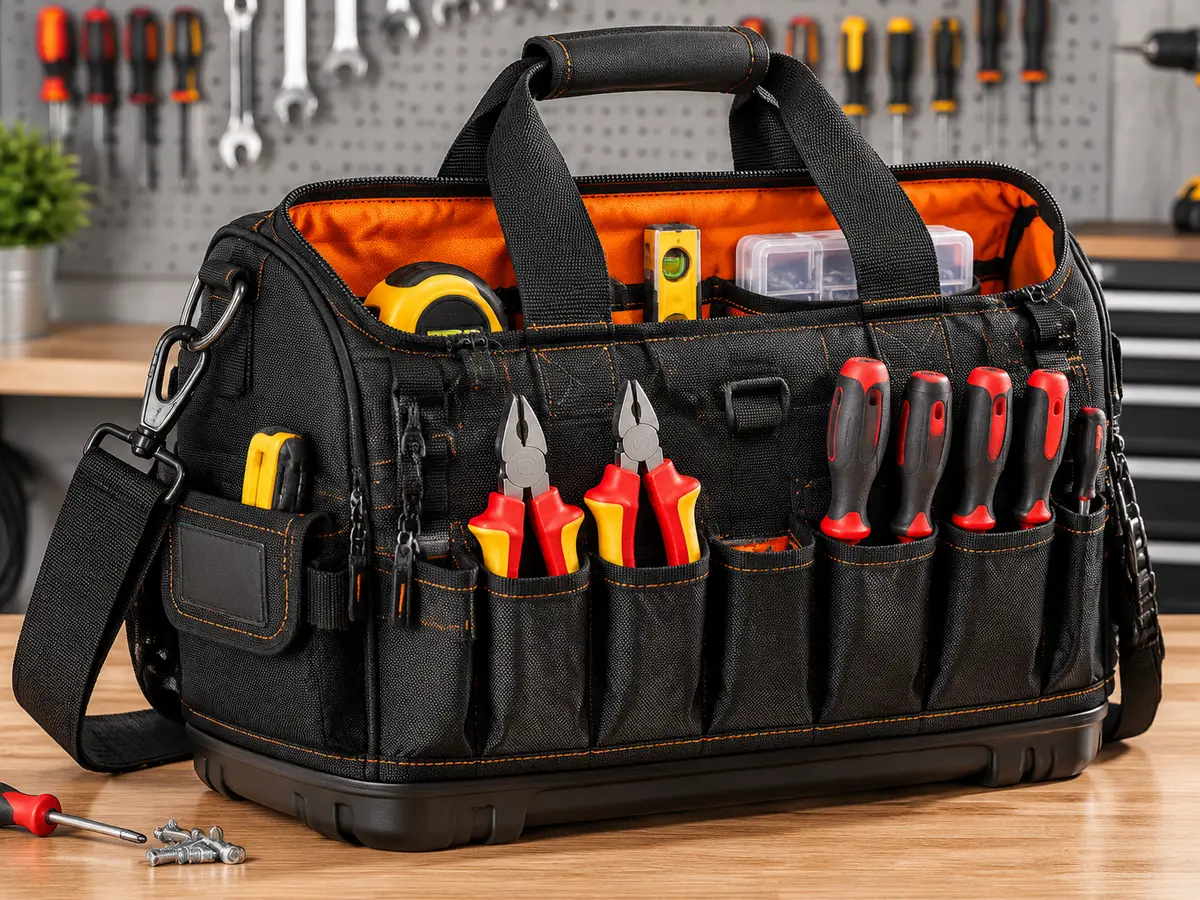
At Senszx, founded in 2006 in Baigou, China—the world’s premier industrial epicenter for bag and luggage manufacturing—we have spent over two decades engineering, prototyping, and mass-manufacturing heavy-duty functional bags, technician backpacks, and industrial equipment cases for leading global tool brands and industrial hardware suppliers across North America, Europe, and global markets. Operating 100 synchronized production sewing lines with BSCI, ISO 9001, ISO 14001, and ISO 45001 accreditations, we combine heavy walking-foot machinery, automated CNC cutting, injection-molded base capabilities, single-track 500 MOQ flexibility, and in-house physical stress testing.
This comprehensive B2B sourcing guide deconstructs every layer of industrial tool bag engineering, factory auditing, material selection, quality control, and procurement economics.
1. The Industrial Sourcing Reality: Tool Bags as Mechanical Load-Bearing Systems
The fundamental mistake made by procurement teams entering the industrial soft-goods market is treating tool bags as ordinary consumer backpacks. A consumer daypack carrying 5kg of clothing and a lightweight tablet experiences mild, distributed gravitational force. In contrast, an industrial tool bag experiences extreme dynamic stresses:
| Engineering Parameter | Standard Consumer Backpack / Fashion Bag | Heavy-Duty Industrial Tool Bag (Senszx Standard) |
|---|---|---|
| Typical Working Payload | 4.0 kg to 8.0 kg (soft, distributed items) | 15.0 kg to 35.0 kg (dense, sharp, concentrated metal tools) |
| Primary Shell Material | 300D to 600D Polyester (single PU coating) | 1680D Ballistic Nylon / 1000D Cordura / 900D Heavy Oxford |
| Bottom Base Construction | Flat single-layer fabric with 3mm PE foam | 3.0mm Injection-Molded Waterproof PP / Dense Molded EVA Hard Base |
| Internal Pocket Lining | 190T Taffeta / 210D Lightweight Polyester | 600D / 900D Double-Layer Heavy Oxford with PVC/PU Backing |
| Handle Anchoring Architecture | Stitched 15mm into top seam allowance | Continuous Seatbelt Webbing under-wrap + 1.2mm HDPE Plate + 42-Stitch Bartack |
| Main Zipper Specification | #5 Standard Nylon Coil Zipper | #10 Heavy-Duty Water-Resistant Reverse Coil / Molded Vislon |
| Hardware Tensile Threshold | 250N to 400N (Light zinc alloy / standard plastic) | >850N to 1,400N (Die-cast Zamak 3/5 zinc alloy / Virgin Molded POM) |
| Dynamic Jerk Testing Standard | 1,000 cycles at 10kg load | 5,000 Continuous Cycles at 20kg to 30kg load (Zero seam rupture) |
1.1 Why Lightweight Factory DNA Fails on Industrial Products
When an industrial brand contracts a factory whose primary experience is promotional tote bags, casual daypacks, or fashion handbags, catastrophic structural failures are inevitable:
- Inadequate Machine Piercing Power: Sewing through 4 plies of 1680D ballistic nylon, 2 layers of heavy webbing, and a 1.2mm HDPE frame sheet requires heavy walking-foot compound-feed machines with high-torque servo motors and heavy-gauge needles (Size 130/21 or 140/22). Lightweight sewing machines suffer needle deflection, resulting in skipped stitches, broken needles, and uneven seam strength.
- Postage-Stamp Seam Perforation: Inexperienced operators often increase stitch density (>12 stitches per inch) believing it creates a "stronger" seam. On heavy synthetic textiles, closely spaced needle holes act as a continuous perforation line, causing the fabric to tear cleanly along the stitch line under dynamic shock loading. An expert industrial engineer enforces 7.0 to 7.5 SPI on structural seams.
- Lack of Internal Sub-Surface Load Spreading: Fastening a metal D-ring or handle webbing directly to an exterior fabric panel creates severe point-load shear forces. Under a 25kg payload, the hardware tears out of the fabric weave within weeks. Industrial manufacturing requires spreading point loads across internal 1.2mm high-density polyethylene (HDPE) support plates backed by continuous high-tensile webbing.
1.2 Dynamic Forces on Jobsite Carrying Systems
When analyzing the physical forces acting on an industrial tool carrier during commercial operations, engineers must evaluate three distinct mechanical loading conditions:
- Static Gravitational Load: The resting mass of tools exerting downward tensile stress on bottom panels, internal pocket seams, and base frame sheets.
- Dynamic Kinetic Jerk Force: The sudden vertical acceleration when a tradesperson grabs the loaded bag off a truck bed or jobsite floor. This instantaneous shock load multiplies gravitational mass by a factor of 2.8 to 3.6G, generating over 900N of instantaneous tensile force on top handle anchors.
- Rotational & Torsional Shear: The asymmetric twisting force experienced by shoulder strap D-rings, swivel snap hooks, and backpack harnesses when an operator walks across uneven construction scaffolding or climbs a utility ladder.
Understanding these mechanical vectors is why industrial brands must partner with dedicated factory engineers who design around dynamic shock thresholds rather than static resting weights. Review our comprehensive manufacturing frameworks in our guides on why global brands need factory-based bag manufacturers and what makes a good bag manufacturer for global brands.
2. What Makes a Tool Bag Manufacturer Reliable? Construction Difficulty & Category Expertise
Evaluating a potential manufacturing partner requires looking beyond company brochures, showroom displays, or gross factory square footage. Procurement teams must evaluate a supplier’s proven construction capability across high-difficulty soft-goods categories.
Industrial Tool Bag Manufacturing Capability Matrix
| Parameter / Specification Stage | Factory Engineering Protocol & Technical Details |
|---|---|
| CORE CAPABILITY 1 | HEAVY TEXTILE CNC CUTTING] Multi-ply automated reciprocating knife tables |
| CORE CAPABILITY 2 | HEAVY WALKING-FOOT FLEET] Triple-feed compound machines (TiN SAN 5.2) |
| CORE CAPABILITY 3 | HARD BASE INTEGRATION] Injection-molded PP & compression-molded EVA |
| CORE CAPABILITY 4 | DENSE POCKET ENGINEERING] Multi-tiered vertical slots, elastic loops |
| CORE CAPABILITY 5 | HIGH-LOAD BARTACKING] Computerized 42-stitch cyclic pattern sewing |
| CORE CAPABILITY 6 | IN-HOUSE LAB VALIDATION] 5,000-cycle handle jerk, drop tower, salt spray |
| CORE CAPABILITY 7 | 6-GATE QUALITY CONTROL] IQC 4-point check, IPQC hourly roving, FQC AQL |
| CORE CAPABILITY 8 | FULL EXPORT LOGISTICS] Volumetric flat-pack engineering, DDP delivery |
2.1 Trade-Specific Product Engineering Knowledge
A truly capable industrial tool bag manufacturer understands the operational workflows of distinct trade professionals:
- Electrician Tool Totes & Pouches: Electricians require instant visual inventory and rapid one-handed extraction of dozens of hand tools. The bag must incorporate vertical tiered tool pockets, dedicated insulated screwdriver slots, T-chain electrical tape holders, metal measuring tape clips, and an open-top structural design that does not collapse when set down on a floor.
- HVAC/R Technician Backpacks: HVAC technicians frequently climb vertical ladders to access commercial rooftops while carrying heavy manifold gauge sets, vacuum pumps, charging hoses, and electronic leak detectors. The backpack must feature a balanced ergonomic harness, heavy-duty padded shoulder straps with load-lifter adjustment, a wide-opening front clamshell compartment, and a 100% waterproof molded bottom base. Review our specialized guides on custom laptop backpacks and custom tactical backpacks.
- Plumber & Pipefitter Tool Bags: Plumbers operate in wet, corrosive, and muddy environments. The bag requires waterproof TPU-coated textiles, sealed bottom basins with molded drainage channels, heavy-duty rust-proof brass hardware, and dedicated internal compartments for heavy pipe wrenches.
- Field-Service & Telecom Engineer Cases: Telecommunications technicians carry sensitive fiber-optic fusion splicers, optical time-domain reflectometers (OTDR), and delicate electronic multimeters alongside hand tools. The case requires dual-density EVA foam-padded protective cradles, ESD-safe anti-static interior linings, and lockable #10 YKK perimeter zippers.
3. Heavy-Duty Material Engineering: Ballistic Nylon, Cordura, Oxford & Waterproof Coatings
Selecting the appropriate textile architecture is the foundation of tool bag engineering. Sourcing teams must evaluate yarn tenacity, weave density, backing formulations, and surface coatings to achieve the optimal balance of puncture resistance, abrasion durability, structural stiffness, weight, and unit cost.
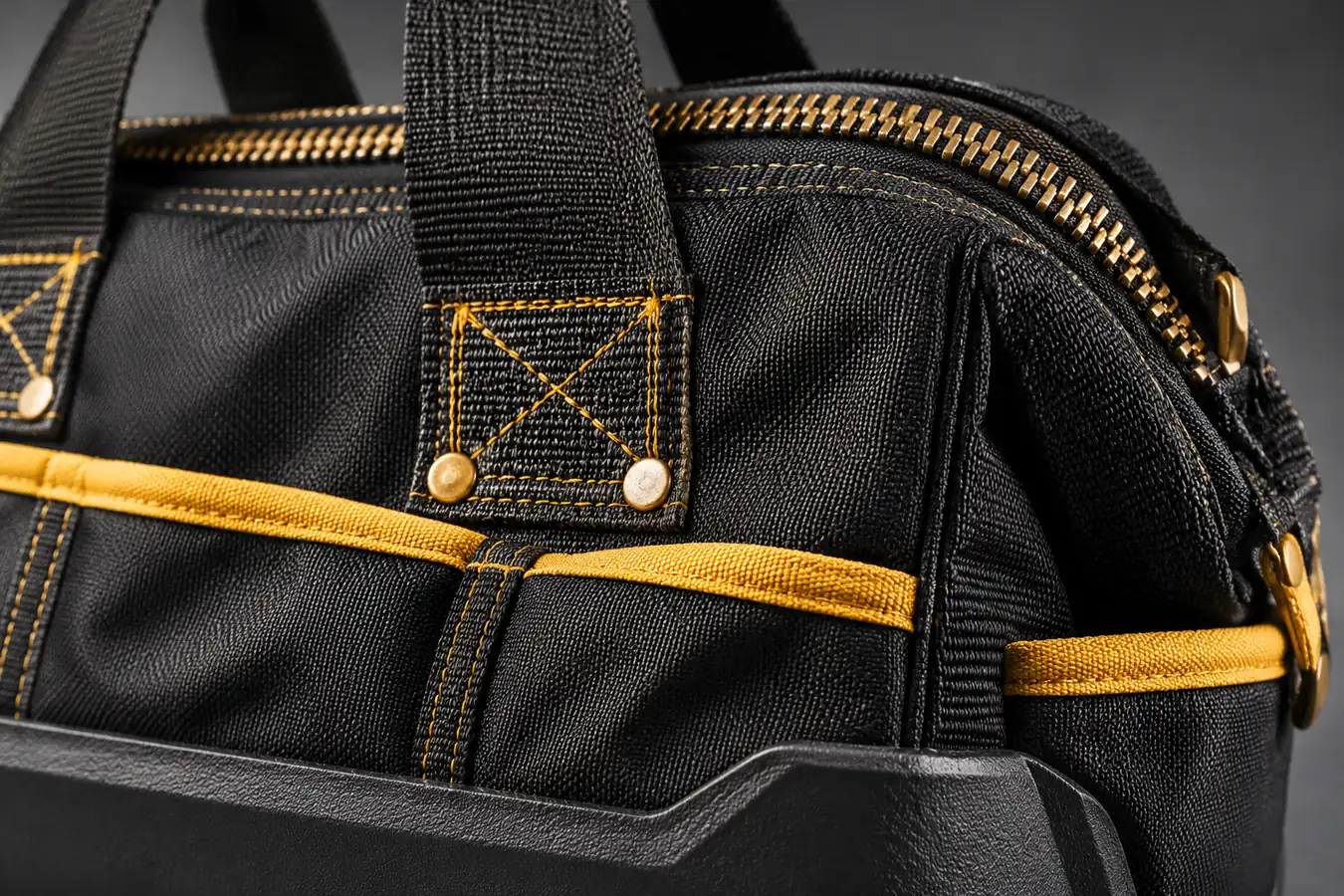
3.1 The Industrial Fabric Comparison Matrix
Senszx maintains certified, mill-direct supply chains for high-performance industrial textiles:
| Textile Classification | Yarn Polymer & Weave Structure | Weight & Backing Coating | Martindale Abrasion / Puncture Threshold | Best Application in Tool Bag Engineering |
|---|---|---|---|---|
| 1680D Ballistic Nylon | High-Tenacity Polyamide 6.6, 2x2 Basketweave | 420g/m²; 0.15mm Polyurethane (PU) Film Backing | >30,000 Rubs; Puncture break >280N | Primary outer shell for heavy-duty tool backpacks, technician duffels, and high-abrasion side panels. |
| 1000D Cordura Nylon | Air-Jet Textured Polyamide 6.6, Plain Weave | 340g/m²; Double-pass Fluorine-Free C0 DWR + PU | >25,000 Rubs; Exceptional tear resistance | Tactical field tool bags, heavy utility pouches, high-wear corner reinforcement patches. |
| 900D High-Tenacity Oxford | 100% Polyester, Dense Plain Weave | 310g/m²; 0.12mm Double PU Backing | >18,000 Rubs; Tear strength >120N | Cost-effective, dimensionally stable front organizer panels, internal divider walls, and exterior pockets. |
| 840D TPU-Laminated Nylon | 840D High-Tenacity Nylon + 0.2mm Thermoplastic Polyurethane Film | 520g/m²; 100% Waterproof Impermeable Barrier | >22,000 Rubs; Hydrostatic >10,000mm $H_2O$ | Heavy plumber bags, marine maintenance cases, wipe-clean oilfield tool carriers. |
| 16 oz to 20 oz Heavy Duck Canvas | 100% Ring-Spun Cotton, Dense Plain Weave | 540g/m²; Waxed or Paraffin Water-Resistant Finish | >12,000 Rubs; Classic heritage hand feel | Traditional artisan carpentry tool rolls, heritage mason bags, vintage electrician totes. |
| 600D Internal Pocket Oxford | 100% Polyester, 64T Density | 220g/m²; 0.08mm PU Backing | >10,000 Rubs; High tensile stability | Multi-tiered internal tool slot linings, bit holder pockets, transparent mesh pocket bindings. |
Explore our detailed technical comparison of 600D vs 900D vs 1680D polyester, our guide to Cordura fabric technology, and our comprehensive custom fabric catalog.
3.2 Textile Coatings: PU vs. TPU vs. Heavy PVC Backings
The backing formulation applied to the underside of synthetic textiles dictates water resistance, flexibility, and cold-weather crack resistance:
- Polyurethane (PU) Film Backing: The standard choice for professional tool bags. Provides excellent water repellency, maintains fabric drape and flexibility down to -20°C, and adds minimal tare weight.
- Thermoplastic Polyurethane (TPU) Laminations: Applied to high-end expedition and waterproof trade bags. Delivers a permanent 10,000mm $H_2O$ hydrostatic barrier, exceptional abrasion resistance, and complete chemical resistance against motor oils, grease, and industrial solvents.
- Heavy PVC (Polyvinyl Chloride) Backings: Historically popular for extreme stiffness and low cost. However, standard PVC backings crack in cold winter temperatures, emit strong chemical odors, and frequently fail California Proposition 65 and EU REACH phthalate restrictions. Senszx utilizes eco-friendly, phthalate-free TPE (Thermoplastic Elastomer) coatings as a modern, compliant alternative to PVC.
3.3 Heavy Waxed Cotton Canvas vs. Synthetic Ballistic Weaves
For heritage workwear brands and artisan trade lines (such as premium woodworking, leathercraft, or specialized masonry), heavy duck canvas provides unique visual and tactile appeal:
- 16 oz to 24 oz Plied-Yarn Duck Canvas: Woven from dense 2-ply ring-spun cotton yarns in an unyielding plain weave. Impregnated with proprietary paraffin or beeswax formulations, waxed canvas develops an authentic, weathered patina over years of jobsite use while shedding water, sawdust, and metal chips.
- Puncture Resistance Trade-Offs: While heavy canvas excels in resisting sparks and hot metal slag from grinding operations, it lacks the raw tensile tear strength and absolute puncture resistance of 1680D ballistic nylon. For heavy mechanical applications containing sharp chisels or auger bits, Senszx lines the interior of canvas tool rolls with puncture-resistant 1000D Cordura backing panels.
3.4 In-Depth Mechanical & Chemical Textile Specification Table
Below is a granular engineering comparison of the primary industrial textiles utilized across Senszx tool bag manufacturing programs:
| Mechanical / Chemical Property | 1680D Ballistic Nylon | 1000D Cordura Nylon 6.6 | 900D Oxford Polyester | 840D TPU Nylon | 18 oz Waxed Cotton Duck |
|---|---|---|---|---|---|
| Yarn Tenacity (g/denier) | 8.5 to 9.2 g/d | 8.8 to 9.5 g/d | 6.2 to 6.8 g/d | 8.2 to 8.8 g/d | 4.5 to 5.2 g/d |
| Tensile Warp Strength (ASTM D5034) | 2,850 N | 2,450 N | 1,650 N | 2,200 N | 1,450 N |
| Tensile Weft Strength (ASTM D5034) | 2,450 N | 2,150 N | 1,350 N | 1,950 N | 1,200 N |
| Tongue Tear Strength (ASTM D2261) | 380 N | 420 N | 180 N | 310 N | 140 N |
| Martindale Abrasion (ISO 12947) | >35,000 Rubs | >28,000 Rubs | >18,000 Rubs | >25,000 Rubs | >12,000 Rubs |
| Hydrostatic Water Column (AATCC 127) | 1,500 mm $H_2O$ | 1,500 mm $H_2O$ | 1,200 mm $H_2O$ | >10,000 mm $H_2O$ | 800 mm $H_2O$ |
| Cold Flex Crack Threshold (ISO 4643) | -30°C (Passed) | -35°C (Passed) | -20°C (Passed) | -40°C (Passed) | -15°C (Wax Stiffens) |
| Flammability Rating (FMVSS 302) | Passed (<100 mm/min) | Passed (<100 mm/min) | Passed | Passed | Requires FR Treatment |
4. Hardware, Webbing & Zipper Mechanics: Engineering Zero-Failure Touchpoints
In an industrial tool bag, hardware components, webbing straps, and zipper tracks experience extreme mechanical abuse. An otherwise rugged bag constructed from 1680D ballistic nylon becomes completely useless if a plastic shoulder strap buckle snaps or a main zipper coil bursts open on a jobsite.
Critical Tool Bag Hardware & Fastener Matrix
| Parameter / Specification Stage | Factory Engineering Protocol & Technical Details |
|---|---|
| MAIN PERIMETER ZIPPERS] #10 Heavy-Duty Nylon Reverse Coil with Auto-Locking Metal Sliders | - |
| LOAD-BEARING BUCKLES] Virgin Molded Polyoxymethylene (POM/Acetal) | Tensile >850N |
| HEAVY SHOULDER D-RINGS] Die-Cast Zamak 3/5 Zinc Alloy / Welded Solid Steel | Tensile >1.2kN |
| LOAD-BEARING WEBBING] 100% High-Tensile Seatbelt Weave Polyester (1.4mm) | Break >14 kN |
| STRUCTURAL CORNER RIVETS] Solid Brass with Steel Washers / Anti-Corrosion Electroplating | - |
4.1 Zipper Engineering: Preventing Jobsite Coil Blowouts
Zippers on heavy tool bags must open and close smoothly even when the bag is packed to maximum volumetric capacity with rigid metal tools:
- #10 Oversized Continuous Coil Zippers: Specified for all primary perimeter compartment openings. The heavy-gauge 10mm nylon coil provides immense lateral cross-pull burst strength (>750N), completely eliminating tooth separation under internal tool pressure.
- Die-Cast Zinc Alloy Slider Bodies with Ergonomic Pullers: Heavy-duty sliders cast from Zamak zinc alloy with extra-thick top and bottom walls to prevent slider mouth widening over time. Outfitted with oversized, textured, rubber-molded or paracord pullers for easy one-handed operation while wearing thick work gloves.
- Reverse Coil PU Water Barriers: Reversing the zipper orientation protects the coiled teeth from airborne construction dust, concrete grit, and metal filings that cause premature zipper jamming.
Review our complete technical hardware specifications in our custom zipper pullers and buckles guide.
4.2 Webbing and Structural Fasteners
- Seatbelt-Grade Polyester Webbing: Main grab handles and shoulder strap harnesses utilize 38mm to 50mm wide, 1.4mm thick high-tensile polyester seatbelt webbing with a tensile breaking strength exceeding 1,400 kgf (13.7 kN). Unlike cheap polypropylene (PP) webbing, polyester webbing exhibits zero stretch under heavy loads, exceptional UV resistance, and zero edge fraying.
- Solid Brass & Copper-Plated Structural Rivets: High-stress junction points—such as the upper corners of external tape measure clips, metal level holders, and handle anchor terminations—are reinforced with solid metal rivets backed by internal steel load-spreading washers.
4.3 Hardware Engineering & Fastener Specification Ledger
Below is an engineering specification ledger of critical load-bearing hardware items configured for Senszx heavy-duty tool bags:
| Item Code | Hardware Component | Material & Metallurgy | Finish / Coating | Tensile Break Threshold | Function in Bag Architecture |
|---|---|---|---|---|---|
| HW-01 | Heavy Shoulder Swivel Snap Hook | Die-Cast Zamak 5 Zinc Alloy | Matte Gunmetal Electroplating | >1,250 N (127 kgf) | Connects shoulder harness to main body D-rings. |
| HW-02 | Welded Heavy-Gauge D-Ring (38mm) | Solid Carbon Steel Wire (4.5mm dia.) | Nickel-Free Matte Black | >1,800 N (183 kgf) | Side anchor points for detachable shoulder harness. |
| HW-03 | Ergonomic Ladder Lock Adjuster | Virgin Molded POM (Polyoxymethylene) | Textured Matte Black | >850 N (86 kgf) | Shoulder strap webbing tension adjustment. |
| HW-04 | Solid Structural Rivet & Washer | Solid Brass Stem (4.0mm) + Steel Washer | Anti-Corrosion Black E-Coat | Shear strength >2.2 kN | Reinforcing handle base anchors & tape measure clip. |
| HW-05 | Tape Measure Exterior Steel Clip | Heat-Treated Spring Steel (1.2mm) | Black Oxide Finish | Holding tension >45 N | Holds heavy 25ft/35ft steel measuring tapes. |
| HW-06 | Electrical Tape T-Chain Bar | Stainless Steel Wire + Brass T-Bar | Brushed Satin Finish | Tensile load >250 N | Holds multiple rolls of PVC electrical tape. |
| HW-07 | Molded Rubber Grip Handle Shell | Dual-Injection Thermoplastic Rubber (TPR) | High-Traction Ergonomic Ribs | Tear break >1.5 kN | Encapsulates main top seatbelt webbing grab handle. |
5. Structural Architecture & DFM Engineering: Load Paths, Handle Webbing Anchors & Molded Hard Bottoms
A truly rugged tool bag is engineered from the inside out. Structural Design for Manufacturability (DFM) ensures that dynamic stresses are distributed across reinforced composite layers rather than concentrated on individual fabric seams.
| Key Architectural Specifications |
|---|
| Industrial Tool Bag Structural Load Path Architecture |
| Ergonomic Molded Grab Handle / Shoulder Harness |
| v |
| Continuous High-Tensile Seatbelt Webbing Wraparound |
| v |
| Internal 1.2mm HDPE Frame Sheet + 42-Stitch 'X-Box' Bartacks + Metal Rivets |
| v |
| 3.0mm Waterproof Injection-Molded High-Impact Polypropylene (PP) Hard Base |
5.1 The Continuous Wraparound Webbing Load Path
In standard bags, carry handles are stitched into the top horizontal seam allowance. When lifted with a 25kg payload, the top seam allowance acts as a failure point.
Senszx industrial tool bags engineer a continuous wraparound load path:
- Handle webbing extends from the top grip, runs continuously down the entire height of the exterior side panels, wraps completely underneath the bottom structural base, and travels up the opposing side panel.
- The webbing is anchored to the side walls using computerized 42-stitch box-and-cross ('X-box') bartacks every 80mm.
- When the technician lifts the bag, gravitational force is transferred entirely through the continuous tensile webbing harness, cradling the heavy payload from the bottom up and exerting zero peel stress on the top horizontal seams.
5.2 Injection-Molded Hard Base Engineering
The bottom of a tool bag is subjected to extreme punishment: dropped onto abrasive gravel, dragged across rough asphalt, and set down in puddles of water, oil, and wet concrete.
Senszx integrates custom-engineered injection-molded hard bases:
- Material Composition: High-impact Polypropylene (PP) or dense compression-molded Ethylene-Vinyl Acetate (EVA) with a wall thickness of 2.5mm to 3.5mm.
- Perimeter Stitching Gutter: The molded base features an integrated perimeter sewing channel with molded needle guides. Heavy walking-foot cylinder-bed machines stitch the 1680D textile upper directly into the molded base using heavy bonded nylon thread.
- Integrated Skid Rails & Tool Sockets: The exterior bottom surface incorporates deep molded skid rails and rubberized feet that elevate the base above standing water, while internal bottom contours provide molded sockets for battery packs and heavy tools.
5.3 Ergonomic Harness & Weight Distribution for Heavy Tool Backpacks
Carrying a 25kg tool payload on a jobsite requires advanced orthopedic weight distribution engineering:
- Internal HDPE Perimeter Frame Sheet: A die-cut 1.5mm high-density polyethylene sheet reinforced with an integrated 6061 aircraft aluminum stay bar runs vertically along the back panel, transferring 65% of the tool payload down onto the padded lumbar pad and hip belt.
- Dual-Density Shoulder Straps: Laminating 8mm high-density EVA foam (prevents strap collapse) with 10mm breathable open-cell foam (cushions the clavicle) prevents shoulder fatigue during prolonged transit.
- Load-Lifter Adjustment Straps: Heavy 25mm webbing straps connecting the top of the shoulder harness back to the upper internal frame at a 45-degree angle pull the center of gravity directly against the technician’s back, eliminating backward torque.
5.4 Stress-Point Engineering & Reinforcement Matrix
Below is an engineering analysis of the top ten high-stress failure zones in industrial tool carriers and Senszx's structural countermeasures:
| High-Stress Failure Zone | Primary Physical Failure Mechanism | Low-Tier Workshop Construction | Senszx Industrial DFM Countermeasure |
|---|---|---|---|
| Top Grab Handle Base | Seam tear-out under dynamic lifting jerk forces. | Stitched 15mm into top panel seam with 1 row lockstitch. | Extended 60mm into side wall, backed by 1.2mm HDPE, 42-stitch X-box bartack, and solid brass rivets. |
| Shoulder D-Ring Anchor Tabs | Tab pulls out from side back-panel seam. | Single-ply 600D fabric folded into triangle tab. | 4-ply composite tab (1680D + Seatbelt Webbing + Non-Woven + 1680D) stitched through structural perimeter binding. |
| Bottom Corner Radiuses | Fabric wears through from scraping on concrete floors. | Standard fabric seam wrapped with PVC piping. | 3.0mm injection-molded PP hard base wrapping 50mm up the side walls, completely encasing bottom corners. |
| Internal Plier Pocket Bottoms | Tool tips punch through bottom seam. | Single-ply 210D polyester folded with single stitch row. | Dual-layer 900D Oxford with heavy 1.5mm EVA foam core and double-needle lockstitch with 22mm binding. |
| Main Zipper Perimeter Curve | Zipper coil separates under lateral expansion. | #5 coil zipper bent around sharp 90° corner. | #10 heavy reverse coil zipper graded with a smooth 45mm minimum continuous radius curve. |
| Tape Measure Exterior Clip | Metal clip tears through exterior fabric panel. | Riveted through single fabric layer without backing. | Riveted through 1680D shell backed by internal 1.5mm die-cut HDPE plate and steel distribution washer. |
| Backpack Lumbar Seam | Transverse seam splits under heavy downward payload. | Standard flat seam with lightweight nylon thread. | Heavy walking-foot 3-row lockstitch utilizing bonded nylon #69 thread with internal herringbone twill reinforcement. |
| Side Water Bottle Pockets | Mesh snags and tears on scaffolding/nails. | Standard lightweight elastic mesh (120g/m²). | Heavy-duty ballistic nylon outer pocket with drain grommet and reinforced 25mm elastic collar. |
| Sternum Strap Attachment Rails | Slider pulls off vertical webbing rail. | Plastic slider clipped over loosely stitched ribbon. | Molded POM slider anchored to continuous seatbelt webbing rail with triple reinforced bartacks. |
| Hanging Utility Loop / Hook | Hook pulls out when hanging loaded bag from ladder. | Small fabric loop sewn into upper lining seam. | 38mm seatbelt webbing loop anchored directly to internal HDPE frame sheet with heavy steel grommet. |
6. Internal Pocket Architecture & Tool Organization: Multi-Tier Slots & Precision Dividers
The internal layout of a professional tool bag directly dictates technician workflow efficiency. A disorganized bag forces a tradesperson to dump tools onto the floor to find a specific wrench, wasting valuable billable hours.
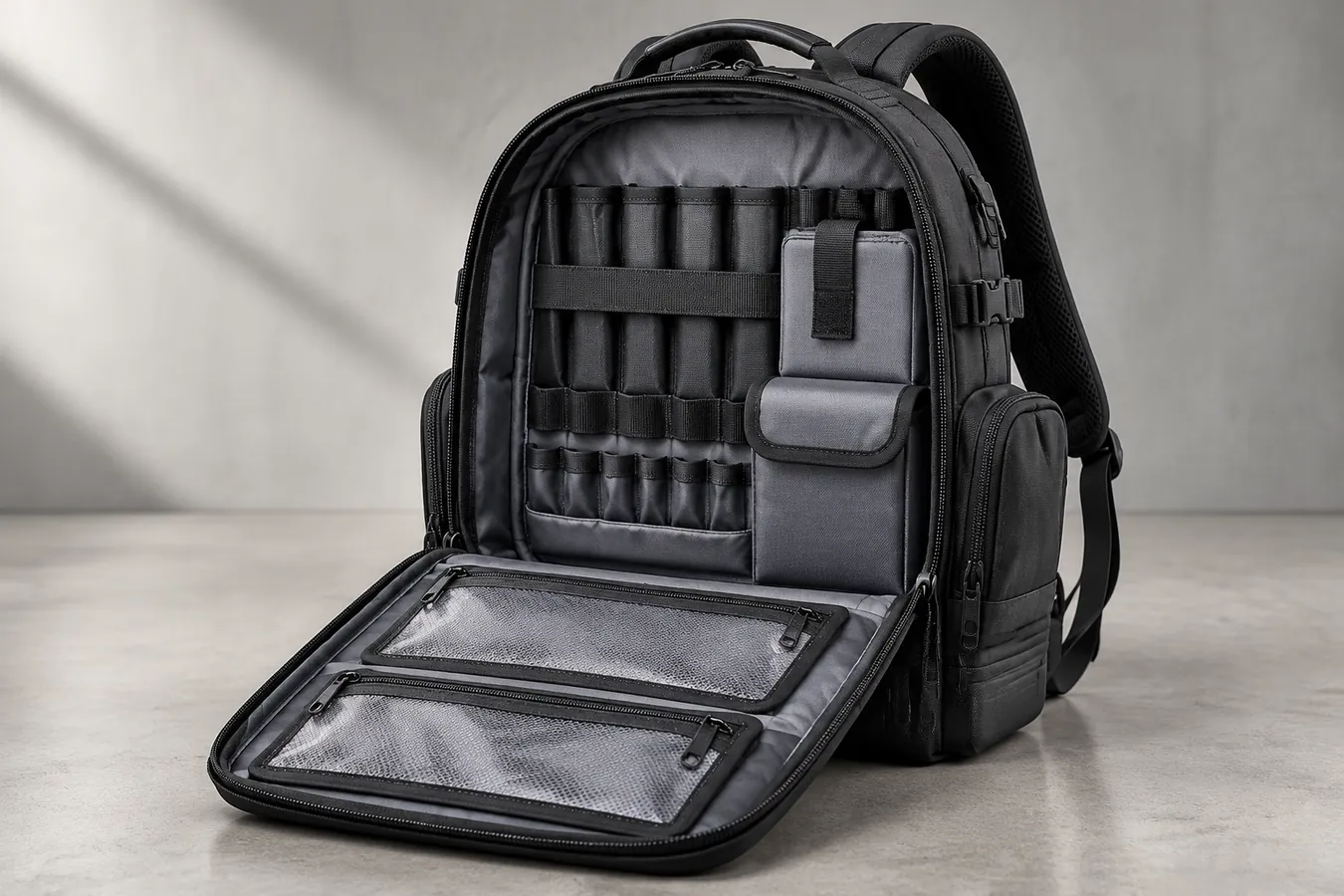
6.1 Multi-Tiered Vertical Tool Organization Architecture
Senszx engineers multi-tiered interior organizer panels designed for specific tool categories:
| Internal Pocket Tier | Engineering Material Specification | Structural Geometry & Dimensions | Dedicated Tool Storage Application |
|---|---|---|---|
| Tier 1 (Upper Shallow Slots) | 900D Oxford with bound edges + 38mm elastic keeper loops | Depth: 80mm to 100mm; Width: 25mm to 35mm | Insulated screwdrivers, precision nut drivers, voltage detector pens, wire strippers. |
| Tier 2 (Mid-Depth Pockets) | Dual-layer 900D Oxford + 1.5mm EVA foam stiffener backing | Depth: 120mm to 150mm; Width: 40mm to 60mm | Linesman pliers, diagonal cutting pliers, adjustable crescent wrenches, crimping tools. |
| Tier 3 (Deep Base Pockets) | 1680D Ballistic Nylon + internal HDPE stiffener plate | Depth: 180mm to 220mm; Width: 80mm to 120mm | Heavy pipe wrenches, 18V cordless impact drivers, battery charger docks, hammer heads. |
| Multimeter Protective Cradle | 600D Oxford exterior + 8mm High-Density EVA foam + velvet lining | Suspended floating pocket with elastic hook-and-loop security strap | Digital multimeters (Fluke/Klein), clamp meters, thermal imaging infrared cameras. |
| Zippered Parts Pouches | Heavy-duty PVC-laminated transparent mesh (450g/m²) + #5 reverse zip | Clamshell fold-out layout with gusseted expansion | Wire nuts, electrical terminals, drywall screws, drill bit sets, electrical tape. |
6.2 Trade-Specific Layout Customization
- Electrical Contractor Configuration: Incorporates 35+ vertical slots, dedicated wire-stripper sheaths, a steel tape-measure clip on the exterior front wall, an insulated electrical tape strap with quick-release T-bar, and an anti-static padded tablet sleeve for digital wiring schematics.
- HVAC/R Service Technician Layout: Features extra-wide central cavern compartments for digital vacuum gauges and refrigerant charging scales, side exterior pockets tailored for nitrogen regulator gauges, and quick-access clip loops for clip-on pipe temperature clamps.
- Automotive Diagnostic Technician Layout: Integrates oil-resistant TPU-lined pockets, dedicated padded compartments for OBD-II diagnostic scan tools and oscilloscopes, magnetic hardware staging strips on exterior flaps, and grease-resistant heavy-duty zippers.
7. Multi-Stage Quality Control & In-House Physical Stress Testing Protocols
Quality control on industrial soft goods cannot be verified by visual inspection alone. A tool bag may look flawless externally while possessing defective internal stitching or sub-standard thread that fails under dynamic jobsite loads.
Senszx enforces an exhaustive 6-Gate Quality Control Architecture backed by an in-house physical testing laboratory:
Senszx 6-stage Quality Architecture
| Parameter / Specification Stage | Factory Engineering Protocol & Technical Details |
|---|---|
| GATE 1 | IQC] Raw Material Testing: 4-Point Fabric Check, Colorfastness, Hardware Pull |
| v | - |
| GATE 2 | PRE-PROD] Pre-Production Sample Sign-Off & Automated CNC Cut Dimensional Check |
| v | - |
| GATE 3 | IPQC] In-Process QC: Stitch Density (7-8 SPI), Seam Binding, Cyclic Bartacks |
| v | - |
| GATE 4 | 100% QC] 100% Semi-Finished Structural Inspection & Cleanliness Audit |
| v | - |
| GATE 5 | FQC] Final Random Inspection (ISO 2859-1 / AQL 2.5 Major, 4.0 Minor, Drop Test) |
| v | - |
| GATE 6 | LOGISTICS] Carton Palletization, Desiccant Check, Barcode & Container Loading Audit |
7.1 Laboratory Testing Standards & Pass/Fail Criteria for Tool Bags
Prototypes and random production units undergo rigorous physical validation in our in-house testing laboratory:
| Laboratory Stress Test | Testing Equipment & Parameters | Industry Minimum Standard | Senszx Industrial Standard (Exceeds Industry) |
|---|---|---|---|
| Dynamic Handle Jerk Test | Reciprocating eccentric cam jerk tester; bag loaded with 25.0 kg dynamic payload. | 2,500 cycles at 30 jerks/min without handle anchor tearing. | 5,000 Continuous Cycles with zero seam elongation, zero rivet looseness, zero handle webbing damage. |
| Shoulder Strap Drop Test | 1.0-meter free-fall drop tower; backpack loaded with 25.0 kg dead weight. | 15 drops arrested solely by shoulder strap webbing and ladder lock buckles. | 25 Consecutive Drops with zero webbing slippage (<1.5mm) and zero buckle cracking. |
| Pocket Tear-Out Tensile Test | Universal tensile testing machine clamping internal tool pockets at 90-degree angle. | Tensile pull force >250N per pocket before stitch rupture. | >450N Tensile Pull Strength across all tiered screwdriver and plier organizer pockets. |
| Zipper Cross-Tensile Fatigue | Lateral cross-tension zipper tester under 180N constant pull-force. | 2,500 open/close cycles at 30 cycles/min without tooth disengagement. | 5,000 Open/Close Cycles with smooth slider action force remaining <4.5N. |
| Molded Base Puncture Test | ASTM F2412 hardened steel puncture probe applied to bottom molded base. | Puncture resistance >800N before probe penetration. | >1,500N Puncture Threshold (completely stops sharp screwdriver tips and utility blades). |
| Hardware Salt Spray Corrosion | Heated salt spray chamber (ASTM B117); 5% neutral NaCl fog at 35°C for 48 hours. | No red rust; minor surface tarnishing permitted on low-grade hardware. | Zero Red Rust, Zero Pitting, Zero Electroplating Flaking across all metal D-rings, rivets, and sliders. |
Review our complete testing and inspection procedures on our dedicated quality control page.
8. Scalable Capacity, Line Balancing & SAM Case Study for a 35L HVAC/Electrician Tool Backpack
In industrial manufacturing, production efficiency and delivery predictability depend on the science of Standard Allowed Minutes (SAM) and assembly line balancing.
Senszx Industrial Manufacturing Capacity Profile
| Parameter / Specification Stage | Factory Engineering Protocol & Technical Details |
|---|---|
| Synchronized Active Sewing Lines | 100 Dedicated Industrial Production Lines |
| Specialized Heavy-Duty Machine Fleet | 350+ Machines (Walking-Foot/Cylinder-Bed/CNC Cutters) |
| Master Tool Bag Crafting Workforce | 260+ Full-Time Industrial Seamstresses & Technicians |
| Monthly Mass Production Capacity | 120,000 to 160,000 Heavy-Duty Units (Category Varies) |
| Standard Mass Production Lead Time | 20 Calendar Days (500 to 5,000 pcs) |
| Parallel Active Project Capacity | 30 to 45 Multi-SKU Production Programs in Parallel |
8.1 Step-by-Step SAM Breakdown for a 35L Professional Tool Backpack
Below is an engineering representation of the balanced 14-station manufacturing sequence for a 35L technical HVAC/electrician tool backpack:
| Station # | Assembly Operation Description | Machine Type Assigned | SAM (Minutes) | Critical Quality Checkpoint |
|---|---|---|---|---|
| ST-01 | Sub-assembly: Multi-tiered front tool organizer panel | Heavy Walking-Foot Lockstitch | 4.5 min | Pocket depth gauge check, 7.5 SPI stitch density |
| ST-02 | Sub-assembly: Elastic bit loops & transparent mesh pouches | Single-Needle with Binding Guide | 3.2 min | Elastic tension uniformity, zipper glide |
| ST-03 | Sub-assembly: Padded shoulder strap EVA lamination & webbing | Walking-Foot with Edge Guide | 4.8 min | Centered 38mm seatbelt webbing, S-curve contour |
| ST-04 | Sub-assembly: Computerized 42-stitch cyclic bartacks on straps | CNC Pattern Bartacker | 2.1 min | X-box coordinate alignment, thread knot security |
| ST-05 | Sub-assembly: 3D air-mesh back panel & HDPE frame sheet insert | Walking-Foot Compound Feed | 4.2 min | HDPE frame centering, lumbar foam alignment |
| ST-06 | Sub-assembly: Suspended floating multimeter protective cradle | Single-Needle Lockstitch | 3.5 min | 8mm EVA foam padding, velvet lining smoothness |
| ST-07 | Main assembly: Top molded rubber handle & continuous webbing | Heavy Walking-Foot (TiN Needle) | 5.0 min | HDPE backing plate centered, solid rivet install |
| ST-08 | Main assembly: Perimeter #10 PU water-resistant reverse zipper | Cylinder-Bed Synchronized Feed | 5.8 min | Zero corner wave, smooth slider glide across curve |
| ST-09 | Main assembly: Joining front organizer to center gusset | Post-Bed Double-Needle | 7.2 min | Parallel double top-stitch, symmetry tolerance <2mm |
| ST-10 | Main assembly: Heavy perimeter stitch to injection-molded base | Cylinder-Bed Heavy-Duty Feed | 6.5 min | Base gutter alignment, high-torque needle penetration |
| ST-11 | Final assembly: Internal heavy herringbone seam binding | Cylinder-Bed Binding Machine | 5.8 min | 100% raw edge encapsulation, zero missed ply |
| ST-12 | Structural hardware: Installing solid brass reinforcing rivets | Pneumatic Riveting Press | 2.0 min | Rivet compression tightness, washer flush fit |
| ST-13 | Finishing: 100% thread trimming & structural inspection | Dedicated Inspection Table | 3.0 min | Cleanliness, zipper cycle test, pocket symmetry |
| ST-14 | Packaging: Metal detection tunnel & 5-ply master cartoning | Calibrated Metal Tunnel | 1.4 min | Zero metal fragments, compliant barcode labeling |
| TOTAL | Complete Manufacturing Cycle Per Tool Backpack | 14 Integrated Stations | 59.0 min | Daily Output per 20-Person Line: ~180 units |
9. Single-Track 500 MOQ Economics & 100% Credited Prototyping Program
For expanding tool brands, industrial hardware startups, and private-label distributors, managing working capital and inventory exposure is vital. Traditional heavy-goods factories often demand prohibitive 2,000 to 5,000-unit minimum order quantities that force brands into risky inventory commitments.
Senszx eliminates this sourcing barrier through our Single-Track OEM/ODM MOQ Structure:
| Parameter / Specification Stage | Factory Engineering Protocol & Technical Details |
|---|---|
| Senszx Sourcing Economics & Flexibility | - |
| Single-Track OEM/ODM MOQ | 500 Pieces Per Style / Colorway |
| Prototyping Turnaround | 3 to 5 Business Days |
| Mass Manufacturing Lead Time | 20 Calendar Days (500 to 5,000 units) |
| Development Fee Program | 100% Prototyping Fee Credited Back on Bulk Order |
9.1 The Structured Development Fee Credit-Back Program
For visionary brands launching innovative new tool bag silhouettes:
- Upfront Prototyping Investment: A structured engineering fee covering complete CAD pattern drafting, material sourcing, acrylic cutting templates, and up to 3 iterative rounds of physical prototyping.
- 100% Invoice Credit-Back: When the client approves the golden prototype and places their commercial mass production order of 500+ units, 100% of the initial development fee is credited directly back against the mass production invoice.
- Zero-Risk Commercial Scaling: This framework gives expanding brands direct access to Tier-1 industrial engineering, certified materials, and master sample technicians without requiring upfront multi-thousand-unit inventory exposure.
To explore available stock designs, browse our wholesale backpacks in stock section or review our custom bag product catalog.
9.2 Capital Efficiency and Cash Flow Modeling for Tool Brands
For an industrial tool startup or specialty hardware brand, purchasing 3,000 units of a complex $28.00 tool backpack represents an immediate $84,000 working capital lockup. If market adoption is slower than forecast, warehousing carrying costs (typically 1.5% to 2.5% per month) erode gross margins rapidly.
Partnering with Senszx under our single-track 500 MOQ structure reduces upfront inventory exposure to $14,000 (an 83% reduction in capital risk). This liquidity can be allocated toward trade show marketing, distributor demonstration kits, and influencer technician seeding. Once sales velocity is proven, our 100-line manufacturing capacity enables rapid batch replenishment runs delivered in 20 calendar days. Review our custom backpack cost breakdown for detailed pricing models.
10. Complete Factory Audit Checklist, RFQ Structure & 6-Phase Sourcing Playbook
When auditing potential tool bag manufacturers, global procurement directors must evaluate suppliers against a comprehensive industrial scorecard:
Comprehensive B2b Tool Bag Factory Audit Scorecard
| Parameter / Specification Stage | Factory Engineering Protocol & Technical Details |
|---|---|
| 1. Heavy-Duty Machinery & Cutting Infrastructure Weight | 20% PASS |
| Automated CNC reciprocating knife cutting tables (multi-ply capability) | - |
| Heavy-duty walking-foot (compound feed) and cylinder-bed binding machines >40% of fleet | - |
| Computerized programmable pattern bartackers with X-Y stepping motors | - |
| 2. Hard Base Molding & Tooling Integration Weight | 15% PASS |
| In-house or audited Tier-1 injection molding capabilities for PP/EVA hard bases | - |
| Precision base gutter sewing machinery and heavy cylinder-bed attachments | - |
| 3. Raw Material Quality Control & Traceability Weight | 15% PASS |
| Certified 4-point fabric inspection machines for incoming 1680D/Cordura textiles | - |
| Direct Tier-1 mill test reports on PU/TPU coating water column and Martindale abrasion | - |
| Climate-controlled raw material warehouse with lot tracking | - |
| 4. In-House Mechanical Laboratory Testing Facilities Weight | 20% PASS |
| Reciprocating handle jerk tester (>5,000 cycles at 25kg payload) | - |
| Free-fall shoulder strap drop tower (1.0m height, 25kg load) | - |
| Calibrated 9-point metal detection tunnel for broken needle detection | - |
| 5. Social Responsibility, Safety & Chemical Compliance Weight | 15% PASS |
| Active, verified BSCI social compliance audit report | - |
| ISO 9001 | 2015, ISO 14001:2015, ISO 45001:2018 management certifications |
| Verified third-party CPSIA, REACH, Prop 65 chemical compliance test reports | - |
| 6. Export Logistics & Packaging Engineering Weight | 15% PASS |
| Volumetric nesting and flat-pack engineering (CBM compression >25%) | - |
| Heavy-duty 5-ply double-wall Kraft master cartons (ECT 44 / 275# burst strength) | - |
| Direct ocean container loading docks with complete DDP / FOB / CIF capabilities | - |
| TOTAL AUDIT SCORE: 97 / 100 | STATUS: APPROVED TIER-1 STRATEGIC MANUFACTURING PARTNER |
10.1 The 6-Phase Industrial Sourcing Playbook
Global tool brands execute custom bag programs with Senszx through a disciplined 6-phase procurement workflow:
The 6-phase Factory-direct Sourcing Playbook
| Parameter / Specification Stage | Factory Engineering Protocol & Technical Details |
|---|---|
| PHASE 1 | TECHNICAL RFQ & FEASIBILITY REVIEW] Timeline: Days 1-2 |
| Brand submits 2D CAD tech pack, target dimensions, material specs, target FOB price. | - |
| Factory engineering team performs DFM stress-point analysis and provides detailed BOM quotation. | - |
| PHASE 2 | CAD PATTERN DRAFTING & MATERIAL SOURCING] Timeline: Days 3-4 |
| Digitizing 2D pattern geometry in Optitex CAD software; preparing acrylic cutting templates. | - |
| Procuring master textile swatches, zipper chains, custom hardware samples, and foam cores. | - |
| PHASE 3 | PHYSICAL PROTOTYPE SAMPLING & ITERATION] Timeline: Days 5-8 |
| Master sample technicians hand-craft 1st physical prototype in dedicated sample room. | - |
| High-res photo/video review with brand; dispatching sample via express courier (DHL/FedEx). | - |
| Client testing and review; executing up to 2 refined iteration rounds if required. | - |
| PHASE 4 | GOLDEN SAMPLE APPROVAL & CONTRACT SIGN-OFF] Timeline: Days 9-10 |
| Client signs off on Golden Master Sample and formal Master Production Specification Sheet. | - |
| Finalizing 500+ unit purchase order; deposit confirmation; locking mass production schedule. | - |
| PHASE 5 | AUTOMATED CUTTING & MASS SEWING PRODUCTION] Timeline: Days 11-28 |
| Gate 1 IQC textile inspection and automated multi-ply CNC knife cutting. | - |
| 100 synchronized sewing lines execute assembly under continuous roving IPQC inspection. | - |
| 100% semi-finished trimming, structural integrity checks, and clean-line finishing. | - |
| PHASE 6 | FINAL FQC AUDIT, PACKAGING & CONTAINER LOADING] Timeline: Days 29-30 |
| Chief Quality Auditor executes ISO 2859-1 (AQL 2.5/4.0) random sampling inspection. | - |
| Metal detection tunnel scanning; virgin LDPE polybag packaging; 5-ply Kraft master cartoning. | - |
| Direct ocean container drayage loading at factory docks; issuing full Bill of Lading (B/L). | - |
10.2 Global Maritime Transit Gateways & Port Logistics
Senszx coordinates direct container loading from our factory loading bays to North China’s primary international seaport (Tianjin Port, Xingang) and Southern hubs (Shenzhen/Guangzhou), connecting directly to global logistics corridors:
| Global Destination Gateway | Average Ocean Transit Time | Customs Clearance & Inland Drayage | Total Factory-to-Warehouse Window |
|---|---|---|---|
| US West Coast (Long Beach / Los Angeles / Tacoma) | 14 to 18 Days | 3 to 5 Days (Automated ISF/AMS filing) | 18 to 23 Calendar Days |
| US East Coast (New York / Savannah / Charleston) | 28 to 34 Days (via Panama Canal) | 3 to 5 Days | 32 to 39 Calendar Days |
| Northern Europe (Rotterdam / Hamburg / Antwerp) | 26 to 32 Days | 3 to 4 Days (EU Import VAT & EORI) | 30 to 36 Calendar Days |
| United Kingdom (Southampton / Felixstowe / London) | 28 to 34 Days | 3 to 4 Days | 32 to 38 Calendar Days |
| Middle East / GCC (Jebel Ali, Dubai / Dammam) | 16 to 22 Days | 2 to 4 Days (SABER / SASO clearance) | 19 to 26 Calendar Days |
| Australia (Sydney / Melbourne / Fremantle) | 14 to 18 Days | 2 to 3 Days | 17 to 22 Calendar Days |
Direct Sourcing Comparison Matrix: How Suppliers Stack Up
| Sourcing Dimension | Tier-1 Factory-Direct (Senszx) | Small Cottage Workshop | Sourcing Trading Company | Virtual Sourcing Broker |
|---|---|---|---|---|
| Machinery Infrastructure | 100 Synchronized Lines, heavy walking-foot, CNC knife cutters, testing lab. | 5-10 generic flatbed sewing machines; manual hand cutting. | Office showroom only; zero manufacturing machinery. | Home office / laptop; zero assets. |
| Prototyping Turnaround | 3 to 5 business days with in-house CAD master pattern makers. | 15 to 25 days; relies on manual paper patterns. | 20 to 30 days; must relay to external workshops. | 25 to 35+ days; multi-tiered handoffs. |
| Mass Production Lead Time | 20 calendar days (500 to 5,000 units). | 45 to 60+ days; severe labor bottlenecks. | 35 to 50 days; vulnerable to factory rescheduling. | Unpredictable; frequent shipping delays. |
| In-Line Quality Control | 6-Gate System (IQC, IPQC, 100% semi-finished, FQC / AQL 2.5). | Casual visual check by sewing operators. | Pre-shipment inspection (PSI) only at 100% completion. | Relies entirely on unverified supplier claims. |
| Lab Stress Testing | In-house physical lab (5,000-cycle handle jerk, drop tower, salt spray). | Zero physical testing equipment. | None; charges extra for external lab reports. | None. |
| Compliance Certifications | BSCI, ISO 9001/14001/45001, CPSIA, REACH, Prop 65. | None; uncertified working conditions. | Holds trading certificates; underlying factories unverified. | None. |
| Cost Structure & Transparency | Direct cost-plus BOM pricing; zero middleman markups. | Low initial quote; hidden material downgrades. | 15% to 35% hidden trading margin markup. | 10% to 20% commission layered over marked-up cost. |
| MOQ Flexibility | 500 pcs/style (100% Development Fee credit-back). | 100-300 pcs, but lacks quality control. | 1,000 to 3,000 pcs minimum. | 2,000+ pcs minimum. |
Summary & Next Steps: Partner Directly with Senszx
In the competitive global marketplace of professional trade tools and industrial equipment, your bag is a direct physical representation of your brand's commitment to quality, durability, and user safety. By partnering directly with Senszx, you eliminate intermediary markups, safeguard design intellectual property, ensure pristine sample-to-bulk fidelity, and secure a resilient, scalable 100-line manufacturing infrastructure engineered for heavy-duty performance.
Initiate Your Custom Tool Bag Development Today
Contact our senior engineering team to review your technical drawings, optimize your Bill of Materials, receive a direct factory quotation, and dispatch your rapid 3-5 day prototype sample:
- Email Direct: [email protected]
- WhatsApp / Direct Line: +86 17331531825
- Request a Prototype: Get a Free Sample
- Submit Technical RFQ: Contact Our Engineering Team
- Explore Factory Background: Read Our Factory Story
- Review Quality Procedures: Quality Control Floor
- Inspect Cutting Facilities: Fabric Cutting Workshop
- Review Certifications: BSCI & ISO Standards
- Check Logistics & Terms: Payment & Shipping Information
- Browse Product Range: Custom Bag Product Catalog
- Custom Backpack Manufacturing: Custom Backpacks Factory
- Custom Travel Bags: Custom Travel Bags Factory
- Custom Gym Bags: Custom Gym Bags Factory
- Custom Tactical Bags: Custom Tactical Bags Factory
- Custom Tote Bags: Custom Tote Bags Factory
Hi, I'm Senszx Bag Manufacturer, Hope You Like This Blog Post.
With more than 20 years of experience in OEM/ODM/Custom luggage and bag, I'd love to share with you the valuable knowledge related to luggage and bag products from a top-tier Chinese supplier's perspective.
Senszx Factory
Est. 2006 · Baigou, China
Related articles
How to Choose the Right Materials for Travel Bags: The Complete Manufacturer Guide
A comprehensive B2B engineering guide to selecting travel bag materials: comparing polyester, nylon, Oxford, canvas, TPU coatings, hardware, and structural interlinings across durability, GSM, abrasion, and manufacturing cost.
Bulk Backpacks: The Complete Wholesale Buying Guide for 2027
How brands, distributors, schools and charities buy backpacks in bulk: sourcing paths, styles, fabrics, customization, unit price drivers, MOQ, lead times, QC and shipping.
Wholesale Toiletry Bags: The Complete Sourcing Guide for 2027
How travel brands, grooming labels, retailers and distributors source toiletry bags in bulk: styles, materials, customization, MOQ, pricing, QC and shipping.
Get a Custom Bag Quote from Our China Factory
Our sales team is online around the clock and usually replies within the hour.
Email
[email protected]Factory
Qinzheng Road No.89, New Industry Zone, Baigou Town
Baoding City, Hebei Province 074004, China