How to Choose a Custom Backpack Manufacturer: The Definitive Bag Factory Sourcing & Audit Guide (2026)
A comprehensive 2026 B2B technical guide to evaluating, auditing, and partnering with cut-and-sew backpack manufacturers and bag factories. Covers stitching engineering, sewing workshop line balancing, tech pack prototyping, MOQ models, social compliance (BSCI/ISO), and landed cost calculations.
Selecting the right backpack manufacturer and bag factory is the single most critical strategic decision an outdoor brand, corporate enterprise, or private-label e-commerce business will ever make. While consumer marketing, industrial design aesthetics, and digital ad conversion capture the public spotlight, your gross margin, brand reputation, defect return rate, and supply chain scalability are forged on the sewing floor of your manufacturing partner.
In today's complex global trade environment, sourcing managers and brand founders face a crowded landscape of trading intermediaries, unverified sourcing agents, and low-tier contract workshops. Misjudging a factory's technical capabilities, sewing machine fleet, stitch engineering standards, or compliance integrity can lead to catastrophic delivery delays, catastrophic structural seam failures under load, custom clearance seizures by US Customs and Border Protection (CBP), and brand-destroying product recalls.
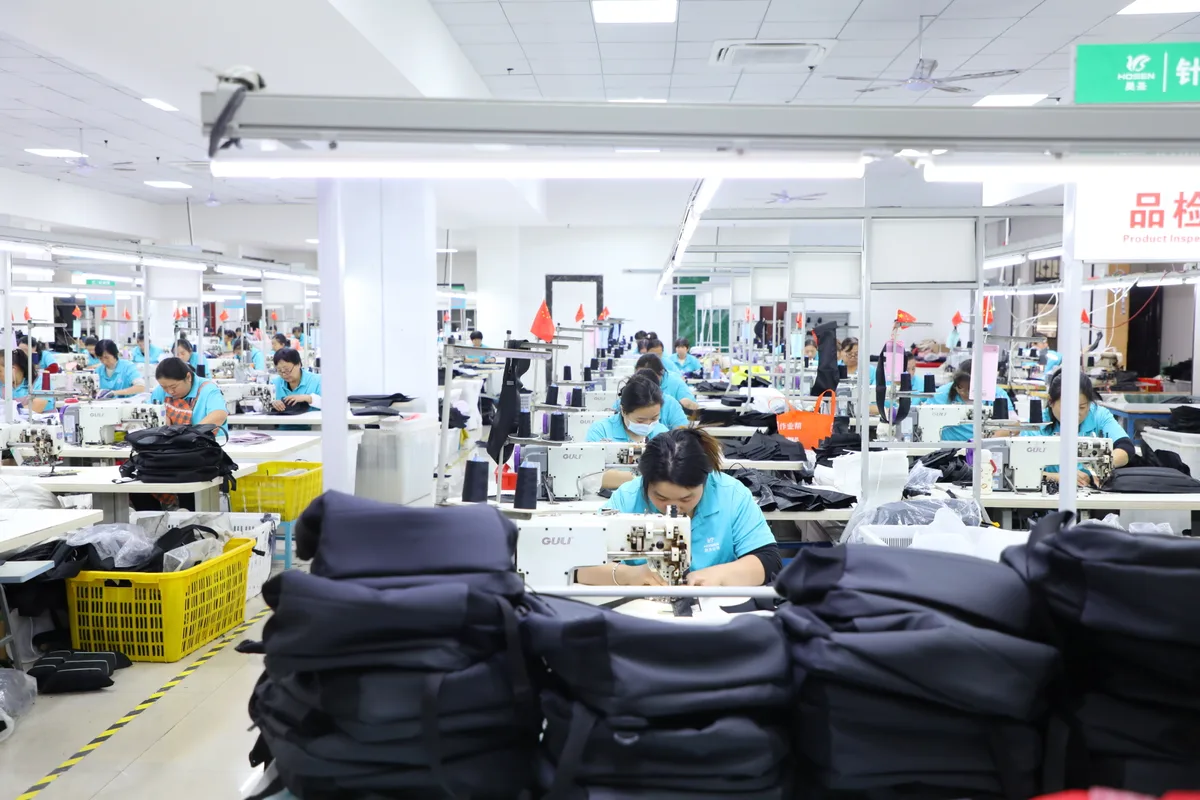
With over two decades of continuous, vertically integrated OEM and ODM luggage and backpack manufacturing at Senszx in Baigou, China (China's historic capital of bag and luggage production), our engineering and production teams have built, tested, and shipped millions of technical bags across the globe. We operate 100 dedicated production lines, manage in-house CAD sample development rooms, and uphold rigorous BSCI, ISO 9001, ISO 14001, ISO 45001, and CE certifications.
This comprehensive 2026 B2B technical guide provides an exhaustive, factory-floor blueprint for evaluating, auditing, and collaborating with a professional custom bag manufacturer. From deconstructing sewing machine mechanics and stitch density tolerances to analyzing line balancing, MOQ development fee offsets, and global tariff compliance, this guide equips your procurement team with actionable manufacturing intelligence.
1. The Global Backpack Manufacturing Landscape: China vs. Vietnam vs. Regional Hubs
When developing a multi-year bag sourcing strategy, procurement directors must evaluate the geopolitical, infrastructural, and raw material supply chain realities of different manufacturing regions. While media headlines frequently discuss shifting production hubs, an objective analysis of bill-of-materials (BOM) ecosystems, technical labor mastery, and landed tariff structures reveals clear distinctions between global manufacturing centers.
+----------------------------------------------------------------------------------------+
|                      GLOBAL BACKPACK MANUFACTURING MATRIX                              |
|                                                                                        |
|  [ China: Baigou / Quanzhou / Guangzhou ]                                              |
|  +-- Ecosystem Maturity: 100% complete localized raw material & hardware supply chain |
|  +-- Technical Competence: High-complexity multi-compartment & technical packs         |
|  +-- Prototyping Speed: 3 - 5 business days from 2D tech pack to physical PPS         |
|  +-- MOQ Flexibility: Single-track 500 pcs per style with rapid line scaling           |
|                                                                                        |
|  [ Vietnam / Southeast Asia: Ho Chi Minh / Binh Duong ]                                |
|  +-- Ecosystem Maturity: 60-70% of fabrics, PU films & zippers imported from China     |
|  +-- Technical Competence: High volume, basic to medium complexity daypacks            |
|  +-- Prototyping Speed: 15 - 25 business days (due to cross-border material transit)   |
|  +-- MOQ Constraints: Strict 3,000 - 5,000 pcs per style per colorway                  |
|                                                                                        |
|  [ Domestic Cut & Sew: United States / Europe ]                                        |
|  +-- Ecosystem Maturity: Highly fragmented; specialized Berry-compliant military mil-spec|
|  +-- Technical Competence: Tactical nylon gear, canvas heritage totes, simple bags     |
|  +-- Prototyping Speed: 10 - 20 business days at premium local labor rates             |
|  +-- Unit Labor Cost: $25.00 - $65.00 per hour (resulting in $80-$220 unit FOB)       |
+----------------------------------------------------------------------------------------+
Comprehensive Regional Sourcing Comparison
| Evaluation Dimension | China (Baigou / Hebei / Guangdong) | Vietnam / Cambodia | United States (Domestic Cut & Sew) | India / Pakistan |
|---|---|---|---|---|
| Primary Industry Advantage | Complete vertical supply cluster (fabrics, trims, hardware, tooling within 15 km) | Lower baseline direct labor rates for ultra-high volume basic runs | Berry Amendment compliance, zero overseas ocean transit time | Natural cotton canvas, jute, low-cost basic promotional totes |
| Material Supply Chain Speed | Immediate (1-2 days) for custom dye lots, high-tenacity nylon, and specialty hardware | Extended (14-21 days) because technical textiles and hardware ship from China | Moderate (7-14 days) for standard mil-spec; high reliance on imported components | Moderate (10-20 days) for synthetic materials; fast for local cotton textiles |
| Standard Production MOQ | 500 pcs per style/colorway (Flexible single-track model) | 3,000 to 5,000 pcs minimum order commitment | 100 to 300 pcs (at substantial unit price premiums) | 1,000 to 2,500 pcs |
| Rapid Sampling Lead Time | 3 to 5 business days (In-house dedicated sample master rooms) | 15 to 25 business days | 10 to 20 business days | 15 to 30 business days |
| Technical Assembly Capacity | Complex 45+ panel technical packs, laptop compartments, internal frames | Medium-to-high volume daypacks, simple duffles, sport bags | Heavy-duty canvas, simple tactical gear, specialty leather | Basic canvas totes, drawstring bags, non-technical backpacks |
| US Import Tariff Baseline | HTS Chapter 42 (17.6% base duty) + Section 301 (7.5% - 25% tariff) | HTS Chapter 42 (17.6% base duty) with zero Section 301 tariff | Zero international customs tariffs; domestic freight only | HTS Chapter 42 (17.6% base duty) |
| Factory Social Auditing | Mature BSCI, Sedex SMETA, ISO 9001/14001/45001 infrastructure | Mature WRAP, BSCI, Better Work auditing networks | OSHA, Fair Labor Standards compliance | Variable; SA8000 and Sedex required for major export audits |
Sourcing Dynamics: The Baigou Advantage
Baigou, located in Hebei Province, functions as the beating heart of China's luggage and bag industry. Housing over 4,000 specialized manufacturing enterprises, 100,000 professional artisans, and the world's largest physical raw material trading market, Baigou enables a degree of supply chain agility that cannot be replicated elsewhere.
When you order custom laptop backpacks, tactical packs, or school bags through a manufacturer like Senszx, every element—from high-density 900D Oxford fabric, waterproof TPU laminations, custom-moulded zinc alloy zipper sliders, POM side-release buckles, EVA foam back padding, to reinforced nylon edge binding—is sourced, color-matched, lab-tested, and delivered to our cutting floor within 24 to 48 hours. This extreme material proximity is why Senszx delivers physical custom prototypes in 3 to 5 business days and executes 500-to-5,000-piece production runs in just 20 calendar days.
For brands interested in exploring detailed raw material comparisons, consult our in-depth guides on custom bag fabrics and synthetic leather and our technical analysis of 600D vs. 900D vs. 1680D polyester performance.
2. Sourcing Models Decoded: OEM vs. ODM vs. Private Label vs. Cut-Make-Trim (CMT)
Procurement success requires selecting the exact engagement model that matches your brand's internal design capabilities, capital allocation, and go-to-market speed. Bag manufacturers generally operate across four distinct engagement frameworks.
+----------------------------------------------------------------------------------------+
|                        BACKPACK MANUFACTURING SOURCING SPECTRUM                        |
|                                                                                        |
|   [ CMT: Cut, Make, Trim ]           [ OEM: Original Equipment ]                       |
|   * Client supplies all fabric & trims   * Client supplies Tech Pack & 2D CAD files    |
|   * Factory supplies only sewing labor   * Factory sources BOM, cuts, sews, packages   |
|   * Highest client management overhead   * Maximum design originality & patent control |
|                                                                                        |
|   [ ODM: Original Design ]           [ Private Label / White Label ]                   |
|   * Factory engineers base silhouette    * Factory maintains stock blank inventory     |
|   * Client modifies trims, colors, logos * Client applies heat-transfer/silicone logo  |
|   * Faster time-to-market (10-15 days)   * Rapid testing; lower initial barrier         |
+----------------------------------------------------------------------------------------+
1. OEM (Original Equipment Manufacturing) — 100% Bespoke Engineering
- Who it is for: Established bag brands, outdoor equipment companies, Kickstarter hardware startups, and lifestyle brands with in-house industrial designers.
- How it works: You provide a comprehensive backpack tech pack, 2D dimensional CAD patterns, bill of materials (BOM), and color specifications (Pantone TCX/TPX). The factory develops physical master paper acrylic patterns, sources exact mill-spec textiles, casts custom-branded hardware tooling, and manufactures your exclusive proprietary product from scratch.
- IP & Ownership: You own all design patterns, aesthetic patents, and custom tooling moulds. The factory signs strict Non-Disclosure Agreements (NDAs) ensuring your designs are never shared or commercialized.
2. ODM (Original Design Manufacturing) — Collaborative Engineering
- Who it is for: Fast-growing consumer brands, Amazon FBA private labelers, and corporate merchandise programs seeking high-performance designs without spending months in R&D.
- How it works: The factory's in-house design engineering department develops pre-tested, market-proven bag silhouettes. You select a foundational platform (such as a 28L commuter laptop pack or a 40L expandable travel pack) and customize the exterior fabric denier, internal lining prints, organizational pocket layout, zipper pull styles, and corporate branding badges.
- Time-to-Market Advantage: Bypasses the 2-to-3-month initial concept R&D phase, enabling rapid sampling in 3 days and mass delivery within 20 days. Explore our full range of custom OEM/ODM bag services to review our engineering frameworks.
3. Private Label / Stock Customization
- Who it is for: Event organizers, corporate gifting programs, and promotional merchandise distributors requiring quick turnaround times.
- How it works: Pre-manufactured, quality-inspected blank backpacks held in factory warehouse stock are customized using advanced post-production branding technologies: 3D high-frequency silicone heat-transfer, laser-engraved metal badge riveting, multi-color silk-screen printing, or precision embroidery. Check our wholesale backpacks in stock catalog for rapid deployment styles.
4. CMT (Cut, Make, and Trim) Contract Manufacturing
- Who it is for: Large multinational conglomerates that maintain direct global master contracts with textile mills (such as Invista Cordura®, Dimension-Polyant X-Pac®, or YKK® Zippers) and ship raw material kits directly to the factory floor.
- How it works: The factory functions purely as a precision labor provider, billing for cutting, sewing assembly, thread, packaging, and factory overhead.
3. Inside a Professional Cut-and-Sew Factory: Anatomy of the Sewing Floor
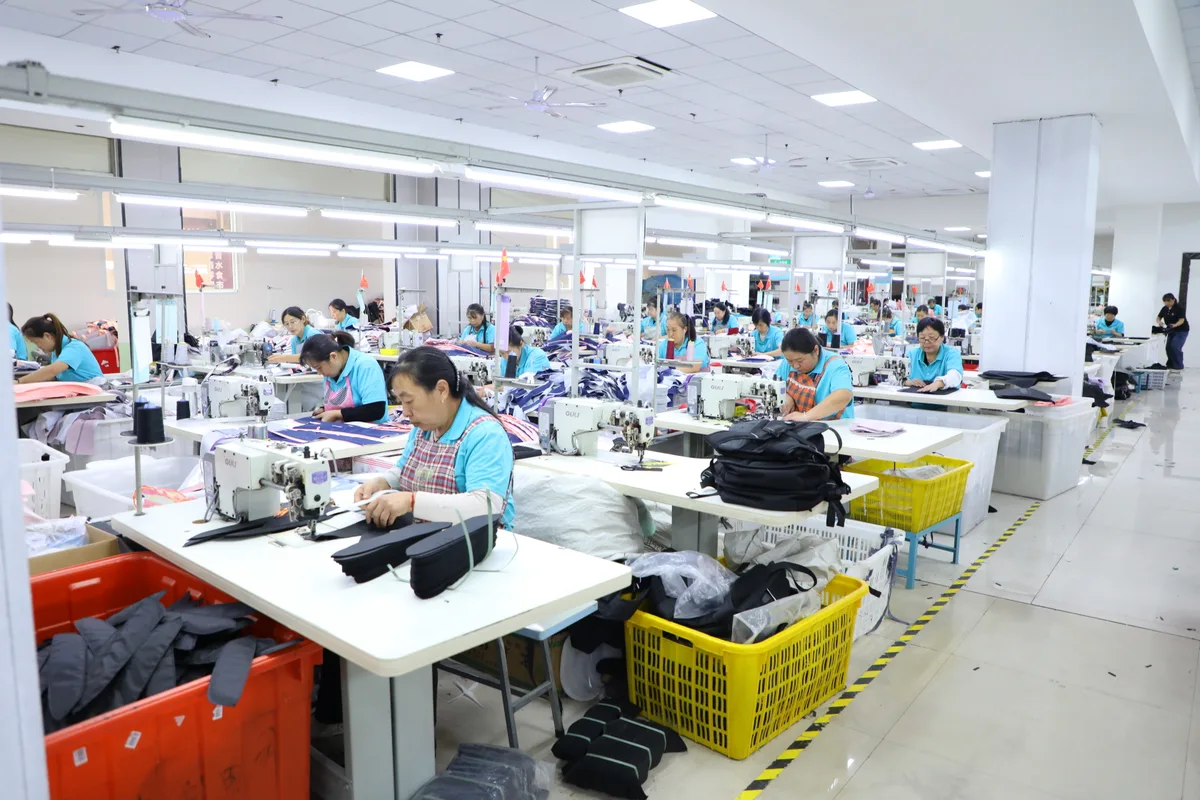
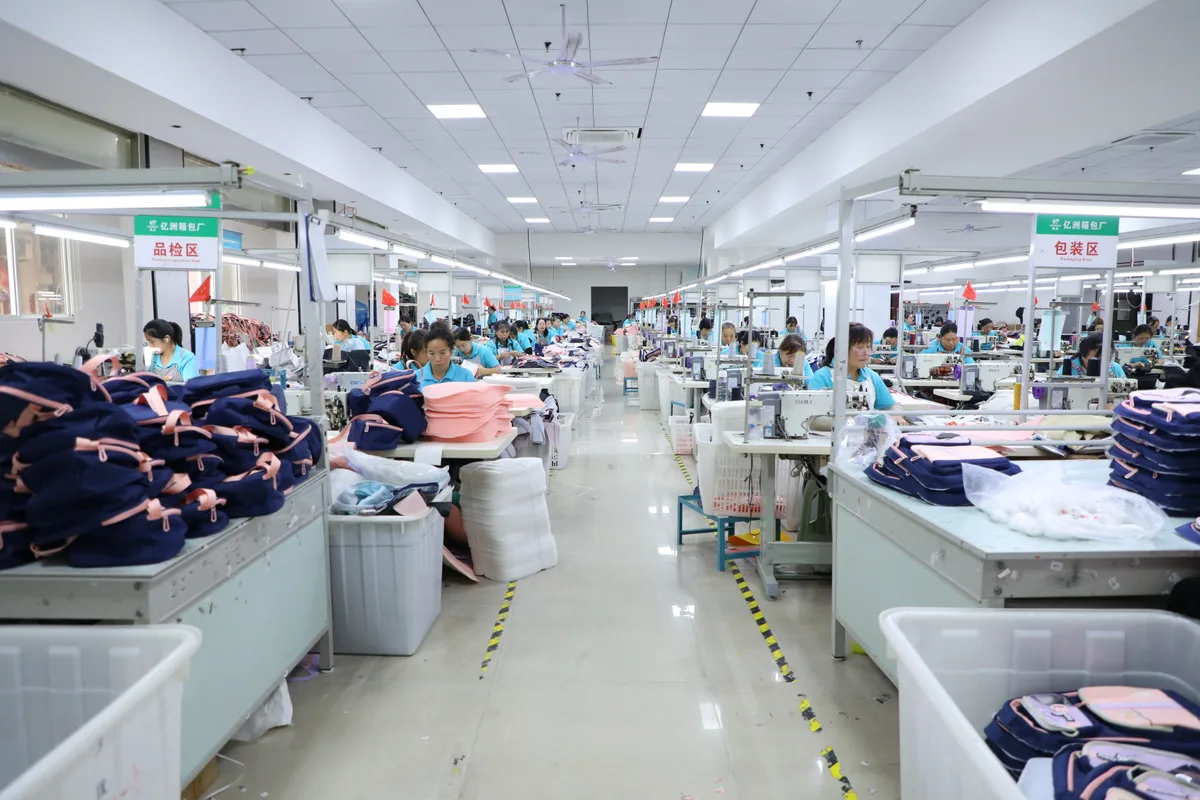
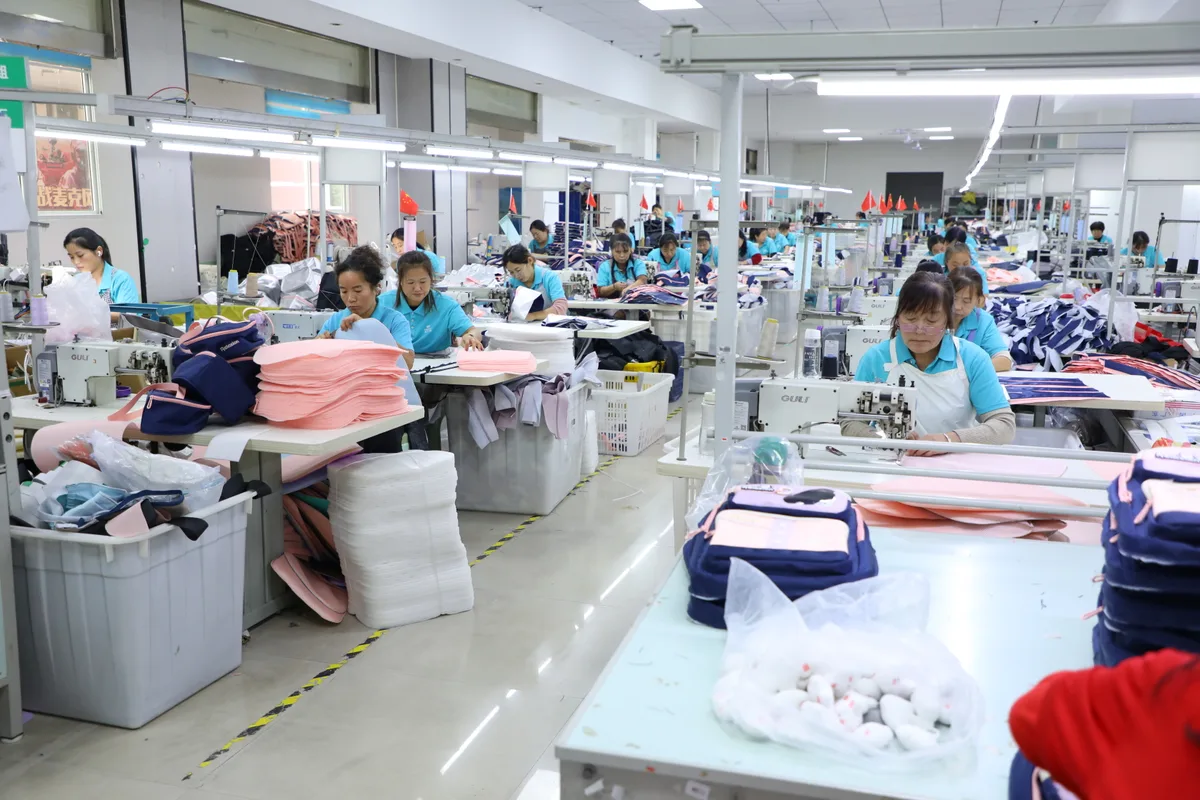
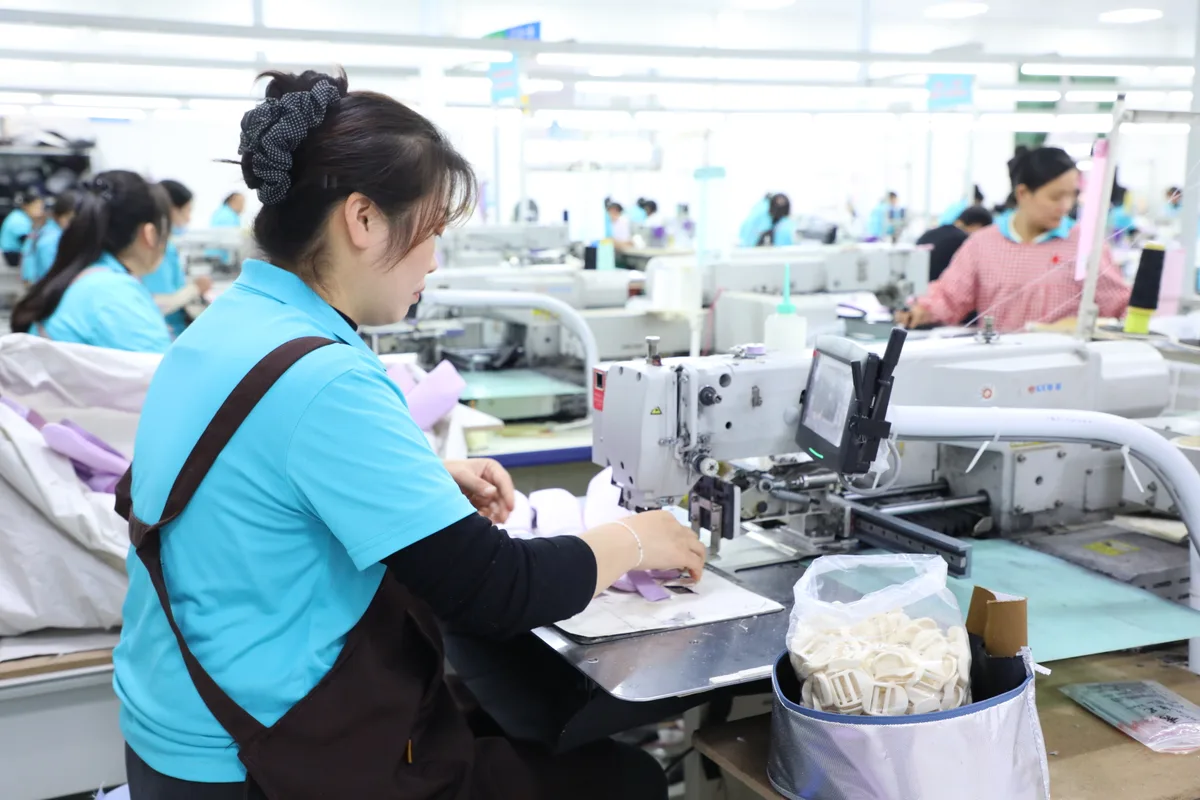
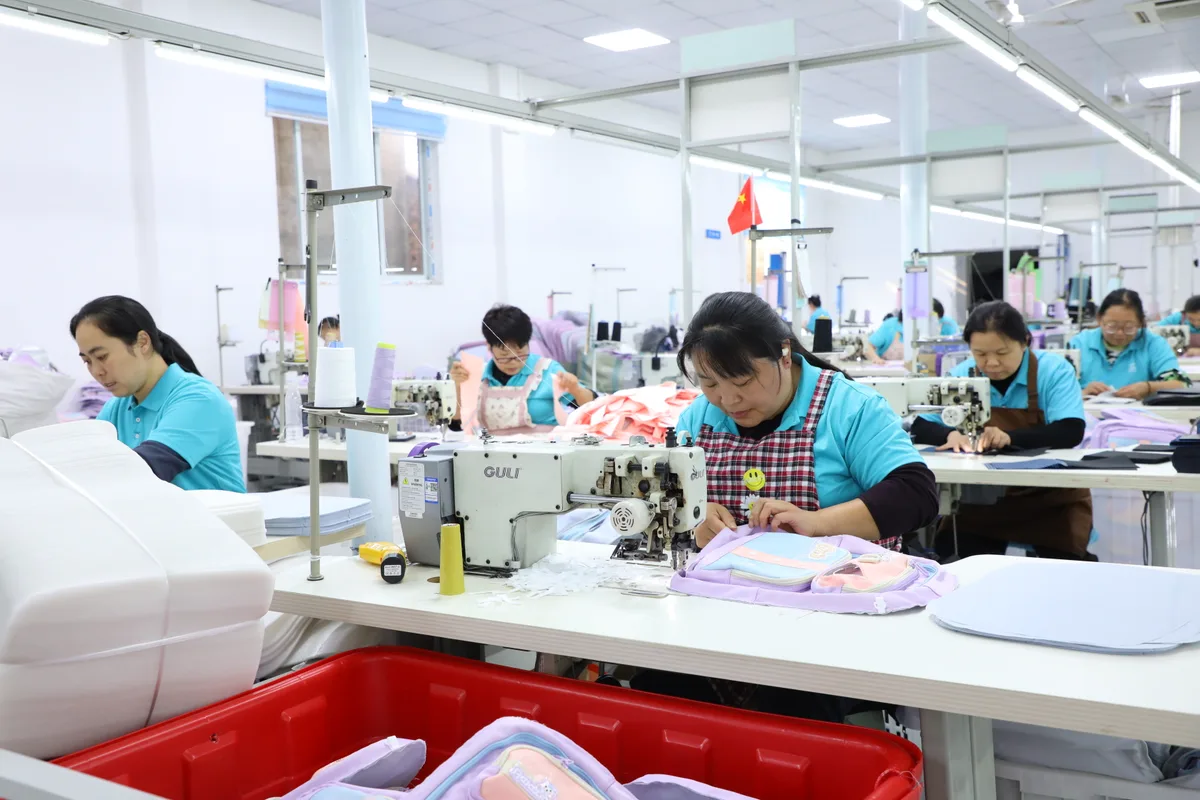
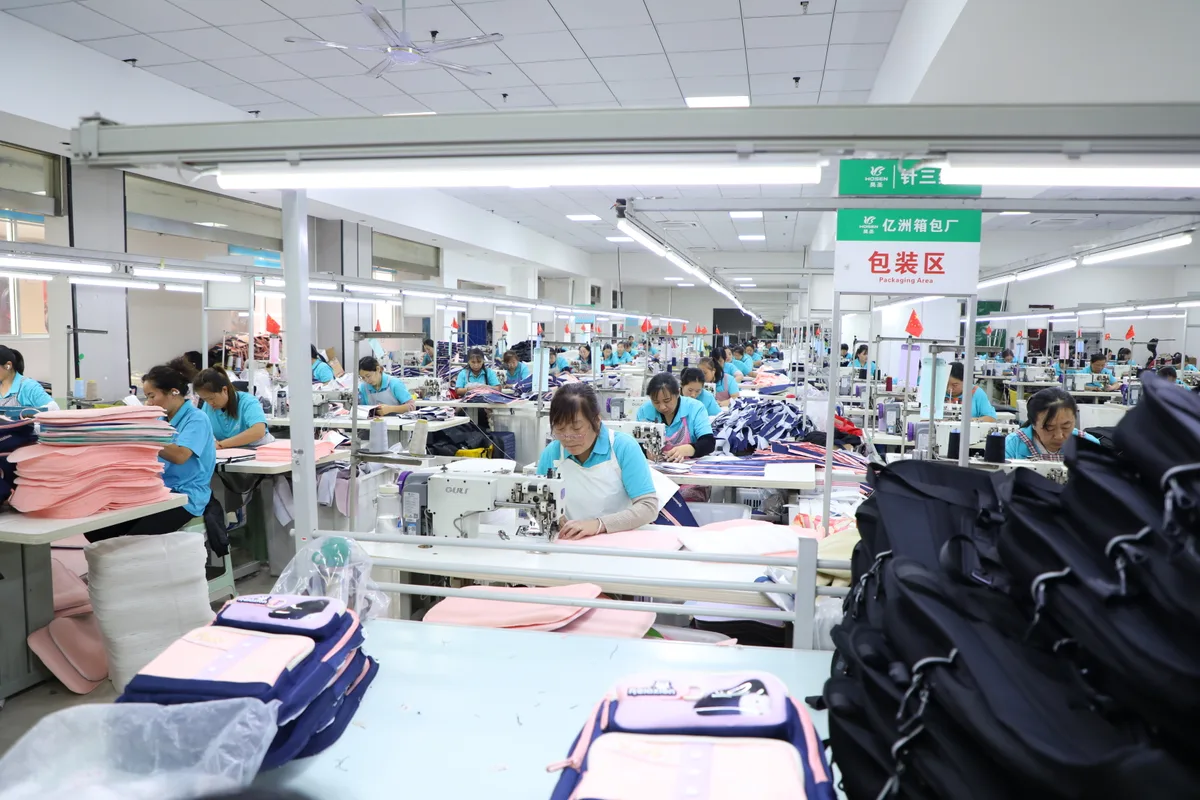
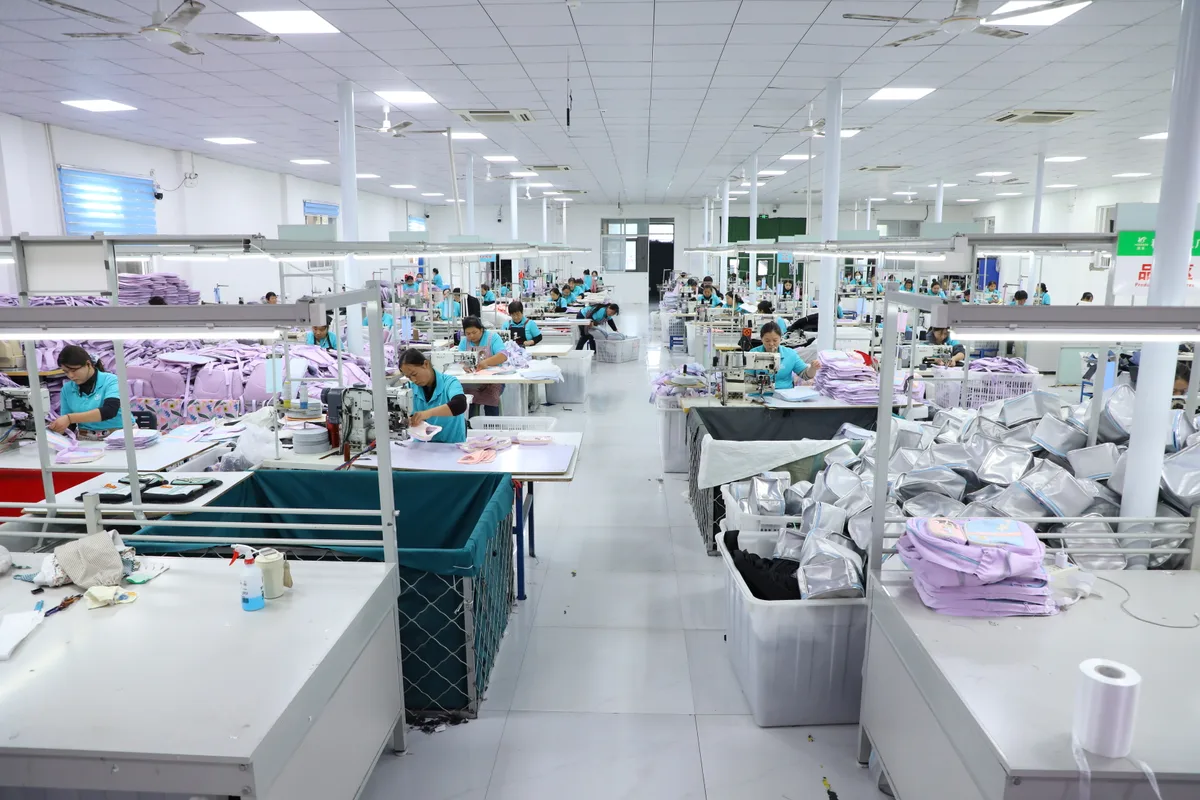
A reputable bag factory is not a simple room filled with standard domestic sewing machines. An industrial cut-and-sew facility is an advanced engineering environment organized around specialized machinery, ergonomic workstation line balancing, and strict quality control gates.
Essential Machine Fleet in a Modern Backpack Manufacturing Plant
To manufacture durable, high-performance backpacks capable of holding 25 kg loads and resisting torrential downpours, a factory must operate six distinct classes of specialized industrial sewing machinery:
+----------------------------------------------------------------------------------------+
|                      INDUSTRIAL BACKPACK MACHINERY FLEET                               |
|                                                                                        |
|  [ Walking Foot Lockstitch ] ---------- [ Electronic Programmable Bartack ]            |
|  * Compound unison-feed transport       * 42-48 stitches per cycle in 1.2 seconds      |
|  * Feeds 8 layers of 900D + foam + webbing * Reinforces strap roots, haul loops, MOLLE   |
|                                                                                        |
|  [ Cylinder-Arm Unison-Feed ] --------- [ Synchronized Double-Needle Post-Bed ]        |
|  * Small diameter cylindrical arm       * Elevated vertical post for 3D box shapes     |
|  * Binds 3D curved perimeter gussets    * Perfect parallel decorative edge stitching   |
|                                                                                        |
|  [ Ultrasonic Welder / Hot-Air Sealer ] - [ CNC Automatic Pattern Plotter / Laser ]    |
|  * Thermoplastic PU waterproof bonding  * Slices 120 fabric plies simultaneously       |
|  * Eliminates needle holes for dry bags * 0.2mm precision tolerances across all panels |
+----------------------------------------------------------------------------------------+
1. Compound-Feed / Walking Foot Lockstitch Machines (e.g., Juki LU-1508N / Brother)
Unlike standard drop-feed machines used in apparel, backpack sewing requires compound unison-feed (where the presser foot, needle, and feed dog move simultaneously). This mechanism grips heavy, slippery, or thick multi-layer assemblies (such as 1000D Cordura + 5mm high-density EVA foam + 210D ripstop lining + 1.5mm HDPE reinforcement board) without layer slippage or puckering.
2. Programmable Electronic Bartack Machines (e.g., Juki LK-1900BN)
Bartacking is the bedrock of structural safety in backpack manufacturing. Controlled by digital servo motors, these machines execute tight, dense clusters of zig-zag locking stitches (typically 42 to 48 stitches per bar) within 1.2 seconds, permanently securing high-stress failure points.
3. Cylinder-Arm Binding Machines (e.g., Juki LS-1341 / Typical)
Standard flatbed sewing machines cannot maneuver inside a narrow, 3D closed backpack chamber. Cylinder-arm machines feature a horizontal tubular arm that allows operators to sew and apply heavy-duty polyester grosgrain edge-binding tape around internal 3D curved perimeter seams without creasing the adjacent panels.
4. Post-Bed Double-Needle Machines
Equipped with an elevated vertical post, these machines enable high-precision topstitching along 3D rounded corners, luggage lid perimeters, and molded foam back panels. The dual-needle setup guarantees flawless, parallel stitch lines with exact 6mm or 8mm spacing.
5. Computerized CNC Knife and Laser Cutting Beds
Mass production accuracy begins in the cutting room. Computerized multi-ply CNC oscillating knife cutting tables slice through 80 to 120 layers of tightly stacked polyester or nylon fabric simultaneously. Laser cutting machines seal synthetic fabric edges with heat, completely eliminating raw edge fraying on micro-weave textiles.
4. Stitching Standards & Construction Engineering: The Physics of Heavy-Duty Bags
The structural integrity of a custom backpack is governed by the laws of mechanical physics and materials science. When a user packs a 17-inch gaming laptop, textbooks, water bottles, and electronics weighing 15 kg (33 lbs) into a daypack, that kinetic energy is focused directly upon a few square centimeters of stitching at the shoulder strap root and bottom gusset.
Critical Stitching Parameters
+----------------------------------------------------------------------------------------+
|                        STITCH SPECIFICATIONS & TOLERANCES                              |
|                                                                                        |
|  [ Stitch Density: 7 - 8 SPI ]                                                         |
|  +-- Too Dense (>10 SPI): Perforates synthetic coatings; turns fabric into postage stamp|
|  +-- Too Loose (<5 SPI): Gaps appear under load; seam pulls open exposing raw edges    |
|  +-- Optimal (7-8 SPI): Maximum tensile strength without compromising fabric weave     |
|                                                                                        |
|  [ Thread Selection: Bonded Polyester ]                                                |
|  +-- Shell & Stress Points: Bonded Polyester V-69 (Tex 70) / Break strength: 11.5 lbs |
|  +-- Internal Linings: Spun Polyester 40/2 or Tex 40 / Smooth low-friction glide       |
|  +-- Heavy-Duty Tactical / Luggage: Bonded Nylon V-92 (Tex 90) / Break strength: 15 lbs|
|                                                                                        |
|  [ Box-X Cross Reinforcement Dimensions ]                                              |
|  +-- Minimum Dimensions: 25mm width x 30mm height rectangular box                      |
|  +-- Cross-Stitch: Corner-to-corner diagonal intersection with double locking stitches |
|  +-- Secondary Bartack: Dual horizontal bartacks across top and bottom entry lines     |
+----------------------------------------------------------------------------------------+
Stitch Engineering Standards Comparison Table
| Seam Type / Construction Zone | Target Stitch Density (SPI) | Thread Specification | Reinforcement Protocol | Minimum Tensile Strength Requirement |
|---|---|---|---|---|
| Main Shoulder Strap Upper Root | 7 - 8 SPI | Bonded Polyester Tex 70 (V-69) | High-tensile nylon webbing underlay + 25x30mm Box-X + Dual 42-stitch electronic bartacks | >35.0 kgf (>343 N) (Continuous static pull) |
| Top Grab / Haul Handle Anchor | 7 - 8 SPI | Bonded Polyester Tex 70 (V-69) | Webbing sandwich insert enclosed inside top seam with double lockstitch + dual bartacks | >30.0 kgf (>294 N) |
| Main Zipper Perimeter Seam | 7 - 8 SPI | Bonded Polyester Tex 45 / 70 | Double-needle lockstitch with 100% polyester grosgrain binding tape over raw edges | >20.0 kgf (>196 N) |
| Internal Laptop Sleeve Pocket | 6 - 7 SPI | Core-Spun Polyester Tex 40 | Reverse backstitch locking (5-6 stitches) at top elastic corners; scratch-free binding | >12.0 kgf (>117 N) |
| Side Water Bottle Mesh Pocket | 7 - 8 SPI | Bonded Polyester Tex 40 | High-recovery elastic tape folded inside double-stitched hem; bottom pleat box bartack | >15.0 kgf (>147 N) |
| MOLLE / PALS Modular Webbing | 8 - 9 SPI | Bonded Nylon Tex 70 (V-69) | Electronic vertical bartacks spaced precisely at 38mm (1.5 in) intervals | >25.0 kgf (>245 N) per loop |
| Bottom Gusset / Floor Seam | 7 - 8 SPI | Bonded Polyester Tex 70 (V-69) | 4-layer flat-felled seam or heavy binding with reinforced water-resistant PU base | >28.0 kgf (>274 N) |
The Danger of Over-Stitching (The "Postage Stamp" Effect)
Inexperienced contract sewing workshops frequently believe that adding more stitches always increases seam strength. In synthetic waterproof-coated fabrics (such as 600D PU-coated polyester or TPU laminates), every needle penetration creates a permanent micro-puncture through the waterproof membrane.
If stitch density exceeds 10 to 12 stitches per inch (SPI), the needle perforations merge into a continuous perforation line—effectively acting like the tear-strip of a postage stamp. Under moderate tensile stress, the fabric shears cleanly along the stitch line. At Senszx, our production supervisors enforce a strict 7 to 8 SPI calibration across all cut-and-sew lines to maximize mechanical interlock while preserving fabric tensile strength.
5. From Tech Pack to Physical Sample: The 3–5 Day Rapid Prototyping Protocol
The bridge between a digital design concept and a scalable mass-manufactured product is the Pre-Production Sample (PPS). Professional bag factories maintain dedicated, standalone sample development departments staffed by master pattern makers who operate independently from the fast-paced mass production lines.
+----------------------------------------------------------------------------------------+
|                      SENSZX 3-5 DAY RAPID PROTOTYPING PROTOCOL                         |
|                                                                                        |
|  [ Day 1: Tech Pack Engineering & Digital Patterning ]                                 |
|  +-- 24-Hour BOM verification & dimensional tolerance checking                         |
|  +-- CAD master pattern generation with seam allowance calculations (8mm - 12mm)       |
|                                                                                        |
|  [ Day 2: Material Staging & Computerized Sample Cutting ]                             |
|  +-- Precision color-matching against Pantone TCX/TPX swatches                         |
|  +-- CNC oscillating knife cutting of shell, lining, foam, and stiffener boards       |
|                                                                                        |
|  [ Day 3: Sub-Assembly Construction & Logo Application ]                               |
|  +-- Front organizer pocket, laptop sleeve, and ergonomic 3D harness preparation       |
|  +-- In-house silicone heat-transfer, embroidery, or metal badge riveting              |
|                                                                                        |
|  [ Day 4: Final 3D Assembly & Internal Seam Binding ]                                  |
|  +-- Cylinder-arm gusset binding, zipper insertion, and perimeter box-X stitching     |
|  +-- High-stress joint bartacking and aesthetic finishing                             |
|                                                                                        |
|  [ Day 5: Quality Audit, Tensile Testing & Express Courier Dispatch ]                 |
|  +-- Complete dimensional audit, zipper cycle testing, and seam pull verification     |
|  +-- Priority international air express dispatch (DHL / FedEx / UPS) to client        |
+----------------------------------------------------------------------------------------+
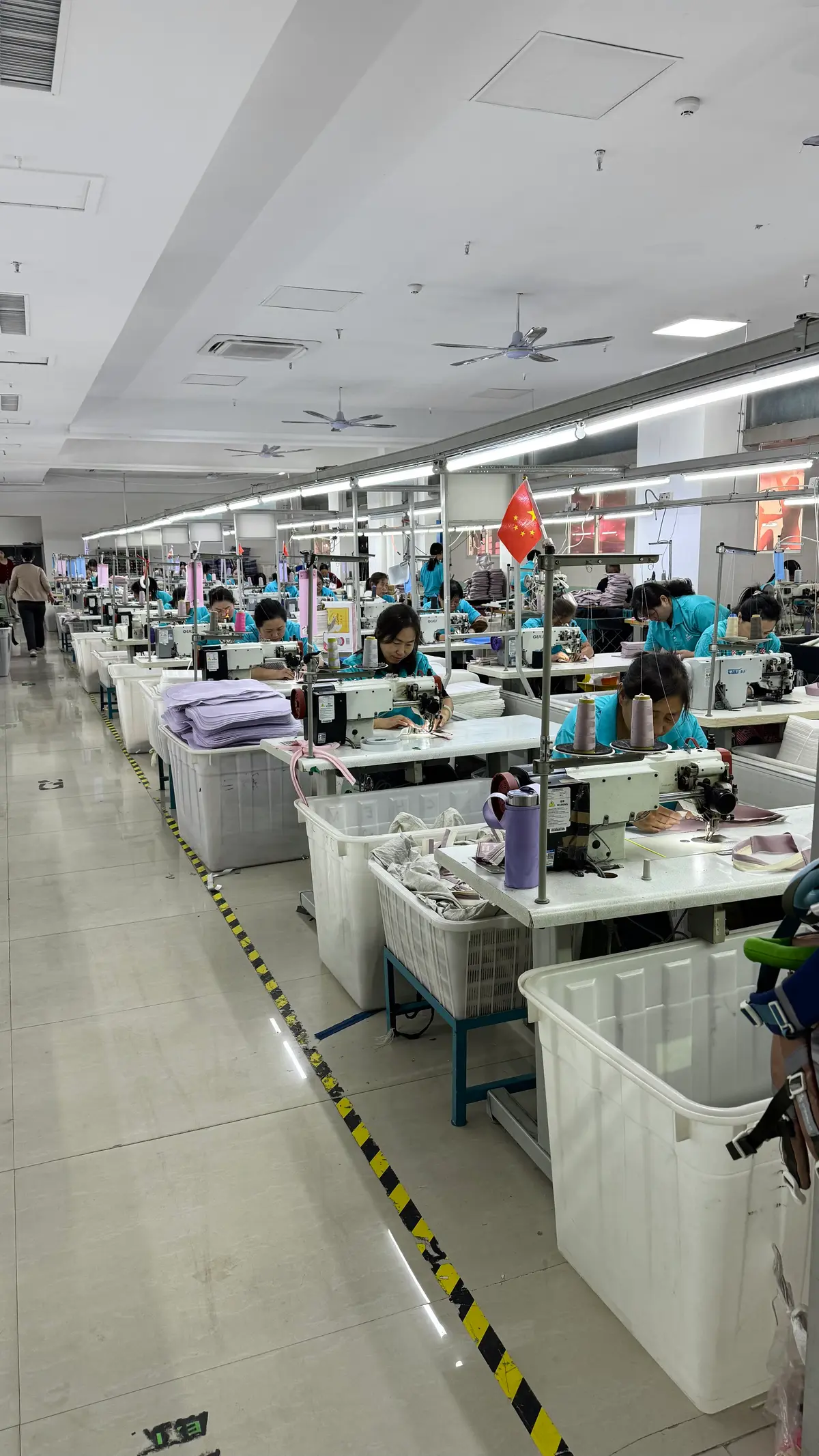
What Must Be Included in Your Tech Pack for Seamless Prototyping
To achieve a flawless physical prototype on the first iteration without costly delays, your design team must supply a comprehensive technical package. For an exhaustive, step-by-step tutorial on drafting professional design files, read our industry-standard guide: How to Write a Backpack Tech Pack: The Definitive B2B Guide.
Key components required by our sample master room include:
- Dimensioned 2D Orthographic Drawings: Front, back, side, top, bottom, and internal cross-sectional views with exact millimeter measurements.
- Complete Bill of Materials (BOM): Itemized listing of shell textiles (denier, coating, finish), lining fabric, zipper gauges (e.g., #5 reverse nylon coil, #8 waterproof TPU), plastic hardware specifications (POM buckles, D-rings), foam densities (EVA, PE, EPE foam), and webbing grades.
- Logo & Artwork Vector Files: 1:1 scale vector files (.AI, .EPS, or .PDF) specifying exact Pantone TCX colors, execution methods (3D embossed silicone, woven damask label, metal plaque), and coordinate placement tolerances (+/- 1.0 mm).
- Physical Reference Photos / Benchmark Samples: Highlighting specific functional mechanisms, such as anti-theft hidden pockets, magnetic Fidlock® buckle integration, or luggage trolley sleeve pass-throughs.
To learn more about our prototyping facilities, explore our backpack sample room and review our free sample development program.
6. Understanding Factory MOQs & Price Ladders: The Single-Track 500 Pcs Model
One of the most frequent friction points between emerging brands and overseas factories is the Minimum Order Quantity (MOQ). Understanding the industrial economics behind factory MOQs helps brands negotiate effectively, budget accurately, and build scalable production partnerships.
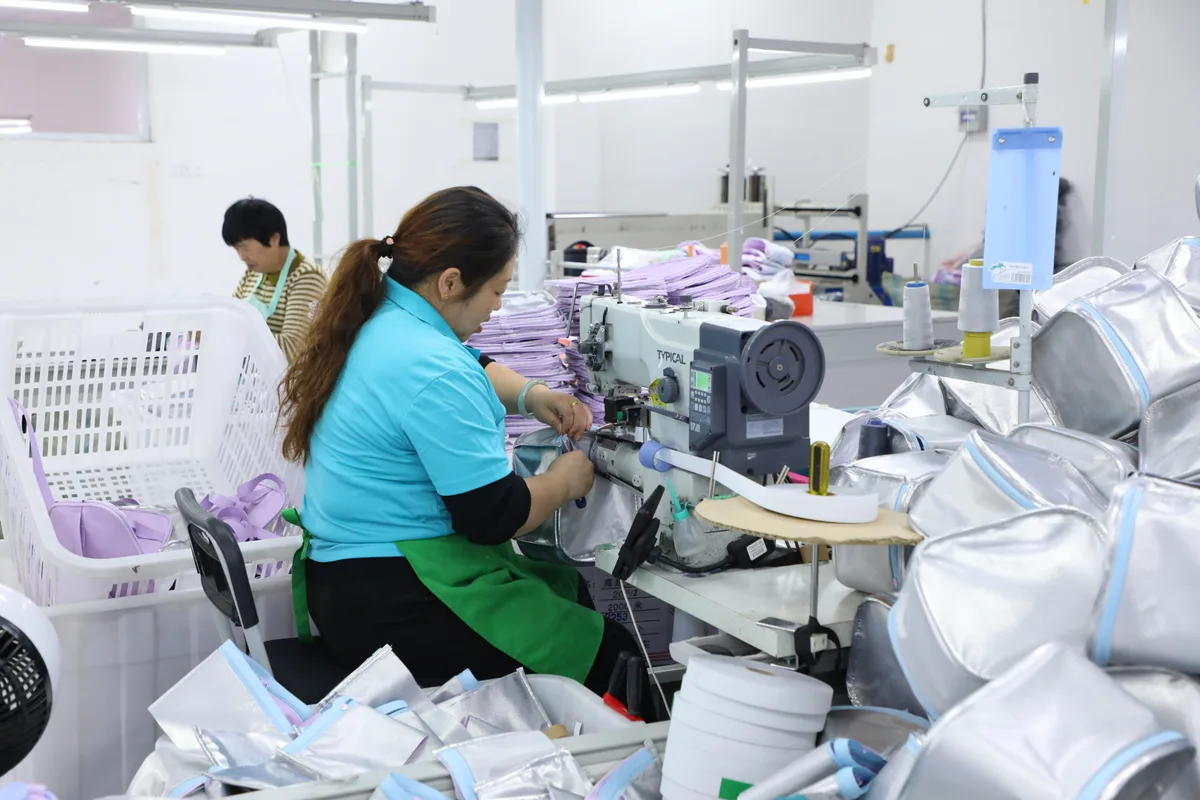
The Hidden Industrial Cost Drivers Behind Factory MOQs
Why do reputable bag factories set MOQs at 500, 1,000, or 3,000 pieces? The constraint is rarely the sewing labor itself—it is driven by upstream raw material minimums and machine setup economics:
+----------------------------------------------------------------------------------------+
|                        UPSTREAM RAW MATERIAL MOQ DEPENDENCIES                          |
|                                                                                        |
|  [ Custom Fabric Dyeing & Coating ] --- Minimum: 1,000 - 1,500 meters per color run    |
|  +-- A custom dyed 900D polyester run yields enough fabric for ~1,200 standard daypacks|
|                                                                                        |
|  [ Custom Jacquard Woven Webbing ] ---- Minimum: 3,000 - 5,000 meters per production run|
|  +-- Continuous high-speed looms require 3,000m minimum thread setup and warping       |
|                                                                                        |
|  [ Custom Moulded Zinc Zipper Pulls ] - Minimum: 2,000 - 5,000 pieces per casting run  |
|  +-- High-pressure die-cast zinc tooling requires setup amortization across batch runs  |
|                                                                                        |
|  [ Multi-Station Sewing Line Setup ] -- 20 to 30 operators re-tooled per style         |
|  +-- First 50 units run at 40% efficiency during operator learning curve               |
+----------------------------------------------------------------------------------------+
The Senszx Single-Track Custom MOQ Model (500 Pcs)
To solve these supply chain barriers for growing private-label brands and corporate buyers, Senszx operates on a refined Single-Track OEM/ODM MOQ of 500 pieces per style/colorway.
By maintaining strategic, high-volume partnerships with major regional textile mills and hardware foundries in Baigou, Senszx stocks hundreds of running master rolls of premium 600D, 900D, 1680D polyester, 420D/840D nylon, and standard black POM hardware. This allows our factory to produce 100% custom-designed, fully branded backpacks at an accessible 500-unit threshold without compromising on raw material quality or unit economics.
+----------------------------------------------------------------------------------------+
|                   SENSZX DEVELOPMENT FEE OFFSET PROGRAM (UNDER 500 PCS)                |
|                                                                                        |
|   [ Startup / Pilot Stage: Order < 500 Pcs ]                                           |
|   * Client pays one-time physical Development Fee ($250 - $450 depending on complexity)|
|   * Includes up to 3 iterative physical prototype revisions & CAD pattern mastery      |
|   * Full BOM sourcing, stress testing, and Pre-Production Sample sign-off              |
|                                      |                                                 |
|                                      v                                                 |
|   [ Commercial Scaling Stage: First Bulk Order >= 500 Pcs ]                            |
|   * Client places formal mass production order (500+ units)                            |
|   * 100% of the initial Development Fee is credited directly against the bulk invoice  |
|   * Net Prototype Cost to Brand = $0.00                                                |
+----------------------------------------------------------------------------------------+
Typical OEM/ODM Price Ladder Breakdown (25L Technical Laptop Backpack)
| Order Quantity Tier | Unit FOB Price Range (Tianjin/Qingdao) | Tooling & Setup Costs | Prototyping Terms | Production Turnaround | Target Customer Profile |
|---|---|---|---|---|---|
| Sample (1 - 3 pcs) | $100 - $180 / prototype | $150 - $350 (Custom hardware mold extra) | Express air delivery in 3-5 days | 3 - 5 days | Design validation, investor pitches, photography |
| 500 - 999 pcs | $12.50 - $16.80 / unit | 100% credited against bulk order | Development fee offset program | 20 calendar days | Brand launches, niche e-commerce, pilot collections |
| 1,000 - 2,499 pcs | $10.80 - $14.20 / unit | Free standard mold setups | Free pre-production sample | 20 - 22 calendar days | Established private-label brands, corporate programs |
| 2,500 - 4,999 pcs | $9.40 - $12.50 / unit | Free custom hardware & pullers | Free pre-production sample | 22 - 25 calendar days | Amazon top-sellers, regional retail chains, distributors |
| 5,000+ pcs | $8.20 - $11.00 / unit | Fully customized jacquard & trims | Free pre-production sample | 25 - 30 calendar days | Tier-1 multinational brands, national school contracts |
For a transparent, itemized line-by-line financial analysis of fabric consumption, cutting yields, labor allocations, and packaging margins, review our comprehensive Custom Backpack Cost Breakdown Guide.
7. On-Site & Remote Factory Audit Checklist: 10 Red Flags Sourcing Managers Must Know
With thousands of trading companies, sourcing agents, and third-party brokers listing products on B2B directories like Alibaba and Global Sources, determining whether you are dealing with a true direct manufacturer or an intermediary is vital. Middlemen add 20% to 40% in hidden markups, distort technical communication, and lack direct control over production scheduling or quality audits.
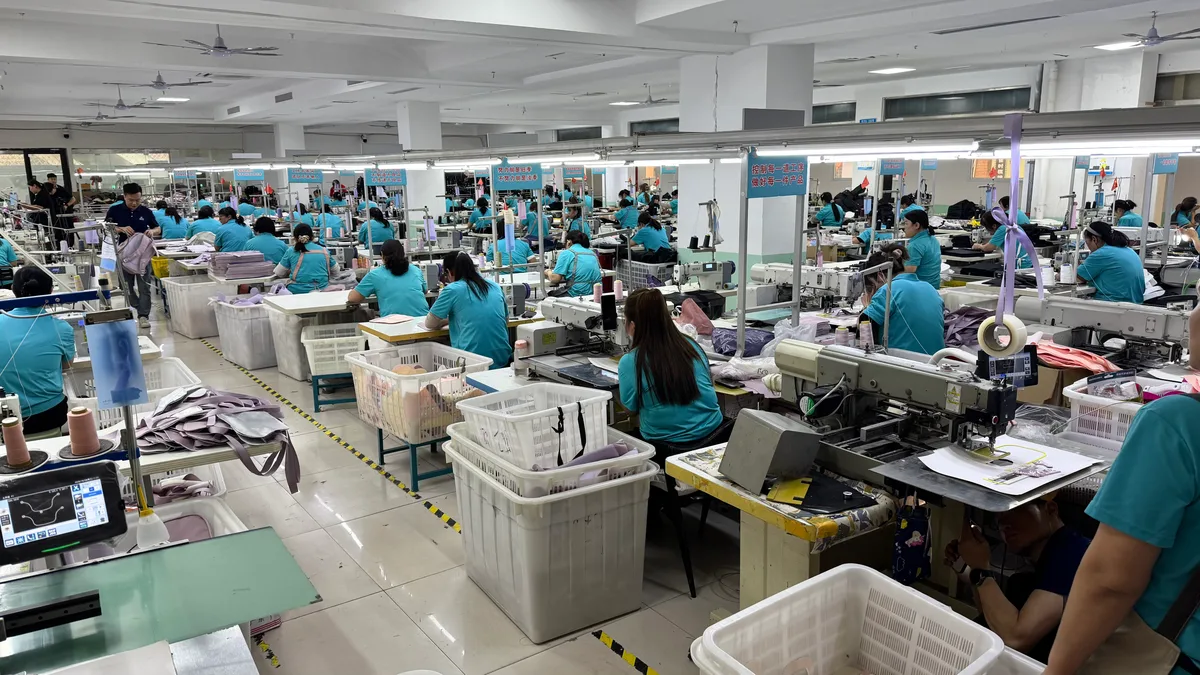
10 Critical Red Flags: Direct Factory vs. Trading Middleman
| Audit Checkpoint | True Direct Manufacturer (e.g., Senszx) | Trading Middleman / Sourcing Agent | Red Flag Risk Level |
|---|---|---|---|
| 1. Factory Floor Video Walkthrough | Immediate, live video tour via WeChat/WhatsApp showing active cut-and-sew lines, machine fleets, and workers. | Refuses live video; provides generic staged showroom photos or pre-recorded clips without branding. | CRITICAL RED FLAG: Indicates no physical plant ownership. |
| 2. Pattern Maker & Sample Room | In-house master pattern makers modify CAD files and adjust physical paper acrylic patterns in 24 hours. | Requires 10 to 20 days just to deliver minor pattern modifications (must outsource to third-party workshops). | HIGH RISK: Creates severe communication delays during sampling. |
| 3. Quotation Transparency | Itemized BOM quotation detailing fabric square meters, zipper length, hardware counts, and labor minutes. | Lumps all costs into a single non-negotiable unit price with zero transparency regarding fabric denier or hardware grade. | HIGH RISK: Conceals sub-tier material downgrading during mass production. |
| 4. Machinery Fleet Knowledge | Sales engineers explain exact needle gauges, walking foot brands (Juki/Brother), and electronic bartack parameters. | Sales reps provide vague answers regarding machine models, SPI tolerances, or line balancing capacities. | MODERATE RISK: Sales team has zero practical manufacturing experience. |
| 5. Audit Certification Ownership | BSCI, ISO 9001/14001/45001 certificates issued in the exact legal corporate name of the operating company. | Certificate displays an entirely different company name (claimed to be a "partner factory" or "sister branch"). | CRITICAL RED FLAG: Ethical compliance and social responsibility cannot be verified. |
| 6. Defect Root Cause Analysis | Engineering team diagnoses root mechanical causes of seam slippage or fabric puckering and offers tooling fixes. | Blames "bad fabric batches" or asks you to accept defective tolerances without offering technical remediation. | HIGH RISK: Inability to solve production bottlenecks. |
| 7. Custom Tooling Management | In-house die-casting and mold storage with strict client NDA protection for custom hardware and logos. | Outsources all tooling without tracking client exclusivity, risking proprietary design leakage. | HIGH RISK: Threat to brand intellectual property (IP). |
| 8. In-Line QC Access | Welcomes third-party quality inspection agencies (SGS, Intertek, QIMA, AsiaInspection) on the factory floor. | Restricts inspector access or demands extra "inspection coordination fees" to allow third-party auditors. | CRITICAL RED FLAG: Factory attempting to conceal defective production. |
| 9. Metal Needle Detection | Mandatory conveyor-belt metal needle detector integrated at the final packaging and polybagging exit station. | No needle detector; bags packed directly into cartons without magnetic or electromagnetic scanning. | CRITICAL RED FLAG: Severe safety hazard for school and retail distribution. |
| 10. Payment & Export Entity | Direct corporate bank account matching the factory's verified export license and customs registration. | Requests payment to personal offshore bank accounts or unrelated third-party holding companies. | HIGH RISK: Financial non-compliance and customs clearance complications. |
To schedule a live, verified virtual factory tour or review our facilities, explore our Senszx factory tour guide and about our manufacturing heritage.
8. Social Compliance, Quality Certifications & US Regulatory Standards
In modern global retail, technical capability is meaningless without verifiable social compliance and regulatory certification. Sourcing from non-compliant facilities exposes your brand to devastating consumer boycotts, customs blockades under the Uyghur Forced Labor Prevention Act (UFLPA), and severe civil penalties from the US Consumer Product Safety Commission (CPSC).
+----------------------------------------------------------------------------------------+
|                    GLOBAL COMPLIANCE & CERTIFICATION PYRAMID                           |
|                                                                                        |
|  [ Social & Ethical Compliance: BSCI / Sedex SMETA ]                                   |
|  +-- Fair wages, zero child labor, voluntary overtime, non-discrimination              |
|  +-- Fire safety, accessible emergency exits, clean drinking water & PPE provision    |
|                                                                                        |
|  [ Quality & Environmental Management: ISO 9001 / ISO 14001 / ISO 45001 ]               |
|  +-- Documented standard operating procedures (SOPs) across all 100 production lines   |
|  +-- Eco-friendly waste water management, zero banned AZO dyes, worker health protocols|
|                                                                                        |
|  [ US Consumer Product Safety: CPSIA / California Proposition 65 ]                     |
|  +-- Total Lead Content: <100 ppm in substrate materials; <90 ppm in surface coatings  |
|  +-- Regulated Phthalates (DEHP, DBP, BBP, DINP, DIBP): <1,000 ppm (0.1%)               |
|  +-- Physical Safety: ASTM F963 small parts, sharp edges, and choking hazard testing   |
+----------------------------------------------------------------------------------------+
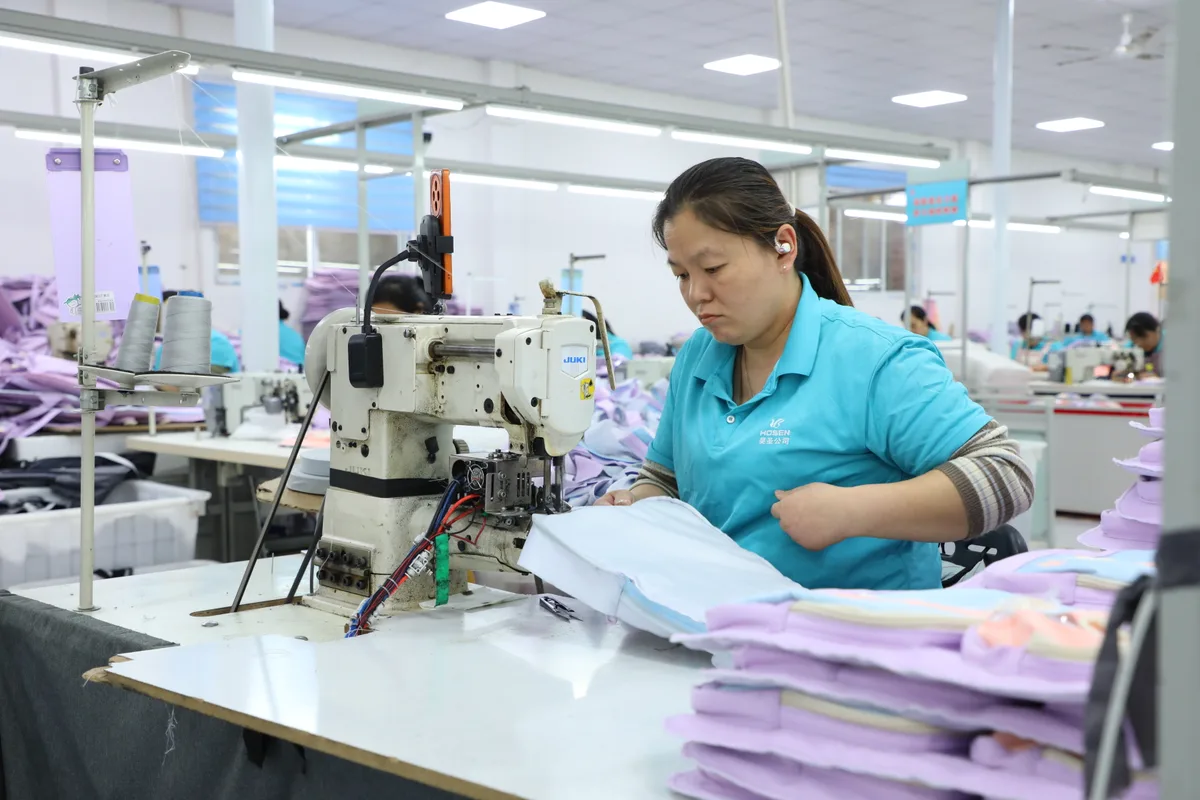
Mandatory US and European Compliance Checklist
- BSCI (Business Social Compliance Initiative):
- Senszx undergoes continuous, unannounced third-party social audits evaluating workplace health and safety, fair compensation, working hour limitations, environmental protection, and ethical business behavior. This certification guarantees full supply chain transparency for major US and European retail partners.
- ISO 9001:2015 (Quality Management System):
- Governs our standard operating procedures (SOPs) from incoming raw material inspection (IQC), in-process quality auditing (IPQC), to final outgoing quality control (FQC).
- CPSIA (Consumer Product Safety Improvement Act) for US Markets:
- All backpacks intended for school, youth, or general consumer use imported into the United States must comply with strict chemical and physical thresholds. Senszx coordinates accredited third-party lab testing (SGS/TÜV) certifying that all exterior fabrics, PVC backings, metal zipper pullers, and plastic clips contain less than 100 ppm total lead and less than 1,000 ppm regulated phthalates.
- California Proposition 65:
- Ensures materials are free from hazardous levels of lead, cadmium, BPA, and phthalates, eliminating the need for warning labels on retail shelves.
- OEKO-TEX® Standard 100 & REACH (EU Standards):
- Verifies that synthetic textiles, dyes, and coatings contain zero carcinogenic amines, formaldehyde, heavy metals, or per- and polyfluoroalkyl substances (PFAS / "forever chemicals").
9. Material Sourcing & Hardware Integration: Engineering the Bill of Materials (BOM)
A custom backpack is a composite architecture composed of up to 40 individual raw materials and trims. A professional bag manufacturer must not only sew expertly—it must actively engineer your Bill of Materials to achieve optimal performance, durability, and cost-efficiency.
+----------------------------------------------------------------------------------------+
|                         ANATOMY OF A PREMIUM BACKPACK BOM                              |
|                                                                                        |
|  [ Shell Textiles ] ------------------ [ Hardware & Fasteners ]                        |
|  * 600D / 900D / 1680D Polyester       * POM (Polyoxymethylene) high-impact buckles     |
|  * 420D / 840D / 1000D Nylon           * Custom zinc alloy electroplated zipper sliders|
|  * Waterproof PU / TPU Lamination      * Magnetic Fidlock® quick-release closures      |
|                                                                                        |
|  [ Internal Components ] ------------- [ Ergonomic Harness Padding ]                   |
|  * 210D / 150D Diamond Ripstop         * 5mm - 8mm High-Density closed-cell EVA foam   |
|  * Brushed velvet laptop lining        * Open-cell breathable sandwich air-mesh (350 GSM)|
|  * PE / HDPE internal framesheet       * High-recovery elastic webbing for side pockets|
+----------------------------------------------------------------------------------------+
1. Performance Shell Fabrics
- Polyester (600D, 900D, 1680D Oxford): The workhorse of modern bag manufacturing. Provides exceptional tensile strength, UV resistance, and vibrant sublimation color printing at competitive cost points. Learn more in our 600D vs. 900D vs. 1680D fabric guide.
- Nylon (420D Ripstop, 840D Ballistic, 1000D Cordura®): The gold standard for outdoor technical hiking packs, tactical military gear, and ultra-durable luggage. Offers 2.5x the abrasion resistance of standard polyester. Read our technical deep dive on what is Cordura fabric and its OEM applications.
- Waterproof Laminations (PU vs. TPU vs. PVC): Polyurethane (PU) coating provides standard weather resistance (1,000mm to 3,000mm hydrostatic head). Thermoplastic Polyurethane (TPU) film allows high-frequency heat-welded seamless construction for 100% submersible dry bags. PVC provides budget water resistance but is heavier and less eco-compliant.
2. Zippers & Fasteners: The #1 Point of Consumer Failure
Consumer warranty data reveals that over 65% of backpack returns are caused by broken zipper coils, jammed slider bodies, or snapped pullers.
- Zipper Gauges: #3 for discreet internal security pockets; #5 for standard exterior accessory pockets; #8 and #10 heavy-duty reverse nylon coil or waterproof TPU laminated zippers for main structural compartments.
- Brands: We integrate genuine YKK®, SBS®, and Senszx factory-certified high-cycle custom zippers engineered to withstand >10,000 continuous open/close cycles. Explore custom branding options in our custom zipper pull and buckle guide.
3. Ergonomic Harness & Foam Padding
- EVA Foam (Ethylene-Vinyl Acetate): Premium closed-cell foam that resists permanent compression set under heavy loads. Essential for ergonomic, contoured shoulder straps and lumbar hip belts.
- EPE Foam (Expanded Polyethylene): Cost-effective, lightweight open-cell foam ideal for internal panel walls and laptop sleeve protection.
- 3D Air Mesh (350+ GSM): Breathable sandwich mesh integrated along the back panel and strap undersides to facilitate airflow, reduce perspiration, and minimize friction against clothing.
10. Quality Control Protocols: In-Line Audits, AQL 2.5 Standards & Testing Equipment
Quality control in bag manufacturing cannot be an afterthought conducted solely at the end of the line. At Senszx, quality assurance is an active, multi-stage protocol embedded into every production station.
+----------------------------------------------------------------------------------------+
|                         SENSZX MULTI-TIER QUALITY GATES                                |
|                                                                                        |
|  [ Stage 1: Incoming Material Inspection (IQC) ]                                       |
|  +-- Martindale fabric abrasion & water repellency testing                             |
|  +-- Zipper tensile burst strength & hardware salt-spray corrosion testing             |
|                                                                                        |
|  [ Stage 2: In-Process Quality Control (IPQC) ]                                        |
|  +-- 1st Off-Line Sample verification against approved master golden PPS sample        |
|  +-- Hourly stitch density (7-8 SPI) and seam alignment station audits                 |
|                                                                                        |
|  [ Stage 3: 100% Finished Goods Inspection (FQC) ]                                     |
|  +-- 100% loose thread trimming, surface cleaning, and zipper cycle verification       |
|  +-- Mandatory passage through automated electromagnetic metal needle detector         |
|                                                                                        |
|  [ Stage 4: Outgoing Quality Assurance (OQA / AQL 2.5) ]                               |
|  +-- Statistical carton pull according to ISO 2859-1 / ANSI/ASQ Z1.4 tables            |
|  +-- Packaging drop testing, carton burst strength, and shipping mark verification     |
+----------------------------------------------------------------------------------------+
ISO 2859-1 (AQL 2.5) Defect Classification Matrix
Senszx conducts all final outgoing audits strictly according to international Acceptable Quality Limit (AQL) 2.5 Level II sampling standards:
| Defect Category | Acceptable Quality Limit (AQL) | Definition & Tolerance | Examples of Manufacturing Defects |
|---|---|---|---|
| Critical Defects | 0.0 (Zero Tolerance) | Any defect that poses a severe consumer safety hazard or violates international customs regulations. | Broken metal needle fragment embedded in lining; mold/mildew presence; missing mandatory legal tracking label. |
| Major Defects | AQL 2.5 | Defects that cause structural failure, reduce product lifespan, or cause consumer retail rejection. | Open seam / skipped stitch >3mm; broken zipper slider; missing bartack at strap root; logo misaligned by >3mm; wrong fabric denier. |
| Minor Defects | AQL 4.0 | Minor cosmetic imperfections that do not impair structural durability or functional performance. | Untrimmed loose thread >5mm; slight removable surface chalk mark; minor packaging crease on polybag. |
In-House Physical Stress & Durability Testing
To guarantee that your custom backpacks survive real-world abuse, our quality testing laboratory subjects production batch samples to rigorous physical stress testing:
- Dynamic Seam Oscillation Drop Test: The backpack is loaded with 15 kg (33 lbs) of distributed dead weight and subjected to 300 continuous cycles of sudden mechanical drops from a height of 1.2 meters, testing shoulder strap anchor tensile resilience.
- Zipper Lateral Burst Strength Test: Using automated tensile testing fixtures to pull zipper teeth laterally until failure, requiring >650 N lateral burst strength on #8 main zippers.
- Color Fastness & Crock Meter Testing: Wet and dry rubbing tests (50 cycles at 9 N force) ensuring that dark dyed fabrics (such as black or navy 900D) will never bleed dye onto light-colored consumer apparel.
11. Production Lead Times, Scheduling & Ocean Freight Logistics
A successful sourcing program requires reliable scheduling and predictable logistics. From initial deposit receipt to ocean container delivery at your domestic 3PL facility, here is how a standard production cycle unfolds at Senszx.
+----------------------------------------------------------------------------------------+
|                     20-DAY MASS PRODUCTION & LOGISTICS SCHEDULE                        |
|                                                                                        |
|  [ Days 1 - 3: Raw Material Arrival & IQC Lab Auditing ]                              |
|  +-- Fabric roll inspection, color matching, and hardware batch verification           |
|                                                                                        |
|  [ Days 4 - 6: Computerized Multi-Ply Fabric Cutting ]                                 |
|  +-- CNC knife & laser cutting of shell, lining, foam, and stiffener panels            |
|                                                                                        |
|  [ Days 7 - 14: Modular Sub-Assembly & Line Assembly ]                                 |
|  +-- Pocket pre-assembly, harness construction, main chamber assembly, gusset binding  |
|                                                                                        |
|  [ Days 15 - 18: 100% Inspection, Thread Trimming & Needle Detection ]                 |
|  +-- Surface cleaning, 100% manual inspection, metal scanning, polybagging             |
|                                                                                        |
|  [ Days 19 - 20: Master Carton Packaging & Container Drayage ]                         |
|  +-- Palletizing, export carton packing, drayage to Tianjin or Qingdao seaport         |
|                                                                                        |
|  [ Days 21 - 45: International Ocean Transit & Customs Delivery ]                      |
|  +-- Ocean freight (14-18 days to US West Coast; 28-32 days to US East Coast / EU)     |
+----------------------------------------------------------------------------------------+
Global Shipping Incoterms Decoded
- FOB (Free on Board - Tianjin / Qingdao / Shenzhen): Senszx handles all domestic trucking, export documentation, export customs clearance, and port terminal handling charges (THC). Your freight forwarder takes custody once the container is loaded onto the ocean vessel.
- CIF (Cost, Insurance, and Freight): Senszx books ocean transport and marine cargo insurance to your destination port (e.g., Port of Los Angeles / Long Beach / New York). Your customs broker handles import entry and domestic trucking.
- DDP (Delivered Duty Paid - Complete Turnkey Solution): The ultimate hassle-free option for busy brand founders and e-commerce companies. Senszx's integrated international logistics network handles everything: ocean shipping, US Customs clearance, HTS Code 4202.92 classification, Section 301 tariff payments, and final domestic liftgate trucking directly to your Amazon FBA fulfillment center or commercial 3PL warehouse.
12. Frequently Asked Questions (FAQ)
Q1: What makes Senszx different from other Chinese bag manufacturers?
Senszx combines 20+ years of deep industrial manufacturing heritage in Baigou with cutting-edge production technology, full social compliance (BSCI, ISO 9001/14001/45001, CE), and true direct factory pricing. We operate 100 production lines, maintain dedicated rapid sample master rooms delivering physical prototypes in 3 to 5 business days, and offer a flexible single-track 500 pcs custom MOQ supported by our full Development Fee Offset Program.
Q2: Can you manufacture custom backpacks from just a sketch or reference photo?
Yes. Our master pattern makers and industrial design engineers can develop complete physical paper patterns, CAD cut files, and technical prototypes from rough concept sketches, mood boards, or physical reference samples. However, providing a comprehensive tech pack accelerates prototyping and eliminates dimensional ambiguity.
Q3: What is your standard payment structure for OEM/ODM bulk orders?
Our standard international commercial terms are a 30% deposit upon formal order confirmation and Pre-Production Sample (PPS) sign-off, with the remaining 70% balance payable upon completion of 100% mass production and final AQL 2.5 quality inspection audit prior to container loading or against the Original Bill of Lading (B/L).
Q4: How do you protect my brand's intellectual property (IP) and proprietary designs?
We execute formal, legally binding bilateral Non-Disclosure Agreements (NDAs) and proprietary manufacturing agreements prior to receiving your design files. All custom moulds, casting dies, and proprietary patterns remain your exclusive intellectual property and are never displayed in public showrooms or shared with third parties.
Q5: What is the difference between waterproof and water-resistant backpacks?
Water-resistant backpacks utilize water-repellent (DWR) surface finishes and internal PU backings capable of shedding light rain showers; however, water can eventually penetrate through needle holes and zipper teeth. 100% waterproof dry packs utilize heavy thermoplastic polyurethane (TPU) or PVC tarpaulin fabrics assembled via high-frequency ultrasonic heat welding and airtight, pressure-sealed zippers, completely eliminating needle perforations.
Q6: Can you match exact custom brand colors for fabrics and zipper trims?
Yes. We match custom shell fabrics, lining textiles, webbing, and plastic buckles to any standardized Pantone Matching System (PMS) TCX or TPX color code. Custom lab-dip fabric swatches are produced and submitted for your physical approval within 3 to 5 days.
Q7: What are the standard dimensions and weight tolerances for master export cartons?
Standard export cartons measure approximately 60 cm x 40 cm x 45 cm, constructed from heavy-duty 5-ply double-wall corrugated cardboard (bursting strength >14 kg/cm²). Each carton typically holds 20 to 25 individually polybagged standard backpacks, maintaining a total gross weight under 18 kg (40 lbs) for ergonomic warehouse handling and Amazon FBA compliance.
Q8: Do you provide custom packaging, barcode labeling, and retail hang tags?
Yes. We offer complete turnkey retail packaging: custom full-color printed hang tags with matte/gloss lamination, embossed foil stamping, custom-printed polybags (with mandatory legal suffocation warnings), GS1/UPC barcode stickers, woven brand labels, and branded silica gel desiccant packs.
Q9: Can Senszx handle drop-testing and certified container loading?
Yes. All bulk shipments undergo carton drop testing (ISTA 1A standard) and are loaded into 20ft or 40ft High Cube containers using our own factory forklift fleet and trained logistics technicians, ensuring zero carton crushing or moisture exposure during transit.
Q10: How do I get started with my first custom backpack manufacturing order?
Simply email your design files, tech pack, or reference photos to our sales engineering team at [email protected] or contact us via WhatsApp at +86 17331531825. We provide transparent, itemized FOB quotations within 24 hours and initiate physical sample development immediately upon design confirmation.
Partner with Senszx: Your Trusted OEM/ODM Bag Manufacturing Partner
Building a world-class bag brand requires a manufacturing partner that shares your obsession with technical precision, uncompromising quality, and supply chain reliability. At Senszx, we transform your design vision into durable, market-leading backpacks that build lasting consumer trust and drive sustainable business growth.
+------------------------------------------------------------------------+
|                   SENSZX MANUFACTURING ADVANTAGES                      |
|                                                                        |
|  [ Single-Track 500 Pcs MOQ ] -- Accessible scaling for custom brands  |
|  [ 3 - 5 Day Rapid Sampling ] -- In-house dedicated master sample room |
|  [ 20-Day Bulk Turnaround ] ---- 100 parallel modular production lines |
|  [ Verified Compliance ] ------- BSCI, ISO 9001/14001/45001, CE audited|
|  [ Development Fee Offset ] ---- 100% credited against 500+ bulk orders|
+------------------------------------------------------------------------+
Ready to Launch Your Next Backpack Collection?
- Submit Your Tech Pack: Send your design specifications to our engineering team at [email protected].
- Instant Engineering Consultation: Connect directly with our manufacturing specialists via WhatsApp at +86 17331531825.
- Explore Our Capabilities: Review our OEM/ODM custom bag manufacturing services and custom manufacturing tailored to your brand.
- Request a Prototype: Discover how fast we can turn your tech pack into reality through our free sample program.
Hi, I'm Senszx Bag Manufacturer, Hope You Like This Blog Post.
With more than 20 years of experience in OEM/ODM/Custom luggage and bag, I'd love to share with you the valuable knowledge related to luggage and bag products from a top-tier Chinese supplier's perspective.
Senszx Factory
Est. 2006 · Baigou, China
Related articles
Custom Travel Bags with Logo: The Complete Manufacturing, Materials & Branding Guide
An exhaustive B2B manufacturing guide to custom travel bags with logo. Master custom duffle, weekender, and carry-on production, compare 6 branding techniques (screen print, heat transfer, woven labels, rubber patches, debossed leather, digital print), fabric specs (600D-1680D, nylon, canvas), hardware, and OEM factory quality control for 500+ unit runs.
Custom Tactical Backpack Manufacturing & Sourcing Guide: Mil-Spec Fabrics, MOLLE Engineering, and OEM Factory Quality Control
A comprehensive B2B engineering guide to manufacturing custom tactical backpacks. Explore 500D vs 1000D Cordura, laser-cut vs nylon MOLLE webbing, reinforced bartack stitching, POM mil-spec hardware, and OEM/ODM production standards for 500+ unit runs.
Backpack CPSIA Compliance & Safety Testing: The Complete US Importer's Technical Guide
Master US backpack safety compliance: CPSIA regulations, CPC vs GCC certificates, Lead & Phthalates limits, Prop 65, tracking labels, and CPSC lab testing protocols.
Get a Custom Bag Quote from Our China Factory
Our sales team is online around the clock and usually replies within the hour.
Email
[email protected]Factory
Qinzheng Road No.89, New Industry Zone, Baigou Town
Baoding City, Hebei Province 074004, China