Custom Drawstring Bags: The Bulk Buyer's Guide to Materials, Printing and Factory Pricing
Factory guide to bulk custom drawstring bags: 210D polyester vs nylon vs cotton vs non-woven, printing methods, MOQ pricing tiers and QC tests.
Custom drawstring bags are the highest-volume promotional bag on earth and the most carelessly specified. A procurement team orders 5,000 "drawstring backpacks with logo", approves a quote in an afternoon, and discovers at the event that the cords fray, the corner grommets pull through, and the print cracked across a quarter of the run. None of that was bad luck. Each failure traces to a line that was missing from the spec: denier, cord type, grommet size, ink system.
This guide is the factory's answer to that gap. Senszx has sewn drawstring bags in Baigou since 2006 alongside our custom backpack programmes, and the drawstring line is where new buyers most often learn the difference between a cheap bag and a cheap-looking one. Everything below is organised the way a real bulk order moves: what the bag is, what it is made of, how the hardware is chosen, how the logo goes on, what it costs by quantity tier, how it is tested, and how the calendar runs from brief to carton. Use it to write a spec that any serious factory can quote in one round.
What Counts as a Drawstring Bag: Four Constructions
"Drawstring bag" covers four structurally different products. Quoting the wrong one is the first source of price confusion, so name the construction before you name anything else.
Cinch sack / drawstring backpack
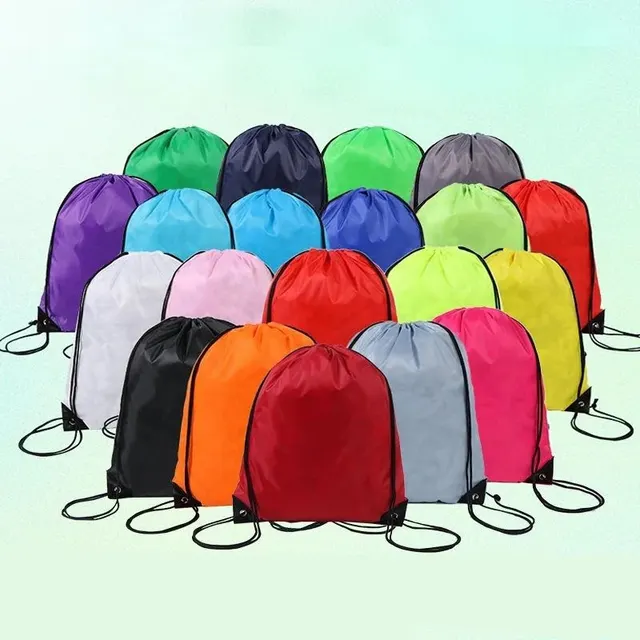
The classic promotional shape: a flat rectangle, roughly 34 × 42 cm, closed at the top by a single cord threaded through a channel and routed down both sides to bottom-corner grommets. The cord does double duty as closure and shoulder strap. Fabric is nearly always 210D polyester or non-woven polypropylene; weight empty is 40-70 g. This is what buyers mean 80% of the time when they ask for custom drawstring bags in bulk, and it is the construction every price table below assumes unless stated otherwise.
Sport drawstring backpack
Same silhouette, built to survive daily gym use: 420D or 600D polyester, a zip front pocket, mesh side pockets for bottles, reinforced corner tabs of webbing instead of bare grommets, and cords of 5-6 mm braided polyester rather than 3-4 mm. Weight 120-220 g. This is the retail-grade version - the one a sports brand sells rather than gives away - and the one we build most for school and club programmes in the Gulf, where it pairs with the school backpack range.
Drawstring pouch / dust bag
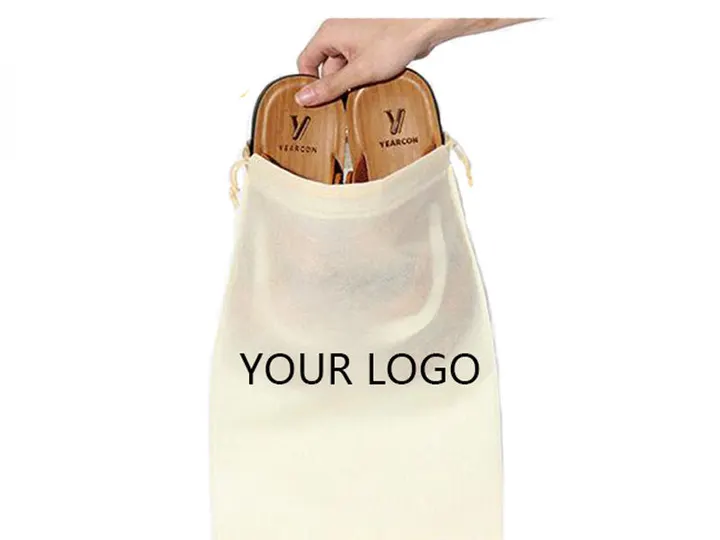
No shoulder cords: a simple top-channel closure with a cord tied or toggled, in sizes from 10 × 15 cm (jewellery) to 40 × 50 cm (shoe and handbag dust bags). Fabric runs from cotton muslin and canvas to microfibre and non-woven. These are packaging, not carry goods, and priced accordingly; they often ship inside our other products - every Senszx handbag programme can include a branded dust bag at a few cents per unit.
Drawstring tote / bucket bag
A gusseted canvas or polyester body with web handles and a drawstring top closure, usually 10-14 oz cotton canvas. This is a fashion and retail construction rather than a promotional one and is better treated under the tote programme - we mention it only so a buyer asking for a "drawstring tote" is not quoted a cinch sack.
| Construction | Typical fabric | Empty weight | Primary use | Typical unit price band (5,000 pcs, 1-colour print) |
|---|---|---|---|---|
| Cinch sack | 210D polyester / non-woven PP | 40-70 g | Events, giveaways, retail packaging | USD 0.55-1.20 |
| Sport drawstring backpack | 420D-600D polyester | 120-220 g | Gym, school, team kit | USD 1.80-4.50 |
| Drawstring pouch | Cotton, microfibre, non-woven | 10-60 g | Dust bag, gift packaging | USD 0.12-0.90 |
| Drawstring tote | 10-14 oz canvas | 180-300 g | Retail, fashion | USD 2.50-6.00 |
Price bands are factory-gate (FOB) figures for standard sizes with one-colour one-side printing; they move with cotton and polyester markets and with the spec choices below, which is the point of the rest of this guide.
Fabric: The Decision That Sets 50-60% of the Price
Fabric is the largest line in a drawstring bag cost and the one with the widest quality spread. Four families cover almost every order.
210D polyester: the default, and why
210 denier polyester taffeta is the standard cinch-sack fabric worldwide because it hits the best ratio of strength to cost to printability. At 55-70 gsm it is light enough that 5,000 bags ship in a handful of cartons, tight enough that screen ink sits on the surface instead of bleeding through, and coated (PU or PA, typically 300-600 mm water column) so a light rain does not soak the contents. Available in 30+ stock colours with no dye minimum. The limits: it is thin, so it tears if pierced; it shows every crease; and uncoated versions have a hand that reads "giveaway" rather than "gift".
Variations buyers should know by name: 210D ripstop (a grid of heavier yarns that stops tears spreading, +5-8% cost), 190T (a lighter 190-thread polyester, 45-55 gsm, used for the cheapest tier and noticeably flimsier), and 210D with PVC backing (stiffer, more waterproof, heavier print surface, +10%).
420D and 600D polyester: the retail tier
Moving to 420D roughly doubles tear strength and gives the bag a body that stands up. 600D - the same fabric specified for most mid-range backpacks, covered in depth in our 600D vs 900D vs 1680D guide - makes a drawstring backpack that reads as a product rather than a promotion. Either is the right call when the bag will be sold, carried daily or branded by a sports or education client. Fabric cost roughly 2-2.5x the 210D figure; sewing is also slower because the panels are stiffer.
Nylon: when weight and feel matter
210D or 420D nylon costs 25-40% more than the equivalent polyester and earns it in two situations: when the brief says "premium feel" (nylon has a softer, more lustrous hand and drapes better) or when the bag must be as light as possible for its strength (nylon has higher tenacity per gram). Nylon takes dye beautifully but is harder to colour-match across lots and absorbs more moisture, so for Gulf and tropical markets we usually steer buyers back to coated polyester unless the feel is the brand.
Cotton and canvas: the natural-fibre tier
Cotton drawstring bags split into muslin (80-120 gsm, pouches and dust bags), light canvas (5-8 oz, retail cinch bags and gift bags) and heavy canvas (10-14 oz, drawstring totes). Cotton prints superbly, reads as sustainable and premium, and is the only mainstream choice for GOTS-organic programmes - everything in our canvas tote guide about weights, shrinkage and certification applies here. The trade-offs for drawstring use: cotton absorbs water, weighs 3-5x polyester at equal strength, and the cord channel wears faster because cotton has less abrasion resistance than polyester.
Non-woven polypropylene: the floor of the market
Non-woven PP at 70-100 gsm is the cheapest drawstring fabric - typically 30-45% under 210D polyester at the bag level - and the right choice when the bag's job is to survive one event and carry a logo at the lowest possible cost per impression. It heat-seals as well as sews, takes screen print and heat transfer, and is available in a wide colour range. The honest limits: it tears at the grommets if overloaded, it pills, and it does not survive washing. Specify it knowingly for single-use programmes; do not specify it for anything a user is meant to keep.
Specialty fabrics worth asking about
RPET (recycled polyester from bottles) is a drop-in replacement for 210D/420D polyester at +10-20% with a GRS certificate - the fastest way to make a promotional drawstring bag programme sustainable. Mesh panels or full mesh bodies ventilate sports kit and swim gear. Reflective polyester or reflective piping serves school and cycling programmes. Clear PVC / TPU drawstring bags answer stadium security policies. Each is a one-line change to the spec with a predictable price delta; ask for the swatch before deciding.
| Fabric | GSM / weight | Relative bag cost | Water resistance | Print quality | Best for |
|---|---|---|---|---|---|
| Non-woven PP | 70-100 | 0.6x | Low | Fair | Single-event giveaways |
| 190T polyester | 45-55 | 0.85x | Medium (coated) | Good | Budget cinch sacks |
| 210D polyester | 55-70 | 1.0x (baseline) | Medium-high (coated) | Very good | Standard promotional programmes |
| 210D ripstop | 60-75 | 1.07x | Medium-high | Very good | Programmes with sharp contents |
| 420D polyester | 120-150 | 1.6x | High | Very good | School, club, retail entry |
| 600D polyester | 180-220 | 2.2x | High | Very good | Sport backpacks, retail |
| 210D/420D nylon | 55-150 | 1.3-2.1x | Medium | Excellent | Premium feel, lightweight |
| Cotton muslin / light canvas | 80-250 | 1.1-1.8x | None | Excellent | Pouches, gift and retail bags |
| RPET 210D/420D | 55-150 | 1.15-1.9x | Medium-high | Very good | Certified sustainable programmes |
Cords, Grommets and Corners: The Hardware That Decides Whether the Bag Survives
Fabric gets the attention; hardware causes the complaints. Three components carry the entire load of a drawstring bag, and each has a cheap version that fails and a correct version that costs cents more.
The cord
The cord is closure, strap and the part the user touches most. Four families are in common use:
| Cord type | Diameter | Feel | Strength | Typical cost impact per bag | Notes |
|---|---|---|---|---|---|
| Polypropylene (PP) braid | 3-4 mm | Slick, slightly plasticky | Adequate | Baseline | Frays at cut ends unless heat-sealed; cheapest tier |
| Polyester braid | 4-5 mm | Soft, matte | Good | +USD 0.03-0.06 | The standard for quality cinch sacks; holds colour, resists UV |
| Nylon braid | 4-6 mm | Softest, slight sheen | Best | +USD 0.08-0.15 | Sport backpacks; stretches slightly under load |
| Cotton cord | 4-6 mm | Natural, matte | Good dry / weaker wet | +USD 0.06-0.12 | Pairs with canvas and muslin; can shrink in wash |
| Flat webbing | 10-15 mm | Strap-like | Best comfort | +USD 0.15-0.30 | Replaces round cord on shoulder runs; premium sport programmes |
Three specification lines prevent most cord failures:
- Diameter and length. A 3 mm cord on a 420D bag cuts into shoulders and looks under-specified; a 6 mm cord on a 210D bag will not run smoothly through the channel. State the diameter and the finished loop length (typically 110-130 cm per side for an adult cinch sack).
- End finish. Heat-sealed ends are the minimum. Knotted ends inside the grommet are standard; metal or plastic aglets (tips) cost USD 0.02-0.05 per bag and are the difference between a product and a giveaway.
- Colour match. Cord is usually sourced separately from fabric; specify whether it should match the body, contrast, or carry a custom colour (custom-dyed cord has a minimum of roughly 5,000 metres, about 2,000 bags' worth).
The grommets
The bottom corners are where cord meets fabric under the full weight of the contents. Three solutions, in ascending order of durability:
- Direct grommet through single-layer fabric. The cheapest construction and the one that fails: on 210D polyester, a 10 mm grommet through one layer pulls through at roughly 3-5 kg of repeated loading. Acceptable only on non-woven single-event bags.
- Grommet through a reinforced corner patch. A square or triangular patch of heavier fabric (often 600D or faux leather) is sewn over the corner before the grommet is set. Pull-through resistance rises to 10-15 kg. This should be the default for any 210D programme that expects reuse; it adds USD 0.04-0.08 per bag.
- Webbing loop instead of grommet. A short loop of 15-20 mm webbing bar-tacked into the corner seam, with the cord threaded through the loop. No metal, no pull-through, and it survives machine washing. Standard on sport drawstring backpacks and the recommended spec when the bag will be sold.
Grommet specification itself: inside diameter 8-12 mm (match to cord: cord diameter × 2 minimum), brass or nickel-plated steel for durability, antique brass or black for aesthetics. Plastic grommets exist and are lighter but crack in cold weather; avoid them for anything shipping to markets with winters.
Cord locks, channels and stoppers
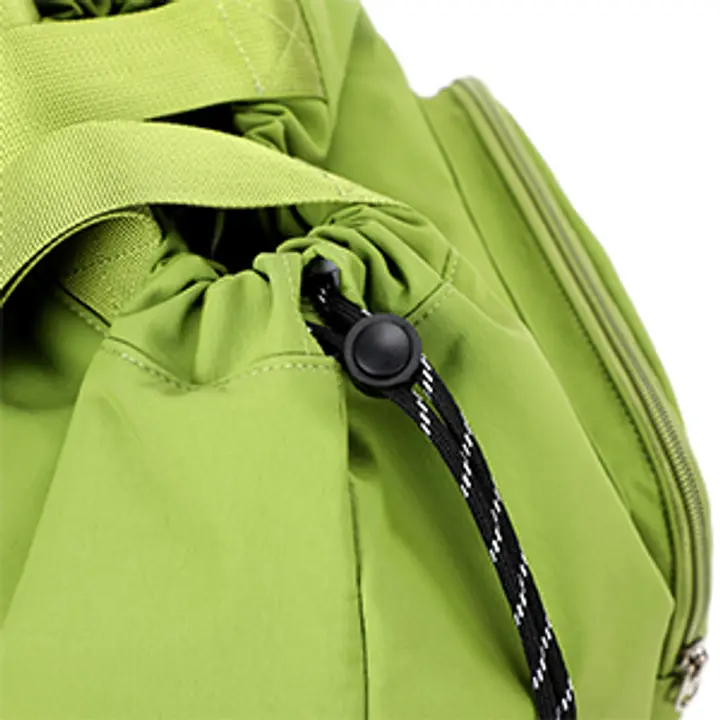
A cord lock (spring toggle) converts the top closure from "pull and knot" to "pull and release"; it costs USD 0.03-0.08 and is expected on sport and retail bags. The cord channel (the folded top hem the cord runs through) should be at least 2.5 cm wide for 4 mm cord and double-stitched; a single-stitched narrow channel is the second most common failure after grommet pull-through. For the main pull points we bar-tack the channel ends - the same construction rule that governs every stress point in our backpack manufacturing process.
Zips, pockets and extras
Adding a front zip pocket turns a cinch sack into a drawstring backpack in both price and perception: USD 0.25-0.60 for the zip, slider, pocket panel and sewing. Mesh side pockets add USD 0.10-0.20 each. An inner pocket or key clip is USD 0.05-0.15. A padded back panel - rare, but requested by school programmes - adds USD 0.40-0.80. Each is a one-line spec change; each should be decided against the bag's actual job rather than added because the mock-up looked bare.
Printing and Decoration: Matching the Method to the Fabric and the Artwork
Decoration is the second-largest cost line after fabric and the most frequent cause of rejected goods. The right method depends on fabric, artwork colour count, coverage area and quantity.
Screen printing
The default for drawstring bags and the method behind most of the price tables in this guide. Plastisol or water-based ink is pushed through a stencilled mesh screen, one screen per colour. On 210D polyester with proper curing, screen print survives 30+ washes and years of UV. Costs: a one-time screen charge of USD 15-40 per colour, then USD 0.08-0.15 per bag for the first colour and USD 0.05-0.10 per additional colour. Economics favour it from about 300 units up. Limits: each colour is a separate pass, so a 6-colour logo is expensive and registration-sensitive; gradients and photographs are not possible; maximum practical print area on a 34 × 42 cm cinch sack is about 25 × 30 cm.
Fabric-specific notes. Polyester needs low-bleed or barrier inks to stop dye migration (a red bag can turn a white print pink over weeks without them - specify "low-bleed" for any light print on a dark polyester bag). Non-woven PP prints well but does not tolerate high cure temperatures. Cotton takes water-based ink beautifully with a soft hand.
Heat transfer (vinyl and printed transfer)
A design is cut or printed onto a carrier film and pressed onto the bag with heat. Two sub-types: vinyl transfer (solid colours, crisp edges, great for names and numbers; USD 0.15-0.40 per bag depending on size and colours) and printed transfer / DTF (full-colour artwork including gradients and photographs; USD 0.20-0.50 per bag, no screen charges). Heat transfer is the right call for multi-colour logos at low quantities (under ~500), for personalisation (individual names), and for artwork that screen printing cannot reproduce. Limits: transfers sit on top of the fabric and can crack or peel after heavy wash cycles; they feel like a patch rather than part of the fabric; and polyester must be pressed at controlled temperatures to avoid scorching.
Sublimation
Dye is turned to gas and bonded into the polyester fibre itself, so the print is permanent, has zero hand, and can cover the entire bag edge to edge in photographic colour. Only works on white or very light polyester (not cotton, not non-woven, not dark colours). Cost is USD 0.60-1.50 per bag for full coverage, with no colour limit. The right choice for all-over patterns, team designs and retail collections - and the method behind most "fully custom" sport drawstring backpacks.
Embroidery
Thread-stitched logos. Premium perception, excellent durability, works on every fabric, but adds weight and cost: USD 0.30-1.20 per bag depending on stitch count (a 7 × 7 cm logo is typically 5,000-8,000 stitches). On thin 210D the back of the embroidery is visible inside the bag and needs a backing patch. Best for 420D/600D sport bags, canvas and premium corporate programmes; rarely economical on promotional cinch sacks.
Woven labels, patches and debossing
A woven label (USD 0.05-0.15) sewn at the hem or on a corner tab adds brand presence at low cost and pairs with any print method. Rubber or PVC patches (USD 0.15-0.40) suit sport and outdoor programmes. Debossed faux-leather patches read premium on canvas. These are the finishing touches that separate a programme a buyer is proud of from one that was merely delivered; most of the retail-grade drawstring programmes we build combine one print method with one label.
| Method | Best fabric | Colours | Min. economical qty | Cost per bag (typical) | Durability | Hand feel |
|---|---|---|---|---|---|---|
| Screen print | Polyester, cotton, non-woven | 1-4 | 300 | USD 0.08-0.35 | Excellent | Light |
| Vinyl heat transfer | Polyester, cotton | 1-3 | 50 | USD 0.15-0.40 | Good | Noticeable |
| Printed transfer / DTF | Polyester, cotton | Unlimited | 50 | USD 0.20-0.50 | Good | Noticeable |
| Sublimation | White/light polyester only | Unlimited | 100 | USD 0.60-1.50 | Permanent | None |
| Embroidery | 420D+, canvas | Up to 9 thread colours | 100 | USD 0.30-1.20 | Excellent | Raised |
| Woven label | Any | Up to 8 | 500 | USD 0.05-0.15 | Excellent | None |
Artwork rules that save a sampling round
- Supply vector files (AI, EPS, PDF) for screen print and vinyl; 300 dpi raster at final size is acceptable only for printed transfer and sublimation.
- Specify colours as Pantone solid coated numbers, not RGB or "our brand blue". Our screen room matches to Pantone under D65 light; without a reference there is nothing to match to.
- Minimum line weight for screen print on 210D is 0.5 mm; minimum reversed-out text is 6 pt. Thinner detail fills in.
- Decide print position and size as a dimension, not a percentage: "logo 18 cm wide, centred, top edge 8 cm below the cord channel" is a spec; "big logo in the middle" is a conversation.
- Approve a physical strike-off on the production fabric and colour before bulk decoration. Ink behaves differently on coated versus uncoated polyester and on every substrate colour; the strike-off is the only honest preview, and we build it into every sample round.
What Custom Drawstring Bags Cost in Bulk: The Price Stack by Quantity Tier
Buyers receive quotes that differ by 3x for what looks like the same bag. The difference is always in the stack, so here it is line by line, using the standard 34 × 42 cm 210D polyester cinch sack with one-colour one-side screen print as the baseline.
The cost stack
| Cost line | Share of unit cost (5,000 pcs baseline) | What moves it |
|---|---|---|
| Fabric | 45-55% | Denier, coating, ripstop, RPET, colour (custom dye lots) |
| Cord and hardware | 10-15% | Cord type and diameter, aglets, grommet spec, corner patches, cord lock |
| Cut and sew labour | 15-20% | Panel count, pockets, bar-tacks, reinforcement, QC level |
| Decoration | 10-20% | Method, colour count, coverage, both sides vs one |
| Packing | 3-5% | Individual polybag, folded vs flat, carton spec, inserts |
| Overhead and margin | 8-12% | Factory scale, order complexity, payment terms |
Two things follow. First, decoration is where buyers most often overspend: a second print colour or printing both sides can add 15-25% to the unit price on a bag whose fabric cost is fixed. Second, hardware is where buyers most often underspend: moving from PP cord and bare grommets to polyester cord with aglets and reinforced corners adds roughly USD 0.10-0.18 per bag - 10-15% on a cheap sack - and eliminates the two most common failures. Spend there before spending on the second colour.
Price by quantity tier
Factory-gate (FOB China) indicative unit prices, standard-size 210D cinch sack, one-colour one-side screen print, stock fabric colour, polybagged. Shipping, duty and decoration set-up charges are separate.
| Quantity | 190T polyester | 210D polyester | 210D with reinforced corners + aglets | 420D sport with zip pocket | Non-woven PP |
|---|---|---|---|---|---|
| 100-299 (sampling / pilot) | USD 1.10-1.50 | USD 1.30-1.80 | USD 1.50-2.10 | USD 3.80-5.50 | USD 0.80-1.10 |
| 300-999 | USD 0.85-1.15 | USD 1.00-1.35 | USD 1.15-1.55 | USD 3.00-4.20 | USD 0.60-0.85 |
| 1,000-2,999 | USD 0.70-0.95 | USD 0.82-1.10 | USD 0.95-1.28 | USD 2.50-3.50 | USD 0.48-0.68 |
| 3,000-4,999 | USD 0.62-0.82 | USD 0.72-0.95 | USD 0.85-1.12 | USD 2.20-3.00 | USD 0.42-0.58 |
| 5,000-9,999 | USD 0.55-0.72 | USD 0.65-0.85 | USD 0.76-1.00 | USD 1.95-2.70 | USD 0.38-0.52 |
| 10,000+ | USD 0.48-0.65 | USD 0.58-0.78 | USD 0.68-0.90 | USD 1.75-2.45 | USD 0.33-0.46 |
Read the table for its shape rather than its decimals: the steep drop between 500 and 3,000 units is set-up amortisation (screens, cutting dies, line changeover); the gentle slope after 3,000 is pure material economics. Our minimum is 500 pieces per fully custom style; the first row therefore applies to 500-piece pilots - useful for testing a bag before committing to a 5,000-piece event order.
The add-ons, priced
| Option | Typical add per bag (5,000 pcs) |
|---|---|
| Second print colour (same side) | +USD 0.05-0.10 |
| Print second side | +USD 0.10-0.18 |
| Full-colour transfer instead of screen print | +USD 0.12-0.35 |
| Sublimation all-over (white 210D) | +USD 0.55-1.20 |
| Polyester cord upgrade (from PP) | +USD 0.03-0.06 |
| Metal aglets | +USD 0.02-0.05 |
| Reinforced corner patches | +USD 0.04-0.08 |
| Cord lock | +USD 0.03-0.08 |
| Front zip pocket | +USD 0.25-0.60 |
| Mesh side pocket (each) | +USD 0.10-0.20 |
| Woven label | +USD 0.05-0.15 |
| Custom fabric colour (dye lot, min ~3,000 m) | +USD 0.04-0.10 and +10-14 days |
| RPET fabric with GRS certificate | +10-20% on fabric line |
| Individual polybag with header card | +USD 0.04-0.09 |
What a quotation should show
A quote that lists only "drawstring bag, 1 colour logo, USD 0.78" cannot be compared to any other quote. Ask every factory for the same seven lines, and Senszx quotes this way by default: fabric (type, denier, gsm, coating, colour), size (finished W × H in cm), cord (type, diameter, finish), corners (construction, grommet spec), decoration (method, colours, position, size), packing (polybag, pcs per carton, carton dimensions) and terms (Incoterm, payment, lead time). Two quotes with identical seven lines can be compared on price; two quotes without them cannot.
Six Drawstring Programmes and How to Spec Each
Different jobs call for different bags. These are the six briefs we see most, each with the spec we would write if the buyer asked us to decide.
Event and conference giveaway
Job: survive one weekend, carry a logo, cost as little as possible per impression. Spec: 210D polyester (not 190T - it photographs badly), 34 × 42 cm, PP or polyester cord 4 mm, grommets through single layer acceptable, one-colour screen print 20 cm wide, no pocket. Non-woven PP is the floor option if budget is the only variable. Order 10-15% over headcount.
School and education programme
Job: daily use by children for a term or a year; parents judge the school by it. Spec: 420D polyester or 210D ripstop with reinforced corners, polyester cord 5 mm with aglets, cord lock, reflective strip or piping, name label inside, one- or two-colour print. In the Gulf, add UV-stable ink and specify light colours for heat. This pairs with our school backpack programmes and often ships in the same container.
Sports club and team kit
Job: gym and match-day bag for athletes who will abuse it. Spec: 420D-600D polyester, webbing corner loops (no grommets), 5-6 mm nylon cord or flat webbing straps, front zip pocket, mesh side pocket, sublimation or multi-colour print with player numbers via vinyl. This is a retail-grade product; price it against the sport backpack column, not the cinch-sack column.
Retail and e-commerce accessory
Job: sell at USD 12-25 as a branded product. Spec: 420D polyester or 8-10 oz canvas, premium hardware (metal aglets, antique grommets or webbing loops, cord lock), woven label plus one print method, individual polybag with header card or kraft tag. Consider RPET or organic cotton for the sustainability story the listing will tell.
Corporate and promotional merchandise
Job: on-brand, long-lived, handed to clients and staff. Spec: 210D ripstop or 420D in a Pantone-matched custom colour (plan the dye-lot lead time), polyester cord in a contrast brand colour, reinforced corners, one-colour print plus woven label. The programmes in our promotional backpack guide follow the same logic one tier up.
Packaging dust bag
Job: protect a product inside a box and carry the brand after unboxing. Spec: cotton muslin 100-120 gsm, non-woven 80 gsm, or microfibre; drawstring pouch construction; one-colour screen print or foil; size the finished bag at product dimensions + 4 cm each way. Usually ordered alongside the main product so the artwork and colour match; MOQ follows the main order.
Quality Control: The Tests That Catch the Three Classic Failures
Drawstring bags fail in three ways - cord, corners, print - and each has a bench test that takes minutes. These are the checks Senszx runs on every programme, and the ones to write into your QC clause.
Incoming fabric. GSM weighed on a cutter-and-scale against the spec ±5%; coating checked with a water-column test (300 mm minimum for coated 210D); colour checked against the approved swatch under D65 light; a tear test on the first roll of every lot.
Cord and hardware. Cord diameter measured; a 10 kg static hang test on the finished cord-and-grommet assembly for 24 hours (bag loaded with weight, hung by cords - no pull-through, no cord stretch beyond 5%); grommet set depth checked (a loose grommet spins; a correct one does not); cord lock cycled 200 times.
Construction. Stitch density 8-10 per inch on the channel and side seams; bar-tacks present at channel ends and corner loops; channel width ≥2.5 cm; no raw edges inside; thread colour matched.
Decoration. Strike-off compared to Pantone under D65; registration within 1 mm on multi-colour prints; cure test (a cured plastisol print does not transfer to white cloth rubbed 20 times); crock test for wet rub; for dye-migration risk (light print on dark polyester) a 48-hour heat-age test at 60 °C.
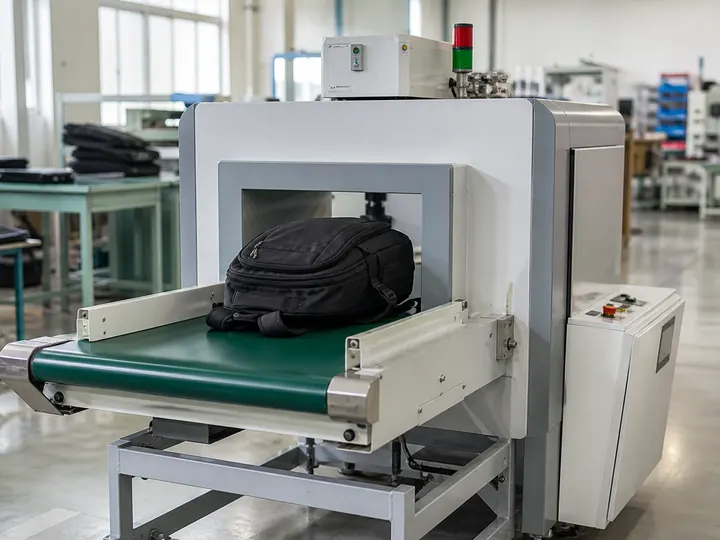
Final inspection. AQL 2.5 Level II sampling on the finished lot - the same protocol described in our quality assurance process - covering measurements, print position ±5 mm, cord length ±2 cm, polybag and carton labelling. Metal detection is run on any programme for children or for retailers that require it.
A spec clause that reads "fabric 210D polyester 65 gsm ±5%, PU coated 400 mm; cord 4 mm polyester braid with heat-sealed ends; corners reinforced with 600D patch, 10 mm nickel grommet; print 1-colour plastisol low-bleed, Pantone 286C, 20 cm wide centred 8 cm below channel; AQL 2.5 Level II" is the difference between a buyer who gets what they ordered and a buyer who gets what the factory had.
Regional Compliance: What Each Market Asks of a Drawstring Bag
A promotional bag is a low-risk product, but it is not an unregulated one, and the requirements differ by destination. Settle these at the brief stage so the certificate scope and labelling are built into the order rather than bolted on at the port.
United States. Drawstring bags for children (under 12) fall under CPSIA: lead and phthalate limits apply to the fabric, cord, grommets, cord locks and print inks, and a Children's Product Certificate backed by third-party testing is required. Cords on children's upper-body products are additionally governed by ASTM F1816 drawstring rules - for a drawstring bag this means avoiding long free cord ends and specifying cord locks or knots that cannot form a loop over the head. California Proposition 65 affects phthalates and certain dyes; most buyers handle it by specifying phthalate-free PVC-free components and keeping the test report on file. Textile labelling (fibre content, country of origin) applies when the bag is sold rather than given away.
Gulf Cooperation Council. Saudi Arabia requires SABER registration and a product certificate of conformity for textile and bag categories; the UAE applies ECAS/ESMA rules; Qatar and Kuwait generally accept GCC conformity marking. Each wants the HS code (4202.92 for textile-faced bags), a test report to the GSO textile standards, and often an Arabic-language label with origin, importer and material. Our GCC buyer guide walks through documents and duties step by step.
European Union. REACH restricts azo dyes, phthalates, PAHs and heavy metals in textiles and components; for children's bags the Toy Safety Directive may apply if the bag is marketed to children under 14 and could be considered a toy. The General Product Safety Regulation (GPSR, applicable from December 2024) requires an EU-based responsible person on the label for most consumer products. Fibre labelling follows Regulation 1007/2011.
Everywhere. OEKO-TEX Standard 100 on the fabric is the pragmatic baseline that satisfies most buyers' chemical-safety questions in one certificate; BSCI or SMETA audits answer the social-compliance question. Both are on file at Senszx and can be issued with a scope that names your programme.
The practical rule: if the bag is for children or for retail sale, specify CPSIA/REACH-compliant components at the quotation stage and budget USD 300-800 for the test report; if it is an adult giveaway, OEKO-TEX fabric and phthalate-free components are usually sufficient. Deciding this at week 10 costs nothing; discovering it at customs costs the shipment.
The 10-Week Drawstring Bag Order Calendar
Drawstring bags are faster than structured backpacks - fewer panels, simpler sewing - but the calendar still has fixed gates. Working back from a delivery date:
| Weeks before delivery | Milestone | Notes |
|---|---|---|
| 10 | Brief and spec locked, quotation signed | Decide fabric, colour (stock vs custom dye), construction, print method now - these set the whole calendar |
| 9 | Deposit paid; fabric and cord booked | Stock colours ship from the mill in days; custom dye lots add 10-14 days; custom-dyed cord adds 7-10 |
| 9-8 | Pre-production sample (3-5 days) | Physical bag in the right fabric with a strike-off of the print; approve or mark up |
| 8 | Sample approved; screens made, cutting dies set | One revision round is normal; a second costs a week |
| 7-5 | Bulk cutting, printing, sewing | 20 days for a standard programme; 10-15 for simple cinch sacks on stock fabric; longer for sublimation or embroidery |
| 5 | In-line QC and pre-shipment inspection | AQL sampling; your inspector or ours; photos and report before packing |
| 4 | Packing and container booking | Cinch sacks pack 200-400 per carton; a 5,000-piece order is often under 2 CBM |
| 4-1 | Freight | Sea: 25-35 days to US West Coast, 18-28 to Jebel Ali or Dammam; air: 5-8 days door to door; the GCC import guide covers documents and duties |
| 0 | Delivery | — |
Compression is possible: stock fabric + one-colour screen print + air freight can deliver in 3-4 weeks. The two things that cannot be compressed are custom dye lots and sample approval - which is why the single most useful question a buyer can answer at week 10 is "is a stock colour acceptable?"
Sourcing Drawstring Bags Factory-Direct: Eight Checks
The drawstring bag market has more traders than factories. Eight questions sort them, and a real factory answers each in a sentence:
- "Which denier and gsm is this quote based on?" A factory states both; a trader says "standard".
- "What is the corner construction?" Grommet through single layer, reinforced patch or webbing loop - the answer tells you whether the quote matches your durability need.
- "Can I see the cord-and-grommet hang test?" A factory has a hook on the wall; a trader has not heard of it.
- "What ink system for a light print on dark polyester?" The right answer mentions low-bleed or barrier ink and dye migration.
- "What is the dye-lot minimum and lead time for a custom colour?" Numbers, not "we can do it".
- "Which certifications apply to this fabric?" OEKO-TEX Standard 100 is baseline; GRS for RPET; GOTS for organic cotton. Ask for the certificate with a scope that names the product.
- "Can you video-call from the sewing floor today?" A factory can walk you to the line; the factory tour and showroom pages show what that call looks like for us.
- "What is the MOQ per design and per colour?" Ours is 100 per design; be suspicious of both "no minimum" (a trader splitting someone else's run) and "5,000" (a line that only wants commodity work).
Four Orders, Four Lessons
Abstract rules land harder as cases. Names withheld; the specs and outcomes are as they ran.
The conference that saved USD 0.06 and spent USD 2,000. A 4,000-piece event order chose 190T over 210D to save six cents a bag. The bags photographed translucent under exhibition lighting and the client's logo was visible reversed from the back. The reorder - in 210D - shipped by air to make the event. Lesson: 190T is a cost line, not a product; use it only where nobody will photograph it.
The school that reordered at the same price with half the complaints. A Gulf school programme's first run used bare grommets on 210D; 8% of bags came back with pulled corners within a term. The reorder added 600D corner patches and polyester cord with aglets (+USD 0.11 per bag) and dropped the second print colour (−USD 0.08). Complaints fell to under 1% at a net cost of three cents. Lesson: hardware before decoration.
The sports brand that discovered sublimation. A club kit supplier had been screen-printing four colours onto 420D bags at USD 0.42 in decoration cost and fighting registration on every lot. Switching to white 210D with all-over sublimation cost USD 0.95 in decoration but eliminated colour limits, registration rejects and the four-screen set-up - and the all-over design sold at a higher retail price. Lesson: when artwork has more than three colours, cost the alternatives.
The retailer that specified the cord. An e-commerce brand sent a spec that named the cord: 5 mm polyester braid, matte, metal aglets, 120 cm loop. The sample passed first time, the bulk matched the sample, and the product reviews mentioned the "quality straps". Lesson: the components that touch the hand are the ones customers notice; specify them.
The distributor that asked about dye migration. A promotional distributor ordering 12,000 navy 210D sacks with a white logo asked one question before approving the strike-off: "what ink?" The answer - standard plastisol - was changed to a low-bleed barrier white at no extra cost, and the 48-hour heat-age test confirmed no pinking. The previous supplier's run had turned pink in the warehouse before the event. Lesson: one question at the strike-off stage can save an entire order.
Frequently Asked Questions
What is the minimum order for custom drawstring bags?
Our MOQ is 500 pieces per fully custom design. Custom-dyed fabric effectively raises the practical minimum to around 2,000-3,000 pieces because of the dye-lot minimum; custom-dyed cord has a similar threshold. Below 300 pieces of decoration, heat transfer is usually more economical than screen printing because there are no screen charges.
How much do custom drawstring bags cost in bulk?
For a standard 34 × 42 cm 210D polyester cinch sack with a one-colour logo, factory-gate prices run roughly USD 0.65-0.85 at 5,000 pieces and USD 0.58-0.78 at 10,000, before freight and duty. Non-woven PP is 30-45% less; a 420D sport drawstring backpack with a zip pocket is 2.5-3.5x more. The price tables above break this down by tier and option.
210D or 420D - which should I choose?
210D for single-event and promotional use where cost per unit is the priority; 420D (or 210D ripstop with reinforced corners) for anything used daily, carried by children, or sold at retail. If you are unsure, the reinforced-corner 210D column is the best value tier for most reusable programmes.
What is the best printing method for a multi-colour logo?
Under about 500 pieces, printed heat transfer (DTF) - no screen charges and unlimited colours. Above that, screen print for up to 3-4 colours if the artwork is flat; sublimation on white polyester if the artwork has gradients, photographs or needs full coverage. Embroidery suits 420D and canvas bags where a premium feel justifies the cost.
Can the print go on both sides?
Yes. Printing the second side typically adds USD 0.10-0.18 per bag at volume. Most programmes print one side; two-sided printing is common for event bags that are carried in crowds and for retail bags where the back is visible on a hanger.
What size should a drawstring bag be?
The promotional standard is 34-36 cm wide × 42-45 cm high - fits A4, a pair of shoes or gym kit. Children's programmes often use 30 × 38 cm; sport backpacks 38 × 48 cm. Pouches and dust bags are sized to the product plus 4 cm each way. Finished dimensions should be in the spec as numbers with a ±1 cm tolerance.
How do I stop the corners pulling out?
Specify reinforced corner patches (600D or faux leather under the grommet) or webbing corner loops instead of bare grommets, and a cord no thicker than half the grommet's inside diameter. Ask for the 10 kg hang test result. This single spec line removes the most common drawstring bag failure.
Are drawstring bags available in recycled or organic material?
Yes. RPET polyester (from recycled bottles) is a drop-in replacement for 210D and 420D at +10-20%, with a GRS certificate; organic cotton muslin and canvas are available with GOTS certification; non-woven PP is recyclable but not recycled. Ask for the certificate scope to cover the specific fabric, not just the mill.
How long does a bulk drawstring bag order take?
Sample in 3-5 days; bulk production in 10-20 days after approval depending on construction and decoration; add 10-14 days for custom dye lots. Sea freight adds 3-5 weeks to the US, 3-4 to the Gulf; air adds about a week. A realistic end-to-end calendar for a custom-colour programme is 10 weeks; stock colour with air freight can be 3-4 weeks.
Can I get a sample before ordering in bulk?
Yes - a pre-production sample in your fabric, colour and construction with a print strike-off takes 3-5 days. Request a free sample with your brief, or send a reference bag and we will match or improve the spec.
The One-Page Summary
- Name the construction first: cinch sack, sport drawstring backpack, pouch or drawstring tote are four different products with four price bands.
- Fabric sets half the cost: 210D polyester is the baseline; 190T is cheaper and looks it; 420D-600D is retail tier; non-woven is single-use; RPET and organic cotton carry the sustainability story.
- Spend on hardware before decoration: polyester cord with aglets and reinforced corners cost cents and eliminate the two classic failures.
- Match print method to fabric and artwork: screen for flat 1-4 colours, DTF for small multi-colour runs, sublimation for all-over on white polyester, embroidery for premium 420D and canvas.
- Write the seven-line spec (fabric, size, cord, corners, decoration, packing, terms) and compare quotes only when they share it.
- Test the three failures: hang test for cord and corners, cure and crock tests for print, AQL 2.5 at final.
- Plan 10 weeks for custom colours, 3-4 for stock with air.
Get a Drawstring Bag Quotation
Send us the seven-line spec, or just a sketch and a quantity, and you will have a priced quotation with fabric swatch options within 24 hours. MOQ 500 pieces fully custom, pre-production sample in 3-5 days, bulk in 10-20 days, BSCI and ISO 9001 certified.
Browse the base styles on our drawstring backpacks page, request a free sample, or send your brief. For Gulf programmes the GCC buyer page covers ports, documents and the seasonal calendar; for the paperwork that makes any bag order faster, the tech pack guide applies to drawstring bags line for line.
Hi, I'm Senszx Bag Manufacturer, Hope You Like This Blog Post.
With more than 20 years of experience in OEM/ODM/Custom luggage and bag, I'd love to share with you the valuable knowledge related to luggage and bag products from a top-tier Chinese supplier's perspective.
Senszx Factory
Est. 2006 · Baigou, China
Related articles
Custom Travel Bags with Logo: The Complete Manufacturing, Materials & Branding Guide
An exhaustive B2B manufacturing guide to custom travel bags with logo. Master custom duffle, weekender, and carry-on production, compare 6 branding techniques (screen print, heat transfer, woven labels, rubber patches, debossed leather, digital print), fabric specs (600D-1680D, nylon, canvas), hardware, and OEM factory quality control for 500+ unit runs.
Custom Tactical Backpack Manufacturing & Sourcing Guide: Mil-Spec Fabrics, MOLLE Engineering, and OEM Factory Quality Control
A comprehensive B2B engineering guide to manufacturing custom tactical backpacks. Explore 500D vs 1000D Cordura, laser-cut vs nylon MOLLE webbing, reinforced bartack stitching, POM mil-spec hardware, and OEM/ODM production standards for 500+ unit runs.
Backpack CPSIA Compliance & Safety Testing: The Complete US Importer's Technical Guide
Master US backpack safety compliance: CPSIA regulations, CPC vs GCC certificates, Lead & Phthalates limits, Prop 65, tracking labels, and CPSC lab testing protocols.
Get a Custom Bag Quote from Our China Factory
Our sales team is online around the clock and usually replies within the hour.
Email
[email protected]Factory
Qinzheng Road No.89, New Industry Zone, Baigou Town
Baoding City, Hebei Province 074004, China