Promotional Backpacks with Logo: The Bulk Buyer's Guide
Factory guide to buying promotional backpacks in bulk: styles, fabrics, logo methods, cost per quantity tier, event timelines and quality checks.
Somewhere between the branded pen nobody keeps and the hoodie nobody budgets for sits the promotional backpack: useful enough to be carried for years, visible enough to turn the carrier into a walking billboard, and - bought correctly - cheap enough to give away by the thousand. This guide is written from the factory floor: what the styles really cost, which logo method survives a conference season, how long production actually takes, and where buyers quietly waste 20-30% of their budget.
At Senszx we have produced promotional backpacks since 2006 - for trade shows, school programmes, corporate onboarding kits, sports events and charity campaigns - at quantities from 500 pieces to tens of thousands. Everything below reflects how these orders are actually quoted, made, printed, packed and shipped.
Why Backpacks Outperform Most Promotional Products
The economics of promotional merchandise come down to one metric: cost per impression. A promotional product earns its budget by being seen, and a backpack is one of the few giveaways that leaves the house daily.
Think about the lifecycle of typical event swag. A lanyard dies with the conference. A stress ball colonises a drawer. A T-shirt becomes sleepwear. A backpack, though, gets carried - to the gym, to school, on a commute, through an airport - and every outing parades the logo at eye height across the busiest public spaces a brand can reach.
Three structural advantages drive this:
Longevity. A well-made 600D polyester backpack survives 2-4 years of regular use. Even a budget 210D drawstring sack typically serves a season of gym visits or a school year. Compare that with the minutes of attention a flyer earns.
Print real estate. A backpack offers the largest continuous branding surface of any wearable promotional item - a front panel can take a 25 x 30 cm print, roughly ten times the area of a pen barrel and three times a cap front, without looking forced.
Perceived value. Recipients rank bags among the most-appreciated promotional gifts because they solve a real problem. A gift that is used is a gift that is kept, and retention is what separates promotion from landfill.
The practical conclusion: if your campaign goal is sustained brand visibility rather than a momentary touch, backpacks deliver one of the lowest costs per impression in the catalogue - provided you match the style and spec to the audience, which is the next section's job.
The Four Promotional Backpack Styles (and When Each Wins)
"Promotional backpack" covers four very different products. Picking the wrong one either wastes budget on features nobody needs or embarrasses the brand with a giveaway that feels cheap. Here is the decision matrix we walk buyers through:
| Style | Typical spec | Best for | Watch out for |
|---|---|---|---|
| Drawstring sack | 210D-420D polyester, cord straps | Events, race packs, PE kits, mass giveaways | Cord exits must be reinforced or bags fail in weeks |
| Classic daypack | 600D polyester, zip main + front pocket | Corporate gifts, school programmes, onboarding kits | Keep features minimal; every pocket adds cost |
| Laptop backpack | 600D-900D, padded 15.6" sleeve | Executive gifts, tech conferences, employee kits | Padding quality varies wildly between factories |
| Specialty (cooler/sling/roll-top) | Varies | Differentiated campaigns, premium tiers | Higher MOQ sensitivity; longer sampling |
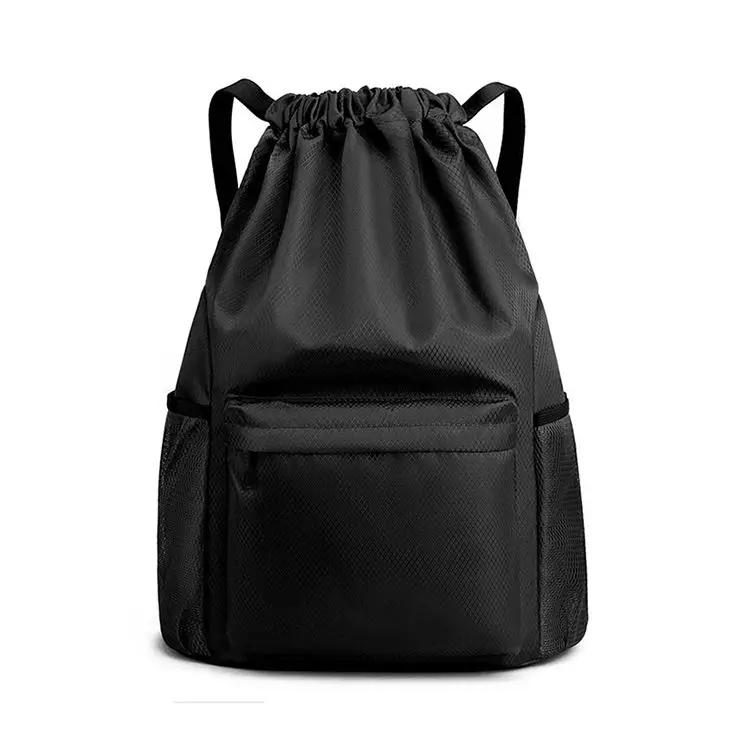
Drawstring sacks: the volume king
When the brief says "five thousand pieces, one event, tight budget", the answer is almost always a drawstring sack. It is the highest-volume promotional bag we produce and the simplest: two panels, a cord channel, corner reinforcement, done. At volume, unit costs sit well under what most buyers expect to pay - which is exactly why they dominate fun runs, trade-show swag walls and school sports days.
The quality difference between a sack that survives and one that embarrasses the brand lives in three details: bar-tacked or grommeted cord exits (the failure point under load), a fabric weight of at least 210D (below that, the bag reads as disposable), and a flat-lying cord channel that does not pucker after the first wash. These details cost cents at the factory and are invisible on a supplier's product photo - one reason a pre-production sample matters even for the cheapest item in the catalogue.
Upgrades that earn their cost: a zipped front pocket (phone and keys - turns an event sack into a gym bag), contrast-colour cords, and a bottom gusset so the bag stands upright. Upgrades that rarely do: linings, laptop sleeves and anything padded - at that point you should simply buy a daypack.
Classic daypacks: the corporate standard
The 600D zip-top daypack is the default corporate promotional backpack: structured enough to look like a product rather than packaging, simple enough to hit aggressive price points at 500+ pieces. It is what new-hire onboarding kits, university welcome packs and dealer-network gifts are built around.
The spec that matters: 600D polyester shell (the industry benchmark for promotional grade), #5 coil zippers with auto-lock sliders, padded back panel, adjustable webbing straps, and a front slip or zip pocket as the single feature. Each additional compartment, mesh side pocket or organiser panel adds sewing minutes, and sewing minutes are the main cost driver after fabric.
Laptop backpacks: the premium tier
When the recipient list is executives, conference speakers or senior employees, the giveaway shifts from "token" to "statement", and the laptop backpack is the standard vehicle. Padded 15.6-inch sleeve, 600D-900D shell, organiser front panel, sometimes a USB pass-through port. Unit cost runs several times a basic daypack - which is fine, because the quantity is usually hundreds, not thousands, and the brand impression per piece is far higher.
One specification rule we push buyers toward: put the budget into the back panel and straps rather than extra pockets. A laptop bag that carries comfortably gets used daily; one with ten pockets and thin straps gets retired after the first heavy commute.
Specialty styles: differentiation plays
Cooler backpacks for summer campaigns and beverage brands, sling bags for youth-focused promotions, roll-tops for outdoor brands - specialty styles cost more and sample slower, but they escape the sea of identical daypacks at a trade show. They make sense when the campaign's entire point is standing out, or when the product ties to the brand's category (a cooler backpack for a drinks brand earns its premium instantly).
Logo Methods: What Survives a Conference Season
The logo is the entire point of a promotional backpack, yet decoration is where the most expensive mistakes happen - a beautiful print that cracks after a month advertises carelessness, not the brand. Here is how the five main methods compare from the production side:
| Method | Best on | Durability | Colour capability | Cost behaviour |
|---|---|---|---|---|
| Screen print | Polyester panels, flat areas | Very good (plastisol/water-based inks) | 1-6 spot colours | Cheapest at volume; cost scales with colour count |
| Heat transfer | Complex artwork, gradients | Good; edges can lift on cheap films | Full colour, photographic | Moderate; no colour-count penalty |
| Sublimation | White/light polyester only | Excellent - ink becomes part of the fibre | Unlimited, edge-to-edge | Economical at scale; all-over capable |
| Embroidery | Premium daypacks, laptop bags | Excellent - survives everything | Up to ~9 thread colours | Priced by stitch count; small logos economical |
| Woven/rubber patches | Any style, premium feel | Excellent | Fine detail via weave or mould | Patch tooling cost amortises over volume |
The practical rules we give buyers:
For drawstring sacks and event volume, a one-colour screen print is the workhorse: fast, cheap, durable. Every extra colour adds a screen and a pass through the press, so a three-colour logo on 5,000 bags costs meaningfully more than a one-colour version - simplify the artwork before the quote, not after.
For corporate daypacks, embroidery reads as premium and never peels, but price it by stitch count: a 9 x 9 cm left-chest-size logo is economical; a full-panel embroidered artwork is not. Many corporate programmes combine a small embroidered logo with a larger screen-printed graphic.
For full-colour mascots, gradients or photography, sublimation on white polyester is the only method that reproduces the artwork faithfully at volume - and it allows all-over designs that turn the whole bag into the graphic. The constraint: the base fabric must be light-coloured polyester.
One factory-side warning: ask any supplier for a production strike-off (a printed/embroidered sample on the actual fabric) before bulk decoration starts. Colour behaves differently on 210D ripstop versus 600D oxford versus cotton canvas; the strike-off is the only honest preview, and skipping it is the single most common cause of promotional-order disputes industry-wide.
What Promotional Backpacks Actually Cost
Promotional bag pricing confuses buyers because the same item spans a wide range depending on quantity, spec and decoration. Rather than quote misleading single numbers, here is the structure of the cost and the tiers where prices step down:
The cost stack per bag:
- Fabric - the largest single input. 210D polyester costs roughly half of 600D per metre; cotton canvas and RPET carry premiums.
- Sewing labour - driven by operation count. A two-panel drawstring sack might take 8-12 minutes of machine time; a multi-pocket laptop bag can take 45+.
- Hardware - zippers, sliders, buckles. One #5 zipper with an auto-lock slider costs several times a cord-and-grommet closure.
- Decoration - as per the table above; scales with colours, stitch count and print area.
- Packing - individual polybags, inserts or retail-ready packaging each add a step.
Quantity tiers where unit price steps down: 500 (our MOQ), 1,000, 3,000, 5,000 and 10,000. The steepest drops happen between 500 and 3,000 pieces, because fabric is bought by the roll and setup costs (screens, embroidery digitising, cutting dies) amortise quickly. Past 5,000 pieces the curve flattens - at that point you are mostly paying material and minutes.
Where buyers waste money (the 20-30% we mentioned):
- Over-speccing the fabric. A 600D bag for a one-day event where a 210D sack would serve. Match lifespan to campaign purpose.
- Multi-colour logos on volume orders. Four screens on 5,000 bags buys a lot of ink and passes. A strong one-colour mark often outperforms.
- Features nobody uses. Side mesh pockets, organiser panels and headphone ports on a giveaway daypack add sewing minutes invisible to the recipient.
- Air freight from a late start. The single biggest avoidable cost in the category - covered in the timeline section below.
- Skipping the sample to save days. A bad surprise at bulk inspection costs far more than the 3-5 days a pre-production sample takes.
For a deeper line-by-line teardown of where each dollar goes in a custom bag quote, see our custom backpack cost breakdown.
A budget template that survives procurement review
When the campaign budget meets the finance team, a single "bags: $X" line invites cuts. The structure that survives review allocates explicitly:
- Product (fabric + labour + hardware): the core line; quote it per quantity tier so the step-downs are visible.
- Decoration: separate line, method named. Finance understands "one-colour screen print" as a deliberate economy; a bundled number hides the discipline.
- Sampling and strike-offs: small, fixed, non-negotiable. Listing it signals process maturity.
- Packing: per the distribution model chosen - polybag, event-ready or gift-grade.
- Freight + duty: quoted CIF or DDP so there are no port surprises; flag the sea/air decision date on the project plan.
- Buffer (3-5%): named honestly. Reorders, replacement pieces, a venue change - something always claims it.
Buyers who present this structure get two advantages: cuts land on the right line instead of the whole programme, and the organisation learns what promotional quality actually costs - which makes next year's budget conversation shorter.
Fabric Choices for Promotional Bags
Fabric decides how the bag feels in the hand, how the print sits, and whether the bag is still alive next year. The promotional range runs:
210D polyester - the entry point. Light, packable, takes screen print and sublimation well. Right for event sacks, race packs and any giveaway with a measured-in-months life expectancy.
420D polyester - the step-up for drawstring bags that need to feel like a product: noticeably denser hand feel for a modest cost increase.
600D polyester - the promotional industry's standard daypack shell. Structured, abrasion-resistant, embroiders cleanly. If the bag is meant to be used daily for a year or more, start here.
RPET (recycled polyester) - physically similar to virgin polyester at 210D-600D weights, made from recycled bottles, and increasingly requested in European and corporate-ESG programmes. Certificates (GRS) are available and worth requesting if sustainability is part of the campaign story - claims without paperwork are a liability now.
Cotton canvas (8-12 oz) - the natural-look option for lifestyle and retail-adjacent campaigns. Heavier, takes screen print beautifully, but costs more and wrinkles in transit; pack accordingly.
Non-woven polypropylene - the floor of the market. We produce it on request for ultra-high-volume, ultra-low-budget programmes, but counsel buyers honestly: a non-woven bag's lifespan is weeks, and the brand impression it leaves matches its price.
For the full fabric engineering detail - weights, coatings, abrasion data and how each behaves under print - our 600D vs 900D vs 1680D polyester guide goes several levels deeper.
The Event Timeline: Working Backward from a Date That Cannot Move
Promotional orders differ from retail orders in one brutal way: the deadline is absolute. A conference, product launch or sports event does not reschedule because a container is late. Most promotional-order disasters are timeline disasters, so here is the realistic calendar, built backward from event day:
| Milestone | Working days before event | What happens |
|---|---|---|
| Artwork locked | 55-65 | Final logo files (vector), colour codes, placement confirmed |
| Quotation + sample approved | 45-55 | Pre-production sample + strike-off signed off |
| Bulk production | 25-45 | 20 days standard at Senszx; simple drawstrings can run faster |
| Sea freight departs | 25-35 | If shipping by sea to Gulf/Europe/US - 15-30 days transit by lane |
| Customs + last-mile | 5-10 | Clearance, deconsolidation, delivery to venue or warehouse |
| Buffer | 5+ | The days that save campaigns |
Read the table bottom-up and the conclusion is plain: a sea-freight promotional order wants 60-75 days from locked artwork to event day. That is the cheap, calm version of the project.
Now the expensive version: start 30 days out, and production is still feasible - a simple drawstring order runs through our lines in well under 20 days - but the ocean leg no longer fits, so the order flies. Air freight for bags (volumetric cargo, mostly air by weight) can multiply the logistics line several times over, and on high-volume drawstring orders the freight can exceed the product cost. The bags cost the same; the calendar decision changed the campaign budget.
Two factory-side levers help late buyers:
Stock-fabric programmes. Running the order on fabrics we hold in stock (black, navy, red, royal blue in standard weights) removes the 7-10 day fabric mill lead and lets simple orders ship in 10-15 days. Colour choice narrows; the date holds.
Split shipment. Fly the quantity needed for the event itself; sail the rest for the follow-up campaign. We split cartons and documents accordingly - a common pattern for product launches with a retail phase behind them.
If your event is in the Gulf, pair this section with our GCC import guide - duty, SABER conformity and port specifics all live there, and our GCC buyer page covers CIF terms to Jebel Ali, Dammam and Doha.
Regional calendars that move the deadline for you
The generic timeline above assumes the calendar is yours to control. Three regional patterns regularly take that control away, and promotional buyers who ship internationally should plan around them:
Chinese New Year (late January to mid-February). Factories across the industry close for two to four weeks, and the fortnight before closure is the busiest production window of the year as every buyer pushes to ship first. A promotional order targeting a March event in Europe or the Gulf must be in production by early January or it will emerge from the holiday queue with no sea-freight slack left. We publish our exact closure dates to customers every November; ask any supplier for theirs before planning a Q1 campaign.
Ramadan and the Gulf gifting season. In GCC markets, corporate gifting concentrates around Ramadan and the Eids, and government/school programmes cluster against the academic year. Working hours across Gulf ports and clearance authorities shorten during Ramadan, adding days to customs that the standard timeline does not show. For a Ramadan campaign, treat the month before as the delivery deadline - goods clearing during Ramadan itself are fighting reduced processing capacity all the way to the venue.
Western Q4. October-December compresses everything: retail peak season fills sea freight, air capacity prices spike toward Black Friday and Christmas, and carrier schedules slip. A promotional order for a January kickoff event is actually a Q4 shipment and should be booked like one - confirmed by September, sailed by November.
The meta-rule: promotional deadlines are set by events, but delivery feasibility is set by everyone else's calendar. Checking whose peak season your shipment crosses is a five-minute exercise that regularly saves five-figure air-freight invoices.
Quality Checks That Matter at Promotional Price Points
"It's just a giveaway" is how brands end up handing out bags that split at the straps in front of the customers they paid to impress. Promotional-grade does not mean uninspected - it means the inspection focuses on the handful of failure points that actually occur:
- Strap and cord anchorage. The number-one field failure. Every Senszx promotional bag has bar-tacked stress points; on drawstrings, the cord exits are grommeted or bar-tacked, and we pull-test samples from every production lot.
- Zipper function. Sliders cycle-tested; auto-lock verified. A jammed zipper converts a useful bag into a complaint.
- Print adhesion and alignment. Rub test against the signed strike-off; placement tolerance ±5 mm against the tech pack.
- Colour consistency. Panels cut from different rolls must match - lot-dye variance is checked at cutting, not discovered at packing.
- AQL 2.5 final inspection. The same statistical sampling standard we run on retail orders, applied to the promotional lines. Third-party inspection (SGS/TUV/Intertek) is welcome any time; for programmes destined for schools or children's events we also run sharp-point and needle detection as standard.
The cost of this regime at promotional volumes is cents per bag. The cost of skipping it is a photograph of your logo on a broken bag, posted by exactly the audience the campaign targeted.
Ordering Promotional Backpacks: The Six-Step Process
For buyers new to factory-direct ordering, here is the entire Senszx flow:
- Brief us. Style, quantity, event date, logo files and target budget. A sketch or reference photo is enough - no tech pack required (we build one free; if you want to learn the format, here is how to write a backpack tech pack).
- Quotation within 24 hours. Two or three spec options at your quantity tiers, FOB and CIF.
- Pre-production sample, 3-5 days. Your fabric, your colours, your logo via free sample programme - you pay only the courier.
- Strike-off approval. Decoration sample on actual fabric photographed or couriered for sign-off.
- Bulk production, 20 days. Daily photo updates on request; AQL 2.5 final inspection before packing.
- Delivery. FOB Tianjin, or CIF/DDP to your port - sea, air or express, documents handled.
MOQ is 500 pieces per style - low enough to pilot with one division or event before committing to the full programme, large enough to keep the unit price sellable.
Four Real Programme Patterns (and the Spec That Fits Each)
Theory only goes so far; promotional orders cluster into recognisable patterns, and each has a spec that has proven itself across hundreds of productions. Match your campaign to the closest pattern and you inherit a tested starting point.
Pattern 1: The trade show swag wall
Scenario. A B2B company exhibits at an industry fair, expects 2,000-5,000 booth visitors over three days, and wants a giveaway that outlives the lanyard. Budget per piece is tight because volume is high.
The spec that works. 210D polyester drawstring sack, one-colour screen print on the front panel, contrast cord in the brand's secondary colour, no pocket. The single most effective upgrade at this tier is not a feature but a print decision: enlarging the logo to near-full-panel. The incremental screen cost is minor, and on a conference floor a 28 cm logo is readable from ten metres - which is the entire point.
The logistics pattern. Trade shows are date-locked and often in a different country. The winning calendar starts 70+ days out and sails; the losing calendar starts 25 days out and flies at multiples of the freight cost. Ship to the venue's advance warehouse, not the booth - advance warehouses receive palletised cartons days early and move them to the stand on build day, which removes the scariest single point of failure (a carton lost on a show floor the morning doors open).
What we have seen go wrong. A buyer printing a QR code too small: screen print at 210D fabric texture needs a QR module size comfortably larger than retail print. If the campaign depends on a scannable code, tell the factory at artwork stage - we tile and test-scan the strike-off before bulk.
Pattern 2: The school programme
Scenario. An education ministry, NGO or school-supplies brand orders backpacks for a back-to-school programme - typically thousands of pieces, often with a logo plus a message, destined for daily use by children for a full school year.
The spec that works. 600D polyester daypack, padded straps and back panel, one main compartment plus front zip pocket, screen print or heat transfer. Child-specific requirements move from optional to mandatory: no detachable small parts, reflective strip on the front panel for road visibility, and needle/sharp-point detection at final inspection (standard on every Senszx school line). Size the bag to the age band - a bag sized for a ten-year-old swamps a six-year-old and the photos of the handover event will show it.
The durability bar is higher than corporate. A school bag is loaded past its design weight daily, dragged on floors and rained on. Spend the budget on strap anchorage (box-stitch plus bar-tack through reinforcement webbing) and zipper quality rather than extra pockets. Our school-programme spec load-tests at 15 kg static for 24 hours - the same bar as our retail school line, because the user does not know the bag was a giveaway.
Seasonality is unforgiving. School programmes concentrate on narrow windows (August-September in the northern hemisphere, Gulf school year start in late August). Production capacity industry-wide tightens in June-July. Order in Q2 for Q3 delivery; late school orders compete for lines and freight with the entire industry at once. The full seasonal calendar is in our school backpack sourcing guide.
Pattern 3: The sports event
Scenario. A marathon, cycling sportive, corporate games or club season needs participant packs - often drawstring sacks handed out with race numbers, sometimes a two-tier kit with a premium item for staff or VIPs.
The spec that works. 210D or 420D drawstring with a sublimated all-over print if the event has a visual identity worth showing, or one-colour screen print if the budget leads. Event bags benefit from a zipped pocket more than any other drawstring use case - participants carry phone, keys and gels. For the premium tier, a 600D gym duffel or training backpack in the same colourway creates a visible staff/VIP distinction on the day.
Personalisation economics. Team kits with individual numbers or names route through heat transfer: each piece gets its own transfer, priced as an add-on. At club scale (tens to low hundreds of pieces) this is affordable and loved; at mass-event scale (thousands) it is rarely worth it versus a well-designed shared graphic.
The weather clause. Outdoor events meet rain. A PU-coated 210D sack sheds a shower; an uncoated budget fabric soaks through onto whatever is inside. The coating costs very little and the difference is the event photo of soggy giveaways versus bags that worked. Specify "PU coated" explicitly - it is the kind of line-item a race organiser does not know to ask for.
Pattern 4: The corporate onboarding and employee kit
Scenario. HR or workplace teams building a new-hire kit or anniversary gift: laptop backpack, notebook, drinkware, delivered to offices or - increasingly - to remote employees' homes in many countries.
The spec that works. 600D-900D laptop backpack with a padded 15.6" sleeve, subtle branding (small embroidered logo rather than a billboard print - employees carry these into client meetings), and colourways that read as product, not merch: black, charcoal, navy. The premium feel of the back panel and straps is what the recipient notices in week two; invest there.
The distribution tail wags the dog. One thousand bags to one office is a pallet; one thousand bags to one thousand homes is a fulfilment project. Decide the distribution model before ordering, because it changes packing: individual shipping-ready boxes with protective fill cost more per unit and more carton volume than bulk polybag packing. We pack to either model - but retrofitting retail boxes onto a bulk-packed order after arrival costs more than specifying them at production.
Preparing Artwork: The File Checklist That Prevents Delays
More promotional orders stall at artwork than at any production stage. The factory needs specific file types for specific processes, and chasing correct files after the quote is signed burns calendar days. Send these with the brief:
For screen print and heat transfer:
- Vector files (.ai, .eps, or .pdf with live vectors). A .png pulled from the website homepage cannot be colour-separated for screens without redraw time.
- Pantone codes for every colour. "Our blue" varies by monitor; PMS 2935 does not.
- Minimum stroke widths: fine lines under ~1 mm fill in on textured fabric. We flag these at artwork review and propose a bolder cut.
For embroidery:
- Vector art is the starting point; we digitise to stitch files (.dst) in-house and send a stitched sample photo for approval. Gradients cannot be embroidered - expect a flat-colour adaptation.
For sublimation / all-over print:
- Full-bleed artwork sized to the cut-panel templates we supply, at 150+ dpi at full size. Remember seams and cord channels interrupt the graphic; our template marks the safe zones.
Placement and sizing:
- State logo position (front panel centre, pocket, strap) and width in centimetres. "Make it look good" produces a sample round; "120 mm wide, centred 60 mm below the top seam" produces approval.
A complete artwork package shaves 3-5 days off every programme - it is the cheapest acceleration available in the entire process. If assembling specs is new territory, our tech pack guide includes a promotional-bag-specific lightweight template.
Packaging and Distribution: The Last Mile of the Brand Experience
The unboxing moment is part of the campaign, and packing decisions made at the factory determine it:
Standard promotional packing is an individual polybag per bag, 25-50 bags per double-wall export carton, carton marks to your warehouse's spec. Functional, cheapest, right for swag walls and bulk handouts.
Event-ready packing adds sorting: cartons pre-grouped by venue, size or team, with printed labels matching your distribution plan. At a multi-city roadshow, cartons labelled per city skip an entire re-sort at the 3PL - the modest extra cost at the factory replaces warehouse labour billed by the hour.
Gift-grade packing wraps each bag in tissue inside a printed box or drawstring dust bag - the corporate-anniversary tier. It multiplies carton volume (boxes do not compress like polybags), which raises freight: budget the logistics line, not just the box cost.
Flat-pack discipline for drawstrings: sacks compress superbly - thousands fit in surprisingly few cartons - but only if packed flat and banded in 50s at the factory. Loose-stuffed cartons arrive as wrinkled piles that need steaming before a premium event. Specify flat-banded packing for any drawstring order that will be photographed.
Container maths for planners: promotional orders often share container space with other campaign material. We supply exact carton dimensions and weights at quotation so your forwarder can plan consolidation - and for Gulf-bound programmes, the GCC import guide walks the full port-to-venue chain.
Measuring ROI: Making the Case for the Backpack Line Item
Promotional budgets face finance scrutiny, and backpacks defend themselves better than almost any line on the sheet when measured properly:
Cost per impression (CPI). The standard industry metric: unit cost divided by lifetime impressions. Bags lead the promotional category on impressions because they travel through public space on a human back for years. Even a conservative model - a daypack carried twice weekly through moderate foot traffic for two years - puts thousands of impressions against a single-digit unit cost, yielding a CPI that broadcast and digital channels cannot approach for a local audience.
Retention rate. A giveaway only generates impressions while kept. Usefulness drives retention, which is why the bag's function is a marketing variable, not just a cost: the zipped pocket that makes a drawstring sack gym-worthy directly extends the impression stream.
Measurable activation. A printed QR code or short URL converts the bag from awareness into a trackable channel - scans tell you the bag is alive years later. (Size the QR for fabric texture; see the artwork section.)
The comparison that wins the meeting. Put the backpack CPI beside the lanyard, the pen and the paid-social CPM for the same audience. The bag's number, honestly modelled, usually ends the discussion - and unlike the ad, the bag is still working next year.
Factory-Direct vs Promotional Distributor: Which Route Fits Your Order
Most promotional backpacks reach brands through one of two channels, and the right choice depends on order shape:
Promotional products distributors (the catalogue companies your marketing team already knows) hold stock designs locally, decorate domestically, and deliver small quantities fast. For 50 pieces needed in ten days with a simple print, they are genuinely the right answer - no factory can beat a local decorator on a two-week turnaround for small lots, and we say so when asked.
Factory-direct wins on every other axis once quantity crosses a few hundred pieces:
| Factor | Distributor route | Factory-direct |
|---|---|---|
| Unit cost at 500+ pcs | Catalogue price includes 30-60% channel margin | Factory price; the margin stays in your budget |
| Design freedom | Pick from the catalogue; logo goes in the print zone | Any style, fabric, colourway, lining, label - it is your bag |
| Decoration options | Usually 1-2 methods per catalogue item | All five methods, combinable, priced transparently |
| Fabric choice | Fixed per SKU | Full range incl. RPET with certificates |
| Custom packaging | Limited | Any packing model from polybag to retail box |
| Lead time | 1-2 weeks (stock + local print) | 20 days production + freight |
| MOQ | Often 25-50 | 100 at Senszx |
| Transparency | Factory invisible; QC report rarely offered | Audit reports, inline photos, third-party inspection welcome |
The practical split we advise: under ~300 pieces or under three weeks of runway, use a local distributor; above that, go factory-direct and bank the channel margin - on a 3,000-piece programme the difference typically funds the entire freight bill with room left over.
A hybrid worth knowing: some brands pilot a design through a distributor's stock item, validate the campaign, then move the reorder to factory-direct with a fully custom spec. The pilot teaches you the real distribution numbers before the big order is cut.
Vetting a Promotional Bag Supplier: Eight Checks Before You Wire a Deposit
The promotional category attracts price-first buying, and price-first buying attracts suppliers who quote low and deliver lower. Eight checks separate factories from façades:
- Ask for the audit trail. BSCI or Sedex social audit, ISO 9001 quality system - real factories have current certificates with scope and site address matching the quotation. We publish ours on the certifications page.
- Ask who actually sews. Trading companies quote convincingly and subcontract invisibly. Ask for factory-floor video on a live call, or visit - a factory that hesitates has something to hide. Our factory tour is standing open, in person or by video.
- Pull-test the sample. Hang the loaded sample by one strap for 24 hours. Promotional-grade failures announce themselves fast.
- Demand a strike-off before bulk decoration. Any supplier who resists printing one sample on actual fabric is planning to ask forgiveness instead.
- Check the inspection standard in writing. "We check quality carefully" is not a standard; "AQL 2.5 final inspection, report with photos before balance payment" is.
- Match the payment structure to risk. 30/70 T/T with the balance after inspection is the promotional-order norm. 100% upfront from an unknown supplier is a donation.
- Verify child-safety capability if relevant. School and kids programmes need needle detection and small-parts awareness as process, not promise - ask how, not whether.
- Watch the first response time. A supplier who takes four days to answer a quotation request will take eight to answer a production problem. The pre-sale cadence is the best preview of the post-deposit relationship you will get.
None of these checks costs money; all of them cost suppliers who deserve to be filtered. For a deeper treatment of finding and qualifying bag factories, see how to manufacture custom backpacks.
Choosing in 60 Seconds: The Decision Tree
If you skimmed to the end, this is the guide compressed into one decision path:
Quantity under 300 or deadline under 3 weeks? → Local promotional distributor, stock design, done.
Volume giveaway, cost leads? → 210D drawstring sack, one-colour screen print, flat-banded packing. Add a zip pocket if the audience will reuse it; add PU coating if the event is outdoors.
Daily-use programme (school, onboarding, dealer kit)? → 600D daypack, strap anchorage over feature count, embroidery or screen print by brand tone. Child users: reflective strip + needle detection, non-negotiable.
Premium recipients? → 600D-900D laptop backpack, small embroidered logo, black or navy, budget spent on back panel and straps. Gift-grade packing if it ships to homes.
Event has a strong visual identity? → Sublimated all-over print on white polyester - the whole bag becomes the artwork.
Sustainability is in the campaign story? → RPET with GRS certificate, and say so on the hang tag - certified claims only.
Shipping to the Gulf? → Add SABER/customs lead time and quote CIF via the GCC buyer page.
And in every branch: artwork as vectors with Pantone codes, physical sample before bulk, strike-off before decoration, AQL 2.5 before balance payment, calendar built backward from the event with a five-day buffer. That sentence is 90% of promotional-order success.
Frequently Asked Questions
What is the minimum order for promotional backpacks?
500 pieces per style at Senszx. Mixed colourways within a style are possible at 500 total.
How fast can I get promotional backpacks with a logo?
From stock fabric with a one-colour screen print: 10-15 days production plus shipping. Standard custom production: 20 days plus shipping. The shipping leg is the real variable - 2-5 days by express, 15-30 by sea depending on lane.
Which backpack style is cheapest for bulk giveaways?
A 210D polyester drawstring sack with a one-colour screen print. It is the lowest-cost item in the promotional bag category that still functions as a bag rather than a pouch.
Can you match our brand's exact Pantone colour?
Yes - two ways. Decoration inks are mixed to Pantone as standard. Fabric itself can be custom-dyed to Pantone above roughly 1,000 pieces per colour; below that, we match from the nearest stock shade and send physical swatches for approval.
Do you print full-colour artwork or photos?
Yes, via sublimation on light polyester (edge-to-edge, unlimited colours) or heat transfer on dark fabrics. Screen print is better value for flat spot-colour logos.
Are eco-friendly promotional backpacks available?
Yes - RPET recycled polyester in all standard weights with GRS certificates, and organic cotton canvas with GOTS on request. ESG-driven corporate programmes increasingly specify these.
Can each bag carry a different name or number?
Individual personalisation (names, team numbers) is possible via heat transfer or embroidery as a priced add-on - common for sports teams and executive programmes. Quote it at brief stage; it affects line routing.
How are promotional backpacks packed for events?
Standard: individual polybags, 25-50 per export carton. Event-ready options: pre-sorted by size/colour per venue, printed carton labels per distribution point, and insert cards inside each polybag.
Do you ship directly to event venues or fulfilment centres?
Yes. DDP to a venue, hotel, warehouse or Amazon FBA - documents, duty and last-mile handled. For multi-city programmes we split one production lot across destinations.
How do I avoid quality problems on a tight-budget order?
Three non-negotiables: approve a physical pre-production sample, approve a strike-off on actual fabric, and require an AQL 2.5 final inspection report. All three are standard at Senszx at every price point.
Lessons from the Factory Floor: What Two Decades of Promotional Orders Taught Us
Every rule in this guide was paid for by someone's order. A closing selection of the recurring lessons - anonymised, but all real patterns we have watched repeat since 2006:
The logo that was approved on screen and rejected in daylight. A brand signed off artwork on a monitor, skipped the physical strike-off to save four days, and received 3,000 bags in a shade of corporate green that looked right under office LEDs and wrong in sunlight. Screens emit colour; fabric reflects it. The strike-off exists because those are different physics. Four days were saved; the reprint cost six weeks and the event went out with the old design.
The drawstring order that doubled mid-production. An event's registration numbers beat forecast, and the buyer needed 2,000 extra sacks inside the original deadline. It worked - because the original order had used a stock fabric. The mill lead time that custom-dyed fabric would have added made the top-up impossible; stock black did not care. The lesson buyers internalise after one event season: forecast optimistically, order the base quantity, and choose specs that leave the reorder door open.
The onboarding kit that taught a packing lesson. One thousand laptop backpacks, bulk-packed fifty to a carton, arrived at an office that had meanwhile gone remote-first. Repacking each bag into a home-shippable box, with fill, at destination-market labour rates, cost more than the bags' entire decoration budget. Distribution model first, packing spec second, order third - the sequence matters more than any individual choice.
The school programme that survived an audit. A ministry programme was challenged publicly on supply-chain ethics mid-delivery. The buyer forwarded our BSCI audit, the needle-detection logs and the AQL reports the same afternoon, and the story died in a day. Documentation feels like bureaucracy until the week it is armour. Serious programmes should file the factory's certificates with the campaign records as routine.
The QR code nobody could scan. Covered in the artwork section, but worth its own epitaph: a beautifully designed code, printed at business-card scale on textured 210D fabric, scanned at roughly one attempt in five. The campaign's entire measurement plan rested on it. Now our artwork review flags every QR under 3 cm as standard. Measurement infrastructure deserves the same QC as the product.
The buyer who asked one extra question. The cheapest of five quotes came in 18% under the field. One buyer asked that supplier a single follow-up - "which factory will sew this, and may we video-call the line?" - and received three days of silence followed by a revised, higher quote from a different company name. The 18% was the margin of a trading company that had not yet found a factory. The question costs nothing; make it standard.
None of these stories is unusual, and that is the point: promotional orders fail in predictable ways, which means they succeed in predictable ways too. Sample, strike-off, inspection, calendar buffer, documentation - the checklist is short, and every item on it was somebody's expensive lesson.
Can I order one sample before committing to bulk?
Yes, and you should - it is how we prefer to start. A production-grade sample in your fabric, colour and logo takes 3-5 days through the free sample programme; you pay only the courier. Approving a physical sample before bulk is the single highest-value step in the entire promotional ordering process, and no reputable factory will discourage it.
Get a Promotional Backpack Quote
Send us your logo, quantity and event date - a sales engineer replies within 12 hours with two or three spec options and honest advice on where your budget works hardest. Free sample in 3-5 days once a direction is chosen, 20-day bulk, and a calendar built backward from your date with the buffer already in it. Mention the style code or campaign pattern from this guide and the first quotation round gets measurably faster and more precise.
Request a free sample or send your brief - and if your campaign ships to the Gulf, our GCC buyer page covers the import side end to end.
Hi, I'm Senszx Bag Manufacturer, Hope You Like This Blog Post.
With more than 20 years of experience in OEM/ODM/Custom luggage and bag, I'd love to share with you the valuable knowledge related to luggage and bag products from a top-tier Chinese supplier's perspective.
Senszx Factory
Est. 2006 · Baigou, China
Related articles
Custom Travel Bags with Logo: The Complete Manufacturing, Materials & Branding Guide
An exhaustive B2B manufacturing guide to custom travel bags with logo. Master custom duffle, weekender, and carry-on production, compare 6 branding techniques (screen print, heat transfer, woven labels, rubber patches, debossed leather, digital print), fabric specs (600D-1680D, nylon, canvas), hardware, and OEM factory quality control for 500+ unit runs.
Custom Tactical Backpack Manufacturing & Sourcing Guide: Mil-Spec Fabrics, MOLLE Engineering, and OEM Factory Quality Control
A comprehensive B2B engineering guide to manufacturing custom tactical backpacks. Explore 500D vs 1000D Cordura, laser-cut vs nylon MOLLE webbing, reinforced bartack stitching, POM mil-spec hardware, and OEM/ODM production standards for 500+ unit runs.
Backpack CPSIA Compliance & Safety Testing: The Complete US Importer's Technical Guide
Master US backpack safety compliance: CPSIA regulations, CPC vs GCC certificates, Lead & Phthalates limits, Prop 65, tracking labels, and CPSC lab testing protocols.
Get a Custom Bag Quote from Our China Factory
Our sales team is online around the clock and usually replies within the hour.
Email
[email protected]Factory
Qinzheng Road No.89, New Industry Zone, Baigou Town
Baoding City, Hebei Province 074004, China